Q.1.Cells were first discovered by _____. (a) Chadwick (b) Dalton (c) Robert Hooke (d) None of these
Q.2. Amoeba acquires its food through _____. (a) Endocytosis (b) Plasmolysis (c) Cell organelles (d) None of these
Q.3. _______ impart beautiful colors to flowers to attract insects for pollination. (a) Centrosome (b) Chromoplasts (c) Plastids (d) Vacuole
Q.4. Ribosomes carry out _____ synthesis. (a) Protein (b) Lipids (c) Enzymes (d) All of these
Fill in the blanks
(i) The movement of water through a selectively permeable membrane is called ______. (ii) ___ is the basic structural and functional unit of life. (iii) ____ is commonly called the physical basis of life. (iv) Cell division for growth and repair is called ______. (v) Transporting channel of the cell is______.
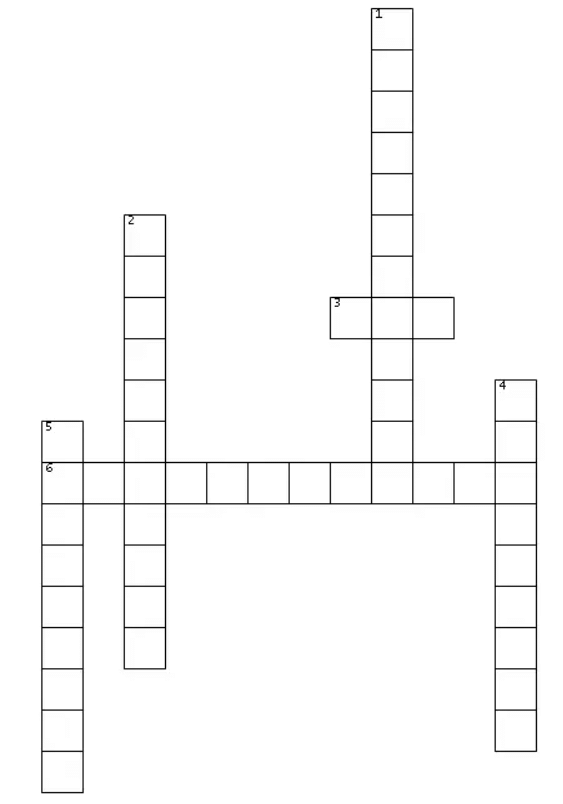
Crossword Puzzle
Q1:
ACROSS
3. ___stands DeoxyriboNucleic Acid
6. These are important for photosynthesis in plants
DOWN
1. They are the powerhouses of the cell
2. Paramoecium is a ____________ organisms
4. It is a kind of waste disposal system of the cell
5. One of the biologists who presented the cell theory
Very Short Answer Questions
Q1: Where are proteins synthesized inside the cell? Q2: Which organelle is known as the powerhouse of the cell? Why? Q3: Why are lysosomes known as suicide bags? Q4: If the organization of a cell is destroyed due to some physical or chemical influence, what will happen? Q5: Where do lipids and proteins get synthesized? Q6: What would happen if the plasma membrane breaks down?
Short Answer Questions
Q1: Who discovered cells in living organisms? Give an example of the unicellular organism. Q2: Why is the cell called the structural and functional unit of life? Q3: What is the function of plastids? Q4: Why do mitochondria have a largely folded inner membrane?
Q1: The nucleus of an atom consists of ______. (a) Protons (b) Electrons and neutrons (c) Protons and neutrons (d) Neutrons Ans: (c)
The nucleus contains protons (+) and neutrons (0); together they’re called nucleons.
Q2: What is the maximum number of electrons which can be present in K and L shells in an atom? (a) 2 and 8 (b) 2 and 18 (c) 2 and 32 (d) 8 and 18 Ans: (a)
The K shell can hold a maximum of 2 electrons. The L shell can accommodate up to 8 electrons.
Q3: Rutherford’s alpha-particle scattering experiment was responsible for the discovery of (a) Atomic Nucleus (b) Electron (c) Proton (d) Neutron Ans: (a)
Rutherford’s alpha-particle scattering experiment led to the discovery of the atomic nucleus. Key findings from the experiment include:
Most alpha particles passed through the gold foil, indicating that atoms are mostly empty space.
Only a few particles were deflected, suggesting that the positive charge of the atom is concentrated in a small area.
A small fraction of particles rebounded, showing that the positive charge and mass are located in the nucleus.
This experiment fundamentally changed our understanding of atomic structure.
Q4: Isotopes of element have: (a) The same physical properties (b) Different chemical properties (c) Different number of neutrons (d) Different atomic numbers Ans: (c)
Isotopes are atoms of the same element. They have the same atomic number but different mass numbers. This difference is due to varying numbers of neutrons.
Q5: Number of valence electrons in Cl– ion are: (a) 16 (b) 8 (c) 17 (d) 18 Ans: (b)
Cl– Ion has 18 electrons (17+1). Hence the number of valence electrons in Cl– ion is 8. Electronic distribution: Cl – 2, 8, 7 Cl– – 2, 8, 8
Q6: An element with configuration 2,8,4 will tend to show valency (a) 3 (b) 2 (c) 4 (d) 5 Ans:(c)
Electronic configuration 2,8,4 ⇒ outermost shell has 4 electrons. To reach a stable octet, the atom needs 4 more (or would have to lose 4), so its valency = 4. (Example: Silicon, Z = 14, commonly shows valency 4 by sharing electrons.)
Q7: Amongst element X (2,8,6) and Y (2,8,8) which is more reactive and why ? (a) X because it is a metal (b) Y because it is non metal (c) X because it has 6 valence electrons (d) Y because it is gas Ans: (c)
Element X is more reactive due to its 6 valence electrons. This means it is more likely to gain 2 electrons to achieve a stable octet configuration.
X has 6 valence electrons.
It tends to gain 2 electrons.
This helps it achieve a stable octet.
Q8: The nucleus of the hydrogen atom is called as (a) Neutron (b) Electron (c) Proton (d) Nucleons Ans: (c)
The nucleus of a hydrogen atom contains a single proton.
Q9: Cathode rays get deflected in a electric field towards (a) Positive plate (b) Negative Plate (c) No deflection takes place (d) First towards negative plate and then towards positive plate Ans: (a)
Cathode rays are negatively charged particles. They are attracted to the positive plate in an electric field. This attraction occurs because opposite charges attract each other.
Q10: The atomic number of an element ‘y’ is 20. The electronic configuration of the ion having inert gas configuration is (a) 2,8,10 (b) 2,18 (c) 2,10,8 (d) 2,8,8 Ans: (d)
The ion with an inert gas configuration has lost 2 electrons. This results in an electronic configuration of 2, 8, 8.
Fill in the Blank
Q1: According to Bohr–Bury rules, the maximum number of electrons in the K-shell is ________ and in the L-shell is ________. Ans: According to Bohr–Bury rules, the maximum number of electrons in the K-shell is 2 and in the L-shell is 8.
Q2: An atom is the smallest unit of an element which takes part in a _________. Ans: An atom is the smallest unit of an element which takes part in a Chemical reaction.
Q3: Mass of an electron is 1/2000 times less than the mass of one atom of__________. Ans: Mass of an electron is 1/2000 times less than the mass of one atom of hydrogen.
Q4: The K-shell of any atom cannot have more than _________ electrons. Ans: The K-shell of any atom cannot have more than two electrons.
Q5: Isotopes are the atoms of ___________ element, having same atomic number but different mass number. Ans: Isotopes are the atoms of the same element, having same atomic number but different mass number.
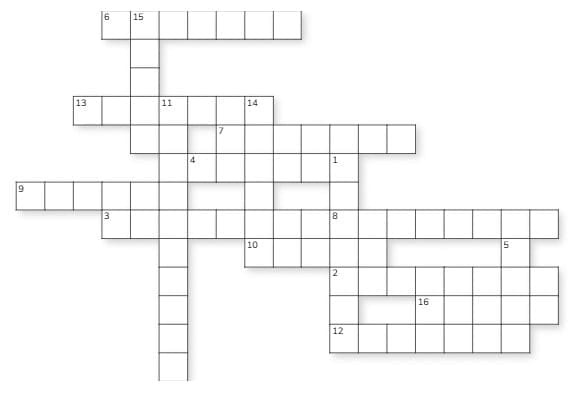
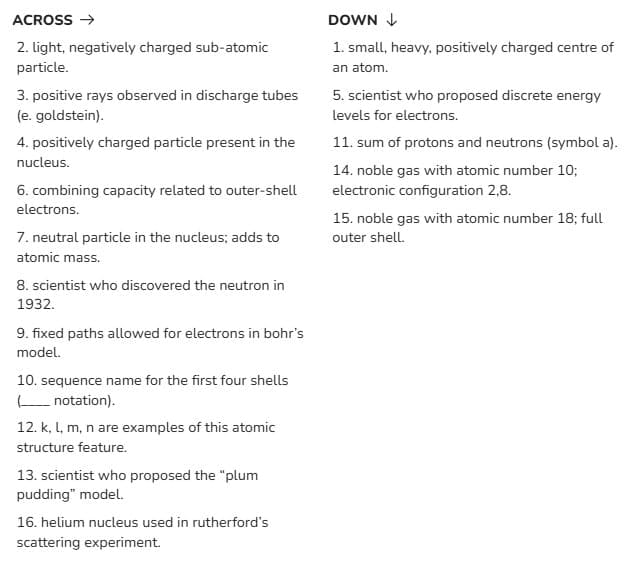
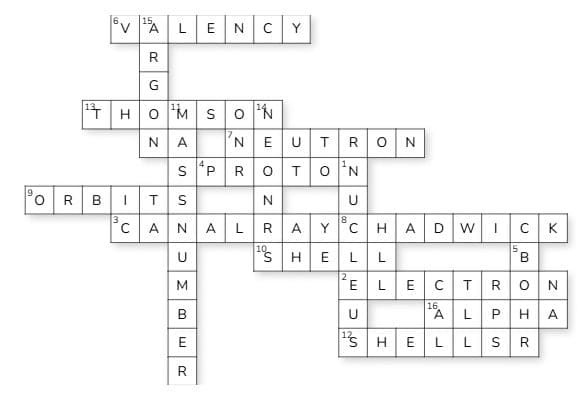
Crossword Puzzle
Ans:
Very Short Answer Questions
Q1: Out of proton and neutron, which is heavier? Ans: Neutron is slightly heavier (1.675 × 10⁻²⁷ kg) than proton (1.67 × 10⁻²⁷ kg).
Q2: Were neutrons known at the time Rutherford performed the scattering experiment? Ans: No, neutrons were not known when Rutherford conducted his scattering experiment. They were discovered later by Chadwick in 1932. Rutherford’s experiment took place in 1911.
Q3: Who discovered canal rays and what do they indicate? Ans: E. Goldstein discovered canal rays; they are positively charged radiations (led to proton concept).
Q4: What is the number of electrons in the valence shell of chlorine (Z = 17)? Ans:7 valence electrons (Cl: 2,8,7).
Q5. What is the basic difference between the isotopes of an element? Ans: Isotopes have the same atomic number but different mass numbers (different neutrons).
Short Answer Questions
Q1: How will you find the valency of chlorine, sulphur and magnesium? Ans: The valency of an element is determined by the number of valence electrons in its outermost shell. Here’s how to find the valency for chlorine, sulphur, and magnesium:
It is easier for magnesium to lose its 2 valence electrons than to gain 6.
Valency: 2
Q2: Describe Bohr’s model of the atom. Ans: The special features of Bohr’s model are given below: (1) An electron revolves in the orbit of atom with well-defined energy. (2) Energy of orbits increases from inner shell to the outer shells i.e. energy for orbit nearest the nucleus is lowest. (3) If energy is supplied then electron moves from lower orbit to the higher orbit and if an electron jumps from higher orbit (energy level) to the lower orbit (energy level) then energy is radiated as electromagnetic waves. (4) Each orbit or shell represents an energy level. Such orbits are represented as K,L,M,N,O……….. and named from centre to outwards. (5) The shell or orbits are associated with certain amount of energy and energy of orbits/shells increases from inward to outwards.eg K<L<M<N<O…………
Q3: What are the limitations of Rutherford’s model of the atom? Ans: Limitations of Rutherford’s Model of the Atom
The model does not explain the stability of the atom.
According to the model, electrons orbiting the nucleus should emit energy due to acceleration.
This energy loss would cause the electrons to spiral inward and eventually collide with the nucleus, leading to an unstable atom.
However, we observe that atoms are generally quite stable.
Q4: Write the postulates of Bohr theory? Ans: The postulates of Bohr’s theory are:
Electrons move around the nucleus in specific circular paths known as orbits.
Each orbit is linked to a fixed amount of energy.
The larger the radius of the orbit, the greater the energy of the electrons.
Electrons can transition between orbits by gaining or losing a specific amount of energy.
Q5: Explain, with examples, how atoms achieve an octet by losing, gaining, or sharing electrons. Ans: By losing electrons (cations, metals):
Atoms with 1–3 valence e⁻ lose them to get nearest noble-gas configuration.
Q1: The nucleus of an atom consists of ______. (a) Protons (b) Electrons and neutrons (c) Protons and neutrons (d) Neutrons
Q2: What is the maximum number of electrons which can be present in K and L shells in an atom? (a) 2 and 8 (b) 2 and 18 (c) 2 and 32 (d) 8 and 18
Q3: Rutherford’s alpha-particle scattering experiment was responsible for the discovery of (a) Atomic Nucleus (b) Electron (c) Proton (d) Neutron
Q4: Isotopes of element have: (a) The same physical properties (b) Different chemical properties (c) Different number of neutrons (d) Different atomic numbers
Q5: Number of valence electrons in Cl– ion are: (a) 16 (b) 8 (c) 17 (d) 18
Q6: An element with configuration 2,8,4 will tend to show valency (a) 3 (b) 2 (c) 4 (d) 5
Q7: Amongst element X (2,8,6) and Y (2,8,8) which is more reactive and why ? (a) X because it is a metal (b) Y because it is non metal (c) X because it has 6 valence electrons (d) Y because it is gas
Q8: The nucleus of the hydrogen atom is called as (a) Neutron (b) Electron (c) Proton (d) Nucleons
Q9: Cathode rays get deflected in an electric field towards (a) Positive plate (b) Negative Plate (c) No deflection takes place (d) First towards negative plate and then towards positive plate
Q10: The atomic number of an element ‘y’ is 20. The electronic configuration of the ion having inert gas configuration is (a) 2,8,10 (b) 2,18 (c) 2,10,8 (d) 2,8,8
Fill in the Blank
Q1: According to Bohr–Bury rules, the maximum number of electrons in the K-shell is ________ and in the L-shell is ________. Q2: An atom is the smallest unit of an element which takes part in a _________. Q3: Mass of an electron is 1/2000 times less than the mass of one atom of__________. Q4: The K-shell of any atom cannot have more than _________ electrons. Q5: Isotopes are the atoms of ___________ element, having same atomic number but different mass number.
Also read: Worksheet Solutions: Structure of the Atom
Crossword Puzzle
Very Short Answer Questions
Q1: Out of proton and neutron, which is heavier? Q2: Were neutrons known at the time Rutherford performed the scattering experiment? Q3: Who discovered canal rays and what do they indicate? Q4: What is the number of electrons in the valence shell of chlorine (Z = 17)? Q5: What is the basic difference between the isotopes of an element?
Short Answer Questions
Q1: How will you find the valency of chlorine, sulphur and magnesium? Q2: Describe Bohr’s model of the atom. Q3: What are the limitations of Rutherford’s model of the atom? Q4: Write the postulates of Bohr theory? Q5: Explain, with examples, how atoms achieve an octet by losing, gaining, or sharing electrons.
Q.1. The maximum number of electrons in L shell is (a) 8 (b) 18 (c) 28 (d) 38
Correct Answer is Option (a) The L shell can accommodate a maximum of 8 electrons. This limit is determined by the 2n² rule, where n represents the shell number.
Q.2. Which of the following statements is correct? (a) Cathode rays travel in straight line and have momentum. (b) Cathode rays travel in straight line and have no momentum (c) Cathode rays do not travel in straight line but have Momentum. (d) Cathode rays do not travel in straight line and have no momentum.
Correct Answer is Option (a)
Cathode rays are streams of electrons.
They travel in straight lines.
Cathode rays carry momentum because they have mass.
This means it can form bonds with two other atoms.
Q.4. Molecular mass of water (H2O) is (a) 18g (b) 8g (c) 33g (d) 34g
Correct Answer is Option (a)
The molecular mass of water (H2O) is calculated by adding the atomic masses of its constituent atoms:
Each hydrogen atom has an atomic mass of 1 u.
Oxygen has an atomic mass of 16 u.
Water consists of two hydrogen atoms and one oxygen atom.
Therefore, the molecular mass of water is: 2 × 1 + 1 × 16 = 18 u. Thus, the correct answer is option (a).
Q.5. Atomicity of chlorine and Argon is (a) Diatomic and Monoatomic (b) Monoatomic and Diatomic (c) Monoatomic and Monoatomic (d) Diatomic and Diatomic
Correct Answer is Option (a)
Chlorine is a diatomic molecule, meaning it consists of two atoms (Cl2).
Argon is monoatomic, consisting of a single atom (Ar).
Thus, the atomicity of chlorine and argon is:
Chlorine: Diatomic
Argon: Monoatomic
Q.6. State the properties of cathode rays?
Properties of cathode rays are: (1) They travel in straight line (2) They have momentum and energy (3) They are deflected by electric and magnetic fields.
Q.7. Define the terms: (a) Atomic number (b) Mass number
Atomic Number is defined as the total number of protons present in an atom. Mass number is defined as the sum total of number of protons and the number of neutrons present in an atom.
Q.8. State the law of constant Proportion?
According to law of constant proportion, whatever the method of its formation, a chemical compound in its pure state will always contain the same elements combined together in the fixed ratio by mass.
Q.9. Which postulate of Dalton’s atomic theory can explain the law of definite proportions?
The postulate of Dalton’s atomic theory which explains the law of definite proportions is “Atoms combine in the ratio of small whole numbers to form compounds and the relative number and kinds of atoms are constant in a given compound.”
Q.10. Which element will be more reactive and why → the element whose atomic number is 10 or the one whose atomic number is 11?
Element with atomic number 11 is more reactive than the one with atomic number 10 because electronic configuration of atomic number 11 will be 2, 8, 1 so, it has to loose only 1e- from its outermost shall to be stable which is more easy than the element with atomic number 10 because its electronic configuration is 2, 8 and has 8e- in the outermost shell and hence is already stable.
Q.11. What is the mass of 0.2 mole of oxygen atoms?
0.2 mole of oxygen atoms Mass of 1 mole of oxygen (O) atoms = 16 g Mass of 0.2 mole of oxygen (O) atoms = 0.2 × 16 = 3.2 g
Q.12. The mass of an atom of element (X) is 2.0 × 10⁻²³ g. Calculate its atomic mass.
One atom of element (X) has mass = 2.0 × 10⁻²³ g. 6.022 × 10²³ atoms of element (X) will have mass = (2.0 × 10⁻²³ g) × (6.022 × 10²³) = 12.044 ≈ 12.0 u
Q.13. Calculate the molar mass of Nitric acid.
Chemical formula of Nitric acid is (HNO3) Molar mass of HNO3 = (1 × atomic mass of H) + (1 × atomic mass of N) + (3 × atomic mass of O) = (1 × 1u) + (1 × 14u) + (3 × 16u) = 63u
Q.14. Explain why the number of atoms in one mole of hydrogen gas is double the number of atoms in one mole of helium gas.
Hydrogen gas is diatomic in nature (H2) while helium gas is monoatomic (He). As a result, the number of atoms in one mole of hydrogen is (2 × NA) which is double as compared to number of atoms in one mole of helium (NA)
Q.15. If the valency of carbon is 4 and that of sulphur is 2, what is the chemical formula and name of the compound formed between carbon and sulphur atoms?
The chemical formula of compound can be written by exchanging the valencies (cross-over). Therefore, the expected formula is C2S4 or CS2. The compound is called carbon disulphide.
Q.1. The maximum number of electrons in L shell is (a) 8 (b) 18 (c) 28 (d) 38
Q.2. Which of the following statements is correct? (a) Cathode rays travel in straight line and have momentum. (b) Cathode rays travel in straight line and have no momentum (c) Cathode rays do not travel in straight line but have Momentum. (d) Cathode rays do not travel in straight line and have no momentum.
Q.4. Molecular mass of water (H2O) is (a) 18g (b) 8g (c) 33g (d) 34g
Q.5. Atomicity of chlorine and Argon is (a) Diatomic and Monoatomic (b) Monoatomic and Diatomic (c) Monoatomic and Monoatomic (d) Diatomic and Diatomic
Q.6. Stat the properties of cathode rays?
Q.7. Define the terms: (a) Atomic number (b) Mass number
Q.8. State the law of constant Proportion?
Q.9. Which postulate of Dalton’s atomic theory can explain the law of definite proportions?
Q.10. Which element will be more reactive and why → the element whose atomic number is 10 or the one whose atomic number is 11?
Q.11. What is the mass of 0.2 mole of oxygen atoms?
Q.12. The mass of an atom of element (X) is 2.0 × 10⁻²³ g. Calculate its atomic mass.
Q.13. Calculate the molar mass of Nitric acid.
Q.14. Explain why the number of atoms in one mole of hydrogen gas is double the number of atoms in one mole of helium gas.
Q.15. If the valency of carbon is 4 and that of sulphur is 2, what is the chemical formula and name of the compound formed between carbon and sulphur atoms?
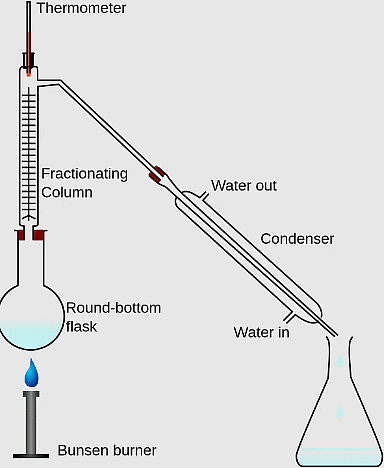
Q.1. Kerosene and Petrol are miscible liquids. The difference between their boiling points is more than 25°C. The two liquids can be separated from each other by _____. (a) Simple distillation (b) Steam distillation (c) Fractional distillation (d) Any of these
Correct Answer is Option (a) By simple distillation. Vapours of the liquid which has low boiling point will be formed first and collected. The liquid having higher boiling point will remain in the vessel.
Q.2. How can a saturated solution be made unsaturated? (a) By heating the solution (b) By cooling the solution (c) By increasing the amount of solute (d) By centrifugation of the solution
Correct Answer is Option (a) A saturated solution can be made unsaturated by increasing the temperature of solution by heating it or by increasing the amount of solvent in the solution i.e. diluting it.
Q.3. The cause of Brownian movement is: (a) Heat changes in liquid state (b) Convection currents (c) Impact of molecules of dispersion medium on on dispersed phase (d) Attractive forces between the particles of dispersed phase and dispersion medium.
Correct Answer is Option (c) Zig-zag path of colloidal particles is called Brownian Movement. Zig-zag path of particles is due to collision of particles of dispersed phase and dispersion medium.
Q.4. In which of the following, dispersed phase is a liquid and dispersion medium is a gas? (a) Cloud (b) Smoke (c) Gel (d) Soap bubble
Correct Answer is Option (a)
In a cloud, tiny water droplets are suspended in air.
This makes it an example of a liquid dispersed phase in a gas dispersion medium.
Q.5. At room temperature, a non-metal which is a liquid is: (a) Sulphur (a) Bromine (a) Chlorine (a) Nitrogen
Correct Answer is Option (b)
Bromine is the only non-metal that exists in liquid form at room temperature. Here are some key points:
It is a reddish-brown liquid.
Bromine has a strong, unpleasant odour.
It is used in various applications, including flame retardants and pesticides.
Fill in the Blanks
1. Common salt is _________.
Ans: Compound Common salt, chemically known as sodium chloride (NaCl), is a compound formed from the chemical combination of sodium and chlorine.
2. A mixture contains more than ______ substance mixed in ______ proportion.
Ans: One, any A mixture is defined as a combination of two or more substances that can be present in any proportion.
3. Properties of a __________ are different from its constituent elements, whereas a _______
shows the properties of its constituting elements.
Ans: Compound, mixture A compound has distinct properties that differ from those of its individual elements, while a mixture retains the properties of its components.
4. A solution is defined as a mixture that is_________
Ans: Homogeneous A homogeneous mixture has a uniform composition throughout, meaning the components are evenly distributed.
5. We can remove salts from a solution by using the process of _________
Ans: Evaporation Evaporation is a method used to separate a solute from a solvent by heating the solution until the solvent turns into vapor.
6. A pure substance has a fixed__________ or ______ at constant temperature.
Ans: Melting Point, Boiling Point A pure substance has specific melting and boiling points that do not change under constant temperature conditions.
7. An element is made up of only one kind of _________.
Ans: Atoms Elements consist of only one type of atom, which defines their unique properties.
8. Miscible liquids are separated by ________ .
Ans: Fractional distillation Fractional distillation is a technique used to separate miscible liquids based on their different boiling points.
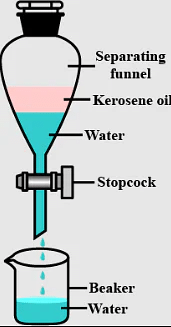
9. Immiscible liquids are separated by using a _______.
Ans: Separating funnel A separating funnel is used to separate immiscible liquids based on their different densities.
10. Filtered tea is a _________ mixture.
Ans: Homogeneous Filtered tea is homogeneous because it has a uniform composition throughout after the solid tea leaves are removed.
11. Alloy is a _______.
Ans: Solid solution An alloy is a solid solution of two or more metals, which results in improved properties compared to the individual metals.
12. Sublimation of camphor is a _________ change.
Ans: Physical Sublimation is a physical change where a substance transitions directly from solid to gas without passing through the liquid state.
13. Most common chemical change we observe in our routine life is rusting of______.
Ans: Iron Rusting is a chemical reaction that occurs when iron reacts with oxygen and moisture, forming iron oxide.
Very Short Answer Question
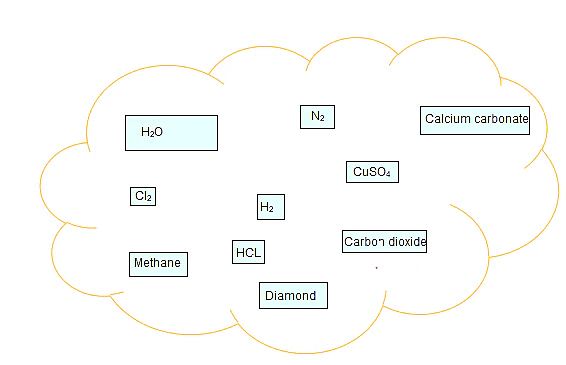
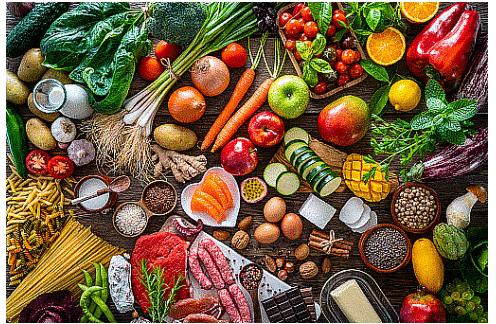
Q.1. Classify the substances given in below figure into elements and compounds
Ans:
Q.2. Give one example each of homogeneous and heterogeneous mixture.
Ans: Homogeneous mixture: An example is brass, which is a uniform mixture of metals. Heterogeneous mixture: An example is sand and water, where the components remain distinct and easily separable.
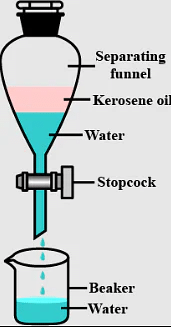
Q.3. Name the apparatus by which mixture of oil and water can be separated.
Ans:Separating funnel is the apparatus used to separate a mixture of oil and water.
Q.4. Is brass a mixture or a compound?
Ans: Brass is classified as a mixture rather than a compound. This is due to the following reasons:
Brass is made up of approximately 30% zinc and 70% copper.
In a mixture, the individual components retain their own properties.
Brass is a mixture because its composition can vary and its constituents retain their properties.
Q.5. What type of solution is an alloy? Liquid solution or solid solution
Ans: Alloy is a type of solid solution. Key points:
An alloy consists of two or more metals or a metal and a non-metal.
It cannot be separated into its components by physical methods.
Alloys exhibit the properties of their constituent materials.
For example, brass is made of approximately 30% zinc and 70% copper.
Q.6. A mixture consisting of two miscible liquids ‘A’ and ‘B’ whose boiling points differ by 50 C can be separated by which process?
Ans: Fractional distillation is the process used to separate a mixture of two miscible liquids, ‘A’ and ‘B’, when their boiling points differ by 50°C.
Q.7. Give one example of solid- liquid homogeneous mixture.
Ans: Salt in water solution
Q.8. What is a Aqua regia?
Ans: Aqua regia is a highly-corrosive mixture of – nitric acid and hydrochloric acid. The mixture is formed by freshly mixing concentrated nitric acid and hydrochloric acid, usually in a volume ratio of 1:3
Q.9. Which method is used to separate two immiscible liquids?
Ans: Separating two immiscible liquids can be effectively achieved using a separating funnel.
The separating funnel allows the two liquids to separate based on their density.
Each liquid forms a distinct layer, making it easy to pour out one layer while leaving the other behind.
This method is commonly used in laboratories for liquid-liquid extractions.
Q.10. Name two elements which are in liquid state at room temperature?
Ans: The only liquid elements at standard temperature and pressure arebromine (Br) and mercury (Hg). Although, elements caesium (Cs),rubidium (Rb), Francium (Fr) and Gallium (Ga) become liquid at or just above room temperature.
Short Answer Types QuestionsQ.1. Try segregating the things around you as pure substances or mixtures.
You can separate materials around you into pure substances or mixtures by performing simple experiments. Here’s how:
Mix chalk powder with water.
Observe that the chalk powder does not dissolve.
Let the mixture settle; the chalk will form a layer at the bottom.
Carefully pour off the water to separate the chalk.
This method demonstrates how mixtures can be separated into their individual components.
Q.2. What is meant by a substance?
A substance is a type of matter that consists of particles that cannot be separated by any physical process. Key characteristics include:
All particles have similar chemical properties.
Substances can be classified as either elements or compounds.
Elements cannot be broken down into simpler substances.
Compounds consist of two or more different elements chemically combined.
In summary, a substance is a pure form of matter with consistent properties throughout.
Q.3. What type of mixtures are separated by the technique of crystallisation?
From impure samples of solids, pure solid crystals can be obtained by the method of crystallization for eg to obtain pure sugar from impure sample of the same.
Q.4. What is tyndall effect? Which kinds of solution show it?
The Tyndall effect is the scattering of light by particles in a solution. This effect occurs when light passes through a medium containing small particles, making the path of the light visible. Solutions that exhibit the Tyndall effect include:
Colloidal solutions: These contain particles that are larger than those in true solutions but smaller than those in suspensions.
Examples: Milk and fog show the Tyndall effect due to their dispersed particles.
Q.5. What is centrifugation? Where it is used?
Centrifugation is a technique used to separate components of a mixture based on their density. It works by spinning the mixture rapidly, causing denser particles to settle at the bottom while lighter ones rise to the top.
Commonly used to separate cream from milk.
Also applied in laboratories for separating blood components.
Used in various industries, including pharmaceuticals and biotechnology.
Q.6. What is crystallization? Where is it used? Why is this better than simple evaporation technique?
Crystallization is a process that separates a pure solid in the form of crystals from its solution. It is used to purify solids. For e.g. salt from sea water is purified using crystallization. It is a better technique than simple evaporation because: (a) Some solid may decompose or get charred on heating to dryness during evaporation. (b) On evaporation, some of the impurities still remain dissolved in the solution.
Q.7. What is a colloid? What are its various properties?
Colloids are heterogeneous mixtures where the particles are too small to be seen with the naked eye. Their properties include:
Heterogeneous mixture: Although they are heterogeneous, they often appear homogeneous.
Particle size: The particles are too small to be individually visible.
Tyndall effect: They scatter light, making the path of a beam visible.
Stability: The particles do not settle when left undisturbed.
Q.8. Write a method to separate different gases from air.
Air is a homogeneous mixture of various gases. It can be separated into its components using fractional distillation. The process involves the following steps:
Compress and cool the air by increasing pressure and decreasing temperature.
This produces liquid air. Allow the liquid air to warm up slowly in a fractional distillation column.
The gases will separate according to their boiling points at different heights in the column.
Q.9. Explain the following giving examples. (a) saturated solution (b) pure substance (c) colloid (d) suspension
(a) saturated solution: It is a solution in which no more solute particles can be dissolved at a particular temperature. (b) pure substance: Such substance that has a uniform composition i.e. has particles with identical properties is called pure substance eg sugar, salt, water, nitrogen etc. (c) colloid: It is a kind of heterogeneous mixture/solution in which particle size is between 1nm and 1000nm. Colloids have dispersion medium and dispersed phase.eg smoke, milk, shaving cream, jelly, cheese etc. (d) suspension: It is a kind of heterogeneous mixture in which insoluble solid particles remain suspended in the medium and dispersion particles are visible to the unaided eyes.eg muddy river water, chalk powder in water, dust storm, sand in water etc.
Q.10. Write the steps you would use for making tea. Use the words solution, solvent, solute, dissolve, soluble, insoluble, filtrate and residue.
To make tea, follow these steps:
Start by heating a sufficient amount of solvent (water) in a pan.
Once heated, add a small amount of solute (sugar) to the water. The sugar will dissolve completely, forming a true solution.
Add tea leaves, which are insoluble, along with a soluble liquid (milk).
Boil the mixture to enhance flavour.
After boiling, use a sieve to filter the mixture. The liquid that passes through is the filtrate, which is your tea.
The leftover tea leaves in the sieve are the residue and should be discarded.
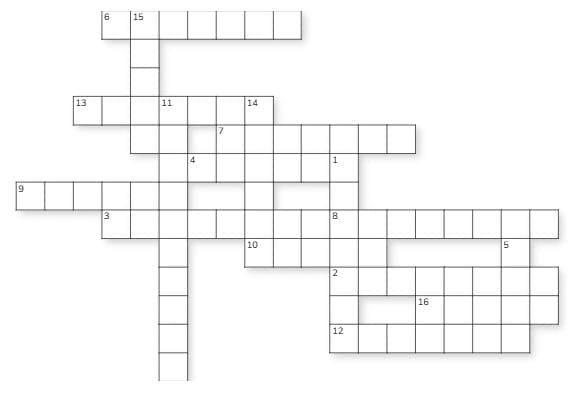
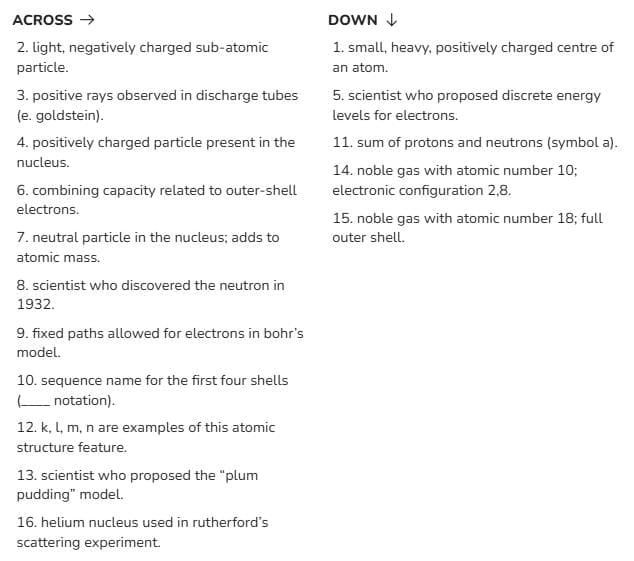
Crossword Puzzle
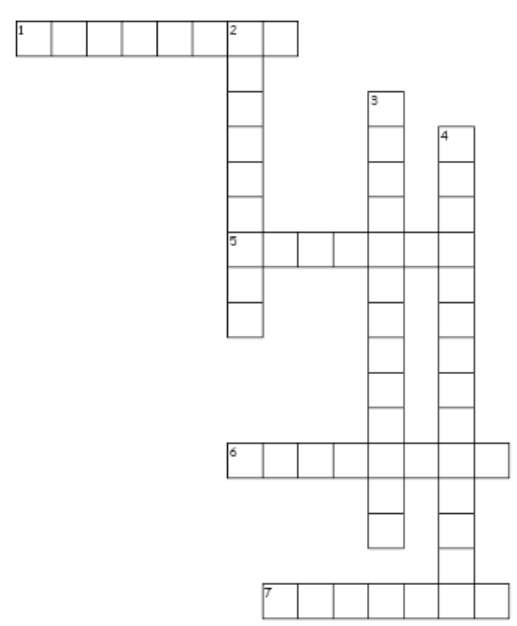
Across 1. hydrogen ______ is a color gas with a smell of rotten eggs 5. The major components in solution 6. Melting point and boiling point are _______ properties 7. Two elements are liquid at room temperature are mercury and _______ Down 2. In colloids ,The particles are called the ______ phase and the medium in which they are distributed is called the dispersion medium. 3. amount of solute present per unit volume or mass of the solution or solvent 4. denser particles are forced to the bottom and the lighter particles stay at the top when spun rapidly
Q.1. Kerosene and Petrol are miscible liquids. The difference between their boiling points is more than 25°C. The two liquids can be separated from each other by _____.
(a) Simple distillation
(b) Steam distillation
(c) Fractional distillation
(d) Any of these
Q.2. How can a saturated solution be made unsaturated? (a) By heating the solution (b) By cooling the solution (c) By increasing the amount of solute (d) By centrifugation of the solution
Q.3. The cause of Brownian movement is: (a) Heat changes in liquid state (b) Convection currents (c) Impact of molecules of dispersion medium on on dispersed phase (d) Attractive forces between the particles of dispersed phase and dispersion medium.
Q.4. In which of the following, dispersed phase is a liquid and dispersion medium is a gas? (a) Cloud (b) Smoke (c) Gel (d) Soap bubble
Q.5. At room temperature, a non-metal which is a liquid is: (a) Sulphur (a) Bromine (a) Chlorine (a) Nitrogen
Fill in the Blanks
1. Common salt is _________.
2. A mixture contains more than ______ substance mixed in ______ proportion. 3. Properties of a __________ are different from its constituent elements, whereas a _______ shows the properties of its constituting elements. 4. A solution is defined as a mixture that is_________ 5. We can remove salts from a solution by using the process of _________ 6. A pure substance has a fixed__________ or ______ at constant temperature. 7. An element is made up of only one kind of _________. 8. Miscible liquids are separated by ________ . 9. Immiscible liquids are separated by using a _______. 10. Filtered tea is a _________ mixture. 11. Alloy is a _______. 12. Sublimation of camphor is a _________ change. 13. Most common chemical change we observe in our routine life is rusting of______.
Very Short Answer Question
Q.1. Classify the substances given in below figure into elements and compounds
Q.2. Give one example each of homogeneous and heterogeneous mixture. Q.3. Name the apparatus by which mixture of oil and water can be separated. Q.4. Is brass a mixture or a compound? Q.5. What type of solution is an alloy? Liquid solution or solid solution Q.6. A mixture consisting of two miscible liquids ‘A’ and ‘B’ whose boiling points differ by 50 C can be separated by which process? Q.7. Give one example of solid- liquid homogeneous mixture. Q.8. What is a Aqua regia? Q.9. Which method is used to separate two immiscible liquids? Q.10. Name two elements which are in liquid state at room temperature?
Short Answer Types Questions
Q.1. Try segregating the things around you as pure substances or mixtures.
Q.2. What is meant by a substance?
Q.3. What type of mixtures are separated by the technique of crystallisation?
Q.4. What is tyndall effect? Which kinds of solution show it?
Q.5. What is centrifugation? Where it is used?
Q.6. What is crystallization? Where is it used? Why is this better than simple evaporation technique?
Q.7. What is a colloid? What are its various properties?
Q.8. Write a method to separate different gases from air.
Q.9. Explain the following giving examples. (a) saturated solution (b) pure substance (c) colloid (d) suspension
Q.10. Write the steps you would use for making tea. Use the words solution, solvent, solute, dissolve, soluble, insoluble, filtrate and residue.
Also read: Worksheet Solutions: Is Matter Around Us Pure
Crossword Puzzle
Across 1. hydrogen ______ is a color gas with a smell of rotten eggs 5. The major components in solution 6. Melting point and boiling point are _______ properties 7. Two elements are liquid at room temperature are mercury and _______ Down 2. In colloids ,The particles are called the ______ phase and the medium in which they are distributed is called the dispersion medium. 3. amount of solute present per unit volume or mass of the solution or solvent 4. denser particles are forced to the bottom and the lighter particles stay at the top when spun rapidly
Q.1. According to ancient philosophers matter consists of: (a) Three constituents (b) Four constituents (c) Five constituents (d) Six constituents.
Correct Answer is Option (c) Matter is made up of five constituents also called tatvas (air, water, earth, fire and sky).
Q.2. Dry ice is: (a) Solid ammonia (b) Solid carbon dioxide (c) Solid sulphur dioxide (d) Normal ice
Correct Answer is Option (b) Dry ice is solid carbon dioxide (CO2).
Q.3. Which of the following statements is not correct for liquid state? (a) Particles are loosly packed in the liquid state (b) Fluidity is the maximum in the liquid state (c) Liquids can be compressed (d) Liquids take up the shape of any container in which these are placed
Correct Answer is Option (b) Fluidity is maximum in the gaseous state and not in the liquid state.
Q.4. Which of the following will sublime? (a) Common salt (b) Sugar (c) Camphor (d) Potassium nitrate
Correct Answer is Option (c) Camphor, ammonium chloride, Phenophthelene sublimes i.e. change from solid to gaseous state directly without passing through liquid state upon heating.
Q.5. When the liquid starts boiling, the further heat energy which is supplied: (a) Is lost to the surrounding as such (b) Increases the temperature of the liquid (c) Increases the kinetic energy of the particles in the liquid (d) Is absorbed as latent heat of vaporisation by the liquid
Correct Answer is Option (d) Heat is absorbed as latent heat of vapourisation. As long as liquid is not boiled, the heat energy which is supplied increases the kinetic energy of particles present in water. Once the liquid starts boiling the heat energy is used to brinchange in the state (liquid-gas). It is known as latent heat of vapourisation.
Fill in the Blanks
1. Matter is made up of small_________.
Correct Answer is Particles
2. The forces of attraction between the particles are _______ in solids, ______ in liquids and _________ in gases.
Correct Answer is Maximum, intermediate, minimum
3. __________ is the change of gaseous state directly to solid state without going through liquid state, and vice-versa.
Correct Answer is Deposition or Desublimation.
4. Evaporation causes __________.
Correct Answer is Cooling
5. Latent heat of fusion is the amount of heat energy required to change 1 kg of solid into liquid at its ________.
Correct Answer is Melting point
6. Solid, liquid and gas are called the three _______ of matter.
Correct Answer is States
7. The smell of perfume gradually spreads across a room due to ______.
Correct Answer is Diffusion
8. Rapid evaporation depends on the ______ area exposed to atmosphere.
Correct Answer is Surface
9. As the temperature of a system increases, the pressure of the gases ______.
Correct Answer is Increases
10. As the volume of a specific amount of gas decreases, it’s pressure _______.
Correct Answer is Increases
11. As the temperature of a gas decreases, It’s volume ______.
Correct Answer is Decreases
12. Gas molecules at higher temperatures have more _______ than at cooler temperatures.
Correct Answer is Kinetic energy
13. A sponge has minute ________, in which ________ is trapped.
Correct Answer is holes, air.
14. The pressure inside of a sealed tube if you raise the temperature go ______
Correct Answer is Up
15. Forces of attraction in liquids are _______ than in solid.
Correct Answer is Weaker
16. Latent heat of ________ is the amount of heat energy required to change 1 kg of solid into liquid at its melting point.
Correct Answer is fusion
Very Short Answer Questions
Q.1. Name one property which is shown by naphthalene and not by sodium chloride.
Naphthalene undergoes sublimation upon heating i.e. it directly changes into vapours. Whereas Sodium chloride (common salt) does not undergo sublimation. It melts on strong heating.
Q.2. A rubber band changes its shape when stretched. Can it be regarded as solid?
Rubber is a solid. It has elastic property due to which it undergoes change in shape when pressure is applied and regains its original shape when pressure is released.
Q.3. Gases can be compressed but solids cannot. Explain.
In gases, interparticle spaces are quite large. On applying pressure, these spaces decrease and the molecules of gas come closer. As a result, the gases can be compressed. Whereas in solids, particles are compactly packed leaving negligible interparticle space thus solids cannot be compressed.
Q.4. Define latent heat of vaporization.
Latent heat of vaporization is the heat energy required to change 1 kg of a liquid to gas at atmospheric pressure at its boiling point.
Q.5. What happens to the heat energy which is supplied to the solid once it has started melting?
Once the solid has started melting heat energy absorbed is consumed in bringing about the change in state from solid to liquid (overcoming the force of attraction between the particles of solids). The heat absorbed is known as latent heat of fusion.
Q.6.The freezing point of water is 0°C. What is the corresponding temperature on the Kelvin scale?
Temperature on Kelvin scale = 0°C+273 = 273K.
Q.7. Are the melting point temperature of the solid state and the freezing point temperature of the liquid state of a substance different?
No, these are the same. For example, melting point of ice and freezing point of water are both 0°C or 273 K.
Q.8. A substance is in liquid state at room temperature and changes into gas upon heating. What will you call its gaseous state?
The gaseous state of the substance is called vapour. Gaseous state of a substance which exists as liquid also is known as vapour.
Q.9. When a crystal of copper sulphate is placed at the bottom of a beaker containing water, the colour of water slowly becomes blue, why?
Copper sulphate on dissolution in water releases (Cu2+ ions) and SO42– ions. Due to diffusion of Cu2+ ions the colour of water slowly becomes blue.
Q.10. The boiling point of ethyl alcohol is 78°C. What is the corresponding temperature on kelvin scale?
Temperature on kelvin scale = 78 + 273 = 351 K
Crossword Puzzle
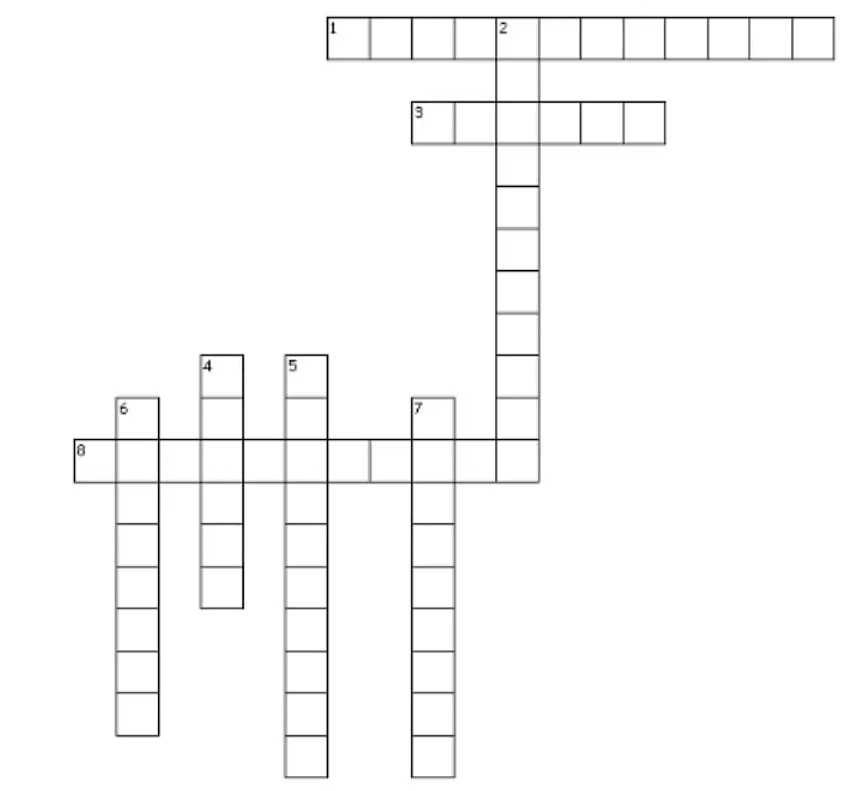
Across 1. BEC stands for Bose-Einstein-______ 3. The state consists of super energetic and super excited particles 8. Conversion of solid to vapour is called ______ Down 2. This is the phenomenon of change of a liquid into vapours at any temperature below its boiling point 4. SI unit of Temperature 5. CNG stands ____ natural gas 6. It is the amount of water vapour present in air. 7. LPG stands for ______petroleum gas.
Q.1. According to ancient philosophers, matter consists of: (a) Three constituents (b) Four constituents (c) Five constituents (d) Six constituents
Q.2. Dry ice is: (a) Solid ammonia (b) Solid carbon dioxide (c) Solid sulphur dioxide (d) Normal ice.
Q.3. Which of the following statements is not correct for liquid state? (a) Particles are loosly packed in the liquid state (b) Fluidity is the maximum in the liquid state (c) Liquids can be compressed (d) Liquids take up the shape of any container in which these are placed
Q.4. Which of the following will sublime? (a) Common salt (b) Sugar (c) Camphor (d) Potassium nitrate
Q.5. When the liquid starts boiling, the further heat energy which is supplied: (a) Is lost to the surrounding as such (b) Increases the temperature of the liquid (c) Increases the kinetic energy of the particles in the liquid (d) Is absorbed as latent heat of vaporisation by the liquid
Fill in the blanks:-
1. Matter is made up of small_________. 2. The forces of attraction between the particles are _______ in solids, ______ in liquids and _________ in gases. 3. __________ is the change of gaseous state directly to solid state without going through liquid state, and vice versa. 4. Evaporation causes __________. 5. Latent heat of fusion is the amount of heat energy required to change 1 kg of solid into liquid at its ________. 6. Solid, liquid and gas are called the three _______ of matter. 7. The smell of perfume gradually spreads across a room due to ______. 8. Rapid evaporation depends on the ______ area exposed to the atmosphere. 9. As the temperature of a system increases, the pressure of the gases ______. 10. As the volume of a specific amount of gas decreases, it’s pressure _______. 11. As the temperature of a gas decreases, I’s volume ______. 12. Gas molecules at higher temperatures have more _______ than at cooler temperatures. 13. A sponge has minute ________, in which ________ is trapped. 14. The pressure inside of a sealed tube if you raise the temperature go ______ 15. Forces of attraction in liquids are _______ than in solid. 16. Latent heat of ________ is the amount of heat energy required to change 1 kg of solid into liquid at its melting point.
Very Short Answer Questions
Q.1. Name one property which is shown by naphthalene and not by sodium chloride.
Q.2. A rubber band changes its shape when stretched. Can it be regarded as solid?
Q.3. Gases can be compressed but solids cannot. Explain.
Q.4. Kelvin scale of temperature is regarded better than the Celsius scale. Assign reason.
Q.5. What happens to the heat energy which is supplied to the solid once it has started melting?
Q.6. The freezing point of water is 0°C. What is the corresponding temperature on the Kelvin scale?
Q.7. Are the melting point temperature of the solid state and the freezing point temperature of the liquid state of a substance different?
Q.8. A substance is in liquid state at room temperature and changes into gas upon heating. What will you call its gaseous state?
Q.9. When a crystal of copper sulphate is placed at the bottom of a beaker containing water?
Q.10. The boiling point of ethyl alcohol is 78°C. What is the corresponding temperature on kelvin scale?
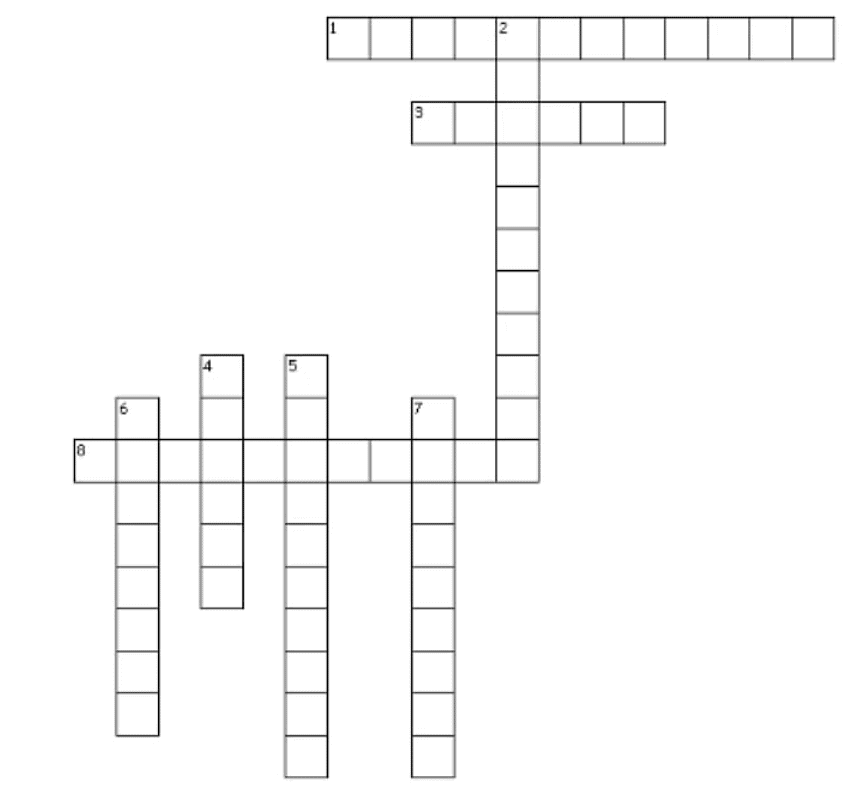
Crossword Puzzle
Across 1. BEC stands for Bose-Einstein-______
3. The state consists of super energetic and super excited particles
8. Conversion of solid to vapour is called ______ Down 2. This is the phenomenon of change of a liquid into vapours at any temperature below its boiling point 4. SI unit of Temperature 5. CNG stands ____ natural gas 6. It is the amount of water vapour present in air. 7. LPG stands for ______petroleum gas.
Improvement in Food Resources refers to the methods aimed at increasing the quantity and quality of food produced through agriculture and animal husbandry to meet the growing demand for food sustainably.
As living organisms, food is essential for our growth, health, and overall development. We obtain food primarily from plants and animals through agriculture and animal husbandry. With India’s growing population, the demand for food is rising, and it is crucial to find ways to increase food production efficiently.
Various Food Resources
This chapter focuses on:
The need to improve crop and livestock production to meet food demand.
Successes like the Green Revolution and the White Revolution boosted food and milk production.
The importance of sustainable practices in agriculture and animal husbandry to protect natural resources.
The connection between food security, increased production, and access to food.
Scientific methods like mixed farming, intercropping, and integrated farming improve yields without harming the environment.
Improvement in Crop Yields
Food Crops and Their Nutritional Benefits
Cereals such as wheat, rice, maize, millets, and sorghum provide us with carbohydrates for energy.
Pulses like gram (chana), pea (matar), black gram (urad), green gram (moong), pigeon pea (arhar), and lentil (masoor) supply us with protein.
Oilseeds, including soybean, groundnut, sesame, castor, mustard, linseed, and sunflower, offer essential fats.
Vegetables, spices, and fruits deliver a variety of vitamins and minerals, along with small amounts of proteins, carbohydrates, and fats.
Fodder crops like berseem, oats, or Sudan grass are grown for livestock feed.
Different Types of Crops in India
In India, the production of food grains has increased fourfold from 1952 to 2010, while the area of land available for cultivation has only risen by 25%.
Factors Affecting Crop Growth
Different crops need specific climatic conditions, temperature, and sunlight duration (photoperiods) to grow and complete their life cycles.
Plants gather energy through photosynthesis, which relies on sunlight.
During the Kharif season (June to October), crops like paddy, soybean, pigeon pea, maize, cotton, green gram, and black gram flourish.
In the Rabi season (November to April), crops such as wheat, gram, peas, mustard, and linseed do well.
Major Activities for Improvement:
Crop Variety Improvement: Enhancing crop types to maximise yields, ensuring high production under diverse conditions.
Crop Production Improvement: Implementing methods to increase overall crop output.
Crop Protection Management: Taking measures to protect crops from damage and loss.
Crop Variety Improvement
Methods for Crop Variety Improvement
Breeding for beneficial traits: Selecting varieties with qualities such as disease resistance and high yields.
Hybridisation: Crossing genetically different plants, which can be intervarietal, interspecific, or intergeneric.
Genetic modification: Introducing specific genes to achieve desired traits in crops.
Try yourself:Which type of crops are grown for livestock feed?
A.Cereals
B.Pulses
C.Oil seeds
D.Fodder crops
The factors for which variety improvement is done are:
Higher yield: To boost crop productivity per acre.
Improved quality: Quality requirements vary by crop; for instance, baking quality is crucial in wheat, while protein quality is essential in pulses.
Biotic and abiotic resistance: Creating varieties that can withstand diseases, insects, drought, salinity, and extreme temperatures.
Change in maturity duration: Shorter periods from sowing to harvesting enhance economic viability, enabling multiple crops per year.
Wider adaptability: Developing varieties that can thrive in various environmental conditions stabilises crop production.
Desirable agronomic characteristics: Traits like height and branching are advantageous for fodder crops, while shorter plants are preferred in cereals to minimise nutrient consumption.
Crop Production Management
In India, as in many other agriculture-focused countries, farming varies from small to very large farms.
Consequently, farmers have differing amounts of land, resources, and access to information and technology.
Financial conditions significantly influence the farming practices and technologies that farmers can adopt.
Cultivation methods and crop yield depend on factors like weather, soil quality, and water availability.
Since weather conditions, such as drought or floods, can be unpredictable, varieties that grow well in various climatic situations are beneficial.
Similarly, varieties that tolerate high soil salinity have also been developed.
Nutrient Management
Plant Nutrients
Essential nutrients: Plants need nutrients from air, water, and soil for growth. Air provides carbon and oxygen, water supplies hydrogen, and soil provides the other thirteen nutrients.
Macro-nutrients: These are nutrients required in large amounts, including carbon, oxygen, hydrogen, and others from the soil.
Micro-nutrients: These are needed in smaller quantities and are also supplied by the soil.
A lack of these nutrients can negatively impact plant growth, reproduction, and disease resistance.
Deficiency of these nutrients affects reproduction, growth, and susceptibility to diseases in plants.
Manure
Manure is an organic substance made from the decomposition of animal waste and plant materials. It is rich in organic matter and essential nutrients, which help improve soil fertility and support healthy plant growth.
Benefits of Manure:
Enriches the soil by adding organic matter and nutrients.
Improves soil structure, which: 1. Increases water retention in sandy soils. 2. Enhances drainage and reduces waterlogging in clayey soils.
Environmentally friendly: It recycles biological and farm waste, reducing the dependence on chemical fertilisers and helping lower water pollution.
Manure
Types of Manure
(i) Compost and vermicompost:
Composting: This involves breaking down waste like animal dung and vegetable scraps to create nutrient-rich compost.
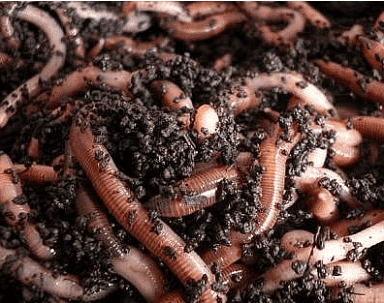
Vermicomposting: In this method, earthworms are used to speed up decomposition, resulting in vermicompost.Vermicomposting
(ii) Green manure: Plants such as sun hemp or guar are grown before planting other crops. When these plants are turned into the soil, they enrich it with nitrogen and phosphorus.
Let’s Revise
Q: How does manure improve soil fertility?
Ans: Manure enriches the soil with organic matter and essential nutrients, improving its fertility.
Q:Why is green manure used before sowing crops?
Ans: Green manure adds nitrogen and phosphorus to the soil, enhancing nutrient availability for the next crop.
Fertilisers
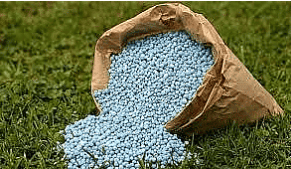
Fertilisers are commercially manufactured nutrients that provide nitrogen, phosphorus, and potassium.
They are essential for promoting the healthy growth of leaves, branches, and flowers, leading to robust plants.
Fertilisers play a major role in increasing crop yields, especially in intensive farming.
Careful application of fertilisers is crucial, including the right amounts, timing, and following guidelines before and after use for full effectiveness.
Excessive watering can wash fertilisers away, leading to water pollution.
Repeated use of fertilisers in one area can harm soil fertility since the soil’s organic matter isn’t restored.
Green manure, made by growing specific plants and turning them into the soil, enriches the soil with nitrogen and phosphorus.Fertilisers
Benefits and Considerations of Fertilisers
Boosts plant growth: Fertilisers deliver key nutrients like nitrogen, phosphorus, and potassium, fostering healthy growth.
Increases yields: When used correctly, fertilisers can enhance crop productivity in high-cost farming.
Soil health impact: Regular use of fertilisers can deplete soil fertility as it does not replenish organic matter and can harm beneficial soil microorganisms.
Proper Application and Precautions
While aiming for maximum crop yields, consider the quick benefits of fertilisers alongside the long-term advantages of manure for soil health.
Fertilisers need to be applied carefully, focusing on the right amount and timing to ensure they are fully used by plants.
Organic farming is a method that minimises or eliminates the use of chemical fertilisers, herbicides, and pesticides. It maximises the use of organic manures, recycled farm waste such as straw and livestock dung, and employs natural agents like blue-green algae for creating biofertilisers. Additionally, neem leaves or turmeric can be used as natural pesticides during grain storage, promoting healthier farming systems.
Try yourself:
What are the factors that influence crop growth?
A.Climate, temperature, and photoperiods
B.Soil quality, water availability, and weather conditions
C.Seed selection, crop nurturing, and crop protection
D.Fertilizer response, disease resistance, and product quality
Organic Farming
Organic farming reduces or eliminates the use of chemicals like fertilisers, herbicides, and pesticides.
Instead, it focuses on maximising the use of organic manures, recycled farm waste (like straw and livestock excreta), and bio-agents, such as cultures of blue-green algae for biofertilisers.
Additionally, neem leaves or turmeric can serve as bio-pesticides for grain storage.
Healthy cropping systems, including mixed cropping, inter-cropping, and crop rotation, are used to enhance control of insects, pests, and weeds while providing essential nutrients to crops.
Try yourself:
What is the purpose of using fertilizers in farming?
A.To speed up the decomposition process
B.To produce nutrient-rich compost
C.To promote plant growth and increase crop productivity
D.To enrich the soil with nitrogen and phosphorus
Also read: NCERT Solutions – Improvement in Food Resources
Irrigation
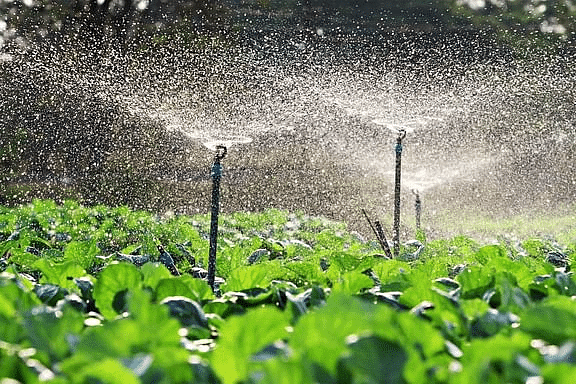
Proper irrigation is very important for the success of crops. Most agriculture in India relies on rain, meaning the success of crops in many areas depends on timely monsoons and adequate rainfall throughout the growing season. Therefore, poor monsoons can lead to crop failure. Ensuring that crops receive water at the right times during their growing season can boost the expected yields of any crop.
Irrigation
Types of Irrigation Systems
Wells: There are two types of wells: dug wells and tube wells. A dug well collects water from shallow water-bearing layers, while a tube well can reach deeper water sources. Pumps are used to lift water from these wells for irrigation.
Canals: This is usually a large and complex irrigation system. Canals receive water from one or more reservoirs or rivers. The main canal splits into branch canals, which have further distributaries to irrigate fields.
River lift system: In areas where canal flow is inconsistent due to insufficient reservoir release, this system is more effective. Water is taken directly from rivers to support irrigation in nearby areas.
Tanks: These are small storage reservoirs that collect and store runoff from smaller catchment areas. New initiatives to increase available water for agriculture include rainwater harvesting and watershed management. This involves creating small check dams, which help raise groundwater levels. The check dams prevent rainwater from flowing away and reduce soil erosion.
Droughts occur due to a lack or irregular distribution of rain. Drought poses a risk to rain-fed farming areas, where farmers rely solely on rain for crop production. Light soils hold less water, and in such areas, crops are negatively affected by drought conditions.
Try yourself:In which irrigation system is water directly drawn from rivers?
A.Wells
B.Canals
C.River lift system
D.Tanks
Cropping Patterns
Cropping patterns refer to various methods of growing crops to achieve the best results.
Types of Cropping Patterns
Mixed cropping: Growing two or more crops at the same time on the same land, such as wheat with gram, wheat with mustard, or groundnut with sunflower. This method reduces the risk of disease and helps protect against crop failure.
Inter-cropping: Planting two or more crops together in a specific pattern, like rows of soybean alternating with rows of maize, or finger millet (bajra) with cowpea (lobia). This ensures that each crop has different nutrient needs, optimising nutrient use and reducing pest and disease spread.
Crop rotation: Growing different crops on the same land in a planned sequence. The choice of crops depends on moisture availability and irrigation. Proper crop rotation can allow for two or three successful harvests in a year.
Crop Protection Management
Field crops face many threats from weeds, insects, and diseases. Managing these threats timely manner is crucial to avoid significant crop damage and losses.
Weeds: Unwanted plants in the fields, such as Xanthium (gokhroo), Parthenium (gazar ghas), and Cyperus rotundus (motha). They compete for resources, reducing crop growth. Therefore, removing weeds early is essential for a good harvest.
Insect pests: They harm plants in three main ways: by cutting roots, stems, and leaves; by sucking sap; and by boring into stems and fruits, all of which can lower crop health and yields.
Diseases: Caused by pathogens like bacteria, fungi, and viruses, which can spread through the soil, water, and air, leading to reduced crop health.
Let’s Revise
Q:What is inter-cropping? Name a crop combination used in intercropping.
Ans: Inter-cropping involves growing two or more crops in a definite pattern, such as alternating rows. Soybean and maize is a common inter-cropping pair.
Q: How do insect pests damage crops?
Ans: By cutting parts, sucking sap, or boring into stems and fruits.
Methods of Control
Pesticides: These include herbicides, insecticides, and fungicides, which are applied to crops or seeds and soil. However, overuse can be harmful to various plants and animals, and it can lead to pollution of the environment.
Mechanical removal: This involves physical methods, such as manual weeding, to manage weed growth.
Preventive measures:
Seed bed preparation: Properly preparing the seed bed and timely sowing of crops can help prevent weed growth.
Intercropping & crop rotation: Planting multiple crops together or rotating them can lessen the impact of pests and diseases.
Resistant varieties: Using crop varieties that resist pests and diseases.
Summer ploughing: Deep ploughing in summer to eliminate weeds and pests, reducing their effect on future crops.
Try yourself:
What is the main objective of organic farming?
A.To maximize the use of chemicals in farming practices.
B.To minimize the use of chemicals and maximize the use of organic manures and bio-agents.
C.To promote the use of chemical fertilizers and pesticides for higher crop yields.
D.To rely solely on chemical fertilizers and pesticides for crop protection.
Storage of Grains
Storage losses in agricultural products can be quite high. The causes of these losses are biotic factors—like insects, rodents, fungi, mites, and bacteria—and abiotic factors, such as improper moisture and temperature in storage. These issues can lead to:
Decline in quality
Weight loss
Reduced germination
Discolouration of produce
Poor marketability
Control Measures
Preventive Measures
Preventive and control measures are implemented prior to storing grains.
Thorough cleaning of the produce is essential.
Proper drying should be done in both sunlight and shade.
Fumigation with pest-control chemicals is necessary.
Effective seedbed preparation, timely sowing of crops, intercropping, and crop rotation assist in controlling weeds.
Utilising resistant varieties and summer ploughing can help eliminate weeds and pests.
Systematic Warehouse Management
This is vital for minimising storage losses.
The process involves organised treatment of grains and effective management of warehouses.
Animal Husbandry
Animal husbandry is the scientific management of livestock, which includes activities such as feeding, breeding, and controlling diseases.
This type of farming involves animals like cattle, goats, sheep, poultry, and fish.
As the population grows and living standards improve, the demand for milk, eggs, and meat also increases.
Moreover, there is a heightened awareness about the humane treatment of livestock, leading to new considerations in farming practices.
Therefore, there is a need to enhance livestock production to meet these rising demands.
Cattle Farming
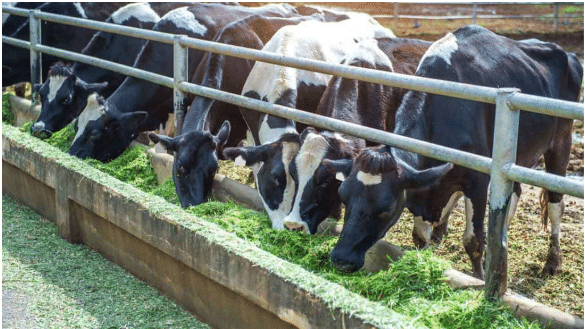
Cattle farming serves two main purposes: producing milk and providing draught power for agricultural tasks like ploughing, watering, and transporting goods.
In India, cattle are classified into two species: Bos indicus (cows) and Bos bubalis (buffaloes).
Female animals that produce milk are referred to as milch animals, while those used for labour are known as draught animals.
The amount of milk produced is influenced by the lactation period, which is the time after a calf is born during which the mother produces milk.
This production can be enhanced by extending the lactation period.
Exotic breeds (like Jersey and Brown Swiss) are often chosen for their longer lactation periods, whereas local breeds (such as Red Sindhi and Sahiwal) are known for their strong disease resistance.
Cross-breeding these types can result in animals that possess both desirable traits.
Animals like cows and buffalo need clean shelters for their health and to ensure they produce clean milk. They should be kept in well-ventilated sheds that protect them from rain, heat, and cold. The floor of the shed should slope to stay dry and make cleaning easier. Cattle Farming
Feeding Requirements
Dairy animals have two types of nutritional needs: (a) maintenance requirement, which keeps them healthy, and (b) milk-producing requirement, which is essential during lactation.
Animal feed consists of (a) roughage, which is high in fibre, and (b) concentrates, which are lower in fibre but rich in proteins and nutrients.
Cattle require a balanced diet that provides all necessary nutrients in the right proportions. Certain feed additives containing micronutrients can also enhance the health and milk yield of dairy animals.
Diseases and Control
Cattle suffer from various diseases that reduce milk production and may cause death.
Healthy cattle eat regularly and have normal posture.
Parasites can be external (causing skin diseases) or internal, like worms affecting the stomach and flukes damaging the liver.
Bacterial and viral infections also occur, for which vaccinations are given.
Let’s Revise
Q:What are milch animals?
Ans: Milch animals are female animals that produce milk.
Q:Name one exotic and one local breed of cattle.
Ans: Exotic: Jersey; Local: Sahiwal.
Poultry Farming
Poultry farming is the practice of raising birds like chickens for their eggs and meat. Special poultry breeds are created for specific roles: layers produce eggs, while broilers are bred for meat. Cross-breeding between local Indian breeds, such as the Aseel, and foreign breeds like the Leghorn aims to create new varieties with desirable characteristics, which include:
High numbers and quality of chicks;
Dwarf broiler parents for commercial chick production;
Ability to adapt to hot weather;
Low maintenance needs;
Smaller egg-laying birds can thrive on cheaper, more fibrous diets made from agricultural by-products.
Egg and Broiler Production
Broiler chickens are raised specifically for meat and sent to market when they are ready. Their diet is rich in protein and contains sufficient fat. The poultry feed includes high levels of vitamins A and K to promote optimal growth and efficient feed usage. Care is taken to minimise mortality and maintain the quality of feathers and meat.
Importance of Good Management Practices
Good management practices are crucial for successful poultry production. This includes:
Maintaining the housing at the correct temperature;
Ensuring the environment and feed are clean, which involves regular cleaning, sanitation, and disinfection;
Preventing and managing diseases and pests through appropriate vaccination which can stop infectious diseases and reduce poultry losses during outbreaks.
The housing, nutritional, and environmental needs of broilers differ somewhat from those of egg layers.
Broilers have different housing, nutritional, and environmental needs compared to egg layers. Their specific diet is designed to support their growth requirements.
Disease Prevention and Control
Poultry can become ill due to:
Viruses
Bacteria
Fungi
Parasites
Nutritional deficiencies
Regular cleaning, sanitation, and disinfectant spraying are essential.
Vaccinations can help prevent infectious diseases and reduce poultry losses during outbreaks.
Farm animals receive vaccinations against major viral and bacterial diseases.
Poultry in India is the most efficient at converting low-fibre food (not suitable for human consumption) into nutritious animal protein.
Try yourself:
What are the two main purposes for which improved poultry breeds are developed?
A.Egg production and meat production
B.Egg production and dairy production
C.Egg production and wool production
D.Meat production and wool production
Fish Production
The main aim is that fish serves as an affordable source of protein in our meals.
Fish production includes various species, such as true finned fish and shellfish like prawns and molluscs.
Fish can be obtained in two ways: through natural resources, known as capture fishing, or through farming, referred to as culture fishery.
Fish are found in both seawater and freshwater environments. Marine fisheries and inland fisheries are two major sources.
Marine Fisheries
India’s marine fishery resources include 7500 km of coastline and the deep seas beyond it.
Popular marine fish found in these waters include pomfret, mackerel, tuna, sardines, and Bombay duck.
Marine fish are caught using various fishing nets from fishing boats.
Yields are increased by locating large schools of fish in the open sea using satellites and echo-sounders.
Some marine fish of high economic value are also farmed in seawater, including finned fish like mullets, bhetki, and pearl spots, shellfish such as prawns, mussels, and oysters, as well as seaweed.
In such a system, a combination of five or six fish species is used in a single fishpond to avoid competition for food.
Aquaculture in Seawater
Certain valuable marine fish are grown in seawater through a method called mariculture.
Examples of farmed finned fish include mullets, bhetki, and pearl spots. Shellfish like prawns, mussels, and oysters are also cultivated.
Seaweed is another product obtained from mariculture, and oysters are cultivated not only for their meat but also for pearl production.
As stocks of marine fish are depleted, the demand can only be met through cultured fisheries, a practice known as mariculture.
Let’s Revise:Besides meat, why are oysters cultivated?
Ans: For pearl production.
Inland Fisheries
Inland Fisheries
Freshwater resources consist of canals, ponds, reservoirs, and rivers.
Brackish water areas, like estuaries and lagoons, are also important for fish.
While fish are captured in these inland waters, most production comes from aquaculture.
Aquaculture in Freshwater Systems
Freshwater aquaculture involves raising fish in resources like canals, ponds, reservoirs, and rivers. Fish can also be cultivated in paddy fields, where they grow alongside rice crops, making efficient use of water and land.
An intensive method used in freshwater aquaculture is composite fish culture, where both local and imported species are reared together. In this system, fish species are carefully selected to avoid competition for food by occupying different zones of the pond: – Catlas feed at the surface, – Rohus feed in the middle layer, – Mrigals and Common Carps feed at the bottom, – Grass Carps consume aquatic weeds.
This arrangement ensures that all available food in the pond is utilised efficiently, resulting in a higher overall fish yield.
However, a major challenge in this system is that many fish species breed only during the monsoon. Additionally, fish seed collected from natural sources may get mixed with other species, affecting the purity and quality of the stock.
To address this issue, scientists have developed methods to breed fish in ponds using hormonal stimulation, which ensures the year-round availability of pure and healthy fish seed in the desired quantities.
Challenges in Fish Farming
Many fish types in composite fish culture only breed during the monsoon season.
A significant issue in fish farming is the shortage of quality fish seed.
To solve this problem, methods have been developed to breed these fish in ponds using hormonal stimulation, ensuring a reliable supply of pure fish seed in the required amounts.
Bee-Keeping
Bee-keeping for honey production is a farming activity. Besides honey, beehives also provide wax, which is used in many medicinal products.
Local bee varieties, such as Apis cerana indica (the Indian bee), A. dorsata (the rock bee), and A. florae (the little bee), are used alongside the Italian bee (A. mellifera) for commercial honey production.
The Italian bees have high honey collection capacity, sting somewhat less, and stay in a given beehive for long periods.
The quality of honey depends on the pasturage, and bee farms or apiaries are established for commercial honey production.
Honey production also provides wax, which is used in various medicinal preparations.
Factors Affecting Honey Quality
The quality of honey relies on the availability of flowers that bees can gather nectar and pollen from.
Besides having enough flowers, the types of blooms influence the flavour of the honey.
Italian bees are known for their high honey production. They are less aggressive, remain in the same hive for extended periods, and breed effectively
 Q.4. Is brass a mixture or a compound?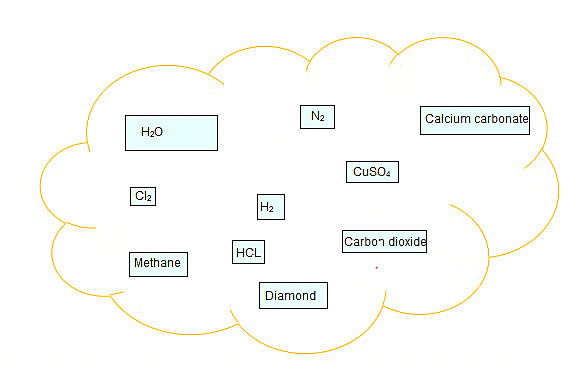


 Vermicomposting
 Fertilisers
 Irrigation

 Cattle Farming

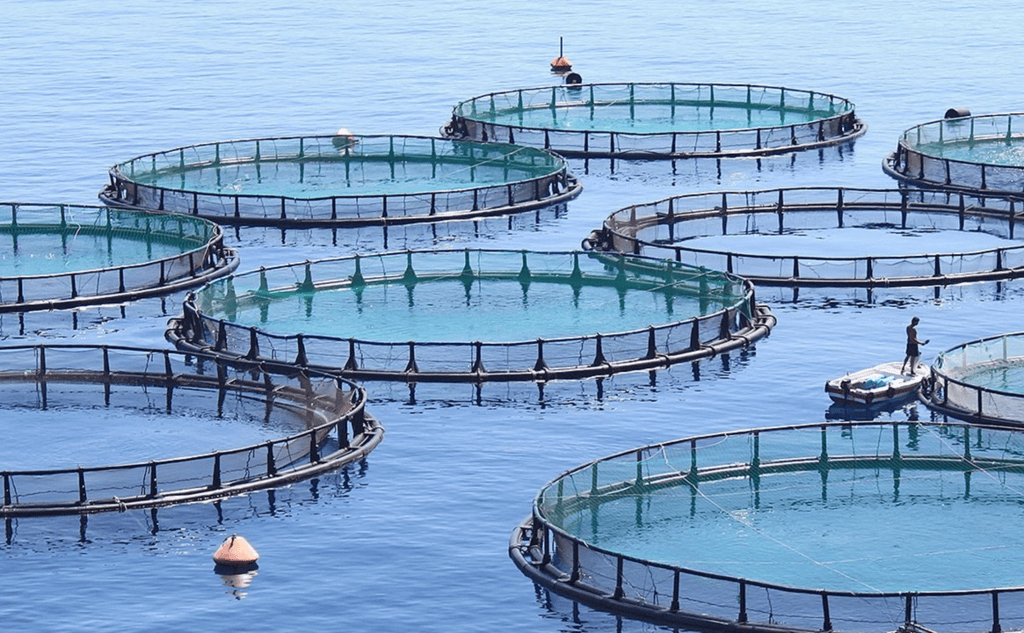 Inland Fisheries