Q2: Case Study: A garden designer is planning a rectangular lawn that is to be surrounded by a uniform walkway. The total area of the lawn and the walkway is 360 square metres. The width of the walkway is same on all sides. The dimensions of the lawn itself are 12 metres by 10 metres. Based on the information given above, answer the following questions: (i) Formulate the quadratic equation representing the total area of the lawn and the walkway, taking width of walkway= x m. (ii) (a) Solve the quadratic equation to find the width of the walkway ‘x’. OR (ii) (b) If the cost of paving the walkway at the rate of ₹ 50 per square metre is ₹ 12,000, calculate the area of the walkway. (iii) Find the perimeter of the lawn.
Ans: (i) Length of rectangular lawn, l = (12 + 2x) m Breadth of rectangular lawn, b = (10 + 2x) m ∴ Area of rectangular lawn = 360 m2 (given) ⇒ (12 + 2x)(10 + 2x) = 360 ⇒ 120 + 24x + 20x + 4x2 = 360 ⇒ 4x2 + 44x + 120 = 360 ⇒ 4x2 + 44x – 240 = 0 ⇒ x2 + 11x – 60 = 0
(ii) (a) Quadratic equation is x2 + 11x – 60 = 0 ⇒ x2 + 15x – 4x – 60 = 0 ⇒ x(x + 15) – 4(x + 15) = 0 ⇒ (x + 15)(x – 4) = 0 ⇒ x = -15 or 4 ⇒ x = 4 ( x can’t be negative) ∴ Width of the walkway= 4 m.
OR (ii) (b) (iii) Length of lawn , l= 12 m, Breadth of lawn, b = 10 m ∴ Perimeter of lawn= 2(l + b) = 2(12 + 10) = 2 x 22 = 44 m
Q3: A student scored a total of 32 marks in class tests in Mathematics and Science. Had he scored 2 marks less in Science and 4 marks more in Mathematics, the product of his marks would have been 253. Find his marks in the two subjects.
Ans: Let the marks scored by a student in Mathematics be x and Science be y. According to question, x + y = 32 ⇒ y = 32 – x …(i) Also, (x + 4)(y – 2) = 253 ⇒ xy – 2x + 4y – 8 = 253 ⇒ xy – 2x + 4y = 261 ⇒ x(32 – x) – 2x + 4(32 – x) = 261 [from(i)] ⇒ 32x – x2 – 2x + 128 – 4x = 261 ⇒ 26x -x2 + 128 = 261 ⇒ x2 – 26x + 133 = 0 ⇒ x2 – 19x – 7x + 133 = 0 ⇒ x(x – 19) – 7(x – 19) = 0 ⇒ (x – 19)(x – 7) = 0 ⇒ x = 7, 19 From (i) when get y = 25, 13 respectively if x = 7, then y = 25 and if x = 19, then y = 13. ∴ Marks in mathematics and science are 7 and 25 or 19 and 13 respectively.
Q4: There is a circular park of diameter 65 mas shown in the following figure, where AB is a diameter. An entry gate is to be constructed at a point P on the boundary of the park such that distance of P from A is 35 m more than the distance of P from B. Find distance of point P from A and B respectively.
Ans: (d) We have, bx2 + ax + c = 0 On comparing with Ax2 + Bx + C = 0, we get A = b, B = a and C = c ∴ D = B2 – 4AC = a2 – 4bc [∵ Discriminant = B2 – 4AC]
Q6: Which of the following quadratic equations has real and equal roots? (a) (x + 1)2 = 2x + 1 (b) x2 +x= 0 (c) x2 – 4 = 0 (d) x2+ x + 1= 0
Ans: Given quadratic equation 4x2 + kx + 1 = 0 has real and equal roots. Comparing with ax² + bx + c = 0, we have a = 4, b = k, c = 1 ∴ D = b2 – 4ac = k2 – 4(4)(1) = 0 ⇒ k2 – 16 = 0 ⇒ k² = 16 ⇒ k = ±4
Q8: Find the smallest value of p for which the quadratic equation x2 – 2(p + 1)x + p2 = 0 has real roots. Hence, find the roots of the equation so obtained.
Ans: Given, x2 – 2(p + 1)x + p2 = 0 has real roots. Compare it with ax2 + bx + c = 0, we get a = 1, b = -2(p + 1), c = p2 ∴ For real roots, we have D ≥ 0 (-2(p + 1))2 – 4 × 1 × p² ≥ 0 ⇒ 4(p2 + 1 + 2p) – 4p2 ≥ 0 ⇒ 4p2 + 4 + 8p – 4p2 ≥ 0 ⇒ 8p + 4 ≥ 0 => p ≥ -1/2 ∴ Smallest value of p is -1/2. Put value of ‘p’ in given equation, So, 1/2, 1/2 are the roots.
Previous Year Questions 2024
Q1: In a flight of 2800 km, an aircraft was slowed down due to bad weather. Its average speed is reduced by 100km/h, and by doing so, the time of flight is increased by 30 minutes. Find the original duration of the flight. (CBSE 2024)
Ans: Let the speed of aircraft be x km/hr. Time taken to cover 2800 km by speed of x km/hr = 2800/x hrs. New speed is (x – 100) km/hr so time taken to cover 2800 km at the speed of (x – 100) km/hr = 2800x – 100 hrs
Q2: The denominator of a fraction is one more than twice the numerator. If the sum of the fraction and its reciprocal is found, the fraction. (CBSE 2024)
Ans: (b) 25/16 Given that, Roots of quadratic equation 4x2 − 5x + k = 0 are real and equal On comparing with ax2 + bx + c = 0, We get, a = 4, b = −5 and c = k For real and equal roots, ⇒ b2 − 4ac = 0 ⇒ (−5)2 − 4(4)(k) = 0 ⇒ 16k = 25 ⇒ k = 25/16
Q4: A rectangular floor area can be completely tiled with 200 square tiles. If the side length of each tile is increased by 1 unit, it would take only 128 tiles to cover the floor. (CBSE 2024) (i) Assuming the original length of each side of a tile is x units, make a quadratic equation from the above information. (ii) Write the corresponding quadratic equation in standard form. (iii) (a) Find the value of x, the length of the side of a tile by factorisation. OR (b) Solve the quadratic equation for x using the quadratic formula.
Ans: (i) Let the original side length of each tile be x units. The area of the rectangular floor using 200 tiles = 200 x2 unit2 The area with increased side length (each side increased by 1 unit) using 128 tiles = 128 (x + 1)2 unit2 So, the required quadratic equation is: 200x2 = 128 (x + 1 )2 (ii) We have, 200x2 = 128 (x + 1)2 ⇒ 200x2 = 128 (x2 + 2x + 1) ⇒ 200x2 = 128x2 + 256x + 128 ⇒ 72x2 − 256x − 128 = 0 which is the quadratic equation is standard form. (iii) (a) We have, 72x2 − 256x − 128 = 0 or, 9x2 − 32x − 16 = 0 or, 9x2 − 36x + 4x − 16 = 0 or, 9x (x − 4) + 4 (x − 4) = 0 or, (x − 4) (9x + 4) = 0
Since the side cannot be negative, thus x = 4 units. OR (b) We have 9x2 − 32x − 16 = 0 On comparing with ax2 + bx + c = 0, we get a = 9, b = −32 and c = −16 Using quadratic formula,
Q5: If the roots of equation ax2 + bx + c = 0, a ≠ 0 are real and equal, then which of the following relations is true? (CBSE 2024) (a) a = b2/c (b) b2 = ac (c) ac = b2/4 (d) c = b2/c
Ans: (c) ac = b2/4 If the discriminant is equal to zero, i.e., b2 − 4ac = 0 where a, b, c are real numbers and a ≠ 0, then roots of the quadratic equation ax2 + bx + c = 0, are real and equal. Thus, b2 – 4ac = 0 or ac = b2/4
Get additional INR 200 off today with EDUREV200 coupon.
Avail Offer
Previous Year Questions 2023
Q6: Find the sum and product of the roots of the quadratic equation 2x2 – 9x + 4 = 0. (CBSE 2023)
Ans: Let α and β be the roots of given quadratic equation 2x2 – 9x + 4 = 0. Sum of roots = α + β = -b/a = (-9)/2 = 9/2 and Product of roots, αβ = c/a = 4/2 = 2
Q7: Find the value of p, for which one root of the quadratic equation px2 – 14x + 8 = 0 is 6 times the other. (CBSE 2023)
Ans: Let the first root be α, then the second root will be 6a Sum of roots = -b/a ⇒ a + 6a = 14/p ⇒ 7a = 14/p ⇒ a = 2/p Product of roots = c/a ⇒ a x 6a = 8/p ⇒ 6a2 = 8/p
⇒ 6(2p)² = 8p
⇒ 6 x 4p² = 8p
⇒ p = 6 x 4/8 ⇒ p = 3 Hence, the value of p is 3.
Q8: The least positive value of k for which the quadratic equation 2x2 + kx + 4 = 0 has rational roots is (2023) (a) ±2√2 (b) 4√2 (c) ±2 (d) √2
Ans: Given quadratic equation is 4x2 – 5 = 0 Discriminant, D = b2 – 4ac = 02 – 4(4)(-5) = 80 > 0 Hence, the roots of the given quadratic equation are real and distinct.
Q10: Find the value of ‘p’ for which the quadratic equation px(x – 2) + 6 = 0 has two equal real roots. (2023)
Ans: The given quadratic equation is px(x – 2) + 6 = 0 ⇒ px2 – 2xp +6 = 0 On comparing with ax2+ bx + c = 0, we get a = p, b = -2p and c = 6 Since, the quadratic equations has two equal real roots.
∴ Discriminant D = 0 ⇒ b2 – 4ac = 0 ⇒ (-2p)2 – 4 x p x 6 = 0 ⇒ 4p2 – 24p = 0 ⇒ p2 – 6p = 0 ⇒ p(p – 6) = 0 ⇒ p = 0 or p = 6 But p ≠ 0 as it does not satisfy equation Hence, the value of p is 6.
Q11: Case Study: While designing the school yearbook, a teacher asked the student that the length and width of a particular photo be increased by n units each to double the area of the photo. The original photo is 18 cm long and 12 cm wide. Based on the above information. Answer the following Questions: (i) Write an algebraic equation depicting the above information. (ii) Write the corresponding quadratic equation in standard form. (iii) What should be the new dimensions of the enlarged photo? OR
Can any rational value of x make the new area equal to 220 cm2? (2023)
Ans: Area = 18 x 12 cm = 216 cm2 Length (l) is increased by x cm So, new length =(18 + x ) cm New width = (12 + x) cm
(i) Area of photo after increasing the length and width = (18 + x)(12 + x) = 2 x 18 x 12 i.e., (18 + x) (12 + x) = 432 is the required algebraic equation. (ii)From part (i) we get, (18 + x) (12 + x) = 432 ⇒ 216 + 18x + 12x + x2 = 432 ⇒ x2 + 30x – 216 = 0 (iii) x2 + 30x – 216 = 0 ⇒ x2+ 36x – 6x – 216 = 0 ⇒ x(x+ 36) – 6 (x+ 36) = 0 ⇒ x = 6, -36 -36 is not possible. So, new length = (18 + 6) cm = 24 cm New width = (12 + 6) cm = 18cm So. new dimension = 24cm x 18 cmOR
According to question (18 + x) (12 + x) = 220 ⇒ 216 + 30x + x2 = 220 ⇒ x2 + 30x + 216 – 220 = 0 ⇒ x2 + 30x – 4 = 0 For rational value of x. discriminant (D) must be perfect square. So, D = b2 – 4ac = (30)2 – 4(1)(-4) = 900 + 16 = 916 ∴ 916 is not a perfect square. So, no rational value of x is possible.
Q12: The roots of the equation x2 + 3x – 10 = 0 are: (a)2,–5 (b)–2,5 (c)2,5 (d)–2,–5 (CBSE 2023)
Ans: (a) To find the roots of the quadratic equation x2 + 3x − 10 = 0, we can use the quadratic formula:
For the equation x2 + 3x − 10 = 0: a = 1 b = 3 c = −10 Substitute these values into the formula:
Now, calculate the two roots:
(i) For x = (-3 + 7) / 2 = 4/2 = 2 (ii) For x = (-3 – 7)/2 = -10/2 = -5
The roots of the equation are 2 and -5. So, the correct answer is: (a) 2,−5
Also read: Short Answer Questions: Quadratic Equations
Previous Year Questions 2022
Q13: If the sum of the roots of the quadratic equation ky2 – 11y + (k – 23) = 0 is 13/21 more than the product of the roots, then find the value of k. (2022)
Ans: Given, quadratic equation is ky2 – 11y + (k – 23) = 0 Let the roots of the above quadratic equation be α and β. Now, Sum of roots, α + β = -(-11)/k = 11/k …(i) and Product of roots, αβ = (k-23)/k …(ii) According to the question, α + β = αβ + 13/21
∴ 11k = k – 23k + 1321 … [From equations (i) and (ii)]
Ans: x2 – 2ax – (4b2 – a2) = 0 ⇒ x2 + (2b – a)x – (2b + a)x – (4b2 – a2) = 0 ⇒ x(x + 2b – a) – (2b + a)(x + 2b – a) = 0 ⇒ (x + 2b – a)(x – 2b – a) = 0 ⇒ (x + 2b – a) = 0, (x – 2b – a) = 0 ∴ x = a − 2b, a + 2b
Q15: In the picture given below, one can see a rectangular in-ground swimming pool installed by a family In their backyard. There is a concrete sidewalk around the pool that is width x m. The outside edges of the sidewalk measure 7 m and 12 m. The area of the pool is 36 sq. m.
Based on the information given above, form a quadratic equation in terms of x Find the width of the sidewalk around the pool. (2022)
Ans: Given, width of the sidewalk = x m. Area of the pool = 36 sq.m ∴ Inner length of the pool = (12 – 2x)m Inner width of the pool = (7 – 2x)m ∴ Area of the pool = A = l x b ⇒ 36 = (12 – 2x) x (7 – 2x) ⇒ 36 = 84 – 24x – 14x +4x2 ⇒ 4x2 – 38x + 48 = 0 ⇒ 2x2 – 19x + 24 = 0, is the required quadratic equation. Area of the pool given by quadratic equation is 2x2 – 19x + 24 = 0 ⇒ 2x2 – 16x – 3x + 24 = 0 ⇒ 2x(x – 8) – 3(x – 8) = 0 ⇒ (x – 8)(2x – 3) = 0 ⇒ x = 8 (not possible) Hence, x = 3/2 = 1.5 Width of the sidewalk =1.5m
Q16: The sum of two numbers is 34. If 3 Is subtracted from one number and 2 is added to another, the product of these two numbers becomes 260. Find the numbers. (2022)
Ans: Let one number be x and another number be y. Since, x + y = 34 ⇒ y = 34 – x (i) Now. according to the question. (x – 3) (y + 2) = 260 (ii) Putting the value or y from (i) in (ii), we get ⇒ (x – 3)(34 – x + 2) = 260 ⇒ (x – 3)(36 – x) = 260 ⇒ 36x – x2 – 108 + 3x = 260 ⇒ x2 – 39x +368 = 0 ⇒ x2– 23x – 16x + 368 = 0 ⇒ x(x – 23) – 16(x – 23) = 0 ⇒ (x – 23)(x – 16) =0 ⇒ x = 23 or 16 Hence; when x = 23 from (i), y = 34 – 23 = 11 When x = 16. then y = 34 – 16 = 18 Hence the required numbers are 23 and 11 or 16 and 18.
Q17: The hypotenuse (in cm) of a right-angled triangle is 6 cm more than twice the length of the shortest side. If the length of the third side is 6 cm less than thrice the length of the shortest side, then find the dimensions of the triangle. (2022)
Let ΔABC be the right angle triangle, right angled at B, as shown in the figure. Also, let AB = c cm, BC = a cm and AC = b cm Then, according to the given information, we have b = 6 + 2a …..(i) (Let a be the shortest side) and c = 3a – 6 …(ii) We know that, b2 = c2 + a2 …..(Pythagoras Theorem) Putting the values of b and c from (i) and (ii) in above equation ⇒ (6 + 2a)2 = (3a – 6)2 + a2 …[Using (i) and (ii)] ⇒ 36 + 4a2 + 24a = 9a2 + 36 – 36a + a2 ⇒ 60a = 6a2 ⇒ 6a = 60 …[∵ a cannot be zero] ⇒ a = 10 cm Now, putting value of a in equation (i), we get b = 6 + 2 × 10 = 26 and putting value of a in equation (ii), we get c = 3 × 10 – 6 = 24 Thus, the dimensions of the triangle are 10 cm, 24 cm and 26 cm.
Q18: Solve the quadratic equation: x2 – 2ax + (a2 – b2) = 0 for x. (2022)
Ans: Roots of quadratic equation are given as 2 and – 5. Sum of roots = 2 + (-5) = -3 Product of roots = 2 (-5) = -10 Quadratic equation can he written as x2 – (sum of roots)x + Product of roots = 0 ⇒ x2 + 3x – 10 = 0
Ans: Let the sides of the two squares be x m and y m, where ; x > y. Then, their areas are x2 and y2 and their perimeters are 4x and 4y respectively. By the given condition, x2 + y2 = 544 ——–(i) and 4x – 4y = 32 ⇒ x – y = 8 ⇒ x = y + 8 ———— (ii) Substituting the value of x from (ii) in (i) we get ⇒ (y + 8)2 + y2 = 544 ⇒ y2 + 64 + 16y + y2 = 544 ⇒ 2y2 + 16y – 480 = 0 ⇒ y2 + 8y – 240 = 0 ⇒ y2 + 20y – 12y – 240 = 0 ⇒ y(y + 20) – 12(y + 20) = 0 ⇒ (y – 12) (y + 20) = 0 ⇒ y = 12 (∵ y ≠ – 20 as length cannot be negative) From (ii), x = 12 + 8 = 20 Thus, the sides of the two squares are 20 m and 12 m.
Q23: A motorboat whose speed is 18 km/h in still water takes 1 hour more to go 24 km upstream than to return downstream to the same spot. Find the speed of the stream. (2020)
Q26: A train covers a distance of 480 km at a uniform speed. If the speed had been 8 km/h less, it would have taken 3 hours more to cover the same distance. Find the original speed of the train. (CBSE 2020)
Ans: Let the original speed of the train be x km/h. Then, time taken to cover the journey of 480 km , t = 480 / x hours Time taken to cover the journey of 480 km with speed of (x – 8) km/h = 480 / x − 8 hours Now, according to question,
Ans: Let the length of the side of one square be x m and the length of the side of another square be y m. Given, x2 + y2= 157 _(i) and 4x + 4y=68 _(ii) x + y = 17 y = 17 – x _(iii) On putting the value of y in (i), we get x2 + (17 – x)2 = 157 ⇒ x2 + 289 + x2 – 34x = 157 => 2x2 – 34x +132 = 0 ⇒ x2 – 17x + 66 = 0 ⇒ x2 – 11x – 6x + 66 =0 ⇒ x(x – 11) – 6(x – 11) = 0 ⇒ (x – 11) (x – 6) = 0 ⇒ x = 6 or x = 11 On putting the value of x in (iii), we get y = 17 – 6 = 11 or y = 17 – 11 = 6 Hence, the sides of the squares be 11 m and 6 m.
Q1: A system of two linear equations in two variables is inconsistent, if the lines in the graph are: (a) coincident (b) parallel (c) intersecting at one point (d) intersecting at right angles
Ans: We have, x + 3y = 6 3y- 2x = -12 On comparing with general equation, we get a1 = 1, b1 = 3, c1 = -6 a2 = – 2, b2 = 3, c2 = 12 Hence, the given pair of equations is consistent.
Hence, (6, 0) is the solution of given system of equations.
Q3: Solve the following pair of equations algebraically: 101x + 102y = 304 102x + 101y = 305
Ans: We have, 101x + 102y = 304 …(i) 102x + 101y = 305 …(ii) Adding equations (i) and (ii), we get 101x + 102y + 102x + 101y = 304 + 305 ⇒ 203x + 203y = 609 ⇒ x + y = 3 …(iii) Subtracting equation (ii) from (i), we get 101x + 102y – 102x – 101y = 304 – 305 ⇒ y – x = -1 …(iv) Adding equations (iii) and (iv), we get x + y + y – x = 3 + (-1) ⇒ 2y = 2 ⇒ y = 1 Substitute of y’ in (iv), we get 1 – x = -1 ⇒ x=1 + 1 = 2 Thus, the solution is x = 2 and y = 1.
Q4: In a pair of supplementary angles, the greater angle exceeds the smaller by 50°. Express the given situation as a system of linear equations in two variables and hence obtain the measure of each angle.
Ans: Let the greater angle be x and smaller angle be y. Using statement, we have x + y = 180° …(i) x – y = 50° …(ii) Adding equations (i) and (ii), we get x + y + x – y = 180° + 50° ⇒ 2x = 230° ⇒ x = 115° Using equation (i), we get 115° + y = 180° ⇒ y = 180° – 115° = 65° So, greater angle is 115° and smaller angle is 65°.
Q5: A man lent a part of his money at 10% p.a. and the rest at 15% p.a. His income at the end of the year is ₹1,900. If he had interchanged the rate of interest on the two sums, he would have earned ₹200 more. Find the amount lent in both cases.
Ans: Let the amount lent at 10% p.a. = ₹x Let the amount lent at 15% p.a. = ₹y According to question, Adding (i) and (ii), we get 25x + 25y = 400000 ⇒ x + y = 16000 …(iii) Subtracting eqn. (i) from (ii), we get 5x – 5y = 2000 ⇒ x – y = 4000 …(iv) adding eqn. (iii) and (iv), we get 2x = 20000 ⇒ x = 10000 Put value of x in eqn. (iii), we get y = 6000 Hence, amount lent at 10% p.a. is ₹10000 and amount lent at 15% p.a. is ₹6000.
Q6: Vijay invested certain amounts of money in two schemes A and B, which offer interest at the rate of 8% per annum and 9% per annum, respectively. He received ₹1,860 as the total annual interest. However, had he interchanged the amounts of investments in the two schemes, he would have received ₹ 20 more as annual interest. How much money did he invest in each scheme?
Ans: Let the amount invested in scheme A be ₹x and in scheme B be ₹y respectively. According to question,
⇒ 8x + 9y = 186000 ….(i)
⇒ 9x + 8y = 188000 ….(ii) On solving equations (i) and (ii), we get 17y = 170000 ⇒ y = 10000 Substituting the value of y in equation (i), we get 8x + 9(10000) = 186000 ⇒ 8x = 186000 – 90000 ⇒ 8x = 96000 ⇒ x = 96000/8 ⇒ x = 12000 ∴ Vijay invested ₹12000 in scheme A and ₹10000 in scheme B.
Q7: A two-digit number is such that the product of its digits is 12. When 36 is added to this number, the digits interchange their places. Find the number.
Ans: Let the tens digit of a number be a and ones digit be b, then two digit number can be written as 10a + b Given, ab = 12 …(i) Also, 10a + b + 36 = 10b + a ⇒ 9a – 9b + 36 = 0 ⇒ a – b + 4 = 0 ⇒ a – b = -4 …(ii) Squaring on both sides, we get (a – b)2 = 16 ⇒ (a + b)2 – 4ab = 16 ⇒ (a + b)2 = 16 + 4(12) ⇒ a + b = ±8 [∴ Using (i)] When a + b = 8, then a = 2, b = 6 [Using (iii)] When a + b = -8, then a = -6, b = -2 [Rejected] Number = 10a + b = 10(2) + 6 = 26
Q8: If x = 1 and y = 2 is a solution of the pair of linear equations 2x – 3y + a= 0 and 2x + 3y – b = 0, then: (a) a = 2b (b) 2a = b (c) a + 2b = 0 (d) 2a + b = 0
Ans: (b) We have, 2x – 3y + a = 0 ..(i) Put x = 1 and y = 2 in (i), we get ∴ 2 – 6 + a = 0 ⇒ a = 4 Put x = 1 and y = 2 in (ii), we get Also, given 2x + 3y – b = 0 ∴ 2 + 6 – b = 0 ⇒ b = 8 ⇒ b = 2 * 4 ⇒ b = 2a [From (i)]
Q9: The value of ‘k’ for which the system of linear equations 6x + y = 3k and 36x + 6y = 3 have infinitely many solution is: (a) 6 (b) 1/6 (c) 1/2 (d) 1/3
Ans: (a) We have, 2x + 1 = 0 and 3y – 5 = 0 ⇒ x = -1/2 and y = 5/3 ∴ Given system of equations has a unique solution.
Previous Year Questions 2024
Q1: The pair of linear equations x + 2y + 5 = 0 and – 3x = 6y – 1 has. (CBSE 2024) (a) unique solution (b) exactly two solutions (c) infinitely many solutions (d) no solutions
Ans: 2x + y = 13 …(i) 4x – y = 17 …(ii) On adding eqn.(i) and eqn.(ii) 6x = 30 x = 5 Put the value of x in eqn.(i) 2 × 5 + y = 13 ⇒10 + y = 13 ∴ y = 3 So, x – y = 5 – 3 = 2
Q3: The value of k for which the pair of linear equations 5x + 2y − 7 = 0 and 2x + ky + 1 = 0 do not have a solution is ______. (CBSE 2024) (a) 5 (b) 4/5 (c) 5/4 (d) 5/2
Ans: Given the pair of linear equations as, ⇒ x + 2y = 9 …(i) ⇒ y − 2x = 2 ⇒ −2x + y = 2 …(ii) Multiplying eqn (i) by 2 and adding to eqn (ii), we get ⇒ (−2x + y) + ( 2x + 4y) = 2 + 18 ⇒ 5y = 20 ⇒ y = 4 Putting in eqn (i), ⇒ x + 2(4) = 9 ⇒ x = 9 − 8 ⇒ x = 1 So, the required solution is x = 1 and y = 4
Q5: Check whether the point (−4, 3) lies on both the lines represented by the linear equations x + y + 1 = 0 and x − y = 1. (CBSE 2024)
Ans: Given the equations of line are ⇒ x + y = −1 …(i) ⇒ x − y = 1 …(ii) The intersection point of both the lines will be the point that lies on both the lines, So, adding eqn (i) and (ii), ⇒ (x + y) + (x − y) = −1 + 1 ⇒ 2x = 0 ⇒ x = 0 Putting in eqn (i), ⇒ 0 + y = −1 ⇒ y = −1 So, the point will be (x, y) = (0, −1) Hence, the point (−4, 3) does not lie on both the lines.
Q6: In the given figure, graphs of two linear equations are shown. The pair of these linear equations is: (CBSE 2024)
(a) consistent with unique solutions. (b) consistent with infinitely many solutions. (c) inconsistent. (d) inconsistent but can be made consistent by extending these lines.
Ans: Given system of linear equations are 7x − 2y = 5 …(i) 8x + 7y = 15 …(ii) By multiplying eq. (i) by 7 and eq. (ii) by 2, we get 49x − 14y = 35 16x + 14y = 30 65x = 65 ∴ x = 1 Substituting the value of x is eq (i), we get 7(1) − 2y = 5 or, 7 − 2y = 5 or −2y = −2, or y = 1 Therefore, x = 1 and y = 1
Q8: Three years ago, Rashmi was thrice as old as Nazma. Ten years later, Rashmi will be twice as old as Nazma. How old are Rashmi and Nazma now? (CBSE 2024)
Ans: Let the age of Rashmi = x years and the age of Nazma = y years Three years ago, Rashmi’s age = (x − 3) years Nazma’s age = (y − 3) years According to the question, (x − 3) = 3(y − 3) ⇒ x − 3 = 3y − 9 ⇒ x = 3y − 6 …(i) Ten years later, Rashmi’s age = x + 10 Nazma’s age= y + 10 According to the question, (x + 10) = 2(y + 10) x + 10 = 2y + 20 x = 2y + 10 …(ii) From eq. (i) and (ii), we get 3y − 6 = 2y + 10 y = 16 Substituting the value of y in eq. (i), we get x = 3 × 16 − 6 = 48 − 6 = 42 Thus, Rashmi is 42 years old, and Nazma is 16 years old.
Get additional INR 200 off today with EDUREV200 coupon.
Avail Offer
Previous Year Questions 2023
Q9: The pair of linear equations 2x = 5y + 6 and 15y = 6x – 18 represents two lines which are (2023) (a) intersecting (b) parallel (c) coincident (d) either intersecting or parallel
Ans: (c) Sol: x + ky = 5 At x = 2, y = 1 2 + k(1) = 5 ∴ k = 3
Q11: The pair of linear equations x + 2y + 5 = 0 and -3x – 6y + 1 = 0 has (2023) (a) A unique solution (b) Exactly two solutions (c) Infinitely many solutions (d) No solution
x = 5 —————(i) y = 7 —————(ii) Draw the line x = 5 parallel to the y-axis and y= 7 parallel to the x-axis. ∴ The graph of equation (i) and (ii) is as follows The lines x = 5 and y = 7 intersect each other at (5, 7).
Q13: Using the graphical method, find whether a pair of equations x = 0 and y = -3 is consistent or not. (2023)
Ans: Let x and y be two numbers such that x> y According to the question, and x + 2y = 13 —- (ii) Subtracting (i) from (ii), we get 3y = 9 ⇒ y = 3 Substitute y = 3 in (i) we get x – 3 = 4 ⇒ x = 7
Q15: (A) If we add 1 to the numerator and subtract 1 from the denominator, a fraction reduces to 1 It becomes 1/2 if we only add 1 to the denominator. What is the fraction? OR (B) For which value of ‘k’ will the following pair of linear equations have no solution? (2023) 3x + y = 1 (2k – 1)x + (k – 1)y = 2k + 1
Ans: (A) Let required fraction be x/y According to question,
x + 1y – 1 = 1
⇒ x + 1 = y – 1
⇒ x = y – 2 … (i)
Also, xy + 1 = 12
⇒ 2x = y + 1 …(ii) From equations (i) and (ii), we get 2y — 4 = y + 1 y = 5 ∴ x = 3 Required fraction x/y is 3/5 OR (B) 3x + y = 1 (2k – 1 )x + (k – 1 )y = 2k + 1
For no solution;
⇒ 32k – 1 = 1k – 1 ≠ 12k + 1
2k – 1 = 3k – 3
⇒ k = 2
Also, 1k – 1 ≠ 12k + 1
2k + 1 ≠ k – 1
⇒ k ≠ -2
Q16: Two schools ‘P’ and ‘Q’ decided to award prizes to their students for two games of Hockey Rs. x per student and Cricket Rs. y per student. School ‘P’ decided to award a total of Rs. 9,500 for the two games to 5 and 4 students respectively, while school ‘Q’ decided to award Rs. 7,370 for the two games to 4 and 3 students respectively.
Based on the given information, answer the following questions. (i) Represent the following information algebraically (in terms of x and y). (ii) (a) What is the prize amount for hockey?
OR
(b) Prize amount on which game is more and by how much? (iii) What will be the total prize amount if there are 2 students each from two games? (CBSE 2023)
Ans: (i) For Hockey, the amount given to per student = x For cricket, the amount given to per student = y From the question, 5x + 4y =9500 (i) 4x + 3y = 7370 (ii)
(ii) (a) Multiply (1) by 3 and (2) by 4 and then subtracting, we get
15x + 12y- (16x + 12y) = 28500 – 29480 ⇒ – x = – 980 ⇒ x = ₹980 The prize amount given for hockey is Rs. 980 per student (b) Multiply (1) by 4 and (2) by 5 and then subtracting, we get 20x + 16y- 20x – 15y = 38000 – 36850 ⇒ y = 1150 The prize amount given for cricket is more than hockey by (1150 – 980) = 170. (iii) Total prize amount = 2 x 980 + 2 x 1150 = Rs. (1960 + 2300) = Rs. 4260
Also read: Facts that Matter: Pair of Linear Equations in Two Variables
Previous Year Questions 2022
Q17: The pair of lines represented by the linear equations 3x + 2y = 7 and 4x + 8y -11 = 0 are (2022) (a) perpendicular (b) parallel (c) intersecting (d) coincident
Ans: (d) Sol: Given equations are, y = 2 and y = – 3.
Clearly, from the graph, we can see that both equations are parallel to each other. So, there will be no solution.
Q19: A father is three times as old as his son. In 12 years time, he will be twice as old as his son. The sum of the present ages of the father and the son is (2022) (a) 36 years (b) 48 years (c) 60 years (d) 42 years
Ans: (b) Sol: Let age of father be ‘x’ years and age of son be ‘y’ years. According to the question, x = 3y ..(i) and x + 12 = 2 (y + 12) ⇒ x – 2y = 12 ..(ii) From (i) and (ii), we get x = 36, y = 12 ∴ x + y = 48 years
Q20: If 17x – 19y = 53 and 19x – 17y = 55, then the value of (x + y) is (2022) (a) 1 (b) -1 (c) 3 (d) -3
The general form of a linear equation is ax + by + c = 0. So, comparing terms:For the first equation, a1 = 1, b1 = 1, c1 = −4. For the second equation, a2 = 2, b2 = k, c2= −3.
For the lines to be parallel (and hence have no solution), we need:
a1a2 = b1b2 ≠ c1c2
So, 1/2 = 1/k
Cross-multiplying gives:
k = 2
Now, let’s check the condition for the
c1c2 = -4-3 = 43
Since 1/2 = 1/k when k = 2 but 1/2 ≠ 4/3, the condition for no solution is satisfied.
Thus, the value of kk for which the equations have no solution is: 2 So, the correct answer is (b) 2.
Q22: The solution of the pair of linear equations x = -5 and y = 6 is (2021) (a) (-5, 6) (b) (-5, 0) (c) (0, 6) (d) (0, 0)
Ans: (a) Sol: (-5, 6) is the solution of x = -5 and y = 6.
Q23: The value of k for which the pair of linear equations 3x + 5y = 8 and kx + 15y = 24 has infinitely many solutions, is (2021) (a) 3 (b) 9 (c) 5 (d) 15
Ans: (a) Sol: 32x + 33y = 34 …(i) 33x + 32y = 31 …(ii) Adding equation (i) and (ii) and subtracting equation (ii) from (i), we get 65x + 65y = 65 or x + y = 1 …(iii) and – x + y = 3 …(iv) Adding equation (iii) and (iv), we get y = 2 Substituting the value of y in equation (iii), x = -1
Q25: Two lines are given to be parallel. The equation of one of the lines is 3x – 2y = 5. The equation of the second line can be (2021) (a) 9x + 8 y = 7 (b) – 12 x – 8 y = 7 (c) – 12 x + 8y = 7 (d) 12x + 8y = 7
Ans: (c) Sol: If two lines a1x + b1y + c1 = 0 and a2x + b2y + c2 = 0 are parallel, then
a1a2 = b1b2 ≠ c1c2 It can only possible between 3x – 2y = 5 and -12x + 8y = 7.
Q26: The sum of the numerator and the denominator of a fraction is 18. If the denominator is increased by 2, the fraction reduces to 1/3. Find the fraction. (2021)
Ans: 5/13 Let the numerator be x and the denominator be y of the fractions. Then, the fraction = x /y. Given , x + y = 18 – (i) and ⇒ 3x – y = 2 . . (ii) Adding (i) and (ii), we get 4x = 20 ⇒ x = 5 Put the value of x in (i), we get 5+ y= 18 ⇒ y = 13 ∴ The required fraction is 5/13
Q27: Find the value of K for which the system of equations x + 2y = 5 and 3x + ky + 15 = 0 has no solution. (2021)
x + 2y = 5 3k + ky = – 15 has no solution. ∴ For K = 6 the given system of equations has no solution.
Q28:Case study-based questions are compulsory. A bookstore shopkeeper gives books on rent for reading. He has a variety of books in his store related to fiction, stories, quizzes etc. He takes a fixed charge for the first two days and an additional charge for subsequent days Amruta paid ₹22 for a book and kept it for 6 days: while Radhika paid ₹16 for keeping the book for 4 days. Assume that the fixed charge is ₹x and the additional charge (per day) is ₹y. Based on the above information, answer any four of the following questions. (i) The situation of the amount paid by Radhika. is algebraically represented by (2021) (a) x – 4 y = 16 (b) x + 4 y = 16 (c) x – 2 y = 16 (d) x + 2 y = 16
Ans: (d) Sol: For Amruta, x + (6 – 2)y = 22 i. e., x + 4y = 22 …(i) For Radhika, x + (4 – 2)y = 16 i.e.,x + 2y = 16 …(ii) Solving equation (i) and (ii). we get x = 10 and y = 3 i.e., Fixed charges (x) = 10 …(iii) and additional charges per subsequent day (y) = ₹ 3 …(iv) x + 2 y = 16 [From equation (ii)]
(ii) The situation of the amount paid by Amruta. is algebraically represented by (2021) (a) x – 2y = 11 (b) x – 2y = 22 (c) x + 4 y = 22 (d) x – 4 y = 11
Ans: (c) Sol: For Amruta, x + (6 – 2)y = 22 i. e., x + 4y = 22 …(i) For Radhika, x + (4 – 2)y = 16 i.e.,x + 2y = 16 …(ii) Solving equation (i) and (ii). we get x = 10 and y = 3 i.e., Fixed charges (x) = 10 …(iii) and additional charges per subsequent day (y) = ₹ 3 …(iv) x + 4 y = 22 [From equation (i)]
(iii) What are the fixed charges for a book? (2021) (a) ₹ 9 (b) ₹ 10 (c) ₹ 13 (d) ₹ 15
Ans: (b) Sol: For Amruta, x + (6 – 2)y = 22 i. e., x + 4y = 22 …(i) For Radhika, x + (4 – 2)y = 16 i.e.,x + 2y = 16 …(ii) Solving equation (i) and (ii). we get x = 10 and y = 3 i.e., Fixed charges (x) = 10 …(iii) and additional charges per subsequent day y = ₹ 3 …(iv) x = ₹ 10 [From equation (iii)]
(iv) What are the additional charges for each subsequent day for a book? (2021) (a) ₹ 6 (b) ₹ 5 (c) ₹ 4 (d) ₹ 3
Ans: (d) Sol: For Amruta, x + (6 – 2)y = 22 i. e., x + 4y = 22 …(i) For Radhika, x + (4 – 2)y = 16 i.e.,x + 2y = 16 …(ii) Solving equation (i) and (ii). we get x = 10 and y = 3 i.e., Fixed charges (x) = 10 …(iii) and additional charges per subsequent day y = ₹ 3 …(iv) y = ₹ 3 [From equation (iv)]
(v) What is the total amount paid by both, if both of them have kept the book for 2 more days? (2021) (a) ₹ 35 (b) ₹ 52 (c) ₹ 50 (d) ₹ 58
Ans: (c) For Amruta, x + (6 – 2)y = 22 i. e., x + 4y = 22 …(i) For Radhika, x + (4 – 2)y = 16 i.e.,x + 2y = 16 …(ii) Solving equation (i) and (ii). we get x = 10 and y = 3 i.e., Fixed charges (x) = 10 …(iii) and additional charges per subsequent day y = ₹ 3 …(iv) Total amount paid for 2 more days by both = (x + 4 y) + 2 y + (x + 2y ) + 2 y = 2 x + 10y = 2 x 10 + 10 x 3 = ₹ 50
Q29: The pair of equations x = a and y = b graphically represent lines which are (2020) (a) Intersecting at (a, b) (b) Intersecting at (b, a) (c) Coincident (d) Parallel
Ans: (a) Sol: The pair of equations x = a and y = b graphically represent lines which are parallel to the y-axis and x-axis respectively. The lines will intersect each other at (a, b).
Q30: If the equations kx – 2y = 3 and 3x + y = 5 represent two intersecting lines at unique points, then the value of k is _________. (2020)
Ans: For any real number except k = -6 kx – 2y = 3 and 3x + y = 5 represent lines intersecting at a unique point. ⇒ k3 ≠ -21 ⇒ k ≠ -6 For any real number except k ≠ -6 The given equation represent two intersecting lines at unique point.
Q31: The value of k for which the system of equations x + y – 4 = 0 and 2x + ky = 3 has no solution. is (2020) (a) -2 (b) ≠2 (c) 3 (d) 2
Q32: Determine graphically the coordinates of the vertices of a triangle, the equations of whose sides are given by 2y – x = 8, 5y – x = 14, and y – 2x = 1. (2020)
2y – x = 8 ..(i) 5y – x = 14 …(ii) and y – 2x = 1 …(iii) are given below:
From the graph of lines represented by given equations, we observe that Lines (i) and (iii) intersect each other at C(2, 5), Lines (ii) and {iii) intersect each other at B(1, 3) and Lines (i) and (ii) intersect each other at 4(-4, 2). Coordinates of the vertices of the triangle are A(-4, 2), B(1, 3) and C(2, 5).
Q33: Solve the equations x + 2y = 6 and 2x – 5y = 12 graphically. (2020)
From the graph, the two lines intersect each other at point (6, 0) ∴ x = 6 and y = 0
Q34: A fraction becomes 1/3 when 1 is subtracted from the numerator, and it becomes 1/4 when 8 is added to its denominator. Find the fraction. (CBSE 2020)
From (ii), 4x = y +8 so, 4x – y – 8 = 0 … (iv) Subtracting (iii) from (iv), we get x = 5 Substituting the value of x in (iii), we get y = 12 Thus, the required fraction is 5/12
Q35: The present age of a father is three years more than three times the age of his son. Three years hence, the father’s age will be 10 years more than twice the age of the son. Determine their present ages. (2020)
Ans:Let the present age of son be x years and that of father be y years.
According to question, we have y = 3x+ 3 ⇒ 3x – y + 3 = 0 (i) And y + 3 = 2(x + 3) + 10 ⇒ y + 3 = 2x + 6 +10 ⇒ 2x – y + 13 = 0 (ii) Subtracting (ii) from (i), we get x = 10 Substituting the value of x in (ii). we get y = 33 So. the present age of the son is 10 years and that of the father is 33 years.
Ans: Given lines are 2x + 3y = 2 and x – 2y = 8 2x + 3y = 2 and x – 2y = 8 ∴ We will plot the points (1, 0), (-2, 2) and (4, – 2 ) and join them to get the graph of 2x + 3y = 2 and we will plot the points (0, -4), (8, 0) and (2, -3) and join them to get the graph of x – 2y = 8
Q37: A train covered a certain distance at a uniform speed. If the train had been 6 km/hr faster, it would have taken 4 hours less than the scheduled time and if the train were slower by 6 km/hr, it would have taken 6 hours more than the scheduled time. Find the length of the journey. (CBSE 2020)
Ans: Let the original uniform speed of the train be x km/hr and the total length of journey be l km. Then, scheduled time taken by the train to cover a distance of l km = l/x hours Now,
lx + 6 = lx – 4
⇒ lx – lx + 6 = 4
⇒ x + 6 – xx(x + 6) = 4
⇒ 6lx(x + 6) = 4
⇒ l = 2x(x + 6)3 … (i)
Also,
lx – 6 = lx + 6
⇒ lx – 6 – lx = 6
⇒ x – x + 6(x – 6)x = 6
⇒ 6l(x – 6)x = 6
⇒ l = x(x – 6) … (ii)
From equations (i) and (ii), we have
2x(x + 6)3 = x(x – 6)
⇒ 2x + 12 = 3x – 18
⇒ x = 30
Putting the value of x in eq. (ii), we get l = 30(30 – 6) = 30 × 24 = 720 Hence, the length of the journey is 720 km.
Also read: Facts that Matter: Pair of Linear Equations in Two Variables
Previous Year Questions 2019
Q38: Draw the graph of the equations x – y + 1 = 0 and 3x + 2y – 12 = 0. Using this graph, find the values of x and y which satisfy both the equations. (2019)
Ans: Let the larger angle be x° and the smaller angle be y°. We know that the sum of two supplementary pairs of angles is always 180°.
We have x° + y° = 180° (i) and x° – y° = 18° (ii) [Given] By (1), we have x° = 180° – y° _(iii) Put the value of x° in (ii), we get 180° – y° – y° = 18° ⇒ 162° = 2y° ⇒ y = 81 From (3), we have x° = 180° – 81° = 99° The angles are 99° and 81°
Q40: Solve the following pair of linear equations: 3x – 5y =4, 2y+ 7 = 9x. (2019)
3x – 5y = 4, ……. (i) 2y+ 7 = 9x 9x – 2y = 7 …….. (ii) Multiply (i) by 3 and subtract from (ii), as
⇒ 9x – 2y – 9x + 15y = -5 → 13y = -5
⇒ y = -513
Put y = -513 in (i), we get
3x – 5 -513 = 4
⇒ 3x + 2513 = 4
⇒ 3x = 4 – 2513
⇒ x = 2713 × 3 = 913
Hence, x = 9/13 and y = -5/13
Q41: A father’s age is three times the sum of the ages of his two children. After 5 years his age will be two times the sum of their ages. Find the present age of the father. (2019)
Ans: Let the ages of two children be x and y respectively.
Father’s present age = 3(x +y) After 5 years, sum of ages of children = x + 5 + y + 5 = x + y + 10 and age of father = 3(x + y) + 5 According to the question, 3(x + y) + 5 = 2(x + y+ 10) 3x + 3y + 5 = 2x + 2y + 20 ⇒ x + y = 15 Hence, present age of father = 3(x + y) = 3 x 15 = 45 years
Q42: A fraction becomes 1/3 when 2 is subtracted from the numerator and will becomes 1/2 when 1 is subtracted from the denominator. Find the fraction. (2019)
x – 4y + p = 0 (i) and 2x + y – q – 2 = 0 (ii) It is given that x = 3 and y = 1 is the solution of (i) and (ii) ∴ 3 – 4 x 1+ p = 0 ⇒ p = 1 and 2 x 3 + 1 – q – 2 = 0 ⇒ q = 5 ∴ q = 5p
Q45: For what value of k, does the system of linear equations 2x + 3y=7 and (k – 1)x + (k + 2) y = 3k have an infinite number of solutions? (CBSE 2019)
Ans: (c) Since both polynomials cut the x-axis at two distinct points each, the total number of distinct zeroes of both the polynomials combined is 2.
Q5: If α and β are the zeroes of the polynomial p(x) = x2 – ax – b, then the value of (α + β + αβ) is equal to: (2025) (a) a + b (c) a- b (b) -a – b (d) -a + b
Ans: (c) Given polynomial is p(x) = x2 – ax – b, and α and β are zeroes of p(x) ∴ Sum of zeroes = α + β =a Product of zeroes = αβ = – b Now, α + β + αβ = a – b Concept Applied If α and β are the zeroes of quadratic polynomial p(x) = ax2 + bx + c, then α + β = -b/a, αβ = c/a.
Q6: If α and β are zeroes of the polynomial p(x) = kx2 – 30x + 45k and α +β = αβ, then the value of ‘k’ is: (2025) (a) (b) (c) 3/2 (d) 2/3
Ans: The given polynomial is p(x) = (p + 1)x2 + (2p + 3)x + (3p + 4) Let α and β are zeroes of given polynomial ⇒ p + 1 = 2p + 3 ⇒ p = -2 Hence, the value of p is – 2.
Q10: If α and β are zeroes of the polynomial p(x) = x2 – 2x – 1, then find the value of (2025)
Ans: Let the zeroes of the polynomial x2 + ax + b be 3x and 4x. ⇒ 49b = 12a2. Hence proved.
Q13: Find the zeroes of the polynomial p(x) = 3x2 – 4x – 4. Hence, write a polynomial whose each of the zeroes is 2 more than the zeroes of p(x). (2025)
Ans: (b) Let, f(x) = x2 – 5x + 4 Let p should be added to f(x) then 3 becomes zero of polynomial. So, f(3) + p = 0 ⇒ (3)2 – 5 × (3) + 4 + p = 0 ⇒ 9 + 4 – 15 + p = 0 ⇒ – 2 + p = 0 ⇒ p = 2
So, 2 should be added.
Q2: Find the zeroes of the quadratic polynomial x2 – 15 and verify the relationship between the zeroes and the coefficients of the polynomial. (2024)
Ans: x2 – 15 = 0 x2 = 15 x = ± √15 Zeroes will be α = √15 , β = – √15 Verification: Given polynomial is x2 – 15 On comparing above polynomial with ax2 + bx + c, we have a = 1, b = 0, c = –15 sum of zeros = α + β Product of zeros = αβ Hence, verified.
Get additional INR 200 off today with EDUREV200 coupon.
Avail Offer
Previous Year Questions 2023
Q1: The graph of y = p(x) is given, for a polynomial p(x). The number of zeroes of p(x) from the graph is (2023)
Ans: (b) The distance between point C and G is 6 units.
Q5: The quadratic polynomial, the sum of whose zeroes is -5 and their product is 6. (2022) (a) x2 + 5x + 6 (b) x2 – 5x + 6 (c) x2 – 5 x – 6 (d) – x2 + 5x + 6
Ans: (a) Let α, β be the zeroes of required polynomial p(x). Given, α + β=-5 and α.β=6 p(x) = x2 – (Sum of zeros)x + (Product of zeros) ∴ p(x)=k[x2 – (-5)x + 6] = k[x2 + 5x + 6] Thus, one of the polynomial which satisfy the given condition is x2+ 5x + 6
Previous Year Questions 2021
Q1: If one zero of the quadratic polynomial x2 + 3x + k is 2 then find the value of k. (2021)
Ans: (b) Given, 2 is a zero of the polynomial p(x) = x2 + 3x + k ∴ p (2) = 0 ⇒ (2)2 + 3(2) + k = 0 ⇒ 4 + 6 + k = 0 ⇒ 10 + k = 0 ⇒ k= -10
Q3: The quadratic polynomial, the sum of whose zeroes is -5 and their product is 6 is ________. (2020) (a) x2 + 5x + 6 (b) x2 – 5x + 6 (c) x2– 5x – 6 (d) -x2 + 5x + 6
Ans: (a) Let α, β be the zeroes of required polynomial p(x) Given, α+ β = -5 and αβ = 6 p(x) = k[x2 – (- 5)x + 6] = k[x2 + 5x + 6] Thus, one of the polynomial which satisfy the given condition is x2 + 5x + 6.
Q4: Form a quadratic polynomial, the sum and product of whose zeroes are (-3) and 2 respectively. (CBSE 2020)
Ans: Let α, β be the zeroes of required polynomial Given, α + β = -3 and αβ = 2 ∴ p(x) = k[x2 – (-3)x + 2] = k(x2 + 3x + 2) For k = 1 , p (x) = x2 + 3x + 2 Hence, one of the polynomial which satisfy the given condition is x2 + 3x + 2.
Q5: The zeroes of the polynomial x2 – 3x – m(m + 3) are: (a) m, m + 3 (b) –m, m + 3 (c) m, – (m + 3) (d) –m, – (m + 3) (CBSE 2020)
x2 − 3x − m(m + 3) = 0 Let’s find the zeroes by applying the quadratic formula:
Substitute into the formula:
Simplify under the square root:
Taking the square root:
So, the zeroes are –m and m + 3. Thus, the correct answer is (b) –m, m + 3.
Practice Test: Polynomials
Start Test
Previous Year Questions 2019
Q1: Find the value of k such that the polynomial x2 – (k + 6)x + 2(2k – 1) has the sum of its zeroes equal to half of its product. [Year 2019, 3 Marks]
Ans: 7 The given polynomial is x2 -(k + 6)x + 2(2k – 1) According to the question Sum of zeroes = 1/2(Product of Zeroes ): ⇒ k + 6 = 1/2 x 2 (2k – 1) ⇒ k + 6 = 2k – 1 ⇒ k = 7
Ans: (c) 8n = (2 × 2 × 2)n Since, factors of 8n do not contain 5 in it. So, 8n can’t ends with 0. ⇒ 0 can’t be the unit digit of 8n.
Q3: If x is the LCM of 4, 6, 8 and y is the LCM of 3, 5, 7 and p is the LCM of x and y, then which of the following is true? (2025) (a) p = 35x (b) p = 4y (c) p = Bx (d) p = 16y
Ans: (a) We have to find the H.C.F of 70 – 5 = 65 and 125 – 8 = 117. ∴ 65 = 5 × 13, 117 = 32 × 13 ⇒ HCF (65, 117) = 13 ∴ Required greatest number = 13.
Q6: Assertion (A): For any two prime numbers p and q, their HCF is 1 and LCM is p + q. Reason (R): For any two natural numbers, HCF x LCM = product of numbers. (a) Both Assertion (A) and Reason (R) are true and Reason (R) is correct explanation of Assertion (A). (b) Both Assertion (A) and Reason (R) are true, but Reason (R) is not the correct explanation of Assertion (A). (c) Assertion (A) is true, but Reason (R) is false. (d) Assertion (A) is false, but Reason (R) (ii) is true. (2025)
Ans: The smallest number divisible by both 644 and 462 is LCM of 644 and 462. 644 = 2 × 2 × 7 × 23 462 = 2 × 3 × 7 × 11 ∴ LCM (644,462) = 2 × 2 × 3 × 7 × 11 × 23 = 21252
Q8: Two numbers are in the ratio 4: 5 and their HCF is 11. Find the LCM of these numbers. (2025)
Hide Answer Ans: Let two numbers be 4x and 5x. HCF (4x, 5x) = 11 ∴ Numbers are 4 × 11 = 44 and 5 × 11 = 55 Since, product of two numbers= HCF × LCM ⇒ 44 × 55 = 11 × LCM
Q9: Three sets of Physics, Chemistry and Mathematics books have to be stacked in such a way that all the books are stored subject-wise and the height of each stack is the same. The number of Physics books is 144, the number of Chemistry books is 180 and the number of Mathematics books is 192. Assuming that the books are of same thickness,determine the number of stacks of Physics, Chemistry and Mathematics books. (2025)
Ans: Number of Physics books = 144 Number of Chemistry books = 180 Number of Mathematics books = 192 Since, 180 = 2 × 2 × 3 × 3 × 5 144 = 2 × 2 × 2 × 2 × 3 × 3 192 = 2 × 2 × 2 × 2 × 2 × 2 × 3 ∴ HCF(180, 144, 192) = 2 x 2 x 3 = 12 ∴ Number of stacks of Physics books = 144/12 = 12 Number of stacks of Chemistry books = 180/12 = 15 Number of stacks of Mathematics books = 192/12 = 16
Q10: Let p, q and r be three distinct prime numbers. Check whether p·q·r + q is a composite number or not. Further, give an example for 3 distinct primes p, q, r such that (i) p·q·r + 1 is a composite number. (ii) p·q·r + 1 is a prime number. (2025)
Ans: Given: p, q, r be distinct prime numbers. We have, pqr + q = q(pr + 1) Here, q is a prime number and pr+ 1 > 1, Thus, pqr + q has factors 1, q, (pr+ 1) and q(pr + 1). Hence, pqr + q is a composite number. …(i) (i) Take p = 3, q = 5 and r = 7, we have pqr + 1 = 3 × 5 × 7 + 1 = 105 + 1 = 106 Thus, pqr + 1 is a composite number for p = 3, q = 5 and r = 7. (ii) Take p = 2, q = 3 and r = 5, we have pqr + 1 = 2 × 3 × 5 + 1 = 30 + 1 = 31 Thus, pqr + 1 is a prime number for p = 2, q = 3 and r = 5.
Q11:is a/an (2025) (a) natural number (b) integer (c) rational number (d) irrational number
Ans: It is given that, √3 is an irrational number. We have to prove that is an irrational number. 3
Let us assume be a rational number. Then, where b ≠ 0 and a, b are co-prime integers. which is a rational number. ⇒ √3 is a rational number. But √3 is an irrational number. So, our assumption is wrong. Hence, is an irrational number.
Q14: Prove thatis an irrational number given that √2 is an irrational number. (2025)
Ans: It is given that, √2 is an irrational number. We have to prove that is an irrational number.
Let us assume be a rational number. ⇒√2 is a rational number. But √2 is an irrational number. So, our assumption is wrong. Hence,is an irrational number.
Previous Year Questions 2024
Q1: The smallest irrational number by which √20 should be multipled so as to get a rational number, is: (CBSE 2024) (a) √20 (b) √2 (c) 5 (d) √5
Ans:(a) HCF(2520, 6600) = 40 LCM(2520, 6600) = 252 × k ∴ HCF × LCM = Ist No. × IInd No. ∴ 40 × 252 × k = 2520 × 6600 ⇒ k = 2520 x 660040 x 252 ⇒ k = 1650
Q5: Teaching Mathematics through activities is a powerful approach that enhances students’ understanding and engagement. Keeping this in mind, Ms. Mukta planned a prime number game for class 5 students. She announced the number 2 in her class and asked the first student to multiply it by a prime number and then pass it to the second student. The second student also multiplied it by a prime number and passed it to the third student. In this way by multiplying by a prime number, the last student got 173250. Now, Mukta asked some questions as given below to the students: (CBSE 2024) (A) What is the least prime number used by students? (B) How many students are in the class? OR What is the highest prime number used by students? (C) Which prime number has been used maximum times?
Ans: (A) So least prime no. used by students = 3(because 2 is announced by the teacher, so the least number used by the students is 3) (B)As the last student got 173250 = 2 × 3 × 3 × 5 × 5 × 5 × 7 × 11 there are 7 factors other than 2, which is announced by teacher. So, Number of student = 7 OR Highest prime number used by student = 11 (C)Prime number 5 is used maximum times i.e., 3 times.
Q6: LCM (850, 500) is: (CBSE 2024) (a) 850 × 50 (b) 17 x 500 (c) 17 x 52 x 22 (d) 17 × 53 × 2
Ans: Let us assume that 6 – 4√5 be a rational number Let …[b ≠ 0; a and b are integers] We know that, is a rational number. But this contradicts the fact that √5 is an irrational number. So, our assumption is wrong. Therefore, 6 – 4√5 is an irrational number.
Q8: Show that 11 × 19 × 23 + 3 × 11 is not a prime number. (CBSE 2024)
Ans: We have 11 × 19 × 23 + 3 × 11 ⇒ 11(19 × 23 + 3) ⇒ 11(437 + 3) ⇒ 11(440) ⇒ 11(2 × 2 × 2 × 5 × 11) ⇒ 2 × 2 × 2 × 5 × 11 × 11 As it can be represented as a product of more than two primes (1 and number itself). So, it is not a prime number.
Q9: If two positive integers p and q can be expressed as p = 18 a²b¹ and q=20 a³b², where a and b are prime numbers, then LCM (p, q) is: (CBSE 2024) (a) 2 a²b² (b) 180 a²b² (c) 12 a²b² (d) 180 a³b²
Ans: Assuming 5 – 2√3 to be a rational number. Here RHS is rational but LHS is irrational. Therefore our assumption is wrong. Hence, 5 – 2√3 is an irrational number.
Q11: Show that the number 5 × 11 × 17 + 3 × 11 is a composite number. (CBSE 2024)
Ans: The numbers are prime numbers and composite numbers. Prime numbers can be divided by 1 and itself. A composite number has factors other than 1 and itself. (5 × 11 × 17) + (3 × 11) = (85 × 11) + (3 × 11) = 11 × (85 + 3) = 11 × 88 = 11 × 11 × 8 = 2 × 2 × 2 × 11 × 11 The given expression has 2 and 11 as its factors. Therefore, it is a composite number.
Q12: In a teachers’ workshop, the number of teachers teaching French, Hindi and English are 48, 80 and 144 respectively. Find the minimum number of rooms required if in each room the same number of teachers are seated and all of them are of the same subject. (CBSE 2024)
Ans: The number of rooms will be minimum if each room accommodates a maximum number of teachers. Since in each room the same number of teachers are to be seated and all of them must be of the same subject. Therefore, the number of teachers in each room must be HCF of 48, 80, and 144. The prime factorisations of 48, 80 and 144 are as under 48 = 24 × 31 80 = 24 × 51 144 = 24 × 32 ∴ HCF of 48, 80 and 144 = 16 Therefore, in each room 16 teachers can be seated.
Q13: Directions: Assertion (A) is followed by a statement of Reason (R). Select the correct option from the following options: (a) Both, Assertion (A) and Reason (R) are true. Reason (R) explains Assertion (A) completely. (b) Both, Assertion (A) and Reason (R) are true. Reason (R) does not explain Assertion (A). (c) Assertion (A) is true but Reason (R) is false. (d) Assertion (A) is false but Reason (R) is true. Assertion (A): If the graph of a polynomial touches x-axis at only one point, then the polynomial cannot be a quadratic polynomial. Reason (R): A polynomial of degree n(n >1) can have at most n zeroes. (CBSE 2024)
Ans: Assertion (A): “If the graph of a polynomial touches the x-axis at only one point, then the polynomial cannot be a quadratic polynomial.” A quadratic polynomial is of the form ax2 + bx + c. It can have two real roots, one real root (if the discriminant is zero), or no real roots (if the discriminant is negative). If the graph of a quadratic polynomial touches the x-axis at exactly one point, this means it has a repeated real root (a double root), which is possible for quadratic polynomials. Hence, the assertion is false. Reason (R): “A polynomial of degree n (n > 1) can have at most n zeroes.” A polynomial of degree n can have at most n real or complex zeroes. This is a true statement, so the reason is true. Given the above analysis, the correct answer is: (d) Assertion (A) is false but Reason (R) is true.
Get additional INR 200 off today with EDUREV200 coupon.
Avail Offer
Previous Year Questions 2023
Q1: The ratio of HCF to LCM of the least composite number and the least prime number is (2023) (a) 1 : 2 (b) 2 : 1 (c) 1 : 1 (d) 1 : 3
Then √3 = a/b; where a and b ( ≠ 0) are co-prime positive integers. Squaring on both sides, we get 3 = a2/b2 ⇒ a2 = 3b2 ⇒ 3 divides a2 ⇒ 3 divides a _________(i) = a = 3c, where c is an integer Again, squaring on both sides, we get a2 = 9c2 ⇒3b2 = 9c2 ⇒b2 = 3c2 ⇒ 3 divides b2 ⇒ 3 divides b _________(ii) From (i) and (ii), we get 3 divides both a and b. ⇒ a and b are not co- prime integers. This contradicts the fact that a and b are co-primes. Hence, √3 is an irrational number.
Also read: Short Answer Questions: Real Numbers – 1
Previous Year Questions 2022
Q1: Two positive numbers have their HCF as 12 and their product as 6336. The number of pairs possible for the numbers is (2022) (a) 2 (b) 3 (c) 4 (d) 1
Ans:(a) Sol: Given, HCF = 12 Let two numbers be 12a and 12b So. 12a x 12b = 6336 ⇒ ab = 44 We can write 44 as product of two numbers in these ways: ab = 1 x 44 = 2 x 22 = 4x 11 Here, we will take a = 1 and b = 44 ; a = 4 and b = 11. We do not take ab = 2 x 22 because 2 and 22 are not co-prime to each other.
For a = 1 and b = 44, 1st no. = 12a = 12, 2nd no. = 12b = 528 For a = 4 and b = 11, 1st no. = 12a = 48, 2nd no. = 12b = 132 Hence, we get two pairs of numbers, (12, 528) and (48, 132).
Q2: If ‘n’ is any natural number, then (12)n cannot end with the digit (2022) (a) 2 (b) 4 (c) 8 (d) 0
Ans: We have, 2 x 3 x 5 + 5 and 5 x 7 x 11 + 7 x 5. We can write these numbers as: 2 x 3 x 5 + 5 = 5(2 x 3 + 1) = 1 x 5 x 7 and 5 x 7 x 11 + 7 x 5 = 5 x 7(11 + 1) = 5 x 7 x 12 = 1 x 5 x 7 x 12 Since, on simplifying. we find that both the numbers have more than two factors. So. these are composite numbers.
Ans: We know that LCM × HCF = Product of two numbers ∴ LCM (135, 225) = Product of 135 and 225 / HCF(135, 225) = 135 x 225 / 45 = 675 So, LCM (135, 225) = 675
Also read: Short Answer Questions: Real Numbers – 1
Ans: Using the formula: HCF (a, b) x LCM (a, b) = a x b ∴ HCF (336, 54) x LCM (336, 54) = 336 x 54 ⇒ 6 x LCM(336, 54) = 18144 ⇒ LCM (336, 54) = 18144 / 6 = 3024
Q2: The HCF of two numbers a and b is 5 and their LCM is 200. Find the product of ab. (2019)
Ans: Let us assume that √5 is a rational number. Then √5 = a/b where a and b (≠ 0} are co-prime integers, if Squaring on both sides, we get 5 = a2b2 ⇒ a2 = 5b2 ⇒ 5 divides a2 ⇒ 5 divides a ———-(i) ⇒ a = 5c, where c is an integer Again, squaring on both sides, we get a2 = 25c2 ⇒ 5b2 = 25c2 ⇒ b2 = 5c2 ⇒ 5 divides b2 ———-(ii) ⇒ 5 divides b From (i) and {ii), we get 5 divides both a and b. ⇒ a and b are not co-prime integers. Hence, our supposition is wrong. Thus, √5 is an irrational number.
Ans: Let us assume √2 be a rational number. Then, √2 = p/q where p, q (q ≠ 0) are integers and co-prime. ; On squaring both sides. we get 2 = p2q2 ⇒ p2 = 2q2 ————(i) ⇒ 2 divides p2 ⇒ 2 divides p ———–(ii) So, p = 2a, where a is some integer. Again squaring on both sides, we get p2 = 4a2 ⇒ 2q2 = 4a2 (using (i)) ⇒ q2 = 2a2 ⇒ 2 divides q2 ⇒ 2 divides q ———–(iii) From (ii) and (iii), we get 2 divides both p and q. ∴ p and q are not co-prime integers. Hence, our assumption is wrong. Thus √2 is an irrational number.
Q7: Prove that 2 + 5√3 is an irrational number given that √3 is an irrational number. (2019)
Ans: Suppose 2 + 5√3 is a rational number. We can find two integers a, b (b ≠ 0) such that 2 + 5√3 = a/b, where a and b are co -prime integers. 5√3 = ab – 2 ⇒ √3 = 15 [ a b – 2] ⇒ √3 is a rational number.
[ ∵ a, b are integers, so 15 [ a b – 2] is a rational number] But this contradicts the fact that √3 is an irrational number. Hence, our assumption is wrong. Thus, 2 + 5√3 is an irrational number.
Q8: Write the smallest number which is divisible by both 306 and 657. (CBSE 2019)
Ans: Given numbers are 306 and 657. The smallest number divisible by 306 and 657 = LCM(306, 657) Prime factors of 306 = 2 × 3 × 3 × 17 Prime factors of 657 = 3 × 3 × 73 LCM of (306, 657) = 2 × 3 × 3 × 17 × 73 = 22338 Hence, the smallest number divisible by 306 and 657 is 22,338.
Q1: Which of the following groups do not constitute a food chain? (1 Mark) (i) Wolf, rabbit, grass, lion (ii) Plankton, man, grasshopper, fish (iii) Hawk, grass, snake, grasshopper, frog (iv) Grass, snake, wolf, tiger (a) (i) and (iv) (b) (i) and (iii) (c) (ii) and (iii) (d) (ii) and (iv)
Ans: (c) A food chain shows a sequence of organisms where each is eaten by the next one. In options (ii) and (iii), the order of organisms is incorrect — they do not represent a proper feeding relationship (for example, man does not eat grasshopper or fish directly, and grass cannot be eaten by a hawk). Hence, (ii) and (iii) do not constitute a food chain.
Q2: The percentage of solar energy which is not converted into food energy by the leaves of green plants in a terrestrial ecosystem is about: (1 Mark)
Ans: (d) Only about 1% of the sunlight that falls on green plants is converted into food energy, so 99% of solar energy remains unutilised.
Q3: Two statements are given — one labelled as Assertion (A) and the other labelled as Reason (R). Select the correct answer to these questions from the codes (A), (B), (C) and (D) as given below
Assertion (A): The amount of ozone in the atmosphere began to drop sharply in the 1980s. Reason (R): The oxygen atoms combine with molecular oxygen to form ozone. (1 Mark)
(a) Both A and R are true, and R is the correct explanation of A. (b) Both A and R are true, but R is not the correct explanation of A. (c) A is true, but R is false. (d) A is false, but R is true.
Ans: (b)Ozone levels dropped sharply in the 1980s due to synthetic chemicals like CFCs, not because oxygen atoms combine with molecular oxygen (which actually forms ozone).
Q4: “Excessive use of chemicals and pesticides in agriculture adversely affects the environment.” Justify this statement. (2 Marks)
Ans: Excessive use of pesticides and chemicals in agriculture leads to their accumulation in soil and water. These chemicals enter the food chain through plants and aquatic organisms and are not degradable. They get progressively accumulated at each trophic level, a process called biological magnification, causing harmful effects on living organisms and the environment.
Q5: Identify from the following a group containing all non-biodegradable substances. (1 Mark)
Ans: (c) DDT, polyester, and glass cannot be broken down by biological processes; hence, they are non-biodegradable substances.
Q6: Two statements are given — one labelled as Assertion (A) and the other labelled as Reason (R). Select the correct answer to these questions from the codes (A), (B), (C) and (D) as given below (1 Mark)
Assertion (A): Animals will not get energy if they eat (consume) coal as food. Reason (R): Specific enzymes are needed for the breakdown of a particular food.
(a) Both A and R are true, and R is the correct explanation of A. (b) Both A and R are true, but R is not the correct explanation of A. (c) A is true, but R is false. (d) A is false, but R is true.
Animals cannot get energy from coal because enzymes are specific and only break down particular biological substances. Since coal cannot be broken down by these enzymes, it cannot provide energy.
Q7: Some harmful chemicals get accumulated in human bodies through the food chain. Name this phenomenon. Explain the reason for the maximum concentration of these chemicals found in our bodies. (3 Marks)
Ans: This phenomenon is called biological magnification.
Harmful chemicals such as pesticides and fertilizers enter the food chain through soil and water. These chemicals are not degradable and thus accumulate in the tissues of organisms.At each successive trophic level, their concentration increases because they are passed on through food. Since human beings occupy the top level in the food chain, the maximum concentration of these chemicals accumulates in our bodies.
Q8: Other than the abiotic components, which of the given biotic components are not required to make an aquarium with small herbivorous fishes a self-sustaining system? (1 Mark) (i) Aquatic plants and aquatic animals (ii) Terrestrial plants and terrestrial animals (iii) Decomposers as bacteria and fungi (iv) Consumers as clown fishes and sea urchins (a) (i) and (iv) (b) (ii) and (iii) (c) (i) and (iii) (d) (ii) and (iv)
A self-sustaining aquarium needs aquatic plants (producers), small herbivorous fishes (consumers), and decomposers. Terrestrial plants/animals and large consumers like sea urchins are not required in such an aquatic ecosystem.
Q9: Two statements are given — one labelled as Assertion (A) and the other labelled as Reason (R). Select the correct answer to these questions from the codes (A), (B), (C) and (D) as given below (1 Mark) Assertion (A): Use of jute bags for shopping reduces pollution. Reason (R): Jute is biodegradable and its bag may be reused as and when needed.
(a) Both A and R are true, and R is the correct explanation of A. (b) Both A and R are true, but R is not the correct explanation of A. (c) A is true, but R is false. (d) A is false, but R is true.
Ans: (a)
Using jute bags helps reduce pollution because jute is biodegradable and such bags can be reused, reducing non-biodegradable plastic waste.
Q10: In the food chains given below, select the most efficient food chain in terms of energy. (1 Mark)
(a)Grass → Grasshopper → Frog → Snake (b) Plants → Deer → Lion (c) Plants → Man (d) Phytoplankton → Zooplankton → Small Fish → Big Fish
The shorter the food chain, the less energy is lost between trophic levels. Since this chain has only two trophic levels, it is the most efficient in terms of energy transfer.
Q11: What are decomposers? Give two examples. State how they maintain a balance in an ecosystem. (3 Mark)
Ans: (c)Lakes are natural ecosystems, while gardens are human-made (artificial) ecosystems maintained by people.
Q13: Human activities that are affecting the environment are: (1 Mark)
(a) Minimising the use of chlorofluorocarbons (b) Excessive use of disposable cups and plates (c) Maximising the use of reusable utensils for eating food and drinking fluids (d) Segregating the wastes into biodegradable and non-biodegradable before disposal
Using disposable cups and plates increases non-biodegradable waste, leading to environmental pollution and harming ecosystems.
Q14: (a) Why are the organisms of first trophic level important in any food chain? (b) Justify the following statement: ‘The flow of energy in an ecosystem is unidirectional.’ (2 Marks)
Ans: (a) The organisms of the first trophic level, known as producers, are very important because they absorb solar energy and convert it into chemical energy through photosynthesis. This stored energy in food becomes the source of energy for all other organisms in the food chain such as herbivores, carnivores, and decomposers. Without producers, no other organisms could survive, as they depend directly or indirectly on them for food.
(b) The flow of energy in an ecosystem is unidirectional, meaning it moves in one direction only — from the Sun → producers → consumers → decomposers. The energy captured by producers does not return to the Sun, nor can it go backward in the chain. At each trophic level, some energy is lost as heat, so the energy available to the next level keeps decreasing, making the flow one-way and non-cyclic.
Q15: A gas ‘X’ is found in the upper layer of atmosphere. It is a deadly poison, but still essential for all life forms on earth. (a) Identify the gas and state the main factor for its depletion in the atmosphere. (b) How is this gas formed in the upper atmosphere? (2 Marks)
(a) The gas ‘X’ is ozone (O₃). It is getting depleted mainly due to synthetic chemicals like chlorofluorocarbons (CFCs) used in refrigerants and fire extinguishers.
(b) In the upper atmosphere, ozone is formed when ultraviolet (UV) radiations split some molecules of oxygen (O₂) into free oxygen atoms (O), which then combine with molecular oxygen to form ozone (O₃).
Q16: Study the food web given below:
(a) Identify the food chain(s) in which the eagle receives the highest energy from the producers. (b) Identify the organism in which a non-biodegradable pesticide will be found in maximum concentration. Name the term used for this phenomenon. (2 Marks)
(a) The food chain in which the eagle receives the highest energy from producers is: Grass → Mouse → Eagle. This is because the chain is shortest, involving fewer trophic levels, so there is less energy loss between steps, and the eagle receives more energy from the producers.
(b) The organism in which a non-biodegradable pesticide will be found in maximum concentration is the Eagle. This is due to biological magnification, where harmful chemicals accumulate progressively at each trophic level, reaching the highest concentration in top consumers.
Q17: Consider the following food chain: Grass → Grasshopper → Frog → Snake → Eagle. If the amount of energy available at third trophic level is 50 kJ, the available energy at the producer level was: (1 Mark)
According to the 10% law, only 10% of energy is transferred from one trophic level to the next. If the third trophic level (frog) has 50 kJ, then: Producer → 1st → 2nd → 3rd Energy at producer level = 50 × 10 × 10 × 10 = 50,000 kJ.
Q18: The incorrect statement about ozone is: (1 Mark)
(a) It is a deadly poisonous gas. (b) It shields the surface of the Earth from UV radiation from sun. (c) It is used as a refrigerant and in fire extinguishers. (d) It is formed by combining an oxygen molecule with a free oxygen atom.
Ozone itself is not used as a refrigerant or in fire extinguishers; CFCs (chlorofluorocarbons) are. Ozone protects the Earth from harmful UV radiation.
Q19: Two statements are given – one labelled as Assertion (A) and the other labelled as Reason (R). Select the correct answer to these questions from the codes (A), (B), (C) and (D) as given below : Assertion (A): Food web is a network of several food chains operating in an ecosystem. Reason (R): Food web decreases the stability of an ecosystem. (1 Mark)
(a) Both A and R are true, and R is the correct explanation of A. (b) Both A and R are true, but R is not the correct explanation of A. (c) A is true, but R is false. (d) A is false, but R is true.
Ans: Natural ponds and lakes are self-sustaining ecosystems that contain producers, consumers, and decomposers. These components interact and maintain a natural balance by recycling nutrients and cleaning the system on their own.
An aquarium or swimming pool, however, is a human-made system that lacks sufficient decomposers and natural processes of purification. Hence, it needs to be cleaned regularly to remove waste and maintain a healthy environment.
Q21: Green plants occupy the first trophic level in every food chain because they: (1 Mark)
(a) exist over a large area. (b) have very less concentration of harmful chemicals. (c) have to feed large number of herbivores. (d) can synthesize food by photosynthesis.
Green plants are producers; they make their own food from inorganic substances using sunlight through photosynthesis, so they always occupy the first trophic level in a food chain.
Previous Year Questions 2024
Q1: For Q. Nos., two statements are given – One labelled as Assertion (A) and the other labelled as Reason (R). Select the correct answer to these questions from the codes (a), (b), (c) and (d) as given below: (1 Mark) (2024) Assertion (A): Accumulation of harmful chemicals is maximum in the organisms at the highest trophic level of a food chain. Reason (R): Harmful chemicals are sprayed on the crops to protect them from diseases and pests. (a) Both Assertion (A) and Reason (R) are true and Reason (R) is the correct explanation of the Assertion (A). (b) Both Assertion (A) and Reason (R) are true, but Reason (R) is not the correct explanation of the Assertion (A). (c) Assertion (A) is true, but Reason (R) is false. (d) Assertion (A) is false, but Reason (R) is true.
Ans: (b) Harmful chemicals do accumulate in organisms at the highest trophic level due to a process called biomagnification, and these chemicals are often sprayed on crops to protect them. However, the reason does not directly explain why the accumulation is highest at the top of the food chain, so it’s not a correct explanation of the assertion.
Q2: (A) Plants -> Deer -> Lion. (1 to 3 Marks) (2024) In the given food chain, what will be the impact of removing all the organisms of the second trophic level on the first and third trophic levels? Will the impact be the same for the organisms of the third trophic level in the above food chain if they were present in a food web? Justify. OR (B) A gas ‘X’ which is a deadly poison is found at the higher levels of the atmosphere and performs an essential function. Name the gas and write the function performed by this gas in the atmosphere. Which chemical is linked to the decrease in the level of this gas? What measures have been taken by an international organization to check the depletion of the layer containing this gas?
Number of plants/organisms of first trophic level will increase.
Number of lions/ organisms of third trophic level will decrease.
No
As the organisms of that level will find alternative foods and will not starve to death / food web is more stable where other animals as prey may be available.
OR
Gas ‘X’ is Ozone.
Ozone shields the surface of the earth from ultra-violet (UV) radiations from the sun.
CFCs (Chlorofluorocarbons)
Succeeded in forging an agreement to freeze CFC production at 1986 levels / Manufacturing of CFC free refrigerators
Q3: Name the term used for the materials which cannot be broken down by biological processes. Give two ways by which they harm various components of an ecosystem. (1 to 3 Marks) (2024)
Two ways: (i) They are inert and persist in the environment for long time and cause pollution. (ii) Cause Biological magnification (iii) Affect the fertility of soil
Q4: Use of pesticides to protect our crops affects organisms at various trophic levels especially human beings. Name the phenomenon involved and explain how does it happen. (1 to 3 Marks) (2024)
Pesticides are washed down into the soil and water bodies.
From the soil pesticides are absorbed by crop plants along with water and minerals and enter the food chain.
These chemicals are non-biodegradable and get accumulated progressively at each trophic level.
As human beings occupy the top level in any food chain, the maximum concentration of these chemicals gets accumulated in our bodies.
Q5: Consider the following statements about ozone: (1 to 3 Marks) (2024) (A) Ozone is poisonous gas. (B) Ozone shields the earth’s surface from the infrared radiation from the sun. (C) Ozone is a product of UV radiations acting on oxygen molecule. (D) At the lower level of the earth’s atmosphere, ozone performs most essential function. The correct statements are (a) (A) and (B) (b) (A) and (C) (c) (B) and (C) (d) (B) and (D)
Ans: (b) Ozone can be harmful at ground level, making it a poisonous gas. Statement (C) is also correct since ozone is formed when ultraviolet (UV) radiation interacts with oxygen molecules. However, statement (B) is incorrect because ozone protects the Earth from UV radiation, not infrared radiation, and statement (D) is misleading because ozone’s essential functions are primarily in the upper atmosphere, not at lower levels.
Q6: Assertion (A) and Reason (R), answer these questions selecting the appropriate option given below: (1 Mark) (2024) Assertion (A): The waste we generate daily may be biodegradable or non-biodegradable. Reason (R): The waste generated, if not disposed off properly may cause serious environmental problems. (a) Both (A) and (R) are true and (R) is the correct explanation of (A). (b) Both (A) and (R) are true and (R) is not correct explanation of (A). (c) (A) is true, but (R) is false. (d) (A) is false, but (R) is true.
The answer is (b) because both statements are true: waste can be either biodegradable (which can break down naturally) or non-biodegradable (which cannot), and improper disposal of waste can indeed lead to serious environmental issues. However, the reason does not explain why waste is categorized as biodegradable or non-biodegradable, so it’s not a direct explanation of the assertion.
Q7: What are decomposers? List two consequences of their absence in an ecosystem. (1 to 3 Marks) (2024)
Ans: Decomposers are the microorganisms that break-down the complex organic substances into simple inorganic substances. Consequences: (i) No replenishment of soil (ii) Foul smell (iii) Breeding of flies (iv) Accumulation of dead plants and animals in the environment. (v) No recycling of nutrients
Q8: We water the soil but it reaches the topmost leaves of the plants. Explain in brief the process involved. (1 to 3 Marks) (2024)
Ans: When water is lost through stomata in the leaves by transpiration, it creates a suction force/transpiration pull, due to which water is pulled up through xylem of the roots to the leaves.
Q9: Some wastes are given below: (1 to 3 Marks) (2024) (i) Garden waste (ii) Ball point pen refills (iii) Empty medicine bottles made of glass (iv) Peels of fruits and vegetables (v) Old cotton shirt The non-biodegradable wastes among these are: (a) (i) and (ii) (b) (ii) and (iii) (c) (i), (iv) and (v) (d) (i), (iii) and (iv)
Ans: (b) Non-biodegradable wastes are those that do not break down naturally in the environment. In the given options, ballpoint pen refills (ii) and empty medicine bottles made of glass (iii) are non-biodegradable because they can persist in the environment for a long time. The other items like garden waste, fruit and vegetable peels, and old cotton shirts decompose naturally and are considered biodegradable.
Q10: Two statements are given one labelled as Assertion (A) and the other labelled as Reason (R). Select the correct answer to these questions from the codes (A), (B), (C) and (D) as given below. (1 Mark) (2024) Assertion (A): Oxygen is essential for all aerobic forms of life. Reason (R): Free oxygen atoms combine with molecular oxygen to form ozone. (a) Both Assertion (A) and Reason (R) are true and Reason (R) is the correct explanation of Assertion (A). (b) Both Assertion (A) and Reason (R) are true, but Reason (R) is not the correct explanation of Assertion (A). (c) Assertion (A) is true, but Reason (R) is false. (d) Assertion (A) is false, but Reason (R) is true.
Ans: (b) Assertion (A) correctly states that oxygen is essential for aerobic life forms, while Reason (R) explains a process involving oxygen and ozone formation, which is also true. However, Reason (R) does not explain why oxygen is essential for life, so the correct answer is (b): both are true, but Reason (R) does not explain Assertion (A).
Q11: Which one of the following is not a natural ecosystem? (1 Mark) (2024) (a) Pond ecosystem (b) Grassland ecosystem (c) Forest ecosystem (d) Cropland ecosystem
Ans: (d) A natural ecosystem is one that occurs naturally without human interference. Among the options given, a cropland ecosystem (d) is not natural because it is created and managed by humans for farming purposes. In contrast, pond, grassland, and forest ecosystems develop naturally in the environment.
Q12: Differentiate between food chain and food web. In a food chain consisting of deer, grass and tiger, if the population of deer decreases, what will happen to the population of organisms belonging to the first and third trophic levels? (3 Marks) (2024)
Population of grass/ first trophic level will increase.
Population of tiger/ third trophic level will decrease.
Q13: Identify the food chain in which the organisms of the second trophic level are missing: (1 Mark) (2024) (a) Grass, goat, lion (b) Zooplankton, Phytoplankton, small fish, large fish (c) Tiger, grass, snake, frog (d) Grasshopper, grass, snake, frog, eagle
In a food chain, the second trophic level usually consists of primary consumers that eat producers (like plants). In option (c), tiger, grass, snake, frog, there are no primary consumers (like a herbivore) between the grass (producer) and the snake. Instead, the snake directly feeds on frogs, which means the second trophic level is missing.
Q14: In which of the following organisms, multiple fission is a means of asexual reproduction? (1 Mark) (2024) (a) Yeast (b) Leishmania (c) Paramoecium (d) Plasmodium
Ans: (d) Multiple fission is a type of asexual reproduction where an organism divides into many parts at once. In this case, Plasmodium (d), which causes malaria, reproduces through multiple fission in its life cycle, producing many daughter cells simultaneously. The other options like yeast, Leishmania, and Paramecium reproduce differently.
Q15: A food chain will be more advantageous in terms of energy if it has: (a) 2 trophic levels (b) 3 trophic levels (c) 4 trophic levels (d) 5 trophic levels (1 Mark) (CBSE 2024)
Ans: (a) In a food chain, energy is lost at each trophic level due to metabolic processes, typically around 90% of energy is lost as heat, while only about 10% is transferred to the next level. Therefore, a food chain with fewer trophic levels will retain more energy available to the organisms at the higher level. With 2 trophic levels (e.g., producers and primary consumers), there is minimal energy loss compared to longer chains, making it more advantageous in terms of energy efficiency. Thus, the correct answer is (a) 2 trophic levels.
Get additional INR 200 off today with EDUREV200 coupon.
Avail Offer
Previous Year Questions 2023
Q1: Use of several pesticides which results in excessive accumulation of pesticides in rivers or ponds, is a matter of deep concern. Justify this statement. (3 Marks) (2023)
Ans: The use of several pesticides results in accumulation of pesticides in rivers and ponds. These chemicals are either washed down into the soil or into the water bodies. From the soil, these are absorbed by the plants along with water and minerals, and from the water bodies these are taken up by aquatic plants and animals and enters the food chain. As these chemicals are not degradable, these get accumulated progressively at each trophic level. As human beings occupy the top level in any food chain, the maximum concentration of these chemicals get accumulated in our bodies i.e., biological magnification. Our food grains such as wheat and rice, vegetables and fruits, and even meat, contain varying amounts of pesticide residues cannot always be removed by washing or other means and causes health hazards.
Q2: How is ozone formed in the higher levels of the atmosphere? “Damage to the ozone layer is a cause of concern.” Justify this statement. (3 Marks) (2023)
Ans: Ozone (O3) is a molecule formed by three atoms of oxygen. It is formed in the stratosphere layer of atmosphere when high energy UV rays act on O2 molecule splitting it into free oxygen (O) atoms. These atoms then combine with molecular oxygen (O2) to form ozone (O3).
Q3: “Although gardens are created by man but they are considered to be an ecosystem.” Justify this statement. (2 Marks) (2023)
Ans: In a garden, various plants like grasses, trees, flower bearing plants such as jasmine, sunflower, rose, and animals like insects, frogs and birds are found. All these living organisms interact with each other and their growth, reproduction and other activities are affected by the abiotic components such as light, water, wind, soil, minerals, etc. of ecosystem. Thus, a garden is considered to be an ecosystem.
Q4: What is the difference between biodegradable and non-biodegradable substances? List two methods of safe disposal of biodegradable domestic waste. (2 Marks) (2023)
Ans: Differences between biodegradable and non-biodegradable substances are as follows : Domestic waste can be safely disposed off by composting. In composting, biodegradable domestic wastes, such as left-over food, fruit, vegetable peels, etc., can be buried in pit, dug into ground. They are converted into compost and used as manure. In landfill a huge pit is made in an open low lying area and wastes are dumped into the pits. Once the pits are full, they are covered with soil and left for decomposition.
Q5: How do harmful chemicals get accumulated progressively at each trophic level in a food chain? (3 Marks) (CBSE 2023)
Ans: The process by which harmful substances enter the food chain and becomes concentrated at each trophic level is known as biomagnification. Example:Biomagnification of DDT in an Aquatic Food Chain
Q6: (A) Why does a kitchen garden called an artificial ecosystem while a forest is considered to be a natural ecosystem? (B) While designing an artificial ecosystem at home, write any two things to be kept in mind to convert it into a selfsustaining system. Give reason to justify your answer. (3 Marks) (CBSE 2023)
Ans: (A) Kitchen gardens are referred to as artificial ecosystems because they are man-made and contain adjusted abiotic and biotic components. It is an ecosystem where plants are produced, including fruits and vegetables, whereas a forest is a place where various creatures live in harmony and rely on one another for food and other necessities. As a result, a forest creates an ecosystem that can support itself. (B) Two things to keep in mind while designing an artificial ecosystem: (1) Balance between biotic and abiotic factors. (2) Recycling of nutrients and wastes. Reason: Abiotic factors include elements like temperature, light, water, and nutrients, whereas biotic factors are things like plants, animals, fungus, and microorganisms. Due of their interdependence, any changes to one of these components can have an impact on the ecosystem as a whole. To support the development and survival of all organisms within the ecosystem, it is crucial to maintain a balance between various components in the ecosystem. Recycling is essential for maintaining the health and sustainability of the ecosystem.
Q7: (A) Construct a food chain of four trophic levels comprising the following:
Hawk, snake, plants, rat
(B) 20,000 J of energy was transferred by the producers to the organism of second trophic level. Calculate the amount of energy that will be transferred by organisms of the third trophic level to the organisms of the fourth trophic level. (3 Marks) (2023)
Ans: (A) The flow of nutrients and energy from one organism to another at different trophic levels forms a food chain. Plants → Rat → Snake → Hawk (B) Only 10% of energy will be transferred to the next trophic level, according to the 10% law of energy transfer, and 90% will be wasted as heat and incomplete digestion. According to this law, (1) Energy is transferred from producers to the second trophic level = 20,000 J. (2) Energy moved from the second to the third trophic level: 10% of 20,000 J = 2,000 J. (3) Energy moved from the third to the fourth trophic level is equal to: 10% of 2,000 J = 200 J
Previous Year Questions 2022
Q1: (i) Why are crop fields considered as artificial ecosystems? (ii) Write a common food chain of four steps operating in a terrestrial ecosystem. (2022 C)
Ans: (i) Crop fields are the artificial ecosystems because in crop fields, both biotic (living) and abiotic (non-living) components are manipulated by human beings. Humans can change edaphic factors by adding fertilisers, water, etc. Biotic components may be changed using biocides or adding useful organisms like earthworms etc. (ii) A food chain consists of various organism at various trophic levels. In terrestrial ecosystem, a common food chain is Grass Grasshopper→ Frog→ Snake
Q2: (i) List two human-made ecosystems. (ii) “We do not clean a pond in the same manner as we do in an aquarium.” Give reason to justify this statement. (Term II, 2021-22)
Ans: (i) The two human made ecosystems are aquarium and garden. (ii) We do not clean pond as we do in an aquarium because the waste generated in a pond is acted upon by the decomposers which convert them into simple soluble substances, whereas, in aquarium, the waste gets mixed with water and left untreated due to absence of decomposers.
Q3: In the following food chain, only 2J of energy was available to the peacocks. How much energy would have been present in Grass? Justify your answer. Grass → Grasshopper → Frog → Snake Peacock (Term II, 2021-22)
Ans: In the given food chain, 20,000 J of energy must have been present in grass. This is because, as per the 10% law of energy transfer, only 10% of energy is transferred to the next trophic level.
Q4: What are human-made ecosystems? Give an example. Can a human-made ecosystem become a self-sustaining ecosystem? Give reason to justify your answer. (2022)
Ans: Artificial ecosystems area unit human-made structures wherever organic phenomena and abiotic elements area unit created to act with one another for survival. it’s not self-sufficient and might decrease while not human facilitated. samples of artificial ecosystems embrace aquariums, agriculture fields, zoos, etc.
A system, that is formed and maintained by mortals, is named synthetic | a synthetic} or man-made system. Some samples of artificial ecosystems area unit aquariums, gardens, agriculture, apiary, poultry, piggery, etc.
Man-made ecosystems don’t seem to be self-sufficient as a result they rely on naturally created ecosystems just like the water bodies. just like the crop fields that could be an artificial system that depends on water bodies like rivers, and groundwater for water and life. Same approach gardens conjointly rely on nature for their property.
All organisms like plants, animals, microorganisms, and mortals further because the physical surroundings act with one another and maintain a balance in nature. All interacting organisms in a locality in conjunction with the non-living constitute the setting kind associate degree system.
All the organic phenomenon elements comprising living organisms and abiotic elements comprising physical factors like temperature, rainfall, soil, etc create an associate degree system.
An artificial system could be a variety of systems created by man by artificial means and not present sort of a forest, ponds, lakes, etc. samples of artificial ecosystems area unit crop fields and gardens.
Man-made ecosystems don’t seem to be self-sufficient as a result they rely on naturally created ecosystems just like the water bodies. just like the crop fields that could be an artificial system that depends on water bodies like rivers, and groundwater for water and life. Same approach gardens conjointly rely on nature for their property.
Hence, artificial ecosystems don’t seem to be self-sufficient.
Q5: (a) Name the group of organisms which form in the first trophic level of all food chains. Why are they called so? (b) Why are the human beings most adversely affected by biomagnification? (c) State one ill-effect of the absence of decomposers from a natural ecosystem. (2022)
Ans: (a) Producers form the first trophic level of all food chains. They are called producers because they are autotrophic organisms which alone are able to manufacture organic food from inorganic raw materials by the process of photosynthesis. They capture sun’s energy and convert it into chemical energy. The chemical energy is used in combining raw materials into organic food. This food is used up by themselves and rest enters the food chains as food for consumers. (b)Human beings are most adversely affected by biomagnification because they occupy the highest trophic level in any food chain. As in biomagnification, successive concentration of non-biodegradable substances increases in the trophic level of food chains, so, it leads to most toxicity at highest trophic level. Hence, maximum concentration of chemicals get accumulated most in their body. (c) Absence of decomposers will lead to the accumulation of dead remains and waste products of organisms in our natural ecosystem. The decomposers breakdown complex organic substances into simple inorganic substances, so, that it can go into the soil and can be used up by plants.
Q6: What is ozone? How is it formed in the upper layers of the earth’s atmosphere? How does ozone affect our ecosystem? (2022)
Ans: Ozone (O3) is a molecule formed by three atoms of oxygen. It is formed in the stratosphere layer of atmosphere when high energy U V rays act on O2 molecule splitting it into free oxygen (O) atoms. These atoms then combine with molecular oxygen (O2) to form ozone (O3).
Ozone shields the surface of the earth from U V radiations from the sun. The depletion of ozone layer will lead to global warming and some serious health issues such as damage of skin cells that leads to skin cancer, snow blindness or inflammation of cornea, increased fatality of young animals, mutations and reduced immunity.
Q7: (a) We do not clean ponds or lakes, but an aquarium needs to be cleaned regularly. Why? (b) Why is ozone layer getting depleted at the higher levels of the atmosphere? Mention one harmful effect caused by its depletion. (2022)
Ans: (a) We do not clean pond as we do in an aquarium because the waste generated in a pond is acted upon by the decomposers which convert them into simple soluble substances, whereas, in aquarium, the waste gets mixed with water and left untreated due to absence of decomposers. (b) The ozone layer is getting depleted at the higher levels of the atmosphere due to use of chlorofluorocarbons (CFCs) which are used in refrigerator. Other ozone depleting substances include carbon tetrachloride, hydrofluorocarbons used in fire extinguisher, air i conditioners, etc. Due to the ozone layer depletion, humans will be directly exposed to the ultraviolet radiations of sun. This will result in serious health issues like skin cancer, sunburns, quick ageing, mutations and weak immune system.
Q8: Kulhads (disposable cups made of day) and disposable paper cups both a re used as an alternative For disposable plastic cups. Which one of these two can be considered as a better alternative to plastic cups and why? (2022)
This was brought in use to replace the plastic cup in trains.
Plastic is a nonbiodegradable harmful substance that does not decompose in nature and affects the ecosystem or environment negatively.
Kulhads are made of biodegradable soil, therefore, this was used to replace the plastic and protect the environment and health of humans.
Discontinuation of kulhads:
Since kulhads are made using clay, it is a practice of harming the environment too.
The clay is fertile soil and kulhads were discontinued to avoid its reduction.
Making of kulhad on a large scale to serve tea passengers in the train was leading to the loss of this top fertile soil.
Q9: (a) What is meant by garbage? List two classes into which garbage is classified. (b) What do we actually mean when we say that “enzymes are specific in their action”? (2022)
Ans: (a) Garbage is the waste material (rubbish) especially of domestic refuse. The two classes into which garbage is classified are (i)Biodegradable (ii)Non-biodegradable. (b) Enzymes are specific in their action. For example, enzyme maltase acts on sugar maltose but not on lactose or sucrose. Different enzymes may act on the same substrate but give rise to different products. Similarly an enzyme may act on different substrates producing different end products.
Also read: Garbage, Waste Management & Depletion of the Ozone Layer
Previous Year Questions 2021
Q1: What are consumers? Name the four categories under which the consumers are further classified. (2021 C)
Ans: Consumers are the organisms which are unable to synthesise their own food. Therefore, they utilise materials and energy stored by the producers or eat other organisms. They are known as the heterotrophs. The consumers are of following categories: (i) Primary or first-order consumers: These include the animals which eat plants or plant products. They are called herbivores or primary (first order) consumers. E.g., Cattle, deer, goat, rabbit, hare, rats, mice, grasshoppers etc (ii) Secondary or second order consumers: These include the animals which depend on primary consumers for their food. They are called primary carnivores or secondary (second order) consumers. Secondary consumers can be carnivores or omnivores. E.g., Cats, dogs, foxes, small fish, etc. (iii) Tertiary or third order consumers: These are large carnivores (or top carnivores) which feed on primary and secondary consumers. These are termed as secondary carnivores or tertiary (third order) consumers. Common examples include shark and crocodile, wolves, lion, etc. (iv) Quaternary or fourth order consumers: These are even larger carnivores which feed on secondary carnivores (tertiary consumers). E.g., Tigers, lions and eagles/hawks etc.
Previous Year Questions 2020
Q1: How is ozone layer formed? State its importance to all life forms on earth. Why the amount of ozone in the atmosphere dropped sharply in the 1980s? (2020)
Ans: When high energy ultraviolet radiations react with oxygen present in stratosphere (the higher level of atmosphere) it splits into its constituent atoms. Since these atoms produced are very reactive, they react with molecular oxygen (O2) to form ozone (O3). Ozone shields the surface of the earth from UV radiations from the sun. The depletion of ozone layer will lead to global warming and some serious health issues such as damage of skin cells that leads to skin cancer, snow blindness or inflammation of cornea, increased fatality of young animals, mutations and reduced immunity. In 1980s, the production of CFCs increased which releases active chlorine in the atmosphere. The active chlorine then reacts with ozone molecules present there to convert them to oxygen. This results in thinning of ozone layer. CFCs are used as refrigerants and in fire extinguishers. That is why, amount of ozone in the atmosphere dropped sharply.
Q2: (a) Write two harmful effects of using plastic bags on the environment. Suggest alternatives to the usage of plastic bags. (b) List any two practices that can be followed to dispose off the waste produced in our homes. (2020)
Ans: (a) Two harmful effects of using plastic bags on the environment: (i) Plastic bags are non-biodegradable substances which are not acted upon by microbes. So, they cannot be decomposed and therefore persist in the environment for a long time causing harm to the soil fertility and quality. (ii) Plastic bags choke drains which result in waterlogging, that allows breeding of mosquitoes and hence leads to various diseases. Jute bags and cloth bags are the alternatives to the polyethene bags. (b) Practices that can be followed to dispose off the waste produced in our homes: (i) Separation of biodegradable and non-biodegradable wastes. (ii) The biodegradable waste can be converted to manure. (iii) Non-biodegradable waste should be disposed off at suitable places from where municipal authorities can pick them up and dispose properly and scientifically. (iv) Use discarded bottles and jars to store food items.
Q3: (A) Construct a terrestrial food chain comprising four trophic levels. (B) What will happen if we kill all the organisms in one trophic level? (C) Calculate the amount of energy available to the organisms at the fourth trophic level if the energy available to the organisms at the second trophic level is 2000 J. (CBSE 2020)
Ans: (A) A terrestrial food chain comprising of four trophic levels: Grass → Grasshopper → Frog → Snake (B) If we kill all the organisms in one trophic level then the transfer of food energy to next level will stop. Organisms of previous trophic level will also increase. For Example: If all herbivores in an ecosystem are killed, there will be no food available for the carnivores of that area. Consequently, they will also die or will shift to other areas. Populations of producers will also increase in absence of herbivores causing an imbalance in the ecosystem. (C) Consider the same food chain that we have made i.e., (A), Grass → Grasshopper → Frog → Snake In this food chain, organism at the second trophic level is grasshopper and the energy available at this trophic level is 2000 J. According to 10% law, 10% of energy will be available to frog (Third trophic level) which is 200 J. The energy available to the snakes will be available as 10% of 200 J. Thus, the energy available to the snake is 20 J. The 10% law states that during transfer of energy from one trophic level to the next trophic level, only about 10% of energy is available to the higher trophic level. To summarise:
Ans: (a) The number of trophic levels in a food chain are limited because at each trophic level only 10% of energy is utilised for the maintenance of organism which occur at that trophic level and the remaining large portion is lost as heat. As a result, organisms at each trophic level pass on lesser energy to the next trophic level, than they receive. The longer the food chain, the lesser is the energy available to the final member of food chain. (b) Biological magnification is characterised by the increase in the non-biodegradable substances (DDT, Hg, etc.) in successive trophic levels of a food chain. The level of such toxic substances will be different in different trophic levels of a food chain because these substances are accumulated more in higher trophic levels.
Q2: Define an ecosystem. Draw a block diagram to show the flow of energy in an ecosystem. (Delhi 2019)
Ans: An ecosystem is defined as a structural and functional unit of the biosphere. It comprises of living organisms and their non-living environment that interact by means of food chains and biogeochemical cycles resulting in energy-flow, biotic diversity and material cycling to form stable self-supporting system. Green plants capture about 1% of the solar energy incident on the earth to carry out the process of photosynthesis. A part of this trapped energy is used by plants in performing their metabolic activities and some energy is released as heat into the atmosphere. The remaining energy is chemical energy stored in the plants as photosynthetic products. When these green plants are eaten up by herbivores, the chemical energy stored in the plants is transferred to these animals. These animals (herbivores) utilise some of this energy for metabolic activities and some energy is released as heat while the remaining energy is stored in their body. This process of energy transfer is repeated till top carnivores. In an ecosystem, transfer of energy follows 10 per cent law, i.e., only 10 per cent of the energy is transferred to each trophic level from the lower trophic level. The given block diagram shows unidirectional flow of energy at different trophic levels in a freshwater ecosystem:
Q3: (a) How can we help in reducing the problem of waste disposal? Suggest any three methods. (Delhi 2019) (b) Distinguish between biodegradable and nonbiodegradable wastes. (DoE, A1 2011)
Recycling: solid, wastes like paper, plastics, metals can be sent to processing factories where they are remoulded or reprocessed to new materials.
Production of compost: Biodegradable wastes like fruit and vegetable peels, plant products, left over food, grass clippings, human and animal waste can be converted into compost by burying this waste into grund and can be used as manure.
Incineration: Burning dawn many household waste, chemical waste and biological waste into ash is known as incineration. A large amount of waste can be easily converted into ash which can be disposed off in landfill.
(b) Differences between:
Previous Year Questions 2017
Q1: (a) What is an ecosystem? List its two main components. (b) We do not clean ponds or lakes, but an aquarium needs to be cleaned regularly. Explain. (CBSE 2013,2017)
Ans: (a) A self-sustaining functional unit consisting of living and non-living components is called an ecosystem. Components: Biotic components like plants and animals. Non-biotic components like soil, wind, light etc. (b) A pond is a complete, natural and self-sustaining ecosystem whereas an aquarium is an artificial and incomplete ecosystem, without decomposers therefore it needs regular cleaning for proper running.
Q2: You have been selected to talk on “ozone layer and its protection” in the school assembly on ‘Environment Day.’ (Delhi 2017) (a) Why should ozone layer be protected to save the environment? (b) List any two ways that you would stress in your talk to bring in awareness amongst your fellow friends that would also help in protection of ozone layer as well as the environment.
Ans: (a) Ozone layer at the higher levels of the atmosphere, acts as a shield to protect earth from the harmful effects of the ultraviolet (UV) radiations; hence, it should be protected. (b)
Urging the people to not to buy aerosol products with CFC that are available in the market.
Conducting poster making competition or street plays presenting the importance of ozone layer on earth.
Q3: Your mother always through that fruit juices are very healthy for everyone. One day she read in the newspaper that some brands of fruit juices in the market have been found to contain certain level of pesticides in them. She got worried as pesticides are injurious to our health. (Foreign 2017) (а) How would you explain to your mother about fruit juices getting contaminated with pesticides? (b) It is said that when these harmful pesticides enter our body as well as in the bodies of other organisms they get accumulated and beyond a limit cause harm and damage to our organs. Name the phenomenon and write about it.
Pesticides are the chemicals used to protect our crops from diseases and pests.
These chemicals are washed down either into the soil or into water bodies.
From the soil, they are absorbed by the terrestial plants along with water and minerals.
From the water bodies, they are absorbed by the aquatic plants.
When the fruits of these plants are used to prepare fruit juices, they are contaminated with the pesticides.
(b)
The phenomenon is called biomagnification. It is the phenomenon in which certain harmful chemicals enter the food chain and get accumulated and increase in concentration at successive trophic levels.
It is because they are not degradable.
The maximum concentration of these chemicals is found in the top level consumers.
Q4: In the following food chain, 100 J of energy is available to the lion. How much energy was available to the producer? (AI 2017)
Ans: The biodegradable and non-biodegradable wastes must be discarded in two different dustbins because biodegradable wastes gets decomposed by the microorganisms whereas non-biodegradable wastes can be recycled and reused.
Q6: Name any two man-made ecosystems. (Foreign 2017)
Ans: Decomposers are microorganisms that derive their nutrition from dead remains and waste products of organisms. They play a vital role in our environment by breaking down the complex organic substance into simple inorganic substance which is made available for plants and other organisms. Hence they act as scavengers and not only keep the environment clean but also replenish the minerals.
Q3: We often use the word environment. What does it mean? (Foreign 2016)
Ans: It is the sum total of all external conditions and influences that affect the life and development of an organism, i.e. the environment includes all the physical or abiotic and biological or biotic factors.
Q4: Why are green plants called producers? (Delhi 2016)
Ans: Energy available at each successive trophic level of food chain is ten per cent of that at the previous level. This is called ten per cent law. Thus, 90 per cent energy is lost to the surroundings at each trophic level. However, plants absorb only one per cent of radiant energy of the Sun during photosynthesis. This is explained as under :
Q2: What is ozone? How and where is it formed in the atmosphere? Explain how does it affect ecosystem. (Foreign 2015)
Ans: Ozone is an isotope of oxygen, i.e. it is a molecule formed by 3 atoms of oxygen. Ozone exists in the ozone layer of stratosphere. At higher level o f atmosphere, O2 molecule breaks down to 2 oxygen atom. The oxygen atom then combines with the oxygen molecule to form ozone. Ozone layer in the atmosphere prevents UV rays from reaching earth. Exposure to excess UV rays causes skin cancer, cataract and damages eye and immune system. It also decreases crop yield and reduces population of phytoplankton, zooplankton and certain fish larvae which are an important constituent of aquatic food chain. It also disturbs rainfall, causing ecological disturbance and reduces global food production. Thus, it affect the ecosystem.
Q3: “Energy flow in food chains is always unidirectional.” Justify this statement. Explain how the pesticides enter a food chain and subsequently get into our body. (Foreign 2015)
Ans: The energy flow through different steps in the food chain is unidirectional. The energy captured by autotrophs does not revert back to the solar input and it passes to the herbivores, i.e. it moves progressively through various trophic levels. Thus energy flow from sun through producers to omnivores is in single direction only. Pesticides are sprayed to kill pests on food plants. The food plants are eaten by herbivores and alongwith the food, pesticides are also eaten by the herbivores. Herbivores are eaten by carnivores and alongwith the herbivore animal, pesticide also enters the body of the carnivore. Man eat both plants and animals and pesticide alongwith food enters the body of human. Concentration of pesticides increases as we move upward in the food chain and the process is called bio-magnification.
Q4: What is an ecosystem? List its two main components. We do not clean natural ponds or lakes but an aquarium needs to be cleaned regularly. Why is it so? Explain. (AI 2015)
Ans: Ecosystem: It is the structural and functional unit of biosphere, comprising of all the interacting organisms in an area together with the non-living constituents of the environment. Thus, an ecosystem is a self-sustaining system where energy and matter are exchanged between living and non-living components. Main components of ecosystem: (i) Biotic Component: It means the living organisms of the environment-plants, animals, human beings and microorganisms like bacteria and fungi, which are distinguished on the basis of their nutritional relationship. (ii) Abiotic Component: It means the non-living part of the environment-air, water, soil and minerals. The climatic or physical factors such as sunlight, temperature, rainfall, humidity, pressure and wind are a part of the abiotic environment. An aquarium is an artificial and incomplete ecosystem compared to ponds or lakes which are natural, self-sustaining and complete ecosystems where there is a perfect recycling of materials. An aquarium therefore needs regular cleaning.
Q5: Write the full name of the group of compounds mainly responsible for the depletion of ozone layer. (Foreign 2015)
Ans: Herbivores are always at the 2nd trophic level.
Q7: The following organisms form a food chain. Which of these will have the highest concentration of nonbiodegradable chemicals? Name the phenomenon associated with it. Insects, Hawk, Grass, Snake, Frog. (Foreign 2015)
Ans: Only green plants can make their own food from sunlight. Green plants, therefore, always occupy the 1st trophic level in a food chain.
Q9: What will be the amount of energy available to the organism of the 2nd trophic level of a food chain, if the energy available at the first trophic level is 10,000 joules? (AI 2015)
Ans: 100 Joules of energy will be available to the organism of the 2nd trophic level.
Q10: (a) What is biodiversity? What will happen if biodiversity of an area is not preserved? Mention one effect of it. (AI 2015) (b) With the help of an example explain that a garden is an ecosystem. (c) Why only 10% energy is transferred to the next trophic level?
Ans: (a) Biodiversity is the existence of a wide variety of species of plants, animals and microorganisms in a natural habitat within a particular environment or existence of genetic variation within a species. Biodiversity of an area is the number of species or range of different life forms found there. Forests are ‘biodiversity hotspots’. Every living being is dependent on another living being. It is a chain. If biodiversity is not maintained, the links of the chain go missing. If one organism goes missing, this will affect all the living beings who are dependent on it. (b) A garden comprises of different kind of flora and fauna such as grasses, flowering and nonflowering plants, trees, frogs, insects, birds, etc. All these living organisms depend and interact with each other and their growth, reproduction and other vital biological activities depend upon the abiotic component comprising of physical factors like temperature, rainfall, wind, soil and minerals. Therefore, we can say that a garden is an ecosystem. (c) Only 10% energy is transferred to the next trophic level because other 90 per cent is used for things like respiration, digestion, running away from predators.
Q11: Differentiate between biodegradable and non-biodegradable substances with the help of one example each. List two changes in habits that people must adopt to dispose non-biodegradable waste, for saving the environment. (CBSE 2015)
Ans: Biodegradable substances: These can be broken down into simpler substances by nature/ decomposers/bacteria/saprophytes/ saprobionts. Example: Human Excreta/Vegetable peels, etc. Non-biodegradable substances: These can’t be broken down into simpler substances by nature/decomposers. Example: Plastic/glass (or any other) (Any one) Habits: (1) Use of separate dustbins for iodegradable and non-biodegradable waste. (2) Recycling of waste. (3) Use of cotton/jute bags for carrying vegetables etc
Q1:Two statements are given – one labelled as Assertion (A) and the other labelled as Reason (R). Select the correct answer to these questions from the codes (A), (B), (C) and (D) as given below : (1 Mark)
Assertion (A): No two magnetic field lines are found to cross each other. Reason (R): The compass needle cannot point towards two directions at the point of intersection of two magnetic field lines. (a) Both A and R are true, and R is the correct explanation of A. (b) Both A and R are true, but R is not the correct explanation of A. (c) A is true, but R is false. (d) A is false, but R is true.
Ans: (A) Both A and R are true, and R is the correct explanation of A.
Assertion (A): Magnetic field lines represent the direction and strength of the magnetic field. They never cross each other because at any point in space, the magnetic field has a unique direction. If two field lines crossed, it would imply two different directions for the magnetic field at that point, which is physically impossible. Thus, A is true.
Reason (R): A compass needle aligns itself along the magnetic field direction at a given point. If field lines intersected, the needle would have to point in two directions simultaneously, which is not possible. This explains why magnetic field lines do not cross. Thus, R is true and correctly explains A.
Conclusion: Option (A) is correct.
Q2:Two statements are given – one labelled as Assertion (A) and the other labelled as Reason (R). Select the correct answer to these questions from the codes (A), (B), (C) and (D) as given below : (1 Mark) Assertion (A): The pattern of the magnetic field of a solenoid carrying a current is similar to that of a bar magnet. Reason (R): The pattern of the magnetic field around a current-carrying conductor is independent of the shape of the conductor. (a) Both A and R are true, and R is the correct explanation of A. (b) Both A and R are true, but R is not the correct explanation of A. (c) A is true, but R is false. (d) A is false, but R is true.
Assertion (A): A current-carrying solenoid produces a magnetic field similar to that of a bar magnet, with one end acting as the north pole and the other as the south pole. The field lines emerge from one end (north) and enter the other (south), resembling a bar magnet’s field. Thus, A is true.
Reason (R): The magnetic field pattern around a current-carrying conductor depends on its shape. For example, a straight conductor produces concentric circular field lines, while a solenoid produces a bar magnet-like field. Thus, R is false as the field pattern is shape-dependent.
Conclusion: Option (C) is correct, as A is true, but R is false and does not explain A.
Q3:Which one of the following statements is not true about a bar magnet? (1 Mark) (a) It sets itself in north-south direction when suspended freely. (b) It has attractive power for iron filings. (c) It produces magnetic field lines. (d) The direction of magnetic field lines inside a bar magnet is from its north pole to its south pole.
Ans: (d) The direction of magnetic field lines inside a bar magnet is from its north pole to its south pole.
Option (A): True. A freely suspended bar magnet aligns itself in the north-south direction due to Earth’s magnetic field, with its north pole pointing toward the geographic north.
Option (B): True. A bar magnet attracts ferromagnetic materials like iron filings due to its magnetic field.
Option (C): True. A bar magnet produces magnetic field lines that emerge from the north pole and enter the south pole, forming closed loops.
Option (D): False. By convention, magnetic field lines outside a bar magnet go from the north pole to the south pole, but inside the magnet, they travel from the south pole to the north pole to form continuous loops.
Conclusion: Option (D) is not true.
Q4:The strength of the magnetic field produced inside a long straight current-carrying solenoid does not depend upon: (1 Mark) (A) Number of turns in the solenoid (B) Direction of current flowing through the solenoid (C) Material of the core filled inside the solenoid (D) Magnitude of current in the solenoid
Ans: (B) Direction of current flowing through the solenoid
For a long current-carrying solenoid, the magnetic field inside is Hence, B depends on:
Number of turns per unit length n (more turns → stronger field),
Core material via μr (e.g., iron increases B),
Magnitude of current I (largerI → larger B).
Changing the direction of current only reverses the polarity (which end is north/south) but does not change the magnitude of BB. Therefore, the strength of the magnetic field does not depend on the direction of current. (Option B).
Q5: (i) The given figure shows the current passing through the straight conductor XY.
(ii) Name and state the rule used in determining the direction of the magnetic field lines in the situation given above. (iii) State Fleming’s left-hand rule. Using this rule, determine the direction of force applied on an electron entering a uniform magnetic field as shown in the figure. (5 Marks)
i) Magnetic Field Lines Due to Current in Conductor XY
When current flows from X to Y in the straight conductor XY, the magnetic field around the wire consists of concentric circles centred on the wire. By the Right-hand thumb rule (thumb along current X→Y; curled fingers give field direction), the field is clockwise around the wire as seen from the X→Y end.
ii) Rule Used to Determine Magnetic Field Direction
Rule Name: Right-Hand Thumb Rule (Maxwell’s Corkscrew Rule) Statement: If you hold a straight conductor in your right hand so that your thumb points in the direction of current, the direction in which your fingers wrap around the conductor gives the direction of the magnetic field lines.
iii) Fleming’s Left Hand Rule and Direction of Force on Electron
Fleming’s Left Hand Rule Statement: Stretch the thumb, forefinger, and middle finger of your left hand mutually perpendicular to each other. If the forefinger points in the direction of the magnetic field, the middle finger in the direction of current (conventional, positive to negative), then the thumb gives the direction of force (motion) on the conductor.
Magnetic field: to the right.
Electron velocity: upwards ⇒ conventional current is downwards.
Set forefinger → right (B), middle finger → down (I).
Thumb then points out of the plane of the paper (towards the observer).
Therefore, the force on the electron is out of the page, perpendicular to both (For a positive charge it would be into the page.)
Q6: (a) Name and state the rule which determines the force on a current-carrying conductor placed in a uniform magnetic field. (b) Consider three diagrams in which the entry of a positive charge (+Q) in a magnetic field is shown. Identify the case in which the force experienced by the charge is (i) maximum, and (ii) minimum. (3 Marks)
Ans: (a) Rule: Fleming’s left-hand rule. (b) (i) Maximum force: When velocity is perpendicular to the magnetic field. (ii) Minimum force: When velocity is parallel to the magnetic field.
(a) Rule:
Name: Fleming’s left-hand rule.
Statement: Stretch the thumb, forefinger, and middle finger of the left hand mutually perpendicular. If the forefinger points in the direction of the magnetic field (B) and the middle finger in the direction of the current (I), the thumb points in the direction of the force (F).
(b) Force on a positive charge:
The force on a moving charge is given by F = qvB sinθ, where q is the charge, v is velocity, B is the magnetic field strength, and θ is the angle between v and B.
(i) Maximum force: F is maximum when sinθ = 1, i.e., θ = 90° (velocity perpendicular to the magnetic field). In the diagram where +Q’s velocity is perpendicular to B, the force is maximum.
(ii) Minimum force: F is minimum (zero) when sinθ = 0, i.e., θ = 0° or 180° (velocity parallel or antiparallel to the magnetic field). In the diagram where +Q’s velocity is parallel to B, the force is zero.
Conclusion: Maximum force at θ = 90°, minimum at θ = 0° or 180°.
Q7:What are magnetic field lines? List two important properties of magnetic field lines. (2 Marks)
Magnetic field lines: These are visual representations of the magnetic field, showing the direction a north pole would move and indicating field strength by their closeness.
Properties:
Closed loops: Field lines emerge from the north pole, travel outside to the south pole, and continue inside from south to north, forming continuous loops.
Non-intersecting: No two field lines cross, as the magnetic field has a unique direction at each point. Intersection would imply multiple directions, which is impossible.
Q8:In order to obtain magnetic field lines around a bar magnet, a student performed an experiment using a magnetic compass and a bar magnet. The magnet was placed on a sheet of white paper fixed on a drawing board. Using a magnetic needle, he obtained on the paper a pattern of magnetic field lines around the bar magnet. (a) By convention, the field lines emerge from the north pole and merge at the south pole. Why? Give reason. (b) State the relationship between the strength of the magnetic field and the degree of closeness of the field lines. (c) (A) (i) No two field lines can ever intersect each other. Give reason. (ii) The magnetic field in a given region is uniform. Draw a diagram to represent it. (4 Marks)
(a) Why field lines emerge from north and merge at south:
By convention, magnetic field lines show the direction a free north pole would move. The north pole of a compass is attracted to the south pole of a magnet and repelled by its north pole. Thus, field lines are drawn emerging from the north pole and merging at the south pole, forming closed loops (inside the magnet, they go from south to north).
(b) Relationship:
The strength of the magnetic field is proportional to the density of field lines. Where field lines are closer together (e.g., near the poles), the field is stronger; where they are farther apart, the field is weaker.
(c) (A):
(i) No intersection: Magnetic field lines do not intersect because the magnetic field at any point has a unique direction. If lines crossed, it would imply two different directions at the intersection point, which is physically impossible, as a compass needle can only point in one direction.
(ii) Uniform magnetic field:
Diagram: Draw parallel, equally spaced straight lines with arrows in the same direction (e.g., left to right). This represents a uniform magnetic field, as seen inside a solenoid or between flat magnet poles.
Conclusion: As described above.
OR
(c) (B) Draw the pattern of the magnetic field lines through and around a current carrying solenoid. What does the pattern of field lines inside the solenoid represent ?
The magnetic field pattern of a current-carrying solenoid resembles that of a bar magnet. One end of the current-carrying solenoid behaves as a magnetic north , while the other behaves as the magnetic south just like in the bar magnet.
Q9: (a) What are magnetic field lines? How is the direction of the magnetic field at a point determined? Draw the pattern of magnetic field lines of the magnetic field produced by a current-carrying circular loop. Mark on it the direction of (i) current and (ii) magnetic field lines. Name the two factors on which the magnitude of the magnetic field due to a current-carrying coil depends.
Magnetic field lines: These are imaginary lines that indicate the direction a north pole would move and show field strength by their density.
Direction determination: Place a small compass needle at the point; the needle’s north pole points in the direction of the magnetic field at that point.
Factors affecting field magnitude: B = (μ₀NI)/(2r).
Current (I): Higher current increases the field strength.
Number of turns (N): More turns increase the field strength.
Q10: (a) Study the following electric circuit diagram and answer the questions that follow : (i) What does the circuit diagram show?
(ii) What will happen if the direction of current is reversed? Justify your answer giving a circuit diagram. (b) Name and state the rule to determine the direction of magnetic field associated with a straight current carrying conductor. (5 Marks)
(a) (i) The circuit diagram shows a current-carrying conductor placed near a compass needle. The conductor appears to form a trapezoidal loop with a key (K) to control the current flow. The compass needle, positioned near the conductor, is used to detect the magnetic field generated by the current. This setup is typically used to demonstrate the relationship between electric current and the magnetic field it produces, such as in an experiment to verify the magnetic effect of current.
(a) (ii) Reversing current:
Effect: Reversing the current direction reverses the force direction on the conductor, per Fleming’s left-hand rule. For example, if the original force is upward, it becomes downward.
Justification: The force direction depends on the current direction (middle finger in Fleming’s rule). Reversing the current (e.g., by swapping battery terminals) changes the middle finger’s direction, reversing the thumb (force).
(b) Rule:
Name: Right-hand thumb rule.
Statement: Hold the conductor with the right hand, thumb pointing in the current direction. The curled fingers indicate the magnetic field direction (concentric circles around the conductor).
OR
(a) Draw the pattern of magnetic field lines of (i) a bar magnet (ii) a current carrying solenoid. List two distinguishing features between the two magnetic fields. (b) Study the following three diagrams in which the entry of an electron in a magnetic field is shown. Identify the case in which the magnetic force experienced by the electron is (i) maximum, and (ii) minimum. Give reason for your answers in each case. (5 Marks)
Two distinguishing features between the two fields:
The magnetic field of the solenoid can be varied as per our requirements just by changing the current or core of the solenoid whereas the magnetic field of the bar magnet is fixed.
The magnetic field outside the solenoid is negligible as compared to the bar magnet.
(b) Let’s analyze each case using the magnetic force on a moving charge:
F=q v B sin θ
Where:
q = charge of particle (electron has negative charge) v = velocity of electron B = magnetic field strength θ = angle between velocity of electron and magnetic field
Case (A): Electron velocity is perpendicular to magnetic field (θ = 90∘)
sin90∘=1
Force is maximum.
Case (B): Electron velocity is at an angle (oblique) to magnetic field (0° < θ < 90°).
sinθ is less than 1 but not zero.
Force is less than maximum but not zero.
Case (C): Electron velocity is parallel (or anti-parallel) to magnetic field (θ = 0∘ or 180∘)
Sin 0∘= 0 or sin 180∘= 0.
Force is minimum (zero).
Q11: Answer the following questions for a case in which a current carrying conductor is placed in a uniform magnetic field : (a) List three factors on which the magnitude of the force acting on a current-carrying conductor in a uniform magnetic field depends. (b) When is the magnitude of the force on the conductor maximum? (c) Name the rule which helps in determining the direction of force on the conductor and give its one application. (3 Marks)
(a) Factors: The force on a current-carrying conductor is given by F = BIL sinθ.
Current (I): Higher current increases the force.
Magnetic field strength (B): Stronger field increases the force.
Length (L): Longer conductor in the field increases the force. [Note: The angle θ also affects the force, but the question asks for three factors.]
(b) Maximum force: F = BIL sinθ is maximum when sinθ = 1, i.e., θ = 90° (conductor perpendicular to the magnetic field).
(c) Rule and application:
Name: Fleming’s left-hand rule.
Statement: Stretch the thumb, forefinger, and middle finger of the left hand mutually perpendicular. Forefinger points to the magnetic field (B), middle finger to the current (I), and thumb to the force (F).
Application: In an electric motor, the rule determines the direction of force on the current-carrying coil, causing it to rotate in the magnetic field, converting electrical energy to mechanical energy.
Q12: Why can’t two magnetic field lines cross each other? Draw magnetic field lines showing the direction of the magnetic field due to a current-carrying long straight solenoid. State the conclusion which can be drawn from the pattern of magnetic field lines inside the solenoid. Name any two factors on which the magnitude of the magnetic field due to this solenoid depends. (5 Marks)
If two magnetic field lines will cross each other, then there will be two directions of magnetic field at the point of crossing, which is not possible in a magnetic field. The field around a solenoid is like that of a bar magnet.
Diagram:
Conclusion: The field lines inside the solenoid are straight, parallel, and equally spaced, indicating a uniform magnetic field, similar to a bar magnet’s interior field.
Factors: The magnetic field inside a solenoid is B = μ₀nI.
Current (I): Higher current increases the field strength.
Number of turns per unit length (n): More turns per unit length increase the field strength.
Previous Year Questions 2024
Q1: (i) Two magnetic field lines do not intersect each other. Why? (ii) How is a uniform magnetic field in a given region represented? Draw a diagram in support of your answer. (1 to 3 Marks) (2024)
Ans:(i) If they intersect then at the point of intersection, there would be two directions of magnetic field or compass needle would point towards two directions, which is not possible. (ii) Uniform magnetic field is represented by equidistant parallel straight lines
Q2: Strength of magnetic field produced by a current carrying solenoid DOES NOT depend upon: (1 Mark) (2024) (a)number of turns in the solenoid (b)direction of the current flowing through it (c)radius of solenoid (d)material of core of the solenoid
Ans: (b) The strength of the magnetic field in a solenoid depends on factors like the number of turns of wire and the radius of the solenoid. However, the direction of the current (whether it flows one way or the opposite) does not affect the strength of the magnetic field itself; it only changes the direction of the field. Therefore, the correct answer is (b).
Q3: Assertion – Reason based questions: (1 Mark) (2024) These questions consist of two statements — Assertion (A) and Reason (R). Answer these questions selecting the appropriate option given below: (a) Both (A) and (R) are true and (R) is the correct explanation of (A). (b)Both (A) and (R) are true, but (R) is not the correct explanation of (A). (c) (A) is true, but (R) is false. (d) (A) is false, but (R) is true. Assertion (A): The deflection of a compass needle placed near a current carrying wire decreases when the magnitude of an electric current in the wire is increased. Reason (R): Strength of the magnetic field at a point due to a current carrying conductor increases on increasing the current in the conductor.
Ans: (d) The assertion states that the deflection of a compass needle decreases as the current increases, which is false. The reason explains that the magnetic field strength increases with more current, which is true. Therefore, the correct answer is (d), as the assertion is false while the reason is true.
Q4: Draw a diagram to show the pattern of magnetic field lines on a horizontal sheet of paper due to a straight conductor passing through its centre and carrying current vertically upwards. Mark on it (i) the direction of current in the conductor and (ii) the corresponding magnetic field lines. State right hand thumb rule and check whether the directions marked by you are in accordance with this rule or not. (1 to 3 Marks) CBSE 2024)
Right-Hand Thumb Rule: When a current-carrying straight conductor is being held in right-hand such that the thumb points towards the direction of current, then fingers will wrap around the conductor in the direction of the magnetic field lines.
Q5: Name the device used to magnetise a piece of magnetic material. Draw a labelled diagram to show the arrangement used for the magnetisation of a cylinder made of soft iron. (1 to 3 Marks) (CBSE 2024)
Ans: (a) (b) Permanent magnet / Current carrying solenoid/ Electromagnet is used to magnetise a piece of magnetic material.
Q6: A rectangular loop ABCD carrying a current I is situated near a straight conductor XY, such that the conductor is parallel to the side AB of the loop and is in the plane of the loop. If a steady current I is established in the conductor as shown, the conductor XY will (1 Mark) (2024) (a) remain stationary. (b) move towards the side AB of the loop. (c) move away from the side AB of the loop. (d) rotate about its axis.
Ans: (b) A rectangular loop ABCD carrying a current I is situated near a straight conductor XY, such that the conductor is parallel to the side AB of the loop and is in the plane of the loop. If a steady current I is established in the conductor as shown, the conductor XY will move towards the side AB of the loop.
Q7: Two statements are given one labelled as Assertion (A) and the other labelled as Reason (R). Select the correct answer to these questions from the codes (A), (B), (C) and (D) as given below. (1 Mark) (2024) (a) Both Assertion (A) and Reason (R) are true and Reason (R) is the correct explanation of Assertion (A). (b) Both Assertion (A) and Reason (R) are true, but Reason (R) is not the correct explanation of Assertion (A). (c) Assertion (A) is true, but Reason (R) is false. (d) Assertion (A) is false, but Reason (R) is true. Assertion (A): Magnetic field lines never intersect each other. Reason (R): If they intersect, then at the point of intersection, the compass needle would point towards two directions, which is not possible.
The assertion states that magnetic field lines never intersect, which is true. The reason explains that if they did intersect, a compass needle would point in two different directions at that point, which is also true. Since the reason correctly explains why the assertion is true, the correct answer is (a).
Q8: A student fixes a sheet of white paper on a drawing board. He places a bar magnet in the centre of it. He sprinkles some iron filings uniformly around the bar magnet. Then he taps the drawing board gently and observes that the iron filings arrange themselves in a particular pattern. (4 to 5 Marks) (2024) (a) Why do iron filings arrange in a particular pattern? (b) What does the crowding of iron filings at the ends of the magnet indicate? (c) What do the lines, along which the iron filings align, represent? (d) If the student places a cardboard horizontally in a current carrying solenoid and repeats the above activity, in what pattern would the iron filings arrange? State the conclusion drawn about the magnetic field based on the observed pattern of the lines.
Ans: (a) The iron filings arrange themselves in a particular pattern because they align with the magnetic field lines created by the bar magnet. The filings act like tiny magnets and are attracted to the lines of force, forming a pattern that shows the shape of the magnetic field around the magnet.
(b) The crowding of iron filings at the ends of the magnet indicates the location of the magnetic poles. The magnetic field is stronger at the poles of the magnet, which is why the filings are more concentrated in these regions. This shows the magnetic field lines emerging from the north pole and entering the south pole.
(c)The lines along which the iron filings align represent the magnetic field lines. These are the paths along which the magnetic force is exerted. The pattern formed by the iron filings shows the direction and shape of the magnetic field around the magnet.
(d) If the student places a cardboard horizontally in a current-carrying solenoid and repeats the activity, the iron filings would arrange themselves in concentric circles around the solenoid, with the pattern showing loops around the solenoid. The magnetic field of a solenoid is similar to that of a bar magnet, with distinct field lines forming a pattern resembling that of a bar magnet’s poles.
Conclusion: The magnetic field inside a solenoid is uniform and parallel to its axis, while outside the solenoid, the magnetic field resembles that of a bar magnet, with a clear direction from one end (north) to the other (south)
Q9: The current-carrying device which produces a magnetic field similar to that of a bar magnet is: (1 Mark) (2024) (a) A straight conductor (b) A circular loop (c) A solenoid (d) A circular coil
Ans: (c) A solenoid is a coil of wire that, when carrying an electric current, creates a magnetic field similar to that of a bar magnet, with distinct north and south poles. This means that a solenoid can generate a uniform magnetic field inside it, making it behave like a bar magnet. Therefore, the correct answer is (c).
Q10:
A uniform magnetic field exists in the plane of the paper as shown in the diagram. In this field, an electron (e–) and a positron (p+) enter as shown. The electron and positron experience forces: (1 Mark) (2024) (a) both pointing into the plane of the paper. (b) both pointing out of the plane of the paper. (c) pointing into the plane of the paper and out of the plane of the paper respectively. (d) pointing out of the plane of the paper and into the plane of the paper respectively.
pointing out of the plane of the paper and into the plane of the paper respectively.
The forces on the electron and positron will be in opposite directions according to the right-hand rule, as they have opposite charges. This means the force on the electron will be in one direction and the force on the positron will be in the opposite direction.
Q11: (a) What happens when a bundle of wires of soft iron is placed inside the coil of a solenoid carrying a steady current? Name the device obtained. Why is it called so? (b) Draw the magnetic field lines inside a current carrying solenoid. What does this pattern of magnetic field lines indicate? (1 to 3 Marks) (2024)
Ans: (a) The pattern of the magnetic field inside a solenoid is uniform and parallel, resembling straight lines. This means that the magnetic field strength is consistent throughout the solenoid, making it effective for applications requiring a stable magnetic field. Therefore, the correct answer is (a).
Previous Year Questions 2023
Q1: Assertion (A) : The magnetic field lines around a current carrying straight wire do not intersect each other. Reason (R) : The magnitude of the magnetic field produced at a given point increases as the current through the wire increases. (1 Mark) (2023) (a) Both Assertion (A) and Reason (R) are true and Reason (R) is the correct explanation of the Assertion (A) (b) Both Assertion (A) and Reason (R) are true, but Reason (R) is not the correct explanation of the Assertion (A) (c) Assertion (A) is true, but Reason (R) is False. (d) Assertion (A) is false, but Reason (R) is true. Ans: (b)
Sol: Assertion is true and reason is also true, but reason is not the correct explanation of assertion. Magnetic field lines around a current carrying straight wire do not intersect each other because at the point of intersection there will be two directions which is not possible. Also, the strength of magnetic held increased by increasing the magnitude of the current in the wire.
Q2: Draw the pattern of the magnetic field produced around a vertical current carrying straight conductor passing through a horizontal cardboard. Mark the direction of current and the magnetic field lines. Name and state the rule which is used to determine the direction of magnetic field associated with a current carrying conductor. (3 Marks) (2023)
Ans: The pattern of magnetic field produced around a vertical current carrying straight conductor passing through a horizontal cardboard is shown in figure. The magnitude of magnetic field produced is (i) ∝ I (ii) ∝ 1/r Right hand thumb rule is used to determine the direction of magnetic field associated with a current carrying conductor. It states that you are holding a current carrying straight conductor in your right hand such that the thumb points towards the direction of current. Then your finger will wrap around the conductor in the direction of the field lines of the magnetic field.
Q3: An alpha particle enters a uniform magnetic field as shown. The direction of force experienced by the alpha particle is ____ (1 Mark) (2023)
(a) Towards right (b) towards left (c) Into the page (d) Out of the page Ans: (d)
Sol: According to the Fleming’s left hand rule, the direction of force is out of the page.
Q4: A constant current flows in a horizontal wire in the plane of the paper from east to west as shown in the figure. The direction of the magnetic field will be north to south at a point N (1 Mark) (2023)
(a) Directly above the wire (b) Directly below the wire (c) Located in the plane of the paper on the north side of the wire (d) Located in the plane of the paper on the south side of the wire
Ans: (a) The direction of the magnetic field at point N, located above a horizontal wire carrying a constant current from east to west, is from north to south. This can be determined using the right-hand thumb rule, which states that if you hold the wire with your right hand and point your thumb in the direction of the current, your fingers will curl in the direction of the magnetic field lines.
Q5: Assertion : A current carrying straight conductor experiences a force when placed perpendicular to the direction of magnetic field. Reason : The net charge on a current carrying conductor is always zero, (1 Mark) (2023) (a) Both A and R are true and R is the correct explanation of A. (b) Both A and R are true and R is not the correct explanation of A. (c) A is true but R is false. (d) A is false but R is true.
Assertion (A) is true because a current-carrying conductor placed perpendicular to a magnetic field experiences a force (Fleming’s Left-Hand Rule).
Reason (R) is true because a current-carrying conductor remains electrically neutral (equal protons and electrons).
However, R does not explain A. The force arises due to the motion of charges (current), not the net charge being zero. Thus, (b) is correct.
Q6: (i) Why is an alternating current (A.C.) considered to be advantageous over direct current (D.C.) for the long distance transmission of electric power? (ii) How is the type of current used in household supply different from the one given by a battery of dry cells? (iii) How does an electric fuse prevent the electric circuit and the appliances from the possible damage due to short circuiting or overloading. (3 Marks) (2023)
Ans: (i) Alternating current (A.C.) is preferred for long-distance power transmission because it experiences significantly lower power loss compared to direct current (D.C.). This efficiency makes A.C. more suitable for delivering electricity over vast distances. (ii) The current used in household supply is alternating in nature while the current given by battery is direct in nature. (iii) Electric fuse protects circuits and appliances by stopping the flow of any unduly high electric current. It consists of a piece of wire made of a metal or an alloy of appropriate melting point, for example aluminium, copper, iron, lead etc. If a current larger than the specified value flows through the circuit, the temperature of the fuse wire increases. This melts the fuse wire and breaks the circuit.
Q7: (A) State the rule used to find the force acting on a current carrying conductor placed in a magnetic field. (B) Given below are three diagrams showing entry of an electron in a magnetic field. Identify the case in which the force will be (1) maximum and (2) minimum respectively. Give reason for your answer. (1 to 3 Marks) (CBSE 2023)
Ans: (A) Fleming’s left-hand rule is used to determine the direction of force experienced by a current carrying conductor placed in a uniform magnetic field. Acc to Fleming’s Left Hand Rule: When a current carrying conductor is placed in a magnetic field, it experiences a force, whose direction is given by Fleming’s left hand rule, which states that “Stretch the forefinger, the central finger and the thumb of your left hand mutually perpendicular to each other. If the forefinger shows the direction of the field and the central finger that of the current, then the thumb will point towards the direction of motion of the conductor, i.e., force.”
(B) Force on electron is maximum in (i) case because the electron direction show that it is moving at right angle to the direction of a magnetic field. Force on electron is minimum in (iii) case as the electron shown is moving parallel to the direction of a magnetic field. The direction of maximum force acting on an electron in (i) case which is into the plane of paper in accordance with Fleming’s left hand rule.
Q8: (A) Draw the pattern of magnetic field lines of: (i) a current carrying solenoid (ii) a bar magnet (B) List two distinguishing features between the two fields. (1 to 3 Marks) (CBSE 2023)
Get additional INR 200 off today with EDUREV200 coupon.
Avail Offer
Previous Year Questions 2022
Q1: Give reason for the following (i) There is either a convergence or a divergence of magnetic field lines near the ends of a current carrying straight solenoid. (ii) The current carrying solenoid when suspended freely rests along a particular direction. (2022)
Ans: (i) There is either a convergence or a divergence of magnetic field lines near the ends of a current carrying straight solenoid because it behaves similar to that of a bar magnet and has a magnetic field line pattern similar to that of a bar magnet. Thus the ends of the straight solenoid behaves like poles of the magnet, where the converging end is the south pole and the diverging end is the north pole. (ii) The current carrying solenoid behaves similar to that of a bar magnet and when freely suspended aligns itself in the north-south direction.
Q2: A student fixes a sheet of white paper on a drawing board using some adhesive materials. She places a bar magnet in the centre of it and sprinkles some iron filings uniformly around the bar magnet using a salt-sprinkler. On tapping the board gently, she observes that the iron filings have arranged themselves in a particular pattern. (a) Draw a diagram to show this pattern of iron filings. (b) What does this pattern of iron filings demonstrate? (c) (i) How is the direction of magnetic field at a point determined using the field lines? Why do two magnetic field lines not cross each other? (2022)
Ans: (a) The pattern of iron filings is shown below.
(b) This pattern of iron filings demonstrate that the magnet exerts its influence in the region surrounding it. Therefore, the iron filings experience a force. The lines along which the iron filings align themselves represent magnetic field lines. (c) (i) The direction of magnetic field is determined by placing a small compass needle in the magnetic field. The North-pole of the compass indicates the direction of magnetic field at that point. Magnetic field lines never intersect each other because it is not possible to have two directions of magnetic field at the same point.
Q3: (i) What is a solenoid? (ii) Draw the pattern of magnetic field lines of the magnetic field produced by a solenoid through which a steady current flows. (2022)
Ans: The magnitude of force experienced by a current carrying conductor placed in a uniform magnetic field is (i)maximum when the conductor is placed perpendicular to the magnetic field, (ii) minimum when the conductor is placed parallel to the magnetic field.
Q5: (i) Name and state the rule to determine the direction of force experienced by a current carrying straight conductor placed in a uniform magnetic field which is perpendicular to it. (ii) An alpha particle while passing through a magnetic field gets projected towards north. In which direction will an electron project when it passes through the same magnetic field? (2022)
Ans: (i) Fleming’s left-hand rule is used to determine the direction of magnetic force experienced by a current carrying straight conductor placed perpendicularly in a uniform magnetic field. Fleming’s left-hand rule, states that when left hand’s thumb, forefinger and centre finger are held mutually perpendicular to one another and adjusted in such a way that the forefinger points in the direction of magnetic field, and the centre finger points in the direction of the current, then the direction in which thumb points, gives the direction of force acting on the conductor. (ii)As we know that, an alpha particle is positively charged. It is given that an alpha particle while passing through a magnetic field gets deflected (projected) towards north. Since an electron is negatively charged, it will deflect in Opposite direction i.e.. south.
Q6: A student was asked to perform an experiment to study the force on a current carrying conductor in a magnetic field. He took a small aluminium rod AB, a strong horseshoe magnet, some connecting wires, a battery and a switch and connected them as shown. He observed that on passing current, the rod gets displaced. On reversing the direction of current, the direction of displacement also gets reversed. On the basis of your understanding of this phenomenon, answer the following questions:
(a) Why does the rod get displaced on passing current through it? (b) State the rule that determines the direction of the force on the conductor AB. (c) If the U shaped magnet is held vertically and the aluminium rod is suspended horizontally with its end B towards due north, then on passing current through the rod B to A as shown, in which direction will the rod be displaced? (2022)
Ans: (a) On passing current, the rod gets displaced because of a magnetic force exerted on the rod when it is placed in the magnetic field. (b) Fleming’s left hand rule is used to determine the direction of magnetic force exerted on the conductor AB. (c) The rod will be displaced towards left according to Fleming’s left-hand rule.
Previous Year Questions 2021
Q1: Why do two magnetic field lines not intersect each other? (2021C)
Ans: The direction of magnetic field (B) at any point is obtained by drawing a tangent to the magnetic field line at that point. In case, two magnetic field lines intersect each other at the point P as shown in figure, magnetic field at P will have two directions, shown by two arrows, one drawn to each magnetic field line at P, which is not possible.
Q2: Name the instrument used to detect the presence of a current in a circuit. (2021C)
Ans: (a) In Figure ‘a’, poles P and Q of the magnet represents north pole and south pole respectively. In figure ‘b’, poles R and S of the magnet also represents north pole and south pole respectively. (b) Magnetic field lines are closed continuous curves directed from north pole to south pole outside the magnet but from south pole to north pole inside the magnet.
Q5: List two factors on which the strength of magnetic field at a point due to a current carrying straight conductor depends. State the rule that determines the direction of magnetic field produced in this case. (Term II, 2021-22C)
Ans: (i) Strength of magnetic field produced by a straight current-carrying wire at a given point is directly proportional to the current passing through it. inversely proportional to the distance of that point from the wire. (ii) Right-hand thumb rule: The straight thumb of right hand points in the direction of electric current. The direction of the curl of fingers represents the direction of magnetic field.
Previous Year Questions 2020
Q1: (a) What is an electromagnet? List any two uses. (b) Draw a labelled diagram to show how an electromagnet is made. (c) State the purpose of soft iron core used in making an electromagnet. (d) List two ways of increasing the strength of an electromagnet if the material of the electromagnet is fixed. (2020)
Ans: (a) An electromagnet is a current-carrying solenoid coil which is used to magnetise steel rod inside it. Electromagnets are used in electric bells and buzzers, loudspeakers and headphones etc. (b) A strong magnetic field produced inside a solenoid can be used to magnetise a piece of magnetic material, like soft iron, when placed inside the coil. The magnet so formed is called an electromagnet. (c) The soft iron core placed in an electromagnet increases the strength of the magnetic field produced. Thus increasing the strength of electromagnet. (d) The strength of electromagnet can be increased by (i) Increasing the current passing through the coil. (ii) Increasing the number of turns in the coil.
Q2: Give reasons for the following: (A) There is either a convergence or a divergence of magnetic field lines near the ends of a current carrying straight solenoid. (B) The current carrying solenoid when suspended freely rests along a particular direction. (CBSE 2020)
Ans: (A) There is a divergence of magnetic field lines near the ends of a current carrying straight solenoid as the ends of the solenoid behave as poles. So, lines emerge and enter the ends, crowding the space and appearing divergent. (B)The current carrying solenoid when suspended freely rests along a particular direction because a current carrying solenoid behaves like a bar magnet with fixed polarities at its ends. The magnetic field lines are exactly identical to those of a bar magnet with one end of solenoid acting as a south-pole and its other end as north-pole
Q3: (A)Draw the pattern of magnetic field lines due to a magnetic field through and around a current carrying circular loop. (B) Name and state the rule to find out the direction of magnetic field inside and around the loop. (CBSE 2020)
(B)The rule used to find the direction of magnetic field lines is right hand thumb rule, which states that if we had the loop wire in our hand such that our thumb points in direction of current then our curled finger show the direction of field at that point.
Q4: What is the role of a fuse used in series with any electrical appliance? Why should a fuse with a defined rating not be replaced by one with a larger rating? (CBSE 2020, 19, 17, 10)
A fuse in a circuit prevents damage to the appliances and the circuit due to overloading and short-circuiting.
Overloading can occur when the live wire and the neutral wire come into direct contact.
In such a situation, the current in the circuit abruptly increases. This is called short-circuiting.
The use of an electric fuse prevents the electric circuit and the appliance from a possible damage by stopping the flow of unduly high electric current.
According to Joule’s Law of heating that takes place in the fuse, it melts to break the electric circuit.
So, a fuse is always connected in series with an appliance.
If it is connected in parallel, then it will not be able to break the circuit and the current keeps on flowing.
Overloading can also occur due to an accidental hike in the supply voltage.
Sometimes, overloading is caused by connecting too many appliances to a single socket.
The fuse with defined rating means the maximum current that can flow through the fuse without melting it.
It blows off when a current more than the rated value flows through it.
If a fuse is replaced by one with larger ratings, then large current will flow through the circuit without melting the fuse.
This large current may damage the appliances.
Q5: (A) What is an electromagnet? List any two uses. (B) Draw a labelled diagram to show how an electromagnet is made. (C) State the purpose of soft iron core used in making an electromagnet. (D) List two ways of increasing the strength of an electromagnet if the material of the electromagnet is fixed. (CBSE 2020)
Ans: (A) An electromagnet is a temporary strong magnet. Its magnetism is only for the duration of current passing through it. The polarity and strength of an electromagnet can be changed. Uses of electromagnet: Electromagnets are used: (1) In electrical appliances like electric bell, electric fan etc. (2) In electric motors and generators. (B)
(C) Soft iron core is used in electromagnets to enhance their strength. The soft iron becomes magnetised when current flows through the coil, significantly increasing the overall magnetic field. (D) Ways of increasing the strength of an electromagnet: (1) If we increase the number of turns in the coil, the strength of electromagnet increases. (2) If the current in the coil is increased, the strength of electromagnet increases
Also watch: Introduction: Magnetic Field
Previous Year Questions 2019
Q1: Two circular coils P and Q are kept close to each other, of which coil P carries a current. What will you observe in the galvanometer connected across the coil Q, (a) if current in the coil P is changed? (b) if both the coils are moved in the same direction with the same speed? Give reason to justify your answer in each case. (CBSE 2011, 2019)
Ans: (a) When the current in coil P is increased, the galvanometer connected to coil Q shows a momentary deflection in one direction. Conversely, if the current in coil P is decreased, the galvanometer deflects in the opposite direction. This occurs because a change in current alters the magnetic field around coil P, which in turn induces a current in coil Q, resulting in the galvanometer’s deflection. (b) If both the coils P and Q are moved in the same direction with the same speed, the magnetic field of both the coils remain unchanged. Hence no induced current is set up in coil Q and there is no deflection in the galvanometer.
Q2: What is the function of a galvanometer in a circuit? (CBSE 2019)
Ans: A Galvanometer is an instrument used to detect the presence of current in a circuit. It indicates whether current is flowing and, if so, its direction.
Q3: One of the major causes of fire in office buildings is short-circuiting. List three reasons which may lead to short-circuiting. How can it be prevented? (CBSE 2019)
Ans: Three possible reasons of short-circuiting of an electrical circuit are as follows:
The insulation of electrical wirings is damaged.
The electrical appliance used in the circuit is defective.
An appliance of higher power rating is being run on an electrical line of lower power rating.
Short-circuiting can be prevented by the use of electrical fuse of appropriate capacity.
Q4: Draw magnetic field lines produced around a current carrying straight conductor passing through a cardboard. Name, state and apply the rule to mark the direction of these field lines. How will the strength of the magnetic field change when the point where magnetic field to be determined is moved away from the straight conductor? Give reason to justify your answer. (Allahabad 2019)
The Right-Hand Thumb Rule helps determine the direction of the magnetic field around a straight current-carrying conductor.
To apply this rule, hold the conductor in your right hand with your thumb pointing in the direction of the current.
Your curled fingers will then indicate the direction of the magnetic field lines surrounding the wire.
To assess the strength of the magnetic field, a compass needle can be used.
As the needle is moved further away from the conductor, the deflection decreases.
This indicates that the strength of the magnetic field diminishes with increasing distance from the wire.
The magnetic field lines form concentric circles around the conductor, which become larger as one moves away from it.
Previous Year Questions 2018
Q1: (a) What are magnetic field lines? How is the direction of magnetic field at a point in a magnetic field determined using field lines? (b) Two circular coils ‘X’ and ‘Y’ are placed close to each other. If the current in the coil ‘X’ is changed, will some current be induced in the coil ‘Y’? Give reason. (c) State ‘Fleming’s right hand rule. (CBSE 2018C) (5 marks)
Ans: (a) Magnetic field lines are imaginary lines along which the north magnetic pole would move in a magnetic field. The direction of a magnetic field at a point is determined by placing a small compass needle. The North pole of the compass indicates the direction of the magnetic field at that point
(b) Yes, if the current in coil X is changed, the magnetic field associated with it also changes around the coil ‘Y’ placed close to ‘X’. This change in magnetic field lines linked with ‘Y’, according to Faraday law of electric magnetic induction, induces a current in the coil Y. (c) Right-Hand Thumb Rule. This rule is used to find the direction of magnetic field due to a straight current carrying wire. It states that if we hold the current carrying conductor in the right hand in such a way that the thumb is stretched along the direction of current, then the curly finger around the conductor represent the direction of magnetic field produced by it. This is known as right-hand thumb rule. Direction of Field Lines due to current carrying straight conductor as shown in figure.
Q2: (a) State Fleming’s left hand rule. (b) Write the principle of working of an electric motor. (c) Explain the function of the following parts of an electric motor. (i) Armature (ii) Brushes (iii) Split ring (CBSE 2018)
Ans: (a) Fleming’s Left-Hand Rule: Stretch the thumb, forefinger and middle finger of the left hand such that they are mutually perpendicular to each other. If the forefinger pointed towards the direction of magnetic field and middle finger in the direction of current, then the thumb will indicate the direction of motion or force experienced by the conductor. It is to be applied only when the current and magnetic field, both are perpendicular to each other. (b) Principle of an electric motor: It works on the principle of magnetic effect of current. When a current carrying conductor is placed perpendicular to the magnetic field, it experiences a force. The direction of this force is given by Fleming’s left hand rule. (c)(i) Armature: It consists of a large number of turns of insulated current-carrying copper wires wound over a soft iron core and rotated about an axis perpendicular to a uniform magnetic field supplied by the two poles of permanent magnet. (ii) Brushes: Two conducting stationary carbon or flexible metallic brushes constantly touches the revolving split rings or commutator. These brushes act as a contact between commutator and terminal battery. (iii) Split ring: The split ring acts as a commutator in an electric motor. With the help of split ring, the direction of current through the coil is reversed after every half of its rotation and make the direction of currents in both the arms of rotating coil remains same. Therefore, the coil continues to rotate in the same direction.
Q1: The most important safety method used for protecting home appliances from short circuiting or overloading is: (a) earthing (b) use of fuse (c) use of stabilizers (d) use of electric meter (CBSE 2017, 13)
Ans: (b) A fuse is a safety device that protects electrical appliances and circuits from damage caused by overloading or short circuits. It contains a metal wire that melts when excessive current flows through it, breaking the circuit and stopping the flow of electricity, which prevents potential damage to appliances and reduces fire risk. Here’s why the other options are not as suitable for preventing short circuits or overloading: (a) Earthing: Protects against electric shocks but does not prevent overloading. (c) Use of stabilizers: Helps maintain a stable voltage but doesn’t protect against overloading or short circuits. (d) Use of electric meter: Measures electricity usage but doesn’t offer any protective function. Therefore, the most important safety method is the use of a fuse.
Previous Year Questions 2016
Q1: Under what condition is the force by a current-carrying conductor placed in a magnetic field maximum? (2016)
Ans: The force acting on a current-carrying conductor placed in a magnetic field is maximum when the direction of current is at right angles to the direction of the magnetic field.
Q2: What is an electric fuse ? Briefly describe its function. Or Explain the use of electrical fuse. What type of fuse material is used for fuse wire and why? (2016)
Ans: An electric fuse is a device that is used ahead of and in series of an electric circuit as a safety device to prevent the damage caused by short-circuiting or overloading of the circuit. It is a small, thin wire of a material whose melting point is low. Generally, wire of tin or tin-lead alloy or tin-copper alloy is used as a fuse wire. If due to some fault electric circuit gets short-circuited, then a strong current begins to flow. Due to such a strong flow of current, the fuse wire is heated up and gets melted. As a result, the electric circuit is broken and current flow stops. Thus, possible damage to the circuit and appliances is avoided.
Q3: (a) List four factors on which the magnitude of magnetic force acting on a moving charge in a magnetic field depends. (b) How will a fine beam of electrons streaming in west to east direction be affected by a magnetic field directed vertically upwards? Explain with the help of a diagram mentioning the rule applied. (2016)
Ans: (a) The magnitude of the magnetic force acting on a moving charge in a magnetic field depends on:
The magnitude of charge
Speed of moving charge
Strength of magnetic field
The angle between the direction of motion of charge and the direction of magnetic field.
(b) The electron streaming from west to east is equivalent to a current from east to west. The magnetic field B is vertically upwards and shown by cross marks (x). Hence, in accordance with Fleming’s left-hand rule, the electron will experience a force in north direction and deflected in that direction.
Q4: What is a solenoid? Draw magnetic field lines due to a current-carrying solenoid. Write three important features of the magnetic field obtained. (2016)
Ans: A solenoid is a coil of large number of circular turns of wire wrapped in the shape of a cylinder. On passing electric current, a magnetic field is developed. Magnetic field lines are drawn below. The field is along the axis of solenoid such that one end of solenoid behaves as north pole and the other south pole. Thus, field of a solenoid is similar to that of a bar magnet. Important features of magnetic field due to a current-carrying solenoid are:
Magnetic field lines inside the solenoid are nearly straight and parallel to its axis. It shows that magnetic field inside a solenoid is uniform.
Magnetic field of solenoid is identical to that due to a bar magnet with one end of solenoid behaving as a north pole and other end as a south pole.
A current-carrying solenoid exhibits the directive and attractive properties of a bar magnet.
Q5: Describe an activity with a neat diagram to demonstrate the presence of magnetic field around a current-carrying straight conductor. (2016)
Take a long straight thick copper wire and insert it through the centre of a plain cardboard. Cardboard is fixed so that it is perfectly horizontal and the thick wire is in vertical direction.
Prepare an electric circuit consisting of a battery, a variable resistance, an ammeter and a plug key.
Connect the copper wire in the circuit between the points X and Y. Sprinkle some iron filings uniformly on the cardboard. Put the plug in key K so that a current flows in the circuit.
Gently tap the cardboard using a finger. We observe that the iron filings align themselves forming a pattern of concentric circles around the copper wire.
These concentric circles represent the magnetic field lines. Direction of field lines is determined by the use of a compass needle. If current is flowing vertically downward then the magnetic field lines are along clockwise direction. If current is flowing vertically upward then the field lines are along anticlockwise direction.
Q6: (a) Describe an activity todraw a magnetic field line outside a bar magnet from one pole to another pole. (2016) (b) What does the degree of closeness of field lines represent?
Ans: (a) Take a bar magnet and place it on a sheet of white paper fixed on a drawing sheet. Mark the boundary of magnet. Take a small compass and place it near the north pole of the magnet. Mark the position of two ends of compass needle. Move the needle to a new position so that its south pole occupies the position previously occupied by its north pole. In this way proceed step by step till we reach the south pole of magnet. Join the points marked on the paper by a smooth curve. This curve represents a magnetic field line as shown in Fig.
(b) The degree of closeness of magnetic field lines signifies the strength of magnetic field.
Q7: What type of current is given by a cell? (CBSE 2016)
Ans: The magnetic field lines around a straight current-carrying conductor form concentric circles with the conductor at the centre. As you move away from the conductor, these circles expand. This pattern indicates that the strength of the magnetic field decreases with distance from the wire.
Ans: A magnetic field line around a magnet is the path along which north pole of a magnetic compass needle points. A magnetic field line gives the direction of magnetic field at a point.
Q3: (a) Describe an activity to show that an electric current-carrying wire behaves like a magnet. (b) Write the rule which determines the direction of magnetic field held developed around a current-carrying straight conductor. (CBSE 2015)
Ans: (a) Take a straight, thick copper wire X Y and connect it to an electric circuit consisting of a battery, key and resistor. Place a small compass near the copper wire. Now put the plugin key K so that a current begins to flow. The compass needle is deflected. It shows that the current-carrying copper wire is behaving like a magnet. (b) The direction of the magnetic field around a straight current-carrying conductor is given by the “right-hand thumb rule”. According to the rule, imagine holding the current-carrying straight conductor in your right hand such that the thumb points towards the direction of the current. Then the fingers of the right hand wrap around the conductor in the direction of the field lines of the magnetic field.
Q4: Out of the three wires live, neutral or earth, which one goes through ON/ OFF switch? (CBSE 2015)
Ans: The live wire is the one that goes through the ON/OFF switch. This wire carries the current to the appliance, allowing it to function when the switch is turned on. When the switch is off, the live wire is disconnected from the appliance, stopping the flow of electricity.
Q5: Why does a current-carrying conductor experience a force when it is placed in a magnetic field? (CBSE 2015)
Ans: A current-carrying conductor produces a magnetic field around it. This magnetic field interacts with the externally applied magnetic field and as a result the conductor experiences a force.
Q6: What is the frequency of A.C. being supplied in our houses? (CBSE 2015)
Ans: The frequency at which A.C. is supplied to residential houses is 50 Hz.
Q7: Describe an activity to explain how a moving magnet can be used to generate electric current in a coil. (CBSE 2015) Or A coil made of insulated copper wire is connected to a galvanometer. What will happen to the deflection of the galvanometer if a bar magnet is pushed into the coil and then pulled out of it? Give reason for your answer and name the phenomenon involved.
Ans: Take a coil AB of insulated copper wire having a number of turns. Connect the ends of coil to a sensitive galvanometer G. Now take a bar magnet NS and rapidly bring the magnet towards the end B of coil as shown in Fig. The galvanometer gives momentary deflection in one direction. Now take the magnet away from the coil, the galvanometer again gives momentary deflection but in the opposite direction. It clearly shows that motion of magnet induces, a current in the coil. Again keep the magnet fixed and gently move the coil AB either towards the magnet or away from the magnet. We get deflection in the galvanometer even now. Thus, an induced current is produced in a coil whenever there is relative motion between the coil and the magnet. This phenomenon is known as electromagnetic induction.
Q8: A metallic conductor is suspended perpendicular to the magnetic field of a horse-shoe magnet. The conductor gets displaced towards left when a current is passed through it. What will happen to the displacement of the conductor if the : (i) current through it is increased? (ii) horse-shoe magnet is replaced by another stronger horse-shoe magnet? (iii) direction of current through it is reversed ? (CBSE 2015)
Ans: (i) On increasing the current flowing through metallic conductor, the force experienced by it is proportionately increased because F ∝ I. (ii) On using a stronger horse-shoe magnet the magnetic force increases because F ∝ Magnetic Field. (iii) On reversing the direction of current the direction of force is reversed and conductor is displaced towards right instead of left direction.
Q9: For the current carrying solenoid as shown below, draw magnetic field lines and giving reason explain that out of the three points A, B and C at which point the field strength is maximum and at which point it is minimum. (CBSE 2015)
Ans: Outside the solenoid magnetic field is minimum. At the ends of solenoid, magnetic field strength is half that of inside it. So Minimum – at point B; Maximum – at point A
Q10: What is meant by solenoid? How does a current carrying solenoid behave? Give its main use. (CBSE 2015)
Ans: Solenoid: A coil of many circular turns of insulated copper wire wound on a cylindrical insulating body (i.e. cardboard etc.) such that its length is greater than its diameter is called solenoid. When current is flowing through the solenoid, the magnetic field line pattern resemble exactly with those of a bar magnet with the fixed polarity North and South pole at its ends and it acquires the directive and attractive properties similar to bar magnet. Hence the current carrying solenoid behaves a bar magnet. Use of current carrying solenoid: It is used to form a temporary magnet called electromagnet as well as permanent magnet.
Q11: What are magnetic field lines? Justify the following statements (a) Two magnetic field lines never intersect each other. (b) Magnetic field lines are closed curves. (CBSE 2015)
Ans: Magnetic field lines: It is defined as the path along which the unit North pole (imaginary) tends to move in a magnetic field if free to do so. (a) The magnetic lines of force do not intersect (or cross) one another. If they do so then at the point of intersection, two drawn tangents at that point indicate that there will be two different directions of the same magnetic field, i.e. the compass needle points in two different directions which is not possible. (b) Magnetic field lines are closed continuous curves. They emerge out from the north pole of a bar magnet and go into its south pole. Inside the magnet, they move, from south pole to north pole.
Q12: A current-carrying conductor is placed in a magnetic field. Now answer the following : (i) List the factors on which the magnitude of force experienced by conductor depends. (ii) When is the magnitude of this force maximum? (iii) If initially this force was acting from right to left, how will the direction of force change, if : (a) direction of magnetic field is reversed? (b) direction of current is reversed? (CBSE 2015)
Ans: (i) The magnitude of force experienced by the current-carrying conductor when placed in a magnetic field depends on current flowing, length of the conductor, the strength of magnetic field, orientation of conductor in the magnetic field. (ii) Magnitude of force is maximum when current-carrying conductor is placed at right angles to the direction of magnetic field. (iii) (a) Direction of force is reversed that is now the force acts from left to right. (b) Direction of force is reversed that is now the force acts from left to right.
Q13: In our daily life, we use two types of electric current whose current-time graphs are given in Fig. 13.29. (i) Name the type of current in two cases. (ii) Identify any one source for each type of current. (iii) What is the frequency of current in case (iv) in our country? (v) Out of the two which one is used in transmitting electric power over long distances and why? (CBSE 2015). Fig (a)Fig (b)
Ans: (i) Current shown in Fig. (a) is direct current (D.C.) but current shown in Fig. (b) is an alternating current (A.C.). (ii) A cell/battery produces D.C. but an A.C. generator produces A.C. (iii) In India frequency of A.C. is 50 Hz. (iv) A.C. is used in transmitting electric power over long distances. It is so because transmission loss of electric power can be minimised for A.C. by employing suitable transformers at generating stations and consuming centres.
Q14: A student fixes a sheet of white paper on a drawing board. He places a bar magnet in the centre of it. He sprinkles some iron filings uniformly around the bar magnet. Then he taps the board gently. Now answer the following questions : (i) What does the student observe? Draw a diagram to illustrate your answer. (ii) Why do the iron filings arrange in such a pattern? (iii) What does the crowding of the iron filings at the ends of the magnet indicate? (CBSE 2015) (5 marks)
Ans: (i) The student observes the magnetic field due to the given bar magnet. The pattern of the magnetic field is shown here. (ii) There is a magnetic field around the given bar magnet. The iron filings experience a force due to the magnetic field and thus align themselves along the magnetic field lines.
(iii) The crowding of the iron filings at the ends of the magnet indicates the position of two magnetic poles N and S of a given bar magnet.
Also watch: Introduction: Magnetic Field
Previous Year Questions 2013
Q1: If the key in the arrangement as shown below is taken out (the circuit is made open) and magnetic field lines are drawn over the horizontal plane ABCD, the lines are:
(a) concentric circles (b) elliptical in shape (c) straight lines parallel to each other (d) concentric circles near the point O but of elliptical shapes as we go away from it. (CBSE 2013)
Ans: (c) In the arrangement described, if the key is taken out and the circuit is open, no current flows through the wire. This means that no magnetic field is generated by the wire. However, if magnetic field lines are drawn over the horizontal plane ABCD in the absence of a current (or any other magnetic source), they would represent the Earth’s magnetic field, which appears as straight, parallel lines over a small horizontal area. Thus, the correct answer is (c) straight lines parallel to each other.
Previous Year Questions 2010
Q1: A magnetic compass needle is placed in the plane of paper near point A, as shown in the figure. In which plane should a straight current carrying conductor be placed so that it passes through A and there is no change in the deflection of the compass? Under what condition is the deflection maximum and why? (CBSE 2010)
Ans: The straight current carrying conductor should be placed in the paper plane, passing through A, to produce a magnetic field perpendicular to the paper plane. This ensures the compass needle remains undeflected due to the vertical magnetic field produced by the wire. The maximum deflection in the compass needle occurs when the conductor is perpendicular to the paper plane and the magnetic field is in the paper plane.
Q1: A wire of resistance R is cut into three equal parts. If these three parts are then joined in parallel, calculate the total resistance of the combination so formed. (2 Mark)
Ans: The total resistance of the combination is R/9.
When a wire of total resistance R is cut into three equal parts, each part has a resistance of R/3 because resistance is directly proportional to length. When these three parts are connected in parallel, the reciprocal of equivalent resistance isHence, the total equivalent resistance becomes
Therefore, the total resistance of the parallel combination is R/9, which shows that connecting smaller equal parts of a wire in parallel greatly reduces the overall resistance.
Q2:Define electric power. When do we say that the power consumed in an electric circuit is 1 watt? (2 Mark)
Electric Power: Power (P) is defined as the rate of doing work or the rate at which electrical energy is consumed or supplied. It is given by the formula: P = V × I, where V is the potential difference (volts) and I is the current (amperes). Alternatively, P = I²R or P = V²/R, where R is resistance (ohms). The SI unit of power is the watt (W). 1 Watt: Power is 1 watt when 1 joule of energy is consumed or transferred in 1 second. Mathematically, 1 W = 1 J/s. For example, if a circuit has a potential difference of 1 volt and a current of 1 ampere, the power is: P = V × I = 1 V × 1 A = 1 W.
Q3: (a) Write the relationship between resistivity and resistance of a cylindrical conductor of length l and area of cross-section A. Hence derive the SI unit of resistivity. (b) Why are alloys used in electrical heating devices? (3 marks)
Ans: (a) Relationship: R = ρl/A; SI unit of resistivity: ohm-meter (Ω·m). (b) Alloys are used due to high resistivity and high melting points.
(a) For a uniform cylindrical conductor of length l and cross-sectional area A, the resistance R is proportional to l and inversely proportional to A. Hence
SI unit derivation:
Resistance (R) is in ohms (Ω).
Area (A) is in square meters (m²).
Length (l) is in meters (m).
Unit of ρ = (Ω × m²)/m = Ω·m. Thus, the SI unit of resistivity is ohm-meter (Ω·m).
(b) Alloys are used in electrical heating devices because their resistivity is generally higher than that of constituent metals and, importantly (as stated in the chapter), alloys do not oxidise (burn) readily at high temperatures — making them suitable and durable for heating elements.
Q4: The following question is Source-based/Case-based question. Read the case carefully and answer the question that follow. In our homes, we receive the supply of electric power through a main supply also called mains, either supported through overhead electric poles or by underground cables. In our country the potential difference between the two wires (live wire and neutral wire) of this supply is 220 V.
(a) Write the colours of the insulation covers of the line wires through which supply comes to our homes. (1 Mark) (b) What should be the current rating of the electric circuit (220 V) so that an electric iron of 1 kW power rating can be operated? (1 Mark) (c) (i) What is the function of the earth wire? State the advantage of the earth wire in domestic electric appliances such as electric iron. (2 marks)
Ans: (a) Red (or brown) for live, black (or blue) for neutral, green (or green-yellow) for earth. (b) Current rating = 4.55 A (minimum 5 A fuse). (c) (i) Function: Provides a low-resistance path for leakage current to prevent electric shock; Advantage: Enhances user safety by grounding excess current.
(a) Colours: In domestic wiring, the standard colours are:
Live wire: Red or brown, carries current from the supply.
Neutral wire: Black or blue, completes the circuit back to the supply.
Earth wire: Green or green-yellow, provides a safety path for leakage current.
These colours help identify wires for safe installation and maintenance.
(b) Current rating:
Power of electric iron, P = 1 kW = 1000 W.
Voltage, V = 220 V.
Power formula: P = V × I.
The circuit needs a fuse with a current rating slightly higher than 4.54 A, typically 5 A, to safely operate the iron without frequent blowing.
(c) (i) Earth wire:
Function: The earth wire connects the metallic body of an appliance to the ground via a metal plate buried in the earth. If there’s a fault (e.g., live wire touching the metal body), it provides a low-resistance path for the leakage current to flow to the ground, preventing electric shock.
Advantage: In appliances like an electric iron, the earth wire ensures that any leakage current is safely diverted, keeping the appliance’s body at earth potential (0 V), thus protecting the user from severe electric shock.
Q5: Consider the following circuits :
In which circuit will the power dissipated in the circuit be (I) minimum (II) maximum ? Justify your answer. (2 Marks)
Ans: (a) Analyze the circuits to determine power dissipation. Use the formula for power dissipation: Minimum power dissipation is in circuit (ii) and maximum is in circuit (iii).
OR
Two lamps, rated 100 W; 220 V and 60 W; 220 V, are connected in parallel to an electric main supply of 220 V. Find the current drawn by the two lamps from the supply. (2 marks)
Ans: Total current = 0.727 A. Given: Lamp 1: 100 W, 220 V; Lamp 2: 60 W, 220 V; connected in parallel to 220 V supply.
Step 1: Current for each lamp
Power formula: P = V × I.
For Lamp 1:
For Lamp 2:
Step 2: Total current in parallel
In a parallel circuit, total current is the sum of individual currents:
Conclusion: The total current drawn from the supply is approximately 0.727 A.
Q6: (a) Define one ampere. (b) The resistance of a wire of 0.01 cm radius is 14 Ω. If the resistivity of the material of the wire is 44 × 10⁻⁸ Ω m, find the length of the wire. (Given π = 22/7) (3 Marks)
Ans: (a) One ampere is the current that flows through a conductor when one coulomb of charge passes through it in one second. (b) Length of the wire = 0.159 m (15.9 cm).
(a) One ampere:
One ampere is defined as the current in a conductor when one coulomb of electric charge flows through it per second. Mathematically, 1 A = 1 C/s. It is the SI unit of electric current.
(b) Length calculation:
Q7: (a) Consider two lamps A and B of rating 50 W; 220 V and 25 W; 220 V respectively. Find the ratio of the resistances of the two lamps (i.e., RA : RB). (2 Marks)
Given: Heat produced per second = 400 J/s (power, P = 400 W); Resistance, R = 4 Ω.
Power formula:
Conclusion: The potential difference across the resistor is 40 V.
Q9:An electric bulb is connected to a power supply of 220 V. If the current drawn by the bulb from the supply is 500 mA, the power of the bulb is: (1 Mark) (a) 11 W (b) 110 W (c) 220 W (d) 1100 W
Given: Voltage, V = 220 V; Current, I = 500 mA = 0.5 A.
Power formula: P = V × I. P = 220 × 0.5 = 110 W.
Conclusion: The power of the bulb is 110 W, option (B).
Q10:Four identical resistors of 12 Ω each are connected in series to form a square ABCD as shown in the figure. The resistance of the network between the two points 1 and 2 is : (a) 48 Ω (b) 36 Ω (c) 9 Ω (d) 6 Ω
Assuming points 1 and 2 are adjacent vertices (e.g., A and B in square ABCD with resistors on each side). The direct path AB is 12 Ω. The other path A-D-C-B is three resistors in series: 12 + 12 + 12 = 36 Ω. These two paths are in parallel:
Q11: In the following Question, two statements are given — one labelled as Assertion (A) and the other labelled as Reason (R). Select the correct answer to these questions from the codes (A), (B), (C) and (D) as given below. (1 Mark)
Assertion (A): Nichrome is an alloy commonly used in electrical heating devices such as electric irons, toasters, etc. Reason (R): The resistivity of nichrome is high, and its resistance decreases with an increase in temperature. (a) Both A and R are true, and R is the correct explanation of A. (b) Both A and R are true, but R is not the correct explanation of A. (c) A is true, but R is false. (d) A is false, but R is true.
Assertion (A): Nichrome is widely used in heating devices like electric irons and toasters due to its high resistivity and high melting point, which allow it to generate significant heat and withstand high temperatures. Thus, A is true.
Reason (R): Nichrome has high resistivity, but its resistance increases slightly with temperature (as it’s a metal alloy with a positive temperature coefficient), not decreases. Thus, R is false.
Conclusion: Option (C) is correct.
Q12:An electric kettle is rated 750 W; 220 V. Can this kettle be used in a circuit which has a fuse of current rating 3 A? Give reason for your answer. (2 Marks)
Ans: No, the kettle cannot be used with a 3 A fuse. Given: Power, P = 750 W; Voltage, V = 220 V; Fuse rating = 3 A.
Current calculation: P = V × I =>
Comparison: The kettle draws 3.41 A, which exceeds the fuse rating of 3 A. A fuse blows if the current exceeds its rating, so the 3 A fuse will blow, disconnecting the circuit.
Conclusion: The kettle requires a fuse rating higher than 3.41 A (e.g., 5 A), so it cannot be used with a 3 A fuse.
Q13:Three resistors of 2 Ω, 3 Ω, and 6 Ω are connected in (i) series, and (ii) parallel. Draw the arrangements of the resistors and find the equivalent resistance of each arrangement. (3 Marks)
Q14:The resistivity of a wire made of an alloy is generally: (1 Mark) (a) Lower than that of its constituent metals. (b) Higher than that of its constituent metals. (c) Decreases with an increase in its area of cross-section. (d) Increases with an increase in its length.
Ans: (B) Higher than that of its constituent metals.
Alloys (e.g., nichrome) are made by mixing metals, which disrupts the regular lattice structure, increasing resistance to electron flow. Thus, the resistivity of alloys is generally higher than that of their constituent metals (e.g., nickel or chromium).
Other options:
(A) Incorrect: Alloys have higher resistivity.
(C) Incorrect: Resistivity is a material property, independent of area.
(D) Incorrect: Resistivity is independent of length; resistance increases with length.
Conclusion: Option (B) is correct.
Q15: Resistance of a wire of length 1 m is 35 Ω at 20°C. If the diameter of the wire is 0.2 mm, determine the resistivity of the material of the wire at that temperature. How will the resistivity of the wire change if the length and diameter of the wire both are doubled? Justify your answer. (Given π = 22/7) (3 Marks)
Use: An electric fuse is used in series to protect circuits from excessive current.
Why: To prevent damage due to overloading or short circuits.
Function: It melts and breaks the circuit if the current exceeds its rating, stopping current flow.
Use: A fuse is a safety device connected in series with an electrical circuit or appliance. It consists of a wire with a low melting point.
Why: It protects circuits and appliances from damage due to excessive current (e.g., from overloading or short circuits) and prevents fire hazards or electric shocks.
Function: When the current exceeds the fuse’s rating, the fuse wire heats up (due to I²R heating) and melts, breaking the circuit and stopping current flow, thus protecting the circuit and appliances.
Q17:A wire of length ‘l’ is gradually stretched so that its length increases to 3l. If its original resistance is R, then its new resistance will be: (1 Mark) (a) 3R (b) 6R (c) 9R (d) 27R
Ans: (C) 9R Given: Original length = l, resistance = R; New length = 3l. Resistance, R = ρl/A. When the wire is stretched to 3l, its volume remains constant (V = l × A = constant).
New length, l’ = 3l.
New area,
New resistance,
Conclusion: The new resistance is 9R, option (C).
Q18:An electric kettle is rated 230 V; 1000 W. Calculate the resistance of its heating element when in operation. (2 Marks)
Conclusion: The resistance of the heating element is 52.9 Ω.
Q19:A voltage source sends a current of 2 A to a resistor of 40 Ω connected across it for 5 minutes. Calculate the electrical energy supplied by the source. (2 Marks)
Electrical energy supplied:E = P × t = 160 × 300 = 48,000 J
Q20: Four resistors, each of resistance 2.0 Ω, are joined end to end to form a square ABCD. Using the appropriate formula, determine the equivalent resistance of the combination between its two ends A and B.
Given: Four resistors, each 2 Ω, form a square ABCD
Circuit analysis:
The square has resistors: AB = 2 Ω, BC = 2 Ω, CD = 2 Ω, DA = 2 Ω.
For resistance between A and B:- Path 1: Direct resistor AB = 2 Ω. – Path 2: Via B → C → D → A (series: BC + CD + DA = 2 + 2 + 2 = 6 Ω). – AB (2 Ω) is in parallel with BCD (6 Ω):
Q21:An electric bulb is rated 220 V; 11 W. The resistance of its filament when it glows with a power supply of 220 V is: (1 Mark) (a) 4400 Ω (b) 440 Ω (c) 400 Ω (d) 20 Ω
Q22:The minimum number of identical bulbs of rating 4 V; 6 W that can work safely with desired brightness when connected in series with a 240 V mains supply is: (1 Mark) (a) 20 (b) 40 (c) 60 (d) 80
Series connection: For n bulbs in series, total voltage = n × 4 V.
Conclusion: Minimum 60 bulbs, option (c).
Q23: The electrical resistivity of three materials A, B, and C at 20°C is given below: (i) Classify these materials as conductor, alloy, and insulator. (ii) Give one example of each of these materials and state one use of each material in the design of an electrical appliance say an electric stove or an electric iron. (3 Marks)
(ii) Example of Insulator: Rubber Uses: Coating of electrical wires
Example of conductor: Tungsten Uses: Tungsten is used as the filament of an electric bulb.
Example of alloy: Nichrome Uses: The heating element of an electric iron
Q24:Define the term “potential difference” between two points in an electric circuit carrying current. Name and define its S.I. unit. Also express it in terms of S.I. unit of work and charge. ( 3 Marks)
Potential Difference: The work done per unit charge to move a charge between two points.
S.I. Unit: Volt, defined as 1 joule of work per 1 coulomb of charge.
Expression: 1 V = 1 J/C.
Potential Difference: It is the energy required or released per unit charge when moving a charge between two points in a circuit. It drives current flow.
S.I. Unit: The volt (V), where 1 volt is the potential difference when 1 joule of work is done to move 1 coulomb of charge.
Expression: V = W/Q, where W is work (joules, J) and Q is charge (coulombs, C). Thus, 1 V = 1 J/C.
Q25: (a) State two applications of Joule’s heating in domestic electric circuits. (b) (i) Establish the relationship between the commercial unit of electric energy and the SI unit of electric energy. (2 Marks)
Ans: (a) Applications: (1) Electric iron for pressing clothes, (2) Electric toaster for heating bread. (b) 1 kWh = 3.6 × 10⁶ J.
(a) Applications:
1. Electric Iron: The electric iron uses Joule’s heating effect to heat up the iron plate, which is then used to press clothes.
2. Electric Heater: Electric heaters use Joule’s heating effect to convert electrical energy into heat energy, which is used to warm up the surroundings.
(b) Relationship:
Commercial unit: Kilowatt-hour (kWh), the energy consumed by a 1 kW device in 1 hour.
SI unit: Joule (J).
1 kWh = 1000 W × 3600 s = 1000 × 3600 J = 3.6 × 10⁶ J.
Conclusion: 1 kWh = 3.6 million joules.
Q26: (a) “The third wire of earth connection is very important in domestic electric appliances.” Justify this statement. (b) List two precautions to be taken to avoid the overloading of domestic electric circuits. (3 Marks)
Ans: (a) The earth wire prevents electric shock by grounding leakage current. (b) Precautions: (1) Avoid connecting too many appliances to one socket, (2) Use fuses with appropriate ratings.
(a) Earth wire importance:
The earth wire connects the metallic body of appliances to the ground. If a fault occurs (e.g., live wire touches the metal body), the earth wire provides a low-resistance path for the current to flow to the ground, preventing electric shock to the user and protecting the appliance from damage.
(b) Precautions:
Avoid multiple appliances per socket: Connecting too many high-power devices increases current, risking overheating and fire.
Use appropriate fuses: A fuse with the correct rating (e.g., 5 A for low-power circuits) blows if current exceeds safe limits, preventing circuit damage or fire.
Q27:(A) Use Ohm’s law to determine the potential difference across the 6 ohm resistor in the following circuit when key is closed : (2 Marks) OR (B) Prove that if the current through a resistor is increased by 100%, then the increase in power dissipated through the resistor will be 300%. (2 Marks)
Finding Total Resistance: The circuit has a 2Ω and a 4Ω resistor in series with the 6Ω resistor. The total resistance can be calculated as follows:Total Resistance,
Finding Total Current: Using Ohm’s law, the total current (I) in the circuit can be calculated using the total voltage (V=6V) and total resistance:
Finding Voltage Across 6Ω Resistor: Now, we can find the voltage across the 6Ω resistor using Ohm’s law:
Therefore, the potential difference across the 6Ω resistor is 3 V.
(B) Power increases by 300%.
Given: Current increases by 100%, i.e., new current I’ = 2I (doubled).
Conclusion: Doubling the current increases power by 300%.
Q28:What is short circuiting? State its possible causes. What is likely to happen if a domestic circuit gets short circuited? Give reason for the justification of your answer. (3 Marks)
Effect: Excessive current flow, causing overheating, fire, or appliance damage.
Reason: Low resistance in the circuit increases current significantly.
Short circuiting: Occurs when the live and neutral wires touch directly, creating a low-resistance path, bypassing the appliance (load).
Causes:
Worn insulation: Damaged insulation on wires allows them to touch.
Faulty wiring: Incorrect connections in appliances or circuits.
Effect:
A short circuit drastically reduces resistance, causing a large current (I = V/R) to flow. This generates excessive heat (H = I²Rt), which can melt wires, cause fires, or damage appliances.
A fuse or circuit breaker trips to prevent damage by breaking the circuit.
Reason: The low resistance in a short circuit allows a very high current, overwhelming the circuit’s capacity, leading to overheating or fire hazards.
Q29:Determine the maximum and minimum resistance which can be obtained by joining five resistors of 1/5 Ω each. (2 Marks)
(B) Calculate potential difference across a 4 ohm resistor that produces 100 W of heat every second. (2 Marks) Ans: Given, Power = 100 W, Resistance = 4Ω. Using Formula,We can rearrange formula to solve for V:Substitute the values: ⇒ The potential difference across the 4 Ω resistor is 20 volts.
Q30: (a) Explain the statement “Potential difference between two points is 1 volt”. (b) What do the symbols given below represent in an electric circuit? Write one function of each. (3 Marks)
(a) 1 volt: Potential difference is 1 volt when 1 joule of work is required to move 1 coulomb of charge between two points. Mathematically, 1 V = 1 J/C.
(b) Symbols:
(i) The first symbol represents an Ammeter. Function: It is used to measure the electric current flowing through a circuit. (ii) The second symbol represents a Variable Resistor (Rheostat). Function: It is used to vary or control the current in a circuit by changing the resistance..
Q31:Study the circuit shown in which two resistors X and Y of resistances 3 Ω and 6 Ω respectively are joined in series with a battery of 2 V. (I) Draw a circuit diagram showing the above two resistors X and Y joined in parallel with the same battery and same ammeter and voltmeter. (1 Mark) (II) In which combination of resistors will the (i) potential difference across X and Y, and (ii) current through X and Y, be the same? (1 Mark) (III) Find the current drawn from the battery by the series combination of the two resistors (X and Y). (2 Marks)
Ans: (A) When two 6 Ω resistances are connected in parallel and the third resistance of 6 Ω is connected in series combinations to this, then equivalent resistance will be 9 Ω
The circuit contains a 1Ω and a 2Ω resistor in series. The total resistance is:
Rtotal = 1 + 2 = 3Ω
Using Ohm’s law:
I = VRtotal = 6V3Ω = 2A
Power consumed by 2Ω resistor is given by:
P = I² × R
P = (2)² × 2 = 4 × 2 = 8W
Q2: (A) (i) Define electric power. Express it in terms of potential difference (V) and resistance (R). (4 to 5 Marks) (2024) (ii) An electric oven is designed to work on the mains voltage of 220 V. This oven consumes 11 units of electrical energy in 5 hours. Calculate : (a) power rating of the oven (b) current drawn by the oven (c) resistance of the oven when it is red hot OR (B) (i) Write the relation between resistance R and electrical resistivity p of the material of a conductor in the shape of cylinder of length / and area of cross-section A. Hence derive the SI unit of electrical resistivity. (ii) The resistance of a metal wire of length 3 m is 60 Ω. If the area of the cross-section of the wire is 4 x 10⁻⁷ m, calculate the electrical resistivity of the wire. (iii) State how would electrical resistivity be affected if the wire (of part ‘ii’) is stretched so that its length is doubled. Justify your answer.
Ans: (A) (i) Electric power: Rate at which electrical energy is dissipated or consumed / Rate of supplying energy to maintain the flow of current through a circuit.
(ii) (a) Energy consumed = 11 units
E = 11 kWh = 11 × 1000
P = 11000 W5 h = 2200 W
Thus, the power rating of the oven is 2200 W or 2.2 kW.
(b) I = PV = 2200220 = 10A
(c) R = V²P = (220)²2200 = 22 Ω
OR
(B)
(i) R = ρ lA
ρ = R × Al
= Ohm × (metre)²metre = ohm metre or Ωm
(ii)
Here l = 3 m, A = 4 × 10⁻⁷ m², R = 60 Ω
ρ = R × Al
= 60 × 4 × 10⁻⁷3 = 80 × 10⁻⁷ Ωm(iii) When a wire is stretched to double its length, its electrical resistivity (ρ) remains constant. A material’s electrical resistivity is intrinsic and does not alter its dimensions (length, cross-sectional area). Therefore, doubling the length of the wire will not affect its electrical resistance.
Q3: Study the I-V graph for three resistors of resistances R1, R2 and R3 and select the correct statement from the following: (1 Mark) (2024) (a) R1 = R2 = R3 (b) R1 > R2 > R3 (c) R3 > R2 > R1 (d) R2 > R3 > R1
This is a graph of current (I) versus voltage (V) for three resistors R1, R2, and R3. The slope of each line in an I-V graph is related to the conductance, which is the reciprocal of resistance (R). Thus, the steeper the slope, the lower the resistance.
From the graph:
R1 has the steepest slope, indicating the lowest resistance.
R3 has the least steep slope, indicating the highest resistance.
Correct interpretation:
The resistances follow the order:
R3 > R2 > R1
Q4: Use Ohm’s law to determine the potential difference across the 3 Ω resistor in the circuit shown in the following diagram when the key is closed. (2 Marks) (2024)
Q5: In the case of four wires of the same material, the resistance will be minimum if the diameter and length of the wire respectively are (1 Mark) (2024) (a) D/2 and L/4 (b) D/4 and 4L (c) 2D and L (d) 4D and 2L
Ans: (d) The resistance of a wire is inversely related to its cross-sectional area and directly related to its length. To minimize resistance, you should use a wire with a larger diameter and a shorter length. Therefore, if you choose a diameter of 4D (making the cross-sectional area much larger) and a length of 2L (shorter compared to the original), you will achieve the minimum resistance, making the correct answer (d) 4D and 2L.
Q6: Explain in brief the function of an electric fuse in a domestic circuit. An electric heater of current rating 3 kW; 220 V is to be operated in an electric circuit of rating 5 A. What is likely to happen when the heater is switched ‘ON’ ? Justify your answer with the necessary calculation. (3 Marks) (CBSE 2024)
An electric fuse is a safety device used in electrical circuits to prevent excessive current from flowing through the wires and damaging the circuit components.
It is designed to melt and break the circuit when the current exceeds a certain limit (which is its rated value).
This helps protect the wiring and connected appliances from damage due to overcurrent.
Here P = 3 kW = 3000 W, V = 220 V, I = ? P = V I
The current drawn by the heater is 13.64 A, but the current rating of the circuit is only 5 A.
This means the current drawn by the heater is significantly higher than the circuit’s rated current.
Since the current drawn by the heater (13.64 A) exceeds the current rating of the circuit (5 A), the circuit will be overloaded, and the fuse will blow to protect the circuit.
The fuse will disconnect the heater from the circuit, preventing further damage to the wires and avoiding potential hazards like overheating or fire.
Q7: (a) State Ohm’s law. Write the formula for the equivalent resistance R of the parallel combination of three resistors of values R1, R2, and R3. (b) Find the resistance of the following network of resistors: (3 Marks) (2024)
Ans: (a) Ohm’s Law: The potential difference, V, across the ends of a given metallic wire in an electric circuit is directly proportional to the current flowing through it, provided its temperature remains the same.
Formula:
1/Rp = 1/R1 + 1/R2 + 1/R3
(b) R + R2 = 3R2
Q8: Case/Source-based questions. (4 to 5 Marks) (CBSE 2024) In a domestic circuit, five LED bulbs are arranged as shown. The source voltage is 220 V and the power rating of each bulb is marked in the circuit diagram. Based on the following circuit diagram, answer the following questions:
(a) State what happens when (i) key K1 is closed. (ii) key K2 is closed. (b) Find the current drawn by the bulb B when it glows. (c) Calculate (i) the resistance of bulb B, and (ii) the total resistance of the combination of four bulbs B, C, D, and E. OR (c) What would happen to the glow of all the bulbs in the circuit when keys K1 and K2 both are closed and the bulb C suddenly gets fused? Give a reason to justify your answer.
Ans: (a) (i) Bulb A glows (ii) Bulbs B, C, D and E glow (b) P = V × I (c) (i) Resistance of bulb B, (alternative formula for calculation (ii) Total resistance of the series combination of four bulbs = 4 x 275 = 1100 W OR (c)
Bulb A will keep glowing with same brightness.
Other bulbs i.e., B, D and E will stop glowing.
Reason: As the bulbs B, D and E are connected in series with fused bulb C, so no current flows through them and thus they will not glow. The bulb A remains unaffected as it is connected in parallel combination.
Q9: Consider the following combinations of resistors: (1 Mark) (2024) The combinations having equivalent resistance 1 is/are: (a) I and IV (b) Only IV (c) I and II (d) I, II and III
Ans: (c) To determine which combinations of resistors have an equivalent resistance of 1 ohm, you need to analyze the given arrangements (I, II, III, and IV) based on how resistors are connected, either in series or parallel. Combinations that meet the criteria of having an equivalent resistance of 1 ohm are identified in options I and II. Therefore, the correct answer is (c) I and II.
Q10: An electric iron of resistance 20Ω draws a current of 5 A. The heat developed in the iron in 30 seconds is: (1 Mark) (2024) (a) 15000 J (b) 6000 J (c) 1500 J (d) 3000 J
Ans: (a) To calculate the heat developed in the electric iron, we can use the formula H = I2 Rt, where H is the heat produced, I is the current (5 A), R is the resistance (20 ohms), and t is the time (30 seconds). Plugging in the values: H = (52) × 20 × 30 = 25 × 20 × 30 = 15000J So, the heat developed in the iron is 15000 J, making the correct answer (a) 15000 J.
Q11: Two wires A and B of the same material, having the same lengths and diameters 0·2 mm and 0·3 mm respectively, are connected one by one in a circuit. Which one of these two wires will offer more resistance to the flow of current in the circuit? Justify your answer. (1 Mark) (2024)
Ans: Wire A will offer more resistance Justification:
Smaller diameter ⇒ Smaller cross-sectional area ⇒ Higher resistance.
Wire A (0.2 mm diameter) has higher resistance than wire B (0.3 mm diameter).
Q12: The following questions are source-based/case-based questions. Read the case carefully and answer the questions that follow. Study the following circuit: (4 to 5 Marks) (2024)
On the basis of this circuit, answer the following questions: (a) Find the value of total resistance between points A and B. (b) Find the resistance between the points B and C. (c) (i) Calculate the current drawn from the battery, when the key is closed. OR (c) (ii) In the above circuit, the 16 Ω resistor or the parallel combination of two resistors of 8 Ω, which one of the two will have more potential difference across its two ends? Justify your answer.
OR (c) (ii) 16 Ω Justification: According to Ohm’s law when same current flows, the potential difference across a higher resistance is always higher. Potential difference across 16 Ω = V = IR = 0.2 x 16 = 3.2V Potential difference across 8 Ω = V = IR(total) = 0.2 x 4 = 0.8V
Q13: An electric source can supply a charge of 500 coulomb. If the current drawn by a device is 25 mA, find the time in which the electric source will be discharged completely. (1 Mark) (2024)
Q14: (a) (i) The potential difference across the two ends of a circuit component is decreased to one-third of its initial value, while its resistance remains constant. What change will be observed in the current flowing through it? Name and state the law which helps us to answer this question. (ii) Draw a schematic diagram of a circuit consisting of a battery of four 1.5 V cells, a 5 Ω resistor, a 10 Ω resistor and a 15 Ω resistor, and a plug key, all connected in series. Now find (I) the electric current passing through the circuit, and (II) the potential difference across the 10 Ω resistor when the plug key is closed. OR (b) (i) When is the potential difference between two points said to be 1 volt? (ii) A copper wire has a diameter of 0.2 mm and resistivity of 1.6 x 10⁻⁸ Ω m. What will be the length of this wire to make its resistance 14 Ω? How much does the resistance change if the diameter of the wire is doubled? (4 to 5 Marks(2024)
The potential difference across the ends of a conductor is directly proportional to the current flowing through it, provided its temperature remains the same. (ii) Total Voltage = V = 4 x 1·5 V = 6 V Total resistance, R(s) = R1+ R2 + R3 = 5 Ω + 10 Ω + 15 Ω = 30 Ω
(I) Current, I = VR = 6 V30 Ω = 0.2 A
(II) V = IR = 0.2 A × 10 Ω = 2 V
OR
(b) (i) When 1 joule of work is done to move a charge of 1 coulomb from one point to the other.
(ii) d = 0.2 mm = 2 × 10⁻⁴ m; R = 14 Ω
ρ = 1.6 × 10⁻⁸ Ω m; A = πd²4
R = ρ lA = 4 ρ lπd² or l = π d² R4 ρ
l = 227 × (2 × 10⁻⁴)²4 × 1.6 × 10⁻⁸ × 14
= 27.5 m
When the diameter is doubled, d’ = 2d A’ = 4A
R’R = AA’ or R’ = RAA’ = RA4A
R’14 = A4A
R’ = 3.5 Ω
Change (14.0 – 3.5) = 10.5 Ω
Q15: In the given circuit the total resistance between X and Y is:
Ans: (d) To find the total resistance between points X and Y, we need to analyze the circuit configuration.
The given resistances are: 2 Ω, 3 Ω, and 6 Ω.
Looking at the circuit: The 3 Ω and 6 Ω resistors are connected in parallel. This parallel combination is then in series with the 2 Ω resistor. Step 1: Calculate the equivalent resistance of the parallel combination of 3 Ω and 6 Ω. Using the formula for parallel resistance:
1/Rparallel = 1/3 + 1/6
1/Rparallel = 2 + 1/6 = 3/6 = 1/2
So, Rparallel = 2Ω. Step 2: Add the series resistance. Now, the 2 Ω (from the parallel combination) is in series with the 2 Ω resistor at the start: Rtotal = 2 + 2 = 4Ω Therefore, the total resistance between points X and Y is 4 Ω. The correct answer is (b) 4 Ω.
Q16: Draw a schematic diagram of a circuit consisting of a battery of four dry cells of 1.5 V each, a 2 Ω resistor, a 6 Ω resistor, a 16 Ω resistor and a plug key all connected in series. Put an ammeter to measure the current in the circuit and a voltmeter across the 16 Ω resistor to measure the potential difference across its two ends. Use Ohm’s law to determine: (A) ammeter reading, and (B) voltmeter reading when the key is closed. (3 Marks) (2024)
Equivalent resistance in the circuit: R = 2 + 6 + 16 = 24 Ω The voltage supplied by the battery: V = 4 × 1.5 = 6 V (A) Using Ohm’s law we can calculate ammeter’s reading I. I = V / R = 6 / 24 = = 0.25 A (B) Voltmeter’s reading is: V’ = IR = 0.25 ×16 = 4 V
Previous Year Questions 2023
Q1: The expressions that relate (i) Q, I and t and (ii) Q, V and W respectively are (here the symbols have their usual meanings): (1 Mark) (2023) (a) (i) I = Q/t (ii) W = V/Q (b) (i) Q = I × t (ii) W = V × Q (c) (i) Q = I/t (ii) V = W/Q (d) (i) I = Q/t (ii) Q = V/W
Ans: (b) The correct expressions that relate charge (Q), current (I), time (t), voltage (V), and work done (W) are as follows: For the relationship between charge, current, and time: Q = I × t (the total charge is the product of current and time). For the relationship between work, voltage, and charge: W = V × Q (the work done is the product of voltage and charge). Thus, the correct answer is (b) (i) Q = I × t and (ii) W = V × Q.
Q2: (i) How is electric current related to the potential difference across the terminals of a conductor? Draw the labelled circuit diagram to verify this relationship. (4 to 5 Marks) (2023) (ii) Why should an ammeter have low resistance? (iii) Two V-I graphs A and B for series and parallel combinations of two resistors are as shown. Giving reason state which graph shows (a) series, (b) parallel combination of the resistors.
Ans: (i) It states that the potential difference V, across the ends of a given metallic wire in an electric circuit is directly proportional to the current flowing through it, provided its temperature remains the same. Mathematically, V ∝ I V = RI where R is resistance of the conductor. (ii) To measure the entire current passing through the circuit, the ammeter should have low resistance. (iii) Series Combination:
RS = R1 + R2 = Maximum resistance. Therefore, the V-I graph for a series combination will have a steeper slope, indicating that the current increases less with the potential difference. Parallel Combination:
Therefore, the V-I graph for a parallel combination will have a flatter slope, showing that the current increases more sharply with the potential difference.So, RA > RB
Graph A: The graph with a steeper slope corresponds to the series combination of resistors.
Graph B: The graph with a flatter slope corresponds to the parallel combination of resistors.
Q3: (a) Define electric power and state its SI unit. The commercial unit of electrical energy is known as ‘unit’. Write the relation between this ‘unit’ and joule. (5 Marks) (2023) (b) In a house, 2 bulbs of 50 W each are used for 6 hours daily and an electric geyser of 1 kW is used for 1 hour daily. Calculate the total energy consumed in a month of 30 days and its cost at the rate of ₹ 8.00 per kWh.
Ans: (a) The electric power of an electrical device is the rate at which electric energy is dissipated or consumed in an electric circuit. Power = Work/Time = Energy/Time The SI unit of electric power is watt (W). 1W = 1 volt x 1 ampere = 1 VA 1 unit = 1 kWh = 3.6 x 10⁶ J (b) 2 bulbs: P = 50 W, t = 6 hr daily 1 geyser: P = 1 kW, t = 1hr E=P x t used by every 2 bulbs + energy used by geyser = 30 days, Rs. = 8/kWh Now, total energy consumed in one day = 2 × 50 × 6 + 1 x 1000 = 1600 Wh Total energy consumed in 30 days = 30 x 1600 Wh = 48 kWh Bill = 8 x 48 = Rs. 384.
Q4: If four identical resistors, of resistance 8 ohms, are first connected in series so as to give an effective resistance Rs, and then connected in parallel so as to give an effective resistance Rp, then the ratio RS / RP is: (a) 32 (b) 2 (c) 0.5 (d) 16 (1 Mark) (CBSE 2023)
Ans: (d) Given: Four identical resistors, each with a resistance of 8Ω. Calculate the total resistance in series ( RS):When resistors are connected in series, the total resistance is the sum of individual resistances: RS = 8 + 8 + 8 + 8 = 4 × 8 = 32Ω Calculate the total resistance in parallel (RP):When resistors are connected in parallel, the total resistance is given by:
So, RP = 2Ω Calculate the ratio RS / RP
Therefore, the correct answer is (d) 16.
Q5: In the following diagram, the position of the needle is shown on the scale of a voltmeter. The least count of the voltmeter and the reading shown by it respectively are:
(a) 0.15 V and 1.6 V (b) 0.05 V and 1.6 V (c) 0.15 V and 1.8 V (d) 0.05 V and 1.8 V (1 Mark) (CBSE 2023)
Ans: (c) To determine the least count of the voltmeter and the reading shown by the needle, let’s analyze the diagram.
Least Count Calculation:
The scale on the voltmeter ranges from 0 to 3 volts.
There are 15 divisions between 0.0 and 1.5 volts, and similarly 15 divisions between 1.5 and 3 volts.
Therefore, each division represents: 1.5V / 15 = 0.1V
So, the least count of the voltmeter is 0.1 V.
Reading of the Voltmeter:
The needle is positioned at 1.8 V on the scale.
Based on this analysis, the correct answer is:
Least count: 0.1 V
Reading shown by the voltmeter: 1.8 V
Thus, the correct option is (c) 0.15 V and 1.8 V.
Q6: (A) An electric iron consumes energy at a rate of 880 W when the heating is at the maximum rate and 330 W when the heating is at the minimum. If the source voltage is 220 V, calculate the current and resistance in each case. (B) What is the heating effect of electric current? (C) Find an expression for the amount of heat produced when a current passes through a resistor for some time. (4 to 5 Marks) (CBSE 2023)
Ans: (A) Power = VI = V2 / R, where V is voltage, I is current, R is resistance. First case, Power = 880 W Voltage = 220 V ⇒ 880 = 220 × I ⇒ I = 4 A ⇒ 880 = 2202 / R ⇒ R = 55 Ω Second Case, Power = 330 W P = VI = V2/R P = 220 × I ⇒ 330 = 2202 / R ⇒ R = 440 / 3 Ω (B) When a conductor provides resistance to current flow, the work done by the current in overcoming this resistance is converted into heat energy. This is known as the current heating effect. (C) The amount of work done W in carrying a charge Q through a wire of resistance R in time t is given by: W = Q × V Since Q = I × t Therefore. W = V × I × t where V is the potential difference across the wire. Since by Ohm’s law, V = IR Therefore, W = I2Rt The electric energy dissipated or consumed is directly proportional to the square of the current I, directly proportional to the resistance R and to the time t during which current flows. H = I2Rt
Get additional INR 200 off today with EDUREV200 coupon.
Avail Offer
Previous Year Questions 2022
Q1: (a) State Ohm’s Law. Represent it mathematically. (2022) (b) Define 1 ohm. (c) What is the resistance of a conductor through which a current of 0.5 A flows when a potential difference of 2V is applied across its ends?
Ans: (a) Ohm’s law states that the electric current flowing through a conductor is directly proportional to the potential difference applied across its ends, provided physical conditions like temperature etc., are kept unchanged. Mathematically, V ∝ I or V/I = constant or V/I = R ⇒ V = IR where, R is called the resistance of the conductor. SI unit of resistance is ohm and is denoted by Ω. It is a constant of proportionality and its value depends upon the size, nature of material and temperature. (b) If the potential difference across the two ends of a conductor is 1 V and the current through it is 1 A, then the resistance R, of the conductor is said to be 1Ω. We know that, R = V/l
Therefore, 1 ohm = 1 volt1 ampere or 1Ω = 1 V1 A
(c) Given, potential difference V = 2V
Current, I = 0.5 A
Using Ohm’s law, V = IR
⇒ R = VI ⇒ R = 2V0.5 A = 4Ω
Q2: In the following figure, three cylindrical conductors A, B and C are shown along with their lengths and areas of cross-section.
If these three conductors are made of the same material and RA,RB, and RC be their respective resistances, then find (I) RA/RB, and (II)RA/RC . (2022)
Ans: (i) L We have three cylindrical conductors A, B and C- These three conductors are made of the same materials and their respective resistance are σ RA. RB and Rc.
∴ R = ρ LA
So, RA = ρ × LA = ρ LA
RB = ρ × L / 22A ⇒ ρ L4A
RC = ρ × LA / (2 × 2) ⇒ ρ LA
Then, (I) RARB = ρ LA / ρ L4A ⇒ 4; RA : RB = 4
(II) RARC = ρ LA / ρ LA ⇒ 1
Q3: (a) List the factors on which the resistance of a uniform cylindrical conductor of a given material depends. (b) The resistance of a wire of 0.01 cm radius is 10Ω. If the resistivity of the wire is 50 x 10-8 Ω m, find the length of this wire. (2022)
Ans: (a) The resistance of a uniform cylindrical conductor depends on (i) Length of the conductor (l) (ii) Area of cross-section of the conductor (A) (b) The formula of resistance, R = ρl/A,
Given, Radius, r = 0.01 cm = 0.0001 m
Resistance, R = 10 Ω
Resistivity, ρ = 50 × 10⁻⁸ Ω m
R = ρ (L / A)
L = (R × A) / ρ
= (10 × 3.14 × (0.0001)²) / (50 × 10⁻⁸)
= 0.628 m
Hence, the length of the wire is 0.628 m.
Q4: Calculate the equivalent resistance of the following electric circuit: (2022)
Ans: First, calculate the resistance of 2 series resistors inside the loop, i.e., = R1 +R2 =10Ω + 10Ω = 20Ω To calculate the equivalent resistance in the given electric circuit, let us find the parallel resistance. For that we use
= R1 × R2R1 + R2
= 20Ω × 20Ω20Ω + 20Ω
= 400Ω40Ω
= 10Ω
Now, again applying the series formula to add the resistors together =10Ω + 10Ω + 20Ω = 40Ω So the total resistance of the given 40Ω
Q5: (i) Write the formula for determining the equivalent resistance between A and B of the two combinations (I) and (II) of three resistors and arranged as follows:
(ii) If the equivalent resistance of the arrangements (I) and (II) are and respectively, then which one of the following graphs is correctly labelled? Justify your answer. (2022)
Ans: (i) We know that resistance R1, R2 and R3 are in series. So, RAB = R1 + R2 + R3 So,
1/R = 1/R1 + 1/R2 + 1/R3
1/R = R2R3 + R3R1 + R1R2/R1R2R3
(ii) The slope of V-I graph gives the resistance. The greater the slope greater will be the resistance. We know, Rs > Rp ∴ Graph (I) is correct
Q6: Study the following electric circuit in which the resistors are arranged in three arms A, B and C (2022) (a) Find the equivalent resistance of arm A. (b) Calculate the equivalent resistance of the parallel combination of the arms B and C. (c) (i) Determine the current that flows through the ammeter. OR (ii) Determine the current that flows in the ammeter when the arm B is withdrawn from the circuit
Ans: The equivalent resistance in the arm A = 5Ω + 15Ω + 20Ω =40 Ω (b) The equivalent resistance of the parallel combination of the arms B and C= ((1/10Ω + 1/20Ω + 1/30Ω) + (1/5Ω + 1/10Ω + 1/15Ω))-1 =20Ω (c) (i) Current flow flowing through the ammeter = 6/60 = 0.1 A OR (ii) Current that flows in the ammeter when the arm B is withdrawn from the circuit = 6/60 = 0.1A
Q7: (i) State Joule’s law of heating. Express it mathematically when an appliance of resistance R is connected to a source of voltage V and the current I flows through the appliance for a time t. (ii) Α 5 Ω resistor is connected across a battery of 6 volts. Calculate the energy that dissipates as heat in 10 seconds. (2022)
Ans: (i) According to Joule’s law of heating, when a current (I) is passed through a conductor of resistance (R) for a certain time (t), the conductor gets heated up and the amount of energy released is given by
Q8: (a) Calculate the resistance of a metal wire of length 2 m and area of cross-section 1.55 × 10⁻⁶ m2 (Resistivity of the metal is 2.8 × 10⁻⁸ Ωm) (b) Why are alloys preferred over pure metals to make the heating elements of electrical heating devices? (2022)
Ans: (a) Here, the length of the wire, l = 2m Area of cross-section, A = 1.55 × 10⁻⁶ m2 Resistivity of metal, ρ = 2.8 × 10⁻⁸ Ω m
∴
(b) Why Alloys Are Preferred Over Pure Metals for Heating Elements
Higher Resistivity: Alloys have higher resistivity than pure metals, which helps in generating more heat.
Less Oxidation & Corrosion: Alloys do not oxidize or corrode easily at high temperatures, increasing durability.
Better Heat Tolerance: Alloys can withstand high temperatures without melting or softening.
Stable Resistance: The resistance of alloys does not change significantly with temperature, ensuring consistent heating. Thus, alloys are preferred for making heating elements in electrical heating devices.
Q9: An electric heater rated 1100 W operates at 220 V. Calculate (i) its resistance, and (ii) the current drawn by it. (2022)
Ans: Power of electric heater, P = 1100 W Operating voltage, V = 220 V (i) Its resistance, R= V2/P R = 220 x 220/1100 Ω : R = 44 Ω operating voltage, V = 220 V So, current I = V/R = 220/44= 5A (ii) Using the formula: I = P / V = 1100 / 220 = 5 A
Q10: (a) What is the meaning of electric power of an electrical device? Write its SI unit. (b) An electric kettle of 2kW is used for 2 hours. Calculate the energy consumed in (i) kilowatt-hour and (ii) joules (2022)
Ans: (a) The electric power of an electrical device is the rate at which electric energy is dissipated or consumed in an electric circuit. Power = Work/Time = Energy/Time The SI unit of electric power is watt (W) 1 W =1 volt × 1 ampere = 1 V A (b) (i) Electrical energy is the product of power and time. E = P x t = 2 kW × 2h = 4kW h (ii) Electric energy consumed in joules 1 kWh =3.6× 10⁶ J 4 kW h = 3.6 × 106 x 4 = 14.4 x 10⁶ J.
Q11: (i) Define electric power and write its SI unit. (ii) Two lamps, one rated 100 W at 220 V, and the other 60 W at 220 V, are connected in parallel to an electric mains supply. What current is drawn from the line if the supply voltage is 220 V? (2022)
Ans: (i) The rate at which electric energy is dissipated or consumed in an electric circuit is called electric power. SI unit of electric power is watt (W). (ii) Given, P1 = 100 W, V1 = 220 V P2 = 60 W, V2 = 220 V P = VI
∴ Total current = l1 + l2 = 0.45 + 0.27 = 0.72 A
Q12: Define the term electric power. An electric device of resistance R when connected across an electric source of voltage V draws a current I. Derive an expression for the power in terms of resistance R and voltage V. What is the power of a device of resistance 400 Ω operating at 200 V ? (2022)
Ans: Electric Power: The rate at which electrical energy is consumed or dissipated is called electrical power. P = VI, [∵ V = IR] P = (IR) I = I2 R
Given:
Resistance (R) = 400 Ω
Voltage (V) = 200 V
Power Calculation: Using the formula: P = V² / R = (200 × 200) / 400 = 40000 / 400 = 100 W
Previous Year Questions 2021
Q1: Two lamps one rated 100W at 220V, and the other 60W at 220V, are connected in parallel to electric mains supply. What current is drawn from the line if the supply voltage is 220V? (2021)
Q1: If a person has five resistors each of value 5Ω, then the maximum resistance he can obtain by connecting them is (2020) (a) 1Ω (b) 5Ω (c) 10Ω (d) 25Ω
Ans: (a) Sol: The maximum resistance can be produced from a group of resistors by connecting them in series. Thus, Rtotal = 12 + 12 + 12 + 12 = 4 × 12 = 2Ω
Q4: A V-I graph for a nichrome wire is given below. What do you infer from this graph? Draw a labelled circuit diagram to obtain such a graph. (2020)
Ans: V-I graph: The nichrome cable’s V-I graph exhibits a straight line. It signifies that the resistance of the wire stays unchanged while the current supply has been varied. That is an ohmic conductor because it follows the ohm’s law. Mathematically, ohm’s law can be represented as: V = IR Here, R is the resistance. V is the voltage. I is the current. The resistance of a wire will be: ⇒ R = V/I = 0.4/0.1 = 4Ω Thus, the circuit diagram for the given case is, Therefore, because nichrome wire has a constant resistance of 4 but also obeys Ohm’s law, it is classified as an ohmic conductor.
Q5: (a) Write the mathematical expression for Joule’s law of heating. (b) Compute the heat generated while transferring 96000 coulomb of charge in two hours through a potential difference of 40 V. (2020)
Ans: (a) As per mathematical expression for Joule.s law of heating Heat produced H = VIt = I2 Rt = V2/R t When a voltage V is applied across a resistance R for time t so that a current I flows through it. (b) Here charge Q = 96000 C, time t = 2 h and potential difference V = 40 V Heat generated H=VIt = VQ ⇒ H = 40 x 96000 = 3840000 J = 3.84 x 10⁶ J
Q6: Two bulbs of 100 W and 40 W are connected in series. The current through the 100 W bulb is 1A. The current through the 40 W bulb will be: (2020) (a) 0.4A (b) 0.6A (c) 0.8A (d) 1A
The same current will flow through both bulbs in series.
When the same current flows through all of the circuit’s components, the circuit is said to be connected in series.
The current has only one path in such circuits.
As an example of a series circuit, consider the household decorative string lights.
This is nothing more than a string of tiny bulbs connected in series.
If one of the bulbs in a series burns out, none of the others will light up.
Hence, Option (D) is correct.
Q7: (a) What is meant by the statement, “The resistance of a conductor is one ohm”? (b) Define electric power. Write an expression relating electric power, potential difference and resistance. (c) How many 132 Ω resistors in parallel are required to carry 5 A on a 220 V line? (2020)
Ans: (a) If a current of 1 ampere flows through it when the potential difference across it is 1 volt (b) The electric power is the electric work done per unit time [P=W/T]. the relation between electric power , potential difference and resistance is P = V2/R (c) R= V/I = 220/5 = 44 ohm R= 44 = 132/n hence, 132/44 = 3 Resistors
Q8: (a) Write the mathematical expression for Joule’s law of heating. (b) Compute the heat generated while transferring 96000 coulombs of charge in two hours through a potential difference of 40 V. (2020)
Ans: (a) The Joule’s law of heating implies that heat produced in a resistor is (i) directly proportional to the square of current for a given resistance, (ii) directly proportional to resistance for a given current, and (iii) directly proportional to the time for which the current flows through the resistor. i.e., H = I2 Rt (b) Given, charge q = 96000C time t = 2h = 7200s and potential difference V = 40V We know,
Q9: A cylindrical conductor of length ‘l‘ and uniform area of cross-section ‘A‘ has resistance ‘R‘. Another conductor of length 2.5l and resistance 0.5R and of the same material has area of cross-section: (a) 5A (b) 2.5A (c) 0.5A (d) 1 / 5A (CBSE 2020)
ρ is the resistivity of the material (constant for a given material),
l is the length of the conductor,
A is the area of cross-section.
Given:
A conductor with length l, area A, and resistance R.
Another conductor of the same material with length 2.5l and resistance 0.5R.
Let the area of cross-section of the second conductor be A′.
Since the two conductors are made of the same material, their resistivity ρ is the same. We can set up the resistance formulas for each conductor:
For the first conductor:
R = ρ ⋅ lA
For the second conductor:
0.5R = ρ ⋅ (2.5l)A’
Now, substitute R = ρ ⋅ lA into the equation for the second conductor:
0.5 ⋅ ρ ⋅ lA = ρ ⋅ (2.5l)A’
Canceling ρ and l from both sides:
0.5 ⋅ 1A = 2.5A’
Rearranging to solve for A’:
A’ = 2.5 × 0.5A = 5A
Therefore, the area of cross-section A′A′ of the second conductor is 5A.
Q10: The resistance of a resistor is reduced to half of its initial value. In doing so, if other parameters of the circuit remain unchanged, the heating effects in the resistor will become: (a) two times (b) half (c) one-fourth (d) four times (CBSE 2020)
The heating effect H in a resistor is given by Joule’s law of heating:
H = I2Rt
where:
I is the current,
R is the resistance,
t is the time.
If the resistance R is reduced to half of its initial value, and assuming the voltage V across the resistor remains unchanged, the current I through the resistor will increase.
Using Ohm’s law: I = V/R
When R is reduced to R/2, the new current I’ becomes:
I’ = VR/2 = 2 × VR = 2I
Now, substituting into the heating formula:
H’ = (I’)² R’ t = (2I)² × R2 × t
= 4I² × R2 × t = 2I² R t
Thus, the heating effect becomes twice the initial heating effect. Therefore, the correct answer is (a) two times.
Q11: Assertion (A): Alloys are commonly used in electrical heating devices like electric iron and heater. Reason (R): Resistivity of an alloy is generally higher than that of its constituent metals but the alloys have low melting points than their constitutent metals. (a) Both (A) and (R) are true, and (R) is the correct explanation of (A). (b) Both (A) and (R) are true, and (R) is not the correct explanation of (A). (c) (A) is true but (R) is false. (d) (A) is false but (R) is true. (CBSE 2020)
Ans: (a) Assertion (A): Alloys are commonly used in electrical heating devices like electric irons and heaters. This is true because alloys have certain properties that make them suitable for these applications, such as high resistivity, which allows them to produce heat effectively. Reason (R): Resistivity of an alloy is generally higher than that of its constituent metals but the alloys have low melting points than their constituent metals.” This statement is also generally true. Alloys like nichrome have a higher resistivity, which is beneficial for heating applications, and they also tend to have controlled melting points, which can sometimes be lower than certain individual metals but still appropriate for their purpose in heating devices. Therefore, both the assertion and reason are correct, and the reason correctly explains why alloys are used in heating devices. So, the correct answer is (a) Both (A) and (R) are true, and (R) is the correct explanation of (A).
Q12: Assertion (A): At high temperatures, metal wires have a greater chance of short circuiting. Reason (R): Both resistance and resistivity of a material vary with temperature. (a) Both (A) and (R) are true, and (R) is the correct explanation of (A). (b) Both (A) and (R) are true, and (R) is not the correct explanation of (A). (c) (A) is true but (R) is false. (d) (A) is false but (R) is true. (CBSE 2020)
Ans: (b) Assertion (A): “At high temperatures, metal wires have a greater chance of short circuiting.” This statement is true. At high temperatures, metal wires can overheat, which may lead to insulation breakdown, increasing the risk of short circuits. Reason (R): “Both resistance and resistivity of a material vary with temperature.” This statement is also true. The resistance and resistivity of metals generally increase with temperature due to increased atomic vibrations, which impede the flow of electrons. However, the reason is not the direct cause of the assertion. The increased risk of short circuiting at high temperatures is mainly due to the possibility of insulation breakdown and not solely because of changes in resistance or resistivity. Therefore, the correct answer is (b) Both (A) and (R) are true, and (R) is not the correct explanation of (A).
Q13: (A) An electric bulb is rated at 200 V; 100 W. What is its resistance? (B) Calculate the energy consumed by 3 such bulbs if they glow continuously for 10 hours for complete month of November. (C) Calculate the total cost if the rate is ₹ 6.50 per unit. (CBSE 2020)
(B) P = 100 W (given 3 such bulbs) = 100 / 1000 = 0.1 kW No. of bulbs = 3 time, t = 10 hours Number of days in the month of November = 30 E = P × t Total energy consumed by 3 bulbs in 30 days = 3 × 0.1 × 10 × 30 = 90 kWh Hence, the energy consumed by 3 such bulbs for the month of November will be 90 kWh. (C) Total cost = ? Rate of per unit = ₹ 6.50 per unit 1 kWh = 1 unit 90 kWh = 90 units Tost cost = 90 × 6.50 = ₹ 585.00 Hence, the total of operating 3 such bulbs will ₹ 585.
Previous Year Questions 2019
Q1: A student carries out an experiment and plots the V-I graph of three samples of nichrome wire with resistances R1, R2 and R3 respectively. Which of the following is true? (2019) (a) R1 = R2 = R3 (b) R1 > R2 > R3 (c) R3 > R2 > R1 (d) R2 > R3 > R1
Ans: (c) Sol: Resistance is given by the slope of V-I graph. Here the graph is I-V graph. So, resistance is given by the inverse of the slope. From the graph, the order of the slope is slope of R1 > slope of R2 > slope of R3 Therefore order of resistance is R3 > R2 > R1. Hence, option (c) is correct.
Q2: When do we say that the potential difference between two points of a circuit in 1 volt? (2019)
Ans: Potential difference between two points of an electric circuit is said to be 1 volt, when a work of 1 J is to be done for moving a charge of 1 C between these two points.
Ans: Resistance of a conductor is the measure of opposition offered by it for the flow of electric charge through it. SI unit of resistance is ‘ohm’ (Ω).
Ans: According to Ohm’s law, temperature remaining constant, the current passing through a conductor is directly proportional to the potential difference across its ends, i.e., V ∝ I or V = IR Here, constant R is known as the resistance of given conductor.
Q5: In the circuit given below, the resistors and have the values and respectively, which have been connected to a battery of 12 V. Calculate
(a) the current through each resistor,(b) the total circuit resistance, and(c) the total current in the circuit. (2019)
(a) As all the resistances are in parallel, the voltage across each of them will be the same, which is 12V.
I1 = V / R1 = 12 / 5 = 2.4A
I2 = V / R2 = 12 / 10 = 1.2A
I3 = V / R3 = 12 / 30 = 0.4A
(b) Total current = I1 + I2 + I3 = 2.4 + 1.2 + 0.4 = 4A
(c) Total circuit resistance = V / Total current = 12 / 4 = 3Ω
Q6: On what factors does the resistance of a conductor depend? Or List the factors on which the resistance of a conductor in the shape of a wire depends. (2019)
Ans: Resistance is defined as the opposition to the flow of electrical current through a conductor. The resistance of an electric circuit can be measured numerically. Conductivity and resistivity are inversely proportional. The more conductive, the less resistance it will have. Resistance = Potential difference/ Current Factors on which the conductor depends
The temperature of the conductor
The cross-sectional area of the conductor
Length of the conductor
Nature of the material of the conductor
Electrical resistance is directly proportional to the length (L) of the conductor and inversely proportional to the cross-sectional area (A). It is given by the following relation. R = ρl/A where ρ is the resistivity of the material (measured in Ωm, ohm meter) Resistivity is a qualitative measurement of a material’s ability to resist flowing electric current. Obviously, insulators will have a higher value of resistivity than of conductors.
Q7: (a) A bulb is rated 40 W, 220 V. Find the current drawn by it when it is connected to a 220 V supply. Also, find its resistance. (b) If the given blub is replaced by a blub of rating 25 W, 220 V, will there be any change in the value of current and resistance? Justify your answer and determine the change. (2019)
Ans: (a) Here power of bulb P = 40 W and voltage V = 220 V
∴ Current drawn by the bulb I = PV = 40220 = 211 A
and resistance of the bulb R = VI = 220(2 / 11) = 220 × 112 = 1210 Ω
(b) On taking another bulb of power P’ = 25 W and voltage V = 220 V, there is a change in the value of current and resistance because their values depend on the power of the bulb.
New current I’ = P’V = 25220 = 544 A
and new resistance R’ = VI’ = 220(5 / 44) = 220 × 445 = 1936 Ω
Q8: Derive the expression for power P consumed by a device having resistance R and potential difference V. Or A device of resistance R is connected across a source of V voltage and draws a current I . Derive an expression for power in terms of voltage (or current) and resistance. (2019)
Ans: When a 2 Ω resistor is joined to a 6 V battery in series with 1 Ω and 2 Ω resistors, total resistance of the combination Rs = 2 + 1 + 2 = 5Ω
∴ Current in the circuit I1 = 6V5Ω = 1.2 A
∴ Power used in the 2Ω resistor P1 = I1² R = (1.2)² × 2 = 2.88 W.
(ii) When 2Ω resistor is joined to a 4V battery in parallel with 12Ω and 2Ω resistors, current flowing in 2Ω resistor is independent of the other resistors.
∴ Current flowing through 2Ω resistor I2 = 4V2Ω = 2 A
∴ Power used in the 2Ω resistor P2 = I2² R = (2)² × 2 = 8 W
P1P2 = 2.88 W8 W = 0.36 : 1.
Q10: Derive the relation R = R1 + R2 + R3 when resistors are joined in series. (2019)
In series combination, the same current flows in all the resistances but the potential difference across each of the resistance is different.
According to Ohm’s law, we have
V1 = IR1, V2 = IR2, V3 = IR3
If the total potential difference between A and B is V, then
V = V1 + V2 + V3
= IR1 + IR2 + IR3
= I(R1 + R2 + R3)
Let the equivalent resistance be R, then
V = IR
and hence IR = I(R1 + R2 + R3)
⇒ R = R1 + R2 + R3.
Q11: (a) Write the relation between resistance and electrical resistivity of the material of a conductor in the shape of a cylinder of length ‘l’ and area of cross-section ‘A’ Hence derive the SI unit of electrical resistivity. (b) Resistance of a metal wire of length 5 m is 100 Ω. If the area of cross-section of the wire is 3 x 10⁻⁷ m2, calculate the resistivity of the material. (2019)
Ans: (a) The resistance R of a conductor, the shape of a cylinder, of length l and area of cross-section A is given as: where ρ is a constant, which is known as the electrical resistivity of the material of conductor. Thus, resistivity ρ = RA/l ∴ SI unit of resistivity ρ shall be = Ω-m (b) Here l = 5 m, R = 100 Ω and A = 3 x 10⁻⁷ m2 ∴ Resistivity of the material of wire ρ = RA/l =
Q12: (a) With the help of a suitable circuit diagram prove that the reciprocal of the equivalent resistance of a group of resistors joined in parallel is equal to the sum of the reciprocals of the individual resistances. (b) In an electric circuit two resistors of 12Ω each are joined in parallel to a 6 V battery. Find the current drawn from the battery. (2019)
In parallel combination of three resistances R1 R2 and R3, the current in each of the resistances is different. If I is the current drawn from the cell then it is divided into branches I1 I2 and I3. Thus, I = I1 + I2 + I3. The potential difference across each of these resistances is the same.
Thus, from Ohm’s law
I1 = V/R1, I2 = V/R2, I3 = V/R3
If R is the equivalent resistance then,
I = V/R
∴ V/R = V/R1 + V/R2 + V/R3
and
∴ 1/R = 1/R1 + 1/R2 + 1/R3
(b) Here R1 = R2 = 12Ω and V = 6V
Net resistance R of the parallel grouping is:
1/R = 1/R1 + 1/R2 = 1/12 + 1/12 = 1/6 ⇒ R = 6Ω
∴ Current drawn by the circuit from the battery I = V/R = 6V/6Ω = 1 A.
Q13: Study the circuit of Fig. and find out : (i) Current in 12 Ω, resistor (ii) difference in the readings of A1 and A2 if any. (2019)
Ans: (i) In the circuit resistor of R1 = 12 Ω is connected in series with parallel combination of two resistors R2 and R3 of 24 Ω each. The effective resistance of parallel combination of R2 and R3 is given as :
∴ Net resistance of the circuit R = R1 + R23 = 12 + 12 = 24Ω
∴ Current through 12Ω resistor = Circuit current I = V/R = 6V/24Ω = 0.25 A
(ii) Both ammeters A1 and A2 give the same reading of 0.25 A and there is no difference in their readings.
Q14: (i) Draw a schematic diagram of a circuit consisting of a battery of five 2 V cells, a 5 Ω resistor, a 10 Ω resistor and a 15 Ω resistor and a plug key all connected in series. (ii) Calculate the electric current passing through the above circuit when the key is closed. (iii) Potential difference across 15 Ω resistor. (2019)
(i) The schematic diagram is given in Fig. 12.25. (ii) Here total voltage V = 5 x 2 = 10 V and total resistance R = R1 + R2 + R3 = 5 + 10 + 15 = 30 Ω ∴ Current passing through the circuit when the key is closed (iii) Potential difference across resistor R3 of 15 Ω
Q15: An electric lamp of resistance 20 Ω and a conductor of resistance 4 Ω are connected to a 6 V battery as shown in the circuit. Calculate (а) the total resistance of the circuit, (b) the current through the circuit, (c) the potential difference across the (i) electric, lamp and (ii) conductor, and (d) power of the lamp. (2019)
Ans: Here voltage of battery V = 6 V, resistance of electric lamp = R1 = 20 Ω and resistance of conductor R2 = 4 Ω. (a) Since R1 and R2 are connected in series, the total resistance of the circuit R = R1 + R2 = 20 + 4 = 24 Ω (b) The current through the circuit I = V/R = 6/24 = 0.25 A (c) (i) Potential difference across the electric lamp V1 = IR1 = 0.25 x 20 = 5 V (ii) Potential difference across the conductor V2 = IR2 = 0.25 x 4 = 1 V (d) Power of the lamp P = I2R1 = (0.25)2 x 20 = 1.25 W
Q16: (a) Three resistors R1, R2 and R3 are connected in parallel and the combination is connected to a battery, ammeter, voltmeter and key. Draw suitable circuit diagram and obtain an expression for the equivalent resistance of the combination of the resistors. (b) Calculate the equivalent resistance of the network shown in Fig. (2019)
(a) The arrangement is shown in circuit diagram of Fig. In parallel combination of three resistances R1 R2 and R3, the current in each of the resistances is different. If I is the current drawn from the cell then it is divided into branches I1 I2 and I3. Thus, I = I1 + I2 + I3. The potential difference across each of these resistances is the same.
Thus, from Ohm’s law
I1 = V/R1, I2 = V/R2, I3 = V/R3
If R is the equivalent resistance then,
I = V/R
∴ V/R = V/R1 + V/R2 + V/R3
and
∴ 1/R = 1/R1 + 1/R2 + 1/R3
(b) In the network, resistors of 20Ω and 20Ω are joined in parallel and make a resistance R1, where
1/R1 = 1/20 + 1/20 = 1/10 or R1 = 10Ω.
This combined resistance R1 = 10Ω is joined in series with a given 10Ω resistance. Hence, the equivalent resistance of the network will be
R = 10 + 10 = 20Ω.
Q17: (a) Three resistors o f resistances R1, R2 and R3 are connected in (i) series, and (ii) parallel. Write expression for the equivalent resistance of the combination in each case. (b) Two identical resistances of 12 Ω each are connected to a battery of 3 V. Calculate the ratio of the power consumed by the resulting combinations with minimum resistance and maximum resistance. (2019)
Ans: (a) (i) In series arrangement, equivalent resistance Rs = R1 + R2 + R3 (ii) In parallel arrangement, equivalent resistance Rp is given as:
1/Rp = 1/R1 + 1/R2 + 1/R3
(b) Here R1 = R2 = 12Ω and V = 3V.
For minimum resistance, two resistors must be connected in parallel so that
1/Rp = 1/R1 + 1/R2 = 1/12 + 1/12 = 1/6 ⇒ Rp = 6Ω
Hence power
Pp = V²/Rp = (3)²/6 = 1.5 W
For maximum resistance, two resistors must be connected in series so that
Rs = R1 + R2 = 12 + 12 = 24Ω
So, the power
Ps = V²/Rs = (3)²/24 = 0.375 W
⇒ Pp/Ps = 1.5/0.375 = 4
Q18: Experimentally prove that in series combination of three resistances: (а) current flowing through each resistance is same, and (b) total potential difference is equal to the sum of potential differences across individual resistors. (2019)
Ans: Series combination o f resistors : We take three resistors R1 R2 and R3 and join them in series between the points X and Y in an electric circuit as shown in Fig. 12.42. (a) Plug the key and note the ammeter reading. Then change the position of ammeter to anywhere in between the resistors and again note the ammeter reading. We find that ammeter reading remains unchanged. It shows that in series arrangement same current flows through each resistor. (b)
Insert a voltmeter across the ends X and Y of the series combination of resistors.
Plug the key so as to complete the circuit and note the voltmeter reading V across the series combination of resistors.
Take out plug from key K and disconnect the voltmeter. Now insert the voltmeter across the ends of first resistor R1 as shown in Fig. 12.43.
Plug the key and note the voltmeter reading V1. Similarly, measure the potential difference across the other two resistors R2 and R3 separately.
Let these potential differences be V2 and V3, respectively. Experimentally we find that V = V1 + V2 + V3
It shows that in series arrangement of resistors total potential difference is equal to the sum of potential differences across individual resistors.
Q19: Unit of electric power may also be expressed as: (a) volt-ampere (b) kilowatt-hour (c) watt-second (d) joule-second (CBSE 2019)
Ans: (a) The unit of electric power can be expressed in terms of volt-ampere (V·A), which represents the power calculated as the product of voltage (in volts) and current (in amperes). This is particularly common in electrical engineering, where 1 watt = 1 volt × 1 ampere. Here’s an explanation of the other options: (b) kilowatt-hour: This is a unit of energy, not power. It represents the amount of energy used over time (1 kilowatt of power used for 1 hour). (c) watt-second: This is also a unit of energy, as it represents the power used over a second (1 watt of power used for 1 second). (d) joule-second: This is a unit related to angular momentum or action in physics, not specifically for electric power. Therefore, the correct answer is (a) volt-ampere.
Q20: When a 4 V battery is connected across an unknown resistor there is a current of 100 mA in the circuit. The value of the resistance of the resistor is: (a) 4 Ω (b) 40 Ω (c) 400 Ω (d) 0.4 Ω (CBSE 2019)
Ans: (b) Using Ohm’s law: V = I × R where: V = 4V (voltage), I = 100mA = 0.1A (current). We can rearrange the formula to solve for R :
Therefore, the resistance of the resistor is 40 Ω.
Q21: (A) In a given ammeter, a student saw that needle indicates 12th division in ammeter while performing an experiment to verify Ohm’s law. If ammeter has 10 divisions between 0 to 0·5 A, then what is the ammeter reading corresponding to 12th division? (B) How do you connect an ammeter and a voltmeter in an electric circuit? (CBSE 2019)
Ans: (A) Least count of ammeter = 0.5/10 = 0.05 A Thus, value corresponding to 12 divisions = 0.05 ×12 = 0.6 A (B) An ammeter is connected in series and a voltmeter is connected in parallel in an electric circuit.
Previous Year Questions 2018
Q1: Show how would you join three resistors, each of resistance 9 Ω so that the equivalent resistance of the combination is (i) 13.5 Ω, (ii) 6 Ω? (2018)
Ans: Here resistances R1 – R2 = R3 = 9Ω (i) To obtain an equivalent resistance Req = 13.5Ω, we connect one resistor R1 in series to the parallel com bination o f R2 and R3 as shown in figure (i). Then (ii) To obtain equivalent resistance Req = 6 Ω, we connect resistor R1 in parallel to the series combination of R2 and R3 as shown in figure (ii). Then
Ans: As per Joule’s law the heat produced in a resistor is (i) directly proportional to square of current flowing through it, (ii) directly proportional to resistance, and (iii) directly proportional to time. Mathematically, Heat H = I2Rt
Q3: Why are metals good conductors of electricity whereas glass is a bad conductor of electricity? Give reason. (2018)
The electrons in the metal are loosely bound while the electrons in the glass are tightly bound together.
Glass has one of the lowest possible heat conduction a solid. A good electrical conductivity is the same as a small electrical resistance.
Silver is the best conductor because its electrons are freer to move than those of the other elements.
When electricity is applied to the metal, ions start to migrate from one end to the other end of the metal, but it is not possible for electrons to travel freely in glass in which electrons are tightly bound.
Glass is a bad conductor of electricity as it has high resistivity and has no free electrons.
In parallel combination of three resistances R1 R2 and R3, the current in each of the resistances is different. If I is the current drawn from the cell then it is divided into branches I1 I2 and I3. Thus, I = I1 + I2 + I3. The potential difference across each of these resistances is the same. Thus, from Ohm’s law If R is the equivalent resistance then, I = V/R ∴ and
Previous Year Questions 2016
Q1: Why do electricians wear rubber hand gloves while working? (2016)
Ans: Rubber is an electrical insulator. Hence electrician can work safely while working on an electric circuit without a risk of getting any electric shock.
Q2: How are two resistors with resistances R1Ω and R2Ω are to be connected to a battery of emf 3 volts to obtain maximum current flowing through it? (2016)
Ans: We know that the power can be stated as the amount of electric energy consumed per unit time. On solving For Energy, we get Energy, E = P/T Here; P = 60W t = 1s E = 60W x 1sec ∴ E = 60J Thus, the energy in joules is 60J.
Q5: (a) What do you mean by the resistance of a conductor? Define its unit. (b) In an electric circuit with a resistance wire and a cell, the current flowing is I. What would happen to this current if the wire is replaced by another thicker wire of the same material and the same length? Give reason. (2016)
Ans: (a) The resistance of a conductor is a property of the conductor, which affects the flow of current through it on maintaining a potential difference across its ends. Unit of resistance is ohm. Resistance of a conductor is said to be 1 ohm, if a potential difference of 1 V is to be applied across its ends for maintaining flow of 1 A current. (b) If given resistance wire is replaced by another thicker wire o f same material and same length then cross-section area of wire is increased and consequently its resistance decreases So the current flowing in the circuit increases.
Q6: (a) Why are electric bulbs filled with chemically inactive nitrogen or argon gas? (b) The resistance of a wire of 0.01 cm radius is 10 Ω. If the resistivity of the material of the wire is 50 x 10-8 Ω-m, find the length of the wire. (2016)
Ans: (a) Electric bulbs are generally filled with some inert gas like nitrogen or argon. This enables to prolong the life of the filament of electric bulb. (b) Here radius of wire r = 0.01 cm = 0.01 x 10⁻² m, resistance R = 10 Ω and resistivity p = 50 x 10-8 Ω-m.
As R = ρLA = ρLπr², hence length L = Rπr²ρ
⇒ L = 10 × 22 × (0.01 × 10⁻²)²7 × 50 × 10⁻⁸ = 2235 m = 0.629 m or 62.9 cm
Q7: (a)Define electric power. Express it in terms of V, I and R where V stands for potential difference, R for resistance and I for current. (b) V -I graphs for two wires A and B are shown in the Fig. 12.34. Both of them are connected in series to a battery. Which of the two will produce more heat per unit time? Give justification for your answer. (2016)
Ans: (a) Electric power is defined as the rate of supplying electrical energy for maintaining current flow through a circuit. Electric power P = VI = I2R = V2/R. (b) We know that slope of V-I graph for a given wire gives its resistance and in given figure slope of graph is more for wire A. It means that RA > RB. In series arrangement same current I flows through both the resistance. As heat produced per unit time is given by I2R, hence it is obvious that more heat will be produced per unit time in wire A.
Q8: (a) Establish a relationship to determine the equivalent resistance IS of a combination of three resistors having resistances R1, R2 and R3 connected in parallel. (b) Three resistors are connected in an electrical circuit as shown. Calculate the resistance between A and B. (2016)
Ans: (a) The arrangement is shown in circuit diagram of Fig. 12.39. In parallel combination of three resistances R1 R2 and R3, the current in each of the resistances is different. If I is the current drawn from the cell then it is divided into branches I1 I2 and I3. Thus, I = I1 + I2 + I3. The potential difference across each of these resistances is the same.
Thus, from Ohm’s law
I1 = V/R1, I2 = V/R2, I3 = V/R3
If R is the equivalent resistance then,
I = V/R
∴ V/R = V/R1 + V/R2 + V/R3
and
∴ 1/R = 1/R1 + 1/R2 + 1/R3
(b) Here series combination of R1 and R2 is joined to R3 in parallel arrangement. Hence the net resistance R between points A and B is given as
Q9: (a) Establish a relationship to determine the equivalent resistance R of a combination of three resistors having resistances R1, R2 and R3 connected in series. (b) Calculate the equivalent resistance R of a combination of three resistors of 2 Ω, 3 Ω and 6 Ω joined in parallel. (2016)
Q8: Define an electric circuit. Draw a labelled, schematic diagram of an electric circuit comprising of a cell, a resistor, an ammeter, a voltmeter and a closed switch. Distinguish between an open and a closed circuit. (2015)
A continuous and closed path of an electric current is called an electric circuit.
A labelled, schematic diagram of an electric circuit showing a cell E, a resistor R, an ammeter A, a voltmeter V and a closed switch S is shown here.
An electric circuit is said to be an open circuit when the switch is in ‘off’ mode (or key is unplugged) and no current flows in the circuit.
The circuit is said to be a closed circuit when the switch is in ‘on’ mode (or key is plugged) and a current flows in the circuit.
Q9: (a) n electrons, each carrying a charge -e, are flowing across a unit cross section of a metallic wire in unit time from east to west. Write an expression for electric current and also give its direction of flow. Give reason for your answer. (b) The charge possessed by an electron is 1.6 x 10⁻¹⁹ coulomb. Find the number of electrons that will flow per second to constitute a current of 1 ampere. (2015)
Ans:(a) Electric current in a circuit is defined as the time rate of flow of electric charge through any cross-section and its direction is opposite to that of flow of electrons. Hence in present case electric current I = As electrons are flowing from east to west, the direction of electric current is from west to east. (b) Here current I = 1 A, time t = 1 s and charge on each electron e = 1.6 x 10⁻¹⁹ C. Hence, number of electrons flowing n =
Q10: (a) List the factors on which the resistance of a cylindrical conductor depends and hence write an expression for its resistance. (b) How will the resistivity of a conductor change when its length is tripled by stretching it? (2015)
Ans: (a) The resistance of a cylindrical conductor i.e., a wire (R) is (i) directly proportional to its length L, (ii) inversely proportional to its cross-section area A and (iii) depends on the nature of material of wire. Mathematically, Here, ρ is known as the resistivity of given material. It is defined as the resistance offered by a unit cube of given material when current flows perpendicular to the opposite faces. (b) The resistivity of the conductor remains unchanged.
Q11: (a) V-I graphs for two wires A and B are shown in the Fig. If both the wires are made of same material and are of same length, which of the two is thicker? Give justification for your answer. (b) A wire of length L and resistance R is stretched so that the length is doubled and area of cross-section halved. How will (i) resistance change, and (ii) resistivity change? (2015)
Ans: (a) Resistance R of wire A is more than that of B (RA > RB) because slope of V-I graph for A is more. The resistance of a wire is inversely proportional to its cross-section area. Hence area of cross-section of wire B, of smaller resistance, must be more. Thus, wire B is thicker. (b) (i) The new resistance of wire Thus, resistance increases to four times its original value. (ii) The resistivity remains unchanged because it does not depend on the dimensions of a conductor of given material.
Q12: Study the electric circuit of Fig. and find (i) the current flowing in the circuit, and (ii) the potential difference across 10 Ω resistor. (2015)
Ans: (i) Here V = 3 V, R1 = 10 Ω and R 2 = 20 Ω. Since R1 and R2 are connected in series, the effective resistance of the circuit R = R1 + R2 = 10 + 20 – 30 Ω ∴ Current flowing in the circuit (ii) The potential difference across R 1 = 10 Ω resistor is V1 = IR1 = 0.1 x 10 = 1.0 V.
Q13: Three resistors of 3 Ω each are connected to a battery of 3 V as shown in Fig Calculate the current drawn from the battery. (2015)
Ans: In the electric circuit shown the series combination of R1 and R2 is joined in parallel to the resistance R3. Hence equivalent resistance R of the circuit is
∴ Current drawn from the battery I = V/R = 3/2 = 1.5 A
Q14: A 5 Ω resistor is connected across a battery of 6 volts. Calculate: (i) the current flowing through the resistor. (ii) the energy that dissipates as heat in 10 s. (2015)
Ans: Here V = 6 V and R = 5 Ω (i) The current flowing through the resistor I = (ii) Energy dissipated as heat in time t = 10 s is ∴ H = I2Rt = (1.2)2 x 5 x 10 = 72 J
Q15: Calculate the amount of heat generated while transferring 90000 coulombs of charge between the two terminals of a battery of 40 V in one hour. Also determine the power expended in the process. (2015)
Ans: Here charge transferred Q = 90000 C, potential difference b etw een the terminals o f battery V = 40 V and time t = 1 h = 3600 s. Current = Amount of heat generated H = Vlt = 40 x 25 x 3600 = 3600000 J = 3.6 x 10⁶ J and power expended
Q16: How many 40 W; 220 V lamps can be safely connected to a 220 V, 5 A line? Justify your answer. (2015)
Ans: The current drawn by a 40 W, 220 V electric lamp As the electric line is o f rating 220 V, 5 A, hence we can connect n lamps in parallel where Thus, we can safely connect 27 lamps of 40 W, 220 V rating to a 220 V, 5 A line.
Q17: What is meant by electric current ? Name and define its SI unit. In a conductor electrons are flowing from B to A. What is the direction of conventional current ? Give justification for your answer. A steady current of 1 ampere flows through a conductor. Calculate the number of electrons that flow through any section of the conductor in 1 second. (Charge on electron — 1.6 x 10⁻¹⁹ coulomb) (2015)
Electric current is defined as the rate of flow of electric charge through a cross- section of a conductor.
If Q charge passes through a section of a conductor in time t, then-current I = Q/t.
SI unit of electric current is an ampere (A). Current is said to be one ampere, if rate of flow of charge through a cross-section of conductor be 1 coulomb per second.
Direction of conventional current is taken as the direction of flow of positive charge or opposite to the direction of flow of negative charge. If negatively charged in a conductor flow from B to A then the direction of conventional current will be from A to B.
Here current I = 1 A, time t = 1 s and charge on electron e = 1.6 x 10⁻¹⁹ C.
Let n electrons flow through a section of conductor so that charge passing through the section is Q= ne. ∴
Q18: What is heating effect of electric current ? Find an expression for amount of heat produced. Name some appliances based on heating effect of current. (2015)
Ans: When a current flows through a conducting wire (resistance wire), heat is developed, and the temperature of the wire rises. It is known as the heating effect of electric current. If V is the potential difference maintained across the ends of a wire then, by definition, the amount of work done for flow of 1 C charge through the wire is V. ∴ Work done for flow of Q charge W = V/Q = V/It [∵ Q = It] where I is the current flowing in time t. As V = IR, hence W= V/It = (IR)It = I2Rt This work done (i.e., electrical energy dissipated) is converted into heat. Hence, the amount of heat produced, Q = I2Rt J This is known as Joule’s law of heating. Incandescent lamps, electric irons, electric stoves, toasters, geysers, electric room heaters, etc., are appliances based on the heating effect of electric current.
Q19: What is the minimum resistance which can be made using five resistors, each of 1 / 5Ω? (a) 1 / 5Ω (b) 1 / 25Ω (c) 1 / 10Ω (d) 25Ω (CBSE 2015, 13, 12)
Ans: (b) To achieve the minimum resistance, all resistors should be connected in parallel because the equivalent resistance of resistors in parallel is always less than any individual resistor. Given: Each resistor has a resistance of 1/5Ω. There are five resistors. When resistors are connected in parallel, the equivalent resistance Req is given by:
Therefore, the minimum resistance that can be made using five resistors, each of 1/5Ω, is 1/25Ω.
Previous Year Questions 2014
Q1: Should the resistance of an ammeter be low or high? Give reason. (CBSE 2014)
An ammeter is used to measure the current flowing through a circuit. To ensure accurate measurement of current, the ammeter should have very low resistance. This is because if the ammeter had high resistance, it would impede the flow of current, and as a result, the current in the circuit would decrease, leading to an incorrect reading.
By having low resistance, the ammeter minimizes the potential drop across it, ensuring that it does not alter the current in the circuit significantly and provides an accurate measurement.
In summary, low resistance in an ammeter ensures that it doesn’t affect the current flow in the circuit, allowing for precise measurement.
Q1: An old person is suffering from an eye defect caused by weakening of ciliary muscles and diminishing flexibility of the eye lens. If the defect of vision is ‘a’ which can be corrected by lens ‘b’, then ‘a’ and ‘b’ respectively are : (1 Mark)
(a) hypermetropia and convex lens (b) presbyopia and bifocal lens (c) myopia and concave lens (d) myopia and bifocal lens
With ageing, the ciliary muscles weaken and the flexibility of the eye lens decreases, reducing the power of accommodation. This causes presbyopia, which is corrected using bifocal lenses containing both concave and convex parts for distant and near vision respectively.
Q2: A person has to keep reading material much beyond 25 cm (say at 50 cm) from the eye for comfortable reading. Name the defect of vision he is suffering from. List two causes responsible for arising of this defect. Draw a labelled diagram showing correction of this defect using eye-glasses. Are these glasses convergent or divergent of light? (3 Marks)
The focal length of the eye lens becomes too long, or
The eyeball becomes too small.
Correction:
Hypermetropia is corrected by using a convex lens (converging lens) of appropriate power.
The convex lens provides the additional focusing power required to form the image on the retina.
Diagram: Glasses Type: Convergent (convex lens)
Q3: The students in a class took a thick sheet of cardboard and made a small hole in its centre. Sunlight was allowed to fall on this small hole and they obtained a narrow beam of white light. A glass prism was taken and this white light was allowed to fall on one of its faces. The prism was turned slowly until the light that comes out of the opposite face of the prism appeared on the nearby screen. They studied this beautiful band of light and concluded that it is a spectrum of white light.
(i) Give any one more instance in which this type of spectrum is observed. (1 Mark) (ii) What happens to white light in the above case? (1 Mark) (iii) (A) List two conditions necessary to observe a rainbow. (2 Marks)
(i)One more instance: A similar spectrum is observed in a rainbow formed in the sky after a rain shower.
(ii)What happens to white light: In the prism experiment, white light splits into its seven component colours — Violet, Indigo, Blue, Green, Yellow, Orange and Red (VIBGYOR). This process is called dispersion of light.
(iii)Conditions necessary to observe a rainbow:
The Sun should be shining in one part of the sky (behind the observer).
Tiny water droplets must be present in the atmosphere in the direction opposite to the Sun, to refract, disperse and internally reflect sunlight to form the rainbow.
OR (iii) (B) Draw a ray diagram to show the formation of a rainbow. Mark on it, points (a), (b) and (c) as given below: (2 Marks) (a) Where dispersion of light occurs. (b) Where light gets reflected internally. (c) Where final refraction occurs.
Hide Answer (iii) (B) Diagram Description: A ray diagram for rainbow formation shows a sunlight ray entering a spherical water droplet. Label:
(a) Dispersion: At the point where the ray enters the droplet, white light splits into colors due to refraction and varying wavelengths.
(b) Internal Reflection: Inside the droplet, the dispersed light reflects off the inner surface (total internal reflection).
(c) Final Refraction: The light exits the droplet, refracting again, forming the spectrum seen as a rainbow.
Q4: The Question consist of two statements – Assertion (A) and Reason (R). Answer the question selecting the appropriate option (a), (b), (c) and (d) as given below :
Assertion (A): White light is dispersed by a glass prism into seven colours. Reason (R): The red light bends the least while the violet the most when a beam of white light passes through a glass prism. (1 Mark)
(a) Both A and R are true, and R is the correct explanation of A. (b) Both A and R are true, but R is not the correct explanation of A. (c) A is true, but R is false. (d) A is false, but R is true.
Ans: (a) A glass prism disperses white light into seven colours because different colours (wavelengths) refract by different amounts in the prism — red bends least and violet bends most — causing the colours to separate.
Q5: The possible way to restore clear vision of those people whose eyeball has elongated is the use of suitable: (1 Mark)
Ans: (b) An elongated eyeball causes myopia (near-sightedness), where the image of distant objects forms in front of the retina. Using a concave (diverging) lens shifts the image back onto the retina, restoring clear distant vision.
Q6: The part of human eye which controls the amount of light entering into it: (1 Mark) (a) Iris (b) Cornea (c) Ciliary muscles (d) Pupil
Ans (A): (i)The sky appears dark to passengers flying at very high altitude: At high altitudes, the atmosphere is very thin, and scattering of light is not prominent. Hence, there is no scattering of sunlight, and the sky appears dark instead of blue. (ii)‘Danger’ signal lights are red in colour: Red light has the longest wavelength and is least scattered by fog, smoke, or dust. Therefore, it can be seen clearly from a distance, making it ideal for danger or warning signals.
OR
(b) What is a rainbow ? “We see a rainbow in the sky only after the rainfall.” Why ? (2 Marks)
Ans: A rainbow is a natural spectrum of sunlight that appears in the sky after a rain shower. It is caused by the dispersion of sunlight by tiny water droplets present in the atmosphere. We see a rainbow only after rainfall because water droplets act like small prisms — they refract, disperse, internally reflect, and then refract sunlight again when it emerges, forming the seven colours (VIBGYOR) visible to the observer in the direction opposite to the Sun.
Q8: A person uses lenses of +2.0 D power in his spectacles for the correction of his vision. (a) Name the defect of vision the person is suffering from. (b) List two causes of this defect. (c) Determine the focal length of the lenses used in the spectacles. (3 Marks)
Ans: (a) Defect: Hypermetropia (far-sightedness). (b) Two causes:
The focal length of the eye lens is too long.
The eyeball has become too small.
(c) Focal length of the lens: Power P = +2.0D. Focal length (in metres). Compute digit by digit: f = 1/2.0 = 0.5 metre = 50 cm. So the lenses used have focal length 0.5 m (50 cm).
Q9: Most of the refraction for the light rays entering the eye occurs at: (1 Mark) (a) Iris (b) Pupil (c) Crystalline lens (d) Outer surface of Cornea
Ans: (d) Most of the refraction of light entering the eye takes place at the outer surface of the cornea, while the crystalline lens provides only finer adjustments of focal length for clear vision.
Q10: The curvature of eye lens of human eye: (1 Mark) (a) is fixed. (b) can be increased. (c) can be decreased. (d) increases or decreases as the case may be.
Ans: (d) The curvature of the eye lens is controlled by the ciliary muscles. It increases to view nearby objects (lens becomes thicker) and decreases to view distant objects (lens becomes thinner).
Q11: A person uses lenses of power -0.5 D in his spectacles for the correction of his vision. (a) Name the defect of vision the person is suffering from. (b) List two causes of this defect. (c) Determine the focal length of the lenses used in the spectacles. (3 Marks)
(c)Focal length of the lens: Power P=−0.5 D. Focal length Compute step by step: f = 1/- 0.5 = -2.0 meters = -200 cm. So the spectacle lens has focal length −2.0 m (the negative sign shows it is a diverging lens).
Previous Year Questions 2024
Q1: The lens system of human eye forms an image on a light sensitive screen, which is called as: (2024) (a) Cornea (b) Ciliary muscles (c) Optic nerves (d) Retina
Ans: (d) The lens system of the human eye forms an image on a light-sensitive screen called the retina. The retina captures the light and sends the visual information to the brain through the optic nerves, allowing us to see.
Q2: Study the diagram given below and answer the questions that follow: (2024) (i) Name the defect of vision represented in the diagram. Give reason for your answer. (ii) List two causes of this defect. (iii) With the help of a diagram show how this defect of vision is corrected.
Ans: (i) Hypermetropia or Far-sightedness. Reason – Image is formed behind the retina. Near point for the person is farther away from the normal near point (25 cm) (ii)
Focal length of the eye lens is too long.
The eyeball has become too small.
(iii) N = Near point of a hypermetropic eye N’= Near point of a normal eye
Q3: Consider the following statements in the context of human eye: (2024) (A) The diameter of the eye ball is about 2.3 cm. (B) Iris is a dark muscular diaphragm that controls the size of the pupil. (C) Most of the refraction for the light rays entering the eye occurs at the crystalline lens. (D) While focusing on the objects at different distances the distance between the crystalline lens and the retina is adjusted by ciliary muscles. The correct statements are — (a) (A) and (B) (b) (A), (B) and (C) (c) (B), (C) and (D) (d) (A), (C) and (D)
Ans: (a) Adult eyeballs measure around 2.3 cm in diameter. The iris is the dark muscular diaphragm, whereas the ciliary muscle adjusts the focal length to focus images on the retina. The eye’s initial surface, where light transitions from air to the cornea, has the most substantial shift in its index of refraction. The cornea accounts for around 80% of refraction, whereas the inner crystalline lens accounts for 20%.
Q4: Assertion – Reason based questions: (2024) These questions consist of two statements — Assertion (A) and Reason (R). Answer these questions selecting the appropriate option given below : Assertion (A): Myopic eye cannot see distant objects distinctly. Reason (R): For the correction of myopia converging lenses of appropriate power are prescribed by eye-surgeons. (a) Both (A) and (R) are true and (R) is the correct explanation of (A). (b) Both (A) and (R) are true, but (R) is not the correct explanation of (A). (c) (A) is true, but (R) is false. (d) (A) is false, but (R) is true.
The assertion (A) states that a myopic eye, or near sighted eye, cannot see distant objects clearly, which is true. However, the reason (R) claims that converging lenses are used to correct myopia, which is false; instead, diverging lenses are prescribed for myopia to help the eye focus on distant objects. Thus, the answer is (c) because (A) is true, but (R) is false.
Q5: When do we say that a particular person is suffering from hypermetropia? List two causes of this defect. Name the type of lens used to correct this defect. (CBSE 2024)
Ans: When he cannot see nearby objects distinctly but can see far object clearly. 2 causes: (i) Focal length of the eye lens is too long. (ii) Eyeball becomes too small. lens used to correct this defect is Convex or Converging lens
Q6: (a) Define the term power of accommodation of human eye. Write the name of the part of eye which plays a major role in the process of accommodation and explain what happens when human eye focuses (i) nearby objects and (ii) distant objects. OR (b) Draw a ray diagram to show the formation of a rainbow in the sky. On this diagram mark A — where dispersion of light occurs, B — where internal reflection of light occurs and C — where refraction of light occurs. List two necessary conditions to observe a rainbow. (2024)
The ability of the eye lens to adjust its focal length, so as to clearly focus rays coming from distant as well as near objects on the retina, is called the power of accommodation of the eye.
Ciliary muscles play a major role in maintaining power of accommodation.
(i) While focusing on nearby objects ciliary muscles contract, eye lens becomes thick and its focal length decreases. (ii) While focusing on distant objects ciliary muscles relax, eye lens becomes thin and its focal length increases. OR (b)
Two conditions: (i) The Presence of tiny water droplets in the atmosphere. (ii) Position of Sun at the back(behind) of the observer.
Q7: Name and explain the phenomenon of light due to which the path of a beam of light becomes visible when it enters a smoke filled room through a small hole. Also state the dependence of colour of the light we receive on the size of the particle of the medium through which the beam of light passes. (CBSE 2024)
Ans: The phenomenon responsible is the Tyndall Effect, where light scatters due to tiny particles in the medium, making the beam visible in a smoke-filled room. Dependence on Particle Size:
Small Particles – Scatter shorter wavelengths (blue/violet) more, making the sky appear blue.
Medium Particles – Scatter all wavelengths almost equally, making the light appear white.
Large Particles – Scatter all wavelengths equally, giving a white or greyish appearance, like clouds.
Q8: When a beam of white light passes through a region having very fine dust particles, the colour of light mainly scattered in that region is: (2024) (a) Red (b) Orange (c) Blue (d) Yellow
Ans: (c) When a beam of white light passes through an area with fine dust particles, the color of light that gets scattered the most is blue. This happens because shorter wavelengths of light, like blue, scatter more easily than longer wavelengths, like red or orange. Therefore, blue light is not visible in such conditions.
Q9: Define the term power of accommodation of human eye. What happens to the image distance in the eye when we increase the distance of an object from the eye ? Name and explain the role of the part of human eye responsible for it in this case. (2024)
Q10: (a) Study the diagram given below and answer the questions that follow: (2024)
(i) Name the defect of vision depicted in this diagram stating the part of the eye responsible for this condition. (ii) List two causes of this defect. (iii) Name the type of lens used to correct this defect and state its role in this case. OR (b) What is dispersion of white light? State its cause. Draw a diagram to show dispersion of a beam of white light by a glass prism.
Hypermetropia (Farsightedness) – Caused by ciliary muscles/eye lens.
(ii) Causes:
Focal length of the eye lens is too long.
Eyeball is too small, forming the image behind the retina.
(iii) Correction:
Convex lens (Converging lens) decreases the focal length, helping focus the image on the retina.
(b) Dispersion of White Light
Definition: Splitting of white light into seven colours when passing through a prism.
Cause: Different colours bend at different angles due to varying wavelengths.
Q11: For Q. Nos.11 and 12, two statements are given – One labelled as Assertion (A) and the other labelled as Reason (R). Select the correct answer to these questions from the codes (a), (b), (c) and (d) as given below: (2024) Assertion (A): The rainbow is a natural spectrum of sunlight in the sky. Reason (R): Rainbow is formed in the sky when the sun is overhead and water droplets are also present in air. (a) Both Assertion (A) and Reason (R) are true and Reason (R) is the correct explanation of the Assertion (A). (b) Both Assertion (A) and Reason (R) are true, but Reason (R) is not the correct explanation of the Assertion (A). (c) Assertion (A) is true, but Reason (R) is false. (d) Assertion (A) is false, but Reason (R) is true.
Assertion (A): True. A rainbow is a natural spectrum formed by the dispersion, refraction, and internal reflection of sunlight by water droplets.
Reason (R): False. Rainbows form when the sun is behind the observer at a low angle (typically ~42° above the horizon for the primary rainbow), not overhead, and water droplets are present in the atmosphere.
Q12: Assertion (A) and Reason (R), answer these questions selecting the appropriate option given below: (CBSE 2024) Assertion (A): Red light signals are used to stop the vehicles on the road. Reason (R): Red coloured light is scattered the most so as to be visible from a large distance. (a) Both (A) and (R) are true and (R) is the correct explanation of (A). (b) Both (A) and (R) are true and (R) is not correct explanation of (A). (c) (A) is true, but (R) is false. (d) (A) is false, but (R) is true.
Ans: (c) The assertion (A) is true because red light signals are indeed used to indicate that vehicles should stop. However, the reason (R) is false; red light is actually scattered the least among the visible colors due to longer wavelength , which is why it can be seen from a distance without much scattering. Therefore, the correct answer is (c), as (A) is true, but (R) is false.
Previous Year Questions 2023
Q1: Observe the following diagram and answer the questions following it :
(i) Identify the defect of vision shown. (ii) List its two causes. (iii) Name the type of lens used for the correction of this defect. (2023)
The two possible reasons due to which the defect of vision arises are:
excessive curvature of the eye-lens
elongation of the eye-ball
A student with myopia has the far point nearer than infinity, thus, the image of a distant object is formed in front of the retina.
Correction of myopia: This defect can be corrected by using a concave lens of suitable power as it brings the image back on to the retina, thus the defect is corrected.
Q2: Observe the following diagram showing an image formation in an eye:
(a) Identify the defect of vision shown in the figure. (b) List its two causes and suggest a suitable corrective lens to overcome this defect (2023)
Ans:(a) Hypermetropia (b) Hypermetropia is caused due to following reasons: (i) Shortening of the eyeball (ii)Focal length of crystalline lens is too long It is corrected by using a convex lens which converges and shifts the image to the retina from behind.
Q3: Define the term dispersion of white light. State the colour which bends (i) the most, and (ii) the least while passing through a glass prism. Draw a diagram to show the dispersion of white light. (2023)
Ans: (i) The phenomenon of the splitting up of the white light into its constituent’s colours is called dispersion of light. Dispersion of light is caused due to different constituents and colours of light after different refractive indices to the material of the prism. (ii) The formation of a rainbow is caused by the dispersion of the white sunlight into its constituent colours. (iii) Based on the dispersion of white light into its constituent’s colours, we can conclude that (a) The white light consists of seven colours. (b) The violet light suffers maximum deviations and the red light suffers minimum deviation.
Q4: What is a rainbow? Draw a labelled diagram to show its formation. (2023)
Ans: After a rain-shower, the sunlight gets dispersed by tiny droplets, present in the atmosphere. The water droplets act like small glass prisms. They refract and disperse the incident sunlight, then reflect it internally, and finally refract it again when it comes out of the raindrop. Due to dispersion or light and internal reflection, different colours reach the observer’s eye, which is called a rainbow.
Q5: The colour of the clear sky from the Earth appears blue but from space, it appears black. Why? (2023)
Ans: As our earth has an atmosphere and space has no atmosphere, the sunlight scatters by the particles in the atmosphere. The amount of scattering of light is inversely proportional to wavelength thus violet, and blue colours scatter more than red and hence the colour of the sky appears blue from the earth.
Q6: A narrow beam XY of white light is passing through a glass prism ABC as shown in the diagram:
Trace it on your answer sheet and show the path of the emergent beam as observed on the screen PQ. Name the phenomenon observed and state its cause. (CBSE 2023)
The phenomenon of the splitting up of the white light into its constituent colours is called dispersion of light. Dispersion of light is caused when different constituent colours of light offer different refractive indices to the material of the prism.
Q7: Give reasons for the following. (A) Danger signals installed at airports and at the top of tall buildings are of red colour. (B) The sky appears dark to the passengers flying at very high altitudes. (C) The path of a beam of light passing through a colloidal solution is visible. (CBSE 2023)
Ans: (A) Red danger signals are used because red light has the longest wavelength in the visible spectrum and is scattered the least by atmospheric particles, fog, or smoke. This allows red light to be visible from greater distances, making it effective for warning signals. (B)At higher altitude either the atmospheric medium is very rare or there are no particles present/no atmosphere, thus the scattering of light taking place is not enough at such heights or no scattering of sunlight takes place. Hence, the sky appears dark to the passengers flying at very high altitude. (C)Tyndall effect deals with the phenomenon of scattering of light by colloidal particles. When a fine beam of sunlight enters a room, the particles present in the room become visible due to scattering of light by these particles. When sunlight passes through a canopy of a dense forest, tiny water droplets in the mist scatter light.
Q8: It is observed that the power of an eye to see nearby objects as well as far off objects diminishes with age. (A) Give reason for the above statement. (B) Name the defect that is likely to arise in the eyes in such a condition. (C) Draw a labelled ray diagram to show the type of corrective lens used for restoring the vision of such an eye. (CBSE 2023)
Ans: (A) We know that the ability of the accommodation factor to alter the focal length declines with ageing. Without corrective spectacles, aged people have difficulty seeing surrounding objects clearly. (B) The person is suffering from presbyopia. (C)
Get additional INR 200 off today with EDUREV200 coupon.
Avail Offer
Previous Year Questions 2022
Q1: In the diagram given below. X and Y are the end colours of the spectrum of white light. The colour of ‘Y’ represents the (2022)
(a) Colour of sky as seen from earth during the day (b) Colour of the sky as seen from the moon (c) Colour used to paint the danger signals (d) Colour of sun at the time of noon.
Ans: (c) Sol: Red colour is used to paint the danger signals. As live know, visible spectrum has violet indigo, blue, green, yellow. orange and red colour and these colours are arranged with red on the top and violet at the bottom (near base of the prism) on the basis of wavelength and frequency, and among these colours red colour has largest wavelength (≈ 750 nm). Thus, here Y will be red.
Previous Year Questions 2021
Q1: Assertion (A): Sky appears blue in the day time. Reason (R) : White light is composed of seven colours. (2021) (a) Both A and R are true and R is the correct explanation of A (b) Both A and R are true, and R is not correct explanation of A (c) (A) is true, but R is false. (d) (A) is false but R is true.
Ans: (b) Sol: The blue colour of clear sky is due to scattering of sunlight
Q2: Which of the following statements is NOT true for the scattering of light? (a) Colour of the scattered light depends on the size of particles of the atmosphere. (b) Red light is least scattered in the atmosphere. (c) Scattering of light takes place as various colours of white light travel with different speed in air. (d) The fine particles in the atmospheric air scatter the blue light more strongly than red. So the scattered blue light enters our eyes. (CBSE Term-1 2021)
Ans: (c) (a) This statement is true. The color of scattered light depends on the size of the particles in the atmosphere. Smaller particles scatter shorter wavelengths (like blue) more than longer wavelengths (like red). (b) This statement is true. Red light is least scattered in the atmosphere because it has a longer wavelength. (c) This statement is NOT true. All colors of white light travel at the same speed in air. Scattering occurs due to the interaction of light with particles, not because of a difference in the speed of various colors in air. (d) This statement is true. Fine particles in the atmosphere scatter blue light more strongly than red light, which is why the sky appears blue to our eyes. Therefore, the correct answer is (c) Scattering of light takes place as various colours of white light travel with different speed in air.
Also read: The Human Eye
Previous Year Questions 2020
Q1: Why is the Tyndall effect shown by colloidal particles? State four instances of observing the Tyndall effect. (2020)
Ans: The phenomenon of scattering of light by the colloidal particles gives rise to the Tyndall effect. When a beam of light strikes colloidal particles, the path of the beam becomes visible. This is known as the Tyndall effect. This phenomenon can be observed when (i) Sunlight passes through a canopy of dense forest when tiny water droplets in the mist scatter light. (ii) torch light is switched on in a foggy environment, light rays are visible after being scattered by the fog particles in the surrounding air. (iii) a fine beam of sunlight enters a smoke-filled room through a small hole. (iv) Shining a flashlight beam into a glass of dilated milk produces a Tyndall effect.
Previous Year Questions 2019
Q1: Define the term power of accommodation. Write the modification in the curvature of the eye which enables us to see the nearby objects. What are the limits of the accommodation power of a healthy normal human eye? (CBSE 2019)
Accommodation power is the property of the eye lens to adjust its focal length to focus objects situated at different distances from the eye on the retina.
When the ciliary muscles are relaxed, the eye lens becomes thin and its focal length is maximum and equal to the diameter of the eyeball. In this condition, one can see distant objects.
At the time of looking at nearby objects, the ciliary muscles of the eye contract and the eye lens become thicker. Consequently, the focal length of the eye lens decreases and nearby objects are focussed at the retina.
There are definite limits to accommodation power for a healthy normal eye. The farthest distance, up to which an eye can see objects clearly, is called the far point of the eye and its value is infinity.
The minimum distance, up to which an eye can see distinctly, is known as the near point of the eye and its value is 25 cm for a normal eye.
Q2: When do we consider a person to be myopic? List two causes of this defect. Explain using a ray diagram how can this defect of an eye be corrected. (CBSE 2019)
A person is said to have a myopic vision if he can see objects situated near the eye clearly but cannot see distant objects.
If a person can see clearly up to a distance x from the eye then it means that the far point of the eye has shifted from infinity to a point O situated at distance V from the eye.
Light rays coming from a distant object (u = ∞) are focussed in front of the retina of the eye.
Two possible causes of myopia are :
Either the power of the eye lens has become more than its normal value due to excessive curvature of the cornea (focal length of eye lens has decreased) or
Elongation of the eyeball due to some genetic defect.
To rectify this defect a concave lens of focal length f is used, which may form the virtual image of the distant object at the far point of the defective eye (i.e., u = – ∞ and v = – x) so that now the defective eye may form the image at the retina.
Obviously, by using the lens formula, we have
⇒ f = -x The ray diagram of the defective eye and its rectification are shown here.
Normal Eye
Myopic Eye
Correction by concave lens
Q3: Name two defects of vision. Mention their cause and the type of lenses used to correct them. (CBSE 2019)
Ans: Two main defects of vision, their cause and correction are as follows : (1) Myopia – In myopia or near-sightedness (or short-sightedness), a person can see nearby objects clearly but cannot see distant objects distinctly. For a myopic eye, the far point is not at infinity but has shifted nearer to the eye. Myopia arises due to either (i) excessive curvature of the cornea, or (ii) elongation of the eyeball. Myopia can be corrected by using a concave lens whose focal length has the same numerical value as the distance of the far point of the defective eye. (2) Hypermetropia -In hypermetropia or long-sightedness, a person can see distant objects distinctly but cannot see nearby objects so clearly. For a longsighted eye, the near point is not at 25 cm but has shifted away from the eye. Hypermetropia arises either because (i) the focal length of the eye lens is too large, or (ii) contraction of the eyeball. Hypermetropia can be corrected by using a suitable convex lens, which forms a virtual image of the object situated at 25 cm at the near point of the defective eye so that the eye lens can focus it on the retina.
Q4: What is a rainbow? Draw a labelled diagram to show the formation of a rainbow. (CBSE 2019) Or Describe the formation of the rainbow in the sky with the help of a diagram.
Ans: A rainbow is a natural spectrum appearing in the sky after a rain shower. A Rainbow is caused by the dispersion of sunlight by tiny water droplets hanging in the atmosphere after a rain shower. The water droplets act like small prisms. As shown in the figure, the water droplets refract and disperse the incident sunlight. These rays are then reflected internally and finally refracted again and come out of raindrops. Due to the dispersion and internal reflection of light different colours reach the observer’s eye and a rainbow is seen. An important point to be noted here is that a rainbow is always formed in a direction opposite to that of the Sun.
Q5: What is atmospheric refraction? Briefly explain. Why does the apparent position of a star appear different from its true position? (CBSE 2019)
Ans: The atmospheric air layer just near the earth’s surface is comparatively denser and the upper layers of the atmosphere are successively rarer and more rarer. Hence, a light ray passing through atmospheric air undergoes refraction. Since the physical conditions of air are not stationary, the apparent position of the distant object, as seen through the air, fluctuates. It is known as an effect of atmospheric refraction. Light coming from a distant star entering into the earth’s atmosphere gradually bends towards the normal on account of atmospheric refraction. Hence, the star appears slightly higher than its actual position when viewed near the horizon.
Q6: The stars appear higher from the horizon than they are. Explain why it is so. (CBSE 2019)
Ans: As we go up and up in earth’s atmosphere, it goes on becoming rarer and more rarer. As a result, the atmospheric layer near the earth’s surface has a maximum refractive index and the refractive index gradually decreases with an increase in height. When a light ray from a star enters into earth’s atmosphere, it travels from a rarer to denser medium and hence continues to bend towards the normal. As a result, an observer on Earth considers the apparent position of a star to be at a higher altitude.
Q7: What happens to the image distance in the normal human eye when we decrease the distance of an object, say 10 m to 1 m? Justify your answer. (Delhi 2019)
Ans: There is no change in the image distance in the eye. The eye lens can adjust its focal length called accommodation. When object distance decreases, ciliary muscles contract and lens becomes thick and its focal length decreases. It facilitates near vision.
Q8: Due to the gradual weakening of ciliary muscles and diminishing flexibility of the eye lens a certain defect of vision arises. Write the name of this defect. Name the type of lens required by such persons to improve their vision. Explain the structure and function of such a lens. (Delhi 2019)
A bifocal lens is required by such persons to improve their vision.
Structure and function of Bifocal lens
To view far-off objects, the upper part of the bifocal lens is a Concave or Diverging lens.
To facilitate or view nearby objects, the Lower part of the bifocal lens is Convex or Converging lens.
Q9: (A) State the role of ciliary muscles present in our eye. (B) Identify the defect of vision in each of the given cases and suggest its corrective measure. (i) The eye lens has become milky and cloudy. (ii) The eye lens has excessive curvature. (iii) The eye lens has large focal length (longer than normal). (iv) Ciliary muscles have weakened.
Ans: (A) Ciliary muscles relax and contract to adjust/modify the focal length of eye lens. (B)Eye defects and corrective measures:
Q10: (A) With the help of diagram explain Isaac Newton’s experiment that led to the idea that the sunlight is made up of seven colours. (B) What is atmospheric refraction? List two natural phenomena based on atmospheric refraction.
Ans: (A) Issac Newton was the first to use a glass prism to obtain the spectrum of white light. He tried to split various colours of the spectrum of white light by using another similar prism, but he could not get any more colours. Thus he proved that sunlight is made of seven colours.
(B) Atmospheric Refraction: It is the refraction of light by the earth’s atmospheric layers having varying refractive indices. Two natural phenomena: (1)Twinkling of stars, (2)Advanced sunrise and delayed sunset.
Previous Year Questions 2018
Q1: (a) Write the function of each of the following parts of the human eye : (i) Cornea (ii) Iris (iii) Crystalline lens (iv) Ciliary muscles. (b) Why does the sun appear reddish early in the morning? Will this phenomenon be observed by an astronaut on the Moon? Give a reason to justify your answer. (CBSE 2018)
Ans: (a) The function of the given parts is stated below: (i) The cornea is the outer bulged-out thin transparent layer of the eye and provides most of the refraction for the light entering into the eye. (ii) The iris controls the size of the pupil of the eye. (iii) The crystalline lens provides the finer adjustment of the focal length required to focus objects situated at different distances in front of the eye on the retina. (iv) The ciliary muscles help in controlling the curvature of the crystalline lens and thus can change the power of the crystalline lens.
(b) In the early morning, the Sun is situated near the horizon. Light from the Sun passes through thicker layers of air and covers a larger distance in the Earth’s atmosphere before reaching our eyes. While passing through atmosphere blue light is mostly scattered away and the Sun appear reddish as shown in Fig.
The phenomenon is not observed by an observer on the Moon because the Moon has no atmosphere of its own and hence no scattering of light is possible.
Q2: (a) What is meant by the term power of accommodation? Name the component of the eye that is responsible for the power of accommodation. (b) A student sitting at the back bench in a class has difficulty in reading. What could be his defect of vision? Draw a ray diagram to illustrate the image formation of the blackboard when he is seated at the (i) back seat and (ii) front seat. State two possible causes of this defect. Explain the method of correcting this defect with the help of a ray diagram. (CBSE 2018)
Ans: (a) Power of accommodation: The ability of an eye lens to adjust its focal length to form a sharp image of the object at varying distances on the retina is called the power of accommodation. The ciliary muscles of the eye are responsible for changing the focal length of the eye lens. (b)
The student is suffering from myopia shortsightedness or nearsightedness.
When a student is seated in the back seat.
In this case, the student is suffering from myopia and has a short focal length of the eye lens. (ii) When a student is seated in the front seat.
Causes: (i) Excessive curvature of the eye lens (ii) Elongation of eyeball. The defect is corrected by using a concave lens of suitable power placed in front of the eye as shown below. It diverges the rays and forms a virtual image of a distant object at the far point of the myopic eye. These diverged rays enter the eye and form the image on the retina. Thus, the concave lens shifts the image back onto the retina instead of in front of it and the defect is corrected.
Q3: (a) What is presbyopia? State its cause. How is it corrected? (b) Why does the sun appear reddish early in the morning? Explain with the help of a labelled diagram. (CBSE 2018C)
Presbyopia is a condition that occurs as a part of normal ageing. Due to loss of power of accommodation of the eye, with age, objects at a normal near working distance will appear blurry. The near point gradually recedes away. This defect of the eye is called Presbyopia.
Sometimes, a person may suffer from both myopia and hypermetropia.
(ii) Presbyopia is caused due to
weakening of ciliary muscles, and
eye lens becomes less flexible and elastic, i.e. reducing the ability of the eye lens to change its curvature with the help of ciliary muscles.
(iii) A bifocal lens will be required to see nearby as well as distant objects. For myopic defects, the upper part of the bifocal lens consists of a concave lens used for distant vision and to correct hypermetropia, the lower part of the bifocal lens consists of a convex lens. It facilitates near vision. (b) At the time of sunrise/sunset, the sun is near the horizon, so the sun’s rays have to travel through a larger atmospheric distance. The fine particles of the atmosphere scatter away the blue component and other shorter wavelengths of the sunlight. As λb < λr, only red colour having a longer wavelength and is least scattered, reaches our eyes. Hence, the sun appears red at sunrise or sunset.
Q1: What eye defect is hypermetropia? What are its two possible causes? Describe with a ray diagram how this defect of vision can be corrected by using an appropriate lens. (CBSE 2017)
Ans: Hypermetropia or long-sightedness is that defect of vision in which the defective eye can see distant objects distinctly but is unable to see distinctly an object placed near his eye. For a nearby object, the image is formed behind the retina. Two possible causes of this defect of vision are : (i) The power of the eye lens is less (or the focal length of the eye lens is more) due to less curvature of the cornea. (ii) The size of the eyeball is shortened. The hypermetropia defect can be corrected by using a converging (convex) lens of appropriate power. Ray diagrams showing the defect and its correction are
Q2: What is dispersion of white light? Draw a neat diagram to show the dispersion of white light by a glass prism. What is the cause of dispersion? (CBSE 2017)
Ans: When a beam of white light passes through a glass prism it splits up into its constituent seven colours. The splitting of white light into its constituent colours when light passes through a dispersive medium is called “dispersion of light”. The seven colours, usually expressed as ‘VTBGYOR’ constitute the spectrum of white light. The ray diagram showing dispersion is given here Cause of Dispersion: When a beam of white light enters a glass prism (or any other dispersive medium), the light ray bends towards the normal one entering into the glass. However, different colours of light bend through different angles concerning the incident ray The red light bends the least while the violet light bends the most. So, rays of different colours emerge along different paths and, thus, become distinct. Hence, dispersion is caused and a spectrum is formed.
Q3: State the cause of dispersion of white light by a glass prism. How did Newton, using two identical glass prisms, show that white light is made of seven colours? Draw a ray diagram to show the path of a narrow beam of white light, through a combination of two identical prisms arranged together in an inverted position concerning each other, when it is allowed to fall obliquely on one of the faces of the first prism of the combination. (AI 2017)
Ans: Cause of dispersion: From Snell’s law of refraction, the angle of refraction of light in a prism depends on the refractive index of the prism material. Moreover, the refractive index of the material varies inversely with the speed of light and also varies inversely with the wavelength of light. Hence, different colours of white light bend through different angles concerning the incident light, as they pass through the glass prism. Newton Experiment: Consider a prism A. When a beam of white light falls obliquely on one of the faces of this prism, it splits up into seven constituent colours. The violet colour deviates the most and the red colour deviates the least. If another identical prism B is placed in an inverted position concerning the first prism A, the constituent coloured rays that emerge out of prism A will be made to merge to come out as a beam of white light, as shown below.
Q4: Name the type of defect of vision a person is suffering from, if he uses convex lenses in his spectacles for the correction of his vision. If the power of the lenses is +0.5 D, find the focal length of the lenses. (AI2017C)
Ans: The defect of vision is hypermetropia. Focal length of lenses,
Q5: A student traces the path of a ray of light through aglassprism fordifferent anglesof incidence. He analyses each diagram and draws the following conclusion: (I) On entering prism, the light ray bends towards its base. (II)Light raysuffersrefractionatthepointof incidence and point of emergence while passing through the prism. (III) Emergent ray bends at certain angle to the direction of the incident ray. (IV)While emerging from the prism, the light ray bends towards the vertex of the prism.
Out of the given inferences, the correct ones are: (a) (I), (II) and (III) (b) (I), (III) and (IV ) (c) (II), (III) and (IV ) (d) (I) and (IV ) (CBSE 2017)
Ans: (a) (I) On entering the prism, the light ray bends towards its base: This is correct. When light enters a denser medium (the prism) at an angle, it bends towards the base of the prism due to refraction. (II) The light ray suffers refraction at the point of incidence and point of emergence while passing through the prism: This is correct. The ray undergoes refraction at both the surfaces of the prism — first when it enters the prism and again when it exits. (III) The emergent ray bends at a certain angle to the direction of the incident ray: This is correct. The emergent ray is deviated from the original path of the incident ray, resulting in a measurable angle of deviation. (IV) While emerging from the prism, the light ray bends towards the vertex of the prism: This is incorrect. When the ray emerges from the prism, it actually bends away from the normal (towards the base of the prism) as it moves from a denser to a rarer medium. Thus, the correct inferences are (I), (II), and (III), making the correct answer (a) (I), (II) and (III).
Q6: What is scattering of light? Why is the colour of the clear sky blue? Explain. (CBSE 2017)
Ans: Scattering of light is the phenomenon of change in the direction of light on striking an obstacle like an atom, a molecule, dust particle, water droplet, etc. The blue colour of the sky is due to the scattering of sunlight by a large number of molecules such as fine dust particles, gases, water vapour, etc. present in Earth’s atmosphere. Due to the very small size of the scatterer as compared to the wavelength of light, light of smaller wavelength, such as blue, is scattered the most as compared to light of longer wavelength.
Q7: Due to gradual weakening of ciliary muscles and diminishing flexibility of the eye lens a certain defect of vision arises. Write the name of this defect. Name the type of lens required by such persons to improve the vision. Explain the structure and function of such a lens. (CBSE 2017)
Ans: The defect of vision that arises due to gradual weakening of ciliary muscles and diminishing flexibility of the eye lens is presbyopia. Most people find it difficult to see nearby objects comfortably and clearly without using corrective lenses. This is corrected by using convex lens of appropriate power. However, sometimes people may suffer from both myopia and hypermetropia. This can be corrected by using a bifocal lens. A bifocal lens consists of two parts – the upper part is concave lens and lower part is convex lens. The upper part is for viewing distant objects and the lower part facilitates near vision.
Q8: Varun instead of copying from the black board used to copy regularly from the notebook of his friend, Sudhir with whom he sat on the same desk. Sudhir told the teacher about it. The teacher asked Varun to get his eyes checked by a doctor and explained to the whole class the reason why Varun copied from Sudhir’s notebook. (A) What in your view, is wrong with Varun’s eyes and how can it be corrected? (B) If the doctor prescribes Varun to use lenses of power – 0.5 D, what is the type of the lenses? (C) Write the values displayed by Sudhir and his teacher.
Ans: (A) Varun is suffering from the defect of vision called myopia. Myopia can be corrected by using concave lens of appropriate power. (B) Power of lens = – 0.5 D. This means it is a concave lens. (C) Values displayed by Sudhir: Concerned, helpful, compassionate Values displayed by teacher: Concerned, Knowledgeable.
Q9: Curvature of eye lens of human eye can be modifiedbyciliary musclestosomeextentso that its focal length is changed as per requirement. How will the curvature and focal length of eye lens change when: (A) a distant object is to be seen, and, (B) a nearby object is to be seen clearly? Write the reason why a normal eye is not able to see clearly, the objects placed closer than 25 cm, without any strain on the eye.
Ans: (A) When we see a distant object, the muscles relax and the lens become thin and its focal length increases. (B)When we see a nearby object, the ciliary muscles contract, this increases the curvature of the eye lens and it becomes thicker. Consequently the focal length of the eye lens decreases. A normal eye is unable to clearly see the objects placed closer than 25 cm because the ciliary muscles of eyes are unable to contract beyond a certain limit.
Previous Year Questions 2016
Q1: Describe an activity to show that the colours of white light split by a glass prism can be recombined to get white light by another identical glass prism. Also, draw a ray diagram to show the recombination of the spectrum of white light. (AI 2016)
Ans: Recombination of Colours: The colours of white light split by a glass prism can be recombined to get white light by another identical glass prism. Newton; demonstrated this phenomenon of recombination of the coloured rays of a spectrum to get back white light. (а) A triangular prism ABC is placed on its base BC. (b) A similar prism A ‘B ‘C ‘ is placed alongside its refracting surface in the opposite direction, i.e. in an inverted position concerning the first prism as shown in the figure. (c) A beam of white light entering the prism ABC undergoes refraction and is dispersed into its constituent seven colours. (d) These constituent seven coloured rays are incident on the second inverted prism A’B’C’ and get further refracted. (e) The second prism recombines them into a beam of white light that emerges from the other side of the second prism and falls on the screen. (f) This is because the refraction or bending produced by the second inverted prism is equal and opposite to the refraction or bending produced by the first prism. This causes the seven colours to recombine. (g) A white patch of light is formed on the screen placed beyond the second prism. This proves the phenomenon of recombination of the spectrum of white light.
Q2: What is the function of the retina in the human eye? (CBSE 2016)
Ans: It provides the fine adjustment of the focal length of the eye lens system to focus images of objects situated at different distances on the retina.
Q4: Write the function of the iris in the human eye. (CBSE 2016)
Q9: Priya prefers to sit in the front row as she finds it difficult to read the blackboard from the last desk in her classroom. State the defect of vision she is suffering from. (CBSE 2016)
Ans: Red light is least scattered by fog or smoke and can be easily seen from a distance.
Q13: (a) What is the function of the iris and pupil of the eye? (b) How does the focal length of the eye lens change as per the distance of the object in front of the eye? (CBSE 2016)
Ans: (a) The iris controls the size of the pupil. It adjusts in size, and therefore, helps in regulating the amount of light entering the eye through a variable aperture ‘pupil’. When the fight is very bright, the pupil becomes very small. However, in dim fight, it opens up completely through the relaxation of the iris. (b) The crystalline eye lens consists of a fibrous, jelly-like material. Its curvature can be modified to some extent by the ciliary muscles. The change in the curvature of the eye lens can change its focal length. When the muscles are relaxed, the lens is thin and its focal length is more (about 2.5 cm). When the ciliary muscles contract the eye lens becomes thicker. Consequently, the focal length of the eye lens decreases.
Q14: What is a prism? Draw a neat diagram to show the refraction of a light ray through a triangular glass prism. Define the angle of deviation. (CBSE 2016)
Ans: An optical prism has two triangular bases and three rectangular lateral surfaces, which are inclined to each other. The angle between its two lateral faces is called the angle of the prism. The labelled diagram has been shown in Fig in which ∠PEN = ∠i = angle of incidence, ∠N’EF = ∠r = angle of refraction and ∠MFR = ∠e = angle of emergence Whenever refraction of light takes place through a prism, the emergent ray bends towards the base of the prism. The angle between the directions of the incident ray and the emergent ray is called the angle of deviation D.
Q15: Explain why the planets do not twinkle but the stars twinkle. (CBSE 2016)
Ans: Stars are very far away from the earth and behave as almost a point object. The atmosphere is made of several layers and their refractive indices keep on changing continuously. So the light rays coming from the star keep on changing their paths continuously. As a consequence, the number of rays (or the light energy) entering the pupil of the eye changes with time and the stars appear twinkling. A planet is comparatively nearer to the Earth and subtends a larger angle at the eye. So, it may be considered a collection of a large number of point-sized objects. Due to atmospheric refraction, the quantity of light coming from any one point-sized object changes with time but the total light entering the observer’s eye due to all these point objects remains almost the same. As a result, the planet does not twinkle.
Q16: Explain with the help of a diagram, how we are able to observe the sunrise about two minutes before the sun gets above the horizon. Hence, explain why does apparent duration of a day from sunrise to sunset is 4 minutes more than its actual duration. (CBSE 2016)
Ans: The air becomes rarer as its height above the earth increases. Its refractive index decreases. A ray of light from the Sun when it enters the atmosphere at the horizon gets refracted from a rarer to a denser medium. The rays, therefore gradually bend towards the normal and the Sun appears to be raised. As a result, the Sun is visible to an observer nearly two minutes before actual sunrise at the horizon. Similarly, even after actual sunset, the Sun is seen by us for about 2 minutes. Thus, in effect, the Sun is seen for 4 minutes more. It means that the apparent duration of the day (from sunrise to sunset) has increased by 4 minutes more than its actual duration.
Q17: (a) What is the dispersion of white light? State its cause. (b) “Rainbow is an example of dispersion of sunlight” Justify this statement by explaining, with the help of a labelled diagram, the formation of a rainbow in the sky. List two essential conditions for observing a rainbow. (Foreign 2016)
Ans: (a) Dispersion: The splitting up of white light into its component colours is called dispersion. Cause of dispersion: From Snell’s law of refraction, the angle of refraction of light in a prism depends on the refractive index of the prism material. Moreover, the refractive index of the material varies with the speed of light. The different constituent colours of white light have different speeds in the transparent material of the prism. Hence for each colour/wavelength, the refractive index of prism material is different. Therefore, each colour bends (refracted) through a different angle concerning incident rays, as they pass through the prism. The red colour has maximum speed in the glass prism, so it is least deviated, while the violet colour has minimum speed so its deviation is maximum. Thus, the ray of each colour emerges along different paths and becomes distinct. (b) Rainbow: It is an optical natural spectrum, produced by nature in the sky, in the form of a multicoloured arc. The rainbow is formed due to the dispersion of sunlight by water droplets suspended in the atmosphere after rainfall. These water droplets act like small prisms. The Sunlight enters the water droplets. At the point of incidence, it refracts and disperses then gets reflected internally and finally gets refracted again at the point of emergence as it comes out of the rain-drop.
Therefore, due to refraction, dispersion and internal reflection of the sunlight, different colours reach the observer’s eye along different paths and become distinct. It creates a rainbow in the sky. Hence “Rainbow is an example of dispersion of sunlight.” Necessary conditions for the formation of a rainbow. (i) The presence of water droplets in the atmosphere, and (ii) The sun must be at the back of the observer, i.e. the observer must stand with his back towards the sun.
Q18: What is atmospheric refraction? Use this phenomenon to explain the following natural events. (a) Twinkling of stars (b) Advanced sunrise and delayed sunset. Draw diagrams to illustrate your answers. (AI 2016)
Ans: Atmospheric Refraction: The refraction of light caused by the earth’s atmosphere due to gradual change in the refractive indices of its different layers by the varying conditions of it, is called atmospheric refraction. (a) Twinkling of stars The hot layers (low densities) of air at a high altitude, behave as an optically rarer medium for the light rays, whereas the cold dense layers (high densities) of air near the earth’s surface, behave as an optically denser medium for the light rays. So, when the light rays (starlight) pass through the various layers of the atmosphere, they will deviate and bend toward the normal. As a result, the apparent position of the star is slightly different from its actual position. Thus, the stars appear slightly higher (above) than their actual positions in the sky. The fluctuation in the positions of the stars occurs continuously due to the changing amount of light entering the eye. The stars sometimes appear brighter and at some other times, they appear fainter. This causes the twinkling of stars. (b) Advanced sunrise and delayed sunset: The sun is visible 2 minutes before sunrise and 2 minutes after sunset because of atmospheric refraction. This can be explained below.
The figure shows the actual position of the sun S at the time of sunrise or sunset, just below the horizon while the apparent position S’ above the horizon appears to us. When the sun is slightly below the horizon, the light rays move through the different layers of varying refractive indices of air and get bent towards the normal. These rays appear to come from S’ which is the apparent position of the sun. That is why, the sun is visible to us when it has been actually below the horizon or before the actual crossing of the horizon by the sun at the time of sunrise or sunset. So, due to the atmospheric refraction, the phenomenon of advanced advance sunrise and delayed sunset is observed.
Q19:In an experiment to trace the path of a ray of light through a triangular glass prism, a student would observe that the emergent ray: (a) is parallel to the incident ray. (b) is along the same direction of incident ray. (c) gets deviated and bends towards the thinner part of the prism. (d) gets deviated and bends towards the thicker part (base) of the prism. (CBSE 2016)
Ans: (d) In a triangular glass prism, when a ray of light passes through, it first bends towards the normal upon entering the prism (due to refraction into a denser medium). As it exits the prism into a less dense medium (air), the emergent ray bends away from the normal. This causes the emergent ray to deviate from its original path, and it generally bends towards the thicker part (base) of the prism. Thus, the correct answer is (d) gets deviated and bends towards the thicker part (base) of the prism.
Ans: The scattering of light depends on the size of the scattering particle and the wavelength of light.
Previous Year Questions 2014
Q1: What is myopia? List two causes for the development of this defect. How can this defect be corrected using a lens? Draw ray diagrams to show the image formation in case of (i) defective eye and (ii) corrected eye. OR
A student is unable to see the words written on the blackboard placed at a distance of approximately 4 m from him. Name the defect of vision the boy is suffering from. Explain the method of correcting this defect. Draw a ray diagram for the: (i) defect of vision and also (ii) for its correction. OR
What is myopia? State the two causes of myopia. With the help of a labelled ray diagram show (a) the eye defect and (b) the correction of myopia. (DoE) (Foreign 2014)
Myopia (Nearsightedness): Myopia is a defect of vision in which a person can see nearby objects clearly but cannot see distant objects distinctly. The image of a distant object is formed in front of the retina instead of on it.
Causes:
Excessive curvature of the eye lens.
Elongation of the eyeball.
Correction:
Concave lens (Diverging lens) is used to correct myopia.
It diverges the incoming light rays so that the eye lens forms the image on the retina instead of in front of it.
Ray Diagrams: (i) Defective Eye – Image of a distant object forms in front of the retina. (ii) Corrected Eye – Concave lens diverges light rays, shifting the image onto the retina.
Q1: Mirror ‘X’ is used to concentrate sunlight in a solar furnace, and Mirror ‘Y’ is fitted on the side of the vehicle to see the traffic behind the driver. Which of the following statements are true for the two mirrors? (1 Mark) (i) The image formed by mirror ‘X’ is real, diminished, and at its focus. (ii) The image formed by mirror ‘Y’ is virtual, diminished, and erect. (iii) The image formed by mirror ‘X’ is virtual, diminished, and erect. (iv) The image formed by mirror ‘Y’ is real, diminished, and at its focus. (A) (i) and (ii) (B) (ii) and (iii) (C) (iii) and (iv) (D) (i) and (iv)
Brief explanation: Mirror X is a concave mirror used to concentrate sunlight — for parallel rays from the Sun it forms a real, highly diminished image at the principal focus. Mirror Y is a convex (rear-view) mirror — it always gives a virtual, diminished, erect image.
Q2:An object is placed at a distance of 60 cm from a concave lens of focal length 30 cm. Use the lens formula to find the position of the image formed in this case. (2 Marks)
For a concave lens take u =−60 cm (object on left) and f = −30 cm. Substitute:
so v = -20 cm
The image is formed at 20 cm on the same side as the object (i.e. v = -20 cm.
Nature: the image is virtual, erect and diminished.
Q3: Draw ray diagrams to show the nature, position, and relative size of the image formed by a convex mirror when the object is placed (i) at infinity and (ii) between infinity and pole P of the mirror. (3 Marks)
For a convex mirror, when the object is at infinity, incident rays are parallel to the principal axis. After reflection, these rays diverge and appear to come from the focus behind the mirror.
Position: At F (behind the mirror)
Nature:Virtual and erect
Size: Highly diminished (point-like)
(ii) Object between infinity and pole P:
For any object in front of a convex mirror, the image is always formed between the pole and focus.
Position: Between P and F (behind the mirror)
Nature:Virtual and erect
Size: Diminished
Q4: (a) (i) The power of a lens ‘X’ is -2.5 D. Name the lens and determine its focal length in cm. For which eye defect of vision will an optician prescribe this type of lens as a corrective lens? (ii) “The value of magnification ‘m’ for a lens is -2.” Using new Cartesian Sign Convention and considering that an object is placed at a distance of 20 cm from the optical centre of this lens, state: (1) the nature of the image formed; (2) size of the image compared to the size of the object; (3) position of the image, and (4) sign of the height of the image. (iii) The numerical values of the focal lengths of two lenses A and B are 10 cm and 20 cm respectively. Which one of the two will show a higher degree of convergence/divergence? Give reason to justify your answer. (5 Marks)
OR
(b) (i) Draw a ray diagram to show the refraction of a ray of light through a rectangular glass slab when it falls obliquely from air into glass. (ii) State Snell’s law of refraction of light. (iii) Differentiate between the virtual images formed by a convex lens and a concave lens on the basis of : (I) object distance, and (II) magnification. (5 Marks)
Ans: (a) (i): Power P = -2.5 D. From the chapter P = 1/f (with f in metres). f = 1/P = 1/-2.5 = -0.4 m = -40 cm. Sign: negative focal length ⇒ concave lens. Eye defect corrected:Myopia (short-sightedness) — a concave lens diverges incoming rays so the image of distant objects forms at the myopic eye’s far point, enabling clear distant vision. (a) (ii):
1. Nature of image: Real and inverted (since v is positive and m is negative).
2. Size of image: Image is twice the size of the object (since |m| = 2).
3. Position of image: 40 cm on the other side of the lens.
(a) (iii): Focal lengths: fA = 10 cm = 0.10 m, fB = 20 cm = 0.20 m. Power P = 1/f so
The smaller the focal length, the greater the optical power (since P = 1/f). xLens with shorter focal length bends rays through larger angles (greater convergence/divergence) and power is the reciprocal of focal length. So lens A (10 cm) shows the higher degree of convergence/divergence because it has the larger power (10 D vs 5 D).
OR
(b)(i)
(b) (ii) Snell’s law of refraction (i) The incident ray, the refracted ray and the normal at the point of incidence all lie in the same plane.
(ii) for a given pair of media and light colour. This constant is the refractive index of the second medium with respect to the first (Snell’s law).
(b)(iii) Difference between virtual images of a convex lens and a concave lens
Q5: An object is placed at a distance of 30 cm in front of a concave mirror of focal length 20 cm. Use the mirror formula to determine the position of the image formed in this case. (2 Marks)
Ans: The image is formed at 60 cm in front of the mirror Given:
Object distance, u = -30 cm (negative due to the new Cartesian sign convention).
Focal length of concave mirror, f = -20 cm (negative for concave mirror).
Mirror formula:
Rearranging for image distance v: 1/v = 1/f – 1/u Substitute the values: 1/v = 1/(-20) – 1/(-30) = -1/20 + 1/30 = -3/60 + 2/60 = -1/60 v = -60 cm
The negative sign indicates the image is formed in front of the mirror (real image). Thus, the image is at 60 cm in front of the mirror.
Q6: An object is placed at a distance of 10 cm in front of a concave mirror of focal length 15 cm. Use the mirror formula to determine the position of the image formed by this mirror. (2 Marks)
Ans: Use the mirror formula For a concave mirror take u = -10 cm (object to the left) and f = -15 cm. Substitute: so, v = +30 cm. The image is formed 30 cm behind the mirror. (i.e v = +30 cm.) Nature: since the object lies between P and F, the image is virtual, erect and enlarged.
Q7: If the absolute refractive indices of two media X and Y are 6/5 and 4/3 respectively, then the refractive index of Y with respect to X will be: (1 Mark) (a) 10/9 (b) 9/10 (c) 9/8 (d) 8/9
Q8: An object is placed at a distance of 30 cm from the pole of a concave mirror. If its real and inverted image is formed at 60 cm in front of the mirror, the focal length of the mirror is: (1 Mark) (a) -15 cm (b) -20 cm (c) +20 cm (d) +15 cm
Using Take u = -30 cm (object to the left) and v = -60 cm (real image in front of mirror, same side as object).
So f = -20 cm.
Q9: A convex lens forms an 8.0 cm long image of a 2.0 cm long object which is kept at a distance of 6.0 cm from the optical centre of the lens. If the object and the image are on the same side of the lens, find (i) the nature of the image, (ii) the position of the image, and (iii) the focal length of the lens. (3 Marks)
Given: h = 2.0 cm, h’ = 8.0 cm, u = -6.0 cm (object distance taken negative by the New Cartesian sign convention).
Step 1: Magnification: Step 2: – Object is placed on the same side as the image.
– For a convex lens, object distance is usually negative if it is to the left (real object). Here, image is on the same side as object. Since both object and image are on the same side, the image is virtual. Step 3: Using formula for magnification:
v = −mu
Substitute:
v = −4 × (−6.0) = 24.0 cm
So, the image distance is +24 cm, meaning image is on the opposite side of the lens from the object. This conflicts with the problem statement that both are on the same side.
Since the question says both are on the same side of the lens, and magnification is positive (upright), then for convex lens object is at -6 cm, image should be on the same side (virtual image) with positive magnification.
If we take object distance u=+6 cm (because of sign conventions sometimes vary for virtual object), thenand Image distance v =−24 cm indicates image is on the same side as object (virtual image). Step 4: Substitute v=−24 cm and u=6 cm:
Q10: Absolute refractive index of water and glass is 4/3 and 3/2, respectively. If the speed of light in glass is 2 × 10^8 m/s, the speed of light in water is: (1 Mark) (a) 9/4 m/s (b) 7/3 m/s (c) 16/9 m/s (d) 9/8 m/s
Q11: A convex mirror used for rear view on an automobile has a focal length of 1.5 m. If a 3 m high bus is located at 6.0 m from the mirror, use the mirror formula to determine the position and size of the image of the bus as seen in the mirror. (3 Marks)
Ans: Given: convex mirror, f = +1.5m; object distance u = −6.0m; object height ho = 3m.
Mirror formula
v>0 ⇒ image is behind the mirror (virtual).
Magnification
Result: The image is 1.2 m behind the mirror, virtual, erect, and diminished, with height 0.6 m.
Q12: To get an image of magnification -1 on a screen using a lens of focal length 20 cm, the object distance must be: (1 Mark) (a) Less than 20 cm (b) 30 cm (c) 40 cm (d) 80 cm
Image on a screen ⇒ real image (thus a convex lens). For a convex lens, magnification m=vu=−1 ⇒ v = −u. Using Lens Formula:
Solve for u: (Sign ‘−’ means the object is placed on the incoming-light side; distance = 40 cm.)
⇒ object is 40 cm from the lens.
Q13: An optical device ‘X’ is placed obliquely in the path of a narrow parallel beam of light. If the emergent beam gets displaced laterally, the device ‘X’ is: (1 Mark) (a) Plane mirror (b) Convex lens (c) Glass slab (d) Glass prism
When a parallel beam of light passes obliquely through a rectangular glass slab, the emergent ray is parallel to the incident ray but laterally displaced — a characteristic property of a glass slab.
Q14: If we want to obtain a virtual and magnified image of an object by using a concave mirror of focal length 18 cm, where should the object be placed? Use the mirror formula to determine the object distance for an image of magnification +2 produced by this mirror to justify your answer. (3 Marks)
Ans: Use the mirror formula and magnification relation. Given f = –18 cm (concave), required m = +2. For mirrors Mirror formula: Substitute v = -2u Hence f = 2u so u = f/2 = -18/2 = -9 cm. the object must be placed 9 cm in front of the mirror (i.e u = -9cm) which is between the pole and the principal focus. The image will be virtual, erect and magnified (since m = +2); its position is v = -2u = +18 cm (i.e. 18 cm behind the mirror).
Q15: In order to obtain large images of the teeth of patients, the dentist holds the concave mirror in such a manner that the teeth are positioned: (1 Mark) (a) at the focus of the mirror (b) between the pole and the focus of the mirror (c) between the focus and the centre of curvature of the mirror (d) at the centre of curvature of the mirror
Ans: (b) between pole and focus of the mirrorWhen an object is placed between the pole and the focus of a concave mirror, the image formed is virtual, erect, and enlarged, which helps the dentist see a magnified view of the teeth.
Q16: The values of absolute refractive indices of kerosene and water are 1.44 and 1.33, respectively. Compare the two media on the basis of their: (2 Marks) (a) optical density (b) mass density (c) relative speed of propagation of light. What do you infer on the basis of the above comparisons?
Ans: (a)Optical density: The optical density of a medium is directly related to its absolute refractive index. Since kerosene has a higher refractive index (1.44) compared to water (1.33), kerosene has a higher optical density. (b) Mass density: Optical (refractive) index does not determine mass density. In fact, water is more mass-dense than kerosene (kerosene floats on water). → No direct relation between optical density and mass density. (c) Relative speed of light: Speed ∝ 1 / refractive index, so light travels slower in kerosene than in water. Numerical ratio: Hence light in kerosene is about 0.924 times as fast as in water.
Q17: (A) (a) Observe the following diagram and compare (i) speed of light and (ii) optical density of the three media A, B, and C. Also give justification for your answer of any one of the two cases in terms of refractive indices of A, B, and C. (b) Redraw the path of a ray of light through the three media, if the ray of light starting from medium A falls on the medium B: (i) Obliquely and the optical density of medium B is made more than that of A and C. (ii) The ray falls normally from medium A to medium B. (5 Marks) OR (B) Analyse the following observation table showing variation of image distance (v) with object distance (u) in case of a convex lens and answer the questions that follow without doing any calculations:
(a) Determine the focal length of the lens. Give reason for your answer. (b) Find magnification of the image formed in Observation No. 3. (c) The numerical value of magnifications in cases of observation 1 and 2 is same. List two differences in the images formed in these two cases. (5 Marks)
Ans: (A) (a) In this problem, we are comparing the speed of light and optical densities of three media: A, B, and C. The speed of light in a medium is inversely proportional to its optical density. This means that the medium with the highest optical density will have the lowest speed of light.
The refractive index (n) of a medium is defined as the ratio of the speed of light in vacuum (c) to the speed of light in the medium (v):
Thus, a higher refractive index indicates a lower speed of light in that medium.
Let’s denote the refractive indices of the three media as follows:
– Refractive index of medium A:
– Refractive index of medium B:
– Refractive index of medium C:
From the problem, if medium B has a higher optical density than A and C, it implies: This means that the speed of light in medium B is less than that in A and C:
Thus, we can conclude: Speed of light: Medium B has the lowest speed of light, followed by A, and then C. Optical densities: Medium B has the highest optical density, followed by A, and then C. 1. Speed of Light Comparison:
Medium A: vA(higher speed)
Medium B: vB(lowest speed)
Medium C: vC (medium speed)
2. Optical Densities Comparison:
Medium A: lowest optical density
Medium B: highest optical density
Medium C: medium optical density
– Speed of Light:
– Optical Densities:
(b) (i) When a ray of light travels from medium A to medium B obliquely and medium B has a higher optical density than A, the ray will bend towards the normal upon entering medium B due to the change in speed.
Redraw the path: The ray will enter medium B at an angle less than the angle of incidence in medium A. Let’s denote:
Angle of incidence in medium A: iA
Angle of refraction in medium B: rB
Using Snell’s law:
⇒ The ray bends towards the normal when entering medium B obliquely. (b) (ii) When the ray of light falls normally from medium A to medium B, it will not bend as the angle of incidence is 0 degrees. The light will continue in a straight line.
Redraw the path: The ray will enter medium B at a right angle (90 degrees) and continue straight without bending.
⇒ The ray continues straight into medium B without bending.
(B)
(a) Focal length: From observation 4, u = -40 cm, v = + 40 cm. Lens formula: = 1/40 – 1/(-40) = 1/40 + 1/40 = 2/40 = 1/20.f = 20 cm (positive, convex lens). Reason: The data is consistent with a convex lens of focal length 20 cm, as verified across observations.
(b) Magnification for Observation 3: u = -30 cm, v = +60 cm. m = v/u = 60/(-30) = -2. The magnification is -2 (inverted, twice the size).
(c) Differences:
Observation 1: u = -15 cm, v = -60 cm. m = v/u = -60/(-15) = 4 (positive, virtual, erect image, same side).
Observation 2: u = -25 cm, v = +100 cm. m = v/u = 100/(-25) = -4 (negative, real, inverted image, opposite side).
Observation 1: Image on same side as object; Observation 2: Image on opposite side.
Previous Year Questions 2024
Q1: At what distance from a convex lens should an object be placed to get an image of the same size as that of the object on a screen? (2024) (a) Beyond twice the focal length of the lens. (b) At the principal focus of the lens. (c) At twice the focal length of the lens. (d) Between the optical centre of the lens and its principal focus.
To get an image of the same size as the object using a convex lens, the object should be placed at twice the focal length of the lens. This distance is called “twice the focal length” because at this position, the light rays coming from the object will converge to form an image that is equal in size.
Q2: An object is placed at a distance of 10 cm from a convex mirror of focal length 15 cm. Find the position of the image formed by the mirror. (2024)
Object distance, u=−10 (negative, object in front of mirror, Cartesian sign convention).
Focal length, f=+15 (positive for convex mirror).
Using the mirror formula: 1f=1v+1u Substitute: 115=1v+1−10
1v=115+110=2+330=530=16 v=+6
The image is formed 6 cm behind the convex mirror (positive v indicates a virtual image).
Q3: Source-based/case-based questions with 2 to 3 short subparts. Internal choice is provided in one of these sub-parts: (2024) Study the data given below showing the focal length of three concave mirrors A, B and C and the respective distances of objects placed in front of the mirrors :
(i) In which one of the above cases the mirror will form a diminished image of the object ? Justify your answer. (ii) List two properties of the image formed in case 2. (iii) (A) What is the nature and size of the image formed by mirror C? Draw ray diagram to justify your answer. OR (iii) (B) An object is placed at a distance of 18 cm from the pole of a concave mirror of focal length 12 cm. Find the position of the image formed in this case.
For a concave mirror, a diminished image is formed when the object is beyond the centre of curvature (u>2f) or at the centre of curvature (u=2f).
Mirror A: Centre of curvature 2f=40cm. Since u=45 cm>40 cm, the image is real, inverted, and diminished.
Mirror B: Centre of curvature 2f=30 cm. Since u=30=2f, the image is real, inverted, and same-sized (considered diminished as it is not magnified).
Mirror C: u=20<f=30 cm. The object is between the pole and focus, producing a virtual, erect, and magnified image.
Thus, Mirrors A and B form diminished images.
ii.) For Mirror B: f=15,u=30 cm.
The object is at the centre of curvature (u=2f=30 cm).
Properties:
Real and inverted: The image forms on the same side as the object and is inverted.
Same size: The image is the same size as the object, located at the centre of curvature.
OR (iii) (B) Here ƒ = –12 cm, u = –18 cm, n = ?
Mirror formula:
v = -36 cm
Q4: (a) State two laws of refraction of light. OR (b) Define the term absolute refractive index of a medium. A ray of light enters from vacuum to glass of absolute refractive index 1.5. Find the speed of light in glass. The speed of light in vacuum is 3 x 10⁸ m/s. (2024)
Ans: (a) Laws of Refraction of light : (i) The incident ray, the refracted ray and the normal to the interface of two transparent media at the point of incidence, all lie in the same plane. (ii) The ratio of the sine of angle of incidence to the sine of angle of refraction is a constant, for the light of a given colour and for the given pair of media. OR (b) Absolute refractive index of a medium is the ratio of speed of light in air/vacuum to the speed of light in the given medium. Given:
c = 3 × 10⁸ m/s; nm = 1.5; vm = ?
Absolute refractive index of a medium (nm):
nm = speed of light in vacuum (c)speed of light in medium (vm)
nm = cvm
vm = cnm = 2 × 10⁸ m/s
Q5: The Phenomena of light involved in the formation of a rainbow in the sky are (2024) (a) Refraction, dispersion and reflection (b) Refraction, dispersion and total internal reflection (c) Dispersion, scattering and reflection (d) Dispersion, refraction and internal reflection
Light bends when entering a different medium, like when sunlight enters a raindrop.
Dispersion:
Different colors of light bend at slightly different angles within the raindrop, causing them to separate.
Total internal reflection:
Light is trapped inside the raindrop and reflected back out if the angle of incidence is greater than the critical angle.
Q6: Absolute refractive index of glass and water is 3/2 and 4/3 respectively. If the speed of light in glass is 2 x 10⁸ m/s, the speed of light in water is: (2024)
Q7: (a) The variation of image distance (v) with object distance (u) for a convex lens is given in the following observation table. Analyse it and answer the questions that follow: (2024)
(i) Without calculation, find the focal length of the convex lens. Justify your answer. (ii) Which observation is not correct ? Why? Draw ray diagram to find the position of the image formed for this position of the object. (iii) Find the approximate value of magnification for u = – 30 cm. OR (b) (i) Define principal axis of a lens. Draw a ray diagram to show what happens when a ray of light parallel to the principal axis of a concave lens passes through it. (ii) The focal length of a concave lens is 20 cm. At what distance from the lens should a 5 cm tall object be placed so that its image is formed at a distance of 15 cm from the lens? Also calculate the size of the image formed.
Ans: (a) (i) S. No. 3, 2f is 50 cm. ∴ 2f = 50 cm, or f = 25 cm. Justification: Object distance(u) and image distance (v) are same so it implies that object is placed at 2F. (ii) S. No. 6, is incorrect. Reason: For u = −15 cm, sign of v must be – ve ( as the image is formed on the same side of the lens as the object) (iii) Magnification: m = v/u = +150-30 = – 5 . OR (b)(i) Principal axis: It is an imaginary line passing through the two centres of curvatures of a lens. (ii) f = − 20 cm; h = 5 cm; v = −15 cm
1u = 1v – 1f
or
1u = 1-15 – 1-20
1u = -115 + 120
1u = -460 + 360
1u = -160
u = -60 cm
or u = − 60 cm object is at a distance of 60 cm from the lens Size of the image(magnification):m = h’h = vu h’ = vu × h = -15-60 × 5 = 1.25 cm
Q8: How will the image formed by a convex lens be affected, if the upper half of the lens is wrapped with black paper? (2024) (a) The size of the image formed will be one-half of the size of the image due to the complete lens. (b) The image of the upper half of the object will not be formed. (c) The brightness of the image will reduce. (d) The lower half of the inverted image will not be formed.
Ans: (c) If the upper half of a convex lens is wrapped in black paper, it blocks some light from passing through. As a result, the brightness of the image formed will reduce, but the size and shape of the image will remain the same since the lower half of the lens can still focus the light.
Q9: Case-based/data-based questions with 3 short sub-parts. Internal choice is provided in one of these sub-parts. (2024) A highly polished surface such as a mirror reflects most of the light falling on it. In our daily life we use two types of mirrors plane and spherical. The reflecting surface of a spherical mirrors may be curved inwards or outwards. In concave mirrors, reflection takes place from the inner surface, while in convex mirrors reflection takes place from the outer surface. (a) Define the principal axis of a concave mirror. (b) A ray of light is incident on a concave mirror, parallel to its principal axis. If this ray after reflection from the mirror passes through the principal axis from a point at a distance of 10 cm from the pole of the mirror, find the radius of curvature of the mirror. (c) (i) An object is placed at a distance of 10 cm from the pole of a convex mirror of focal length 15 cm. Find the position of the image. OR (c) (ii) A mirror forms a virtual, erect and diminished image of an object. Identify the type of this mirror. Draw a ray diagram to show the image formation in this case.
Ans: (a) The Principal axis of a concave mirror is an imaginary line that runs through the centre of the mirror, perpendicular to its surface. It is the line along which light rays parallel to it converge after reflection. (b) Relation between the focal length (f) and the radius of curvature (R):R=2f
Given F = 10 cm, therefore R = 20 cm.
Radius of curvature ,R= 20 cm (c) (i) u = -10 cm, f = +15 cm
1f = 1v + 1u
1v = 1f – 1u = 115 – 1-10
1v = 115 + 110
1v = 16
∴ v = +6 cm
The image is formed at a distance of +6 cm behind the mirror.OR (c) (ii) The mirror that forms a virtual, erect, and diminished image is a convex mirror.
Q10: (a) (i) Draw a ray diagram to show the path of the refracted ray in each of the following cases: (CBSE 2024) A ray of light incident on a concave lens (1) parallel to its principal axis, and (2) is directed towards its principal focus. (ii) A 4 cm tall object is placed perpendicular to the principal axis of convex lens of focal length 24 cm. The distance of object from the lens is 16 cm. Find the position and size of image formed. OR (b) (i) Draw a ray diagram to show the path of the reflected ray in each of the following cases: A ray of light incident on a convex mirror (1) parallel to its principal axis, and (2) is directed towards its principal focus (ii) A 1.5 cm tall candle flame is placed perpendicular to the principal axis of a concave mirror of focal length 12 cm. If the distance of the flame from the pole of the mirror is 18 cm, use mirror formula to determine the position and size of the image formed. (CBSE 2024)
Hide Answer Ans: (a) (i) (1) Parallel to its principal axis (2) is directed towards its principal focus(ii) Given u = –16 cm, f = + 24 cm, h = 4 cm Lens formula:
Magnification:
Image height:
Final Answer:
Position of image: −48−48cm (on same side as object → virtual and erect)
Size of image: +12+12cm (3 times taller than the object)
Q11: The color of light for which the refractive index of glass is minimum, is: (CBSE 2024) (a) Red (b) Yellow (c) Green (d) Violet
The refractive index of glass is lowest for red light, meaning that red light travels through glass the fastest compared to other colors. As a result, red light bends the least when it enters the glass, which is why it has the minimum refractive index.
Previous Year Questions 2023
Q1: The magnification produced when an object is placed at a distance of 20 cm from a spherical mirror is +1/2. Where should the object be placed to reduce the magnification to +1/3? (2023)Ans: Initial Setup:
Object distance: u=−20cm (negative, as the object is in front of the mirror).
Magnification: m=+1/2 (positive, suggesting a virtual, erect image, typical for a convex mirror).
Magnification formula:The image is at v=+10cm, virtual and behind the mirror. Find Focal Length:
Use the mirror formula The positive focal length indicates a convex mirror, consistent with the positive magnification.
New Magnification Requirement:
New magnification: m′=+1/3
Magnification formula:Mirror Formula: The new object distance is 40 cm from the mirror.
Verification: Calculate v′ Magnification: The magnification is +1/3, as required. The object should be placed at a distance of 40 cm from the spherical mirror to reduce the magnification to +1/3+1/3.
Q2: Define the following terms in the context of a diverging mirror: (2023) (i) Principal focus (ii) Focal length Draw a labelled ray diagram to illustrate your answer.
Ans: For Diverging mirror (Convex Mirror) (i) Principal focus: It is the point on the principal axis where rays incident parallel to the principal axis appear to diverge after reflection. (ii) Focal length: The distance between the pole of the mirror and the principal focus is called focal length.
Q3: An object of height 10 cm is placed 25 cm away from the optical centre of a converging lens of focal length 15 cm. Calculate the image distance and height of the image formed. (2023)
Q4: Define power of a lens. The focal length of a lens is -10 cm. Write the nature of the lens and find its power. If an object is placed at a distance of 20 cm from the optical center of this lens, what will be the sign of magnification and nature of image in this case? (2023)
Ans:Power: The ability of a lens to converge or diverge the rays of light is called power of lens. It is the reciprocal of focal length of lens. P = 1f (cm) = 100f (cm) Its Sl unit is dioptre. If f = – 10 cm P = 100f = -10010 = -10D So, lens is concave in nature . u = – 20 cm, f = – 10 cm . As the object placed beyond F image is virtual and thus magnification is +ve.
Q5: The ability of medium to refract light is expressed in terms of its optical density. Optical density has a definite connotation. It is not the same as mass density. On comparing two media, the one with the large refractive index is optically denser medium than the other. The other medium with a lower refractive index is optically rarer. Also the speed of light through a given medium is inversely proportional to its optical density. (2023) i. Determine the speed of light in diamond if the refractive index of diamond with respect to vacuum is 2.42. Speed of light in vacuum is 3 × 10⁸ m/s. ii. Refractive indices of glass, water and carbon disulphide are 1.5, 1.33 and 1.62 respectively. If a ray of light is incident in these media at the same angle (say θ), then write the increasing order of the angle of refraction in these media. iii. (A) The speed of light in glass is 2 × 10⁸ m/s and is water is 2.25 × 10⁸ m/s. (a) Which one of the two optically denser and why? (b) A ray of light is incident normally at the water glass interface when it enters a thick glass container filled with water. What will happen to the path of the ray after entering the glass? Give reason. OR (B) The absolute refractive indices of glass and water are 4/3 and 3/2, respectively. If the speed of light in glass is 2 × 10⁸ m/s, calculate the speed of light in (i) vacuum (ii) water.
n = Speed of light in vacuumSpeed of light in diamond
n = cv
2.42 = 3 × 10⁸Speed of light in diamond
Speed of light in diamond = 3 × 1082.42
= 1.25 × 10⁸ m/s
(ii) rwater < rglass < rcarbon disulphide (iii) (A) (a) Since the speed of light is greater in water than in glass, glass is optically denser than water. This demonstrates that glass presents a greater barrier to light transmission than water. (b) When a ray of light is incident normally at the water-glass interface, it passes straight through without deviation. This happens because the angle of incidence is 0∘0∘, and according to Snell’s law, there is no refraction at normal incidence. Only the speed of light decreases in the glass due to its higher refractive index. OR (B) Refractive index of glass, ηg = 4/3 Speed of light in vacuum Refractive index of water Speed of light in water = 1.73 x 10⁸ m/s Because the information provided is wrong, ideally the speed of light in vacuum is 3 × 10⁸ m/s and the speed of light in water is 2.25 × 10⁸ m/s. The correct solution is
Refractive index of glass, ηg = 32
Refractive index of water, ηw = 43
Refractive index of glass, ηg = Speed of light in vacuumSpeed of light in glass
32 = Speed of light in vacuum2 × 108
Speed of light in vacuum = 3 × 2 × 1082 = 3 × 10⁸ m/s
Refractive index of water, ηw = Speed of light in vacuumSpeed of light in water
43 = 3 × 10⁸Speed of light in water
Speed of light in water = 3 × 3 × 1084
Speed of light in water = 2.25 x 10⁸ m/s
Q6: Many optical instruments consists of a number of lenses. They are combined to increase the magnification and sharpness of the image. The net power (P) of the lenses places in contact is given by the algebraic sum of the powers of the individual lenses P1, P2, P3….as P = P1 + P2 + P3… This is also termed as the simple additive property of the power of lens, widely used to design lens systems of cameras, microscopes and telescopes. These lens systems can have a combination of convex lenses and also concave lenses. (2023) (a) What is the nature (convergent/divergent) of the combination of a convex lens of power +4 D and a concave lens of power -2 D? (b) Calculate the focal length of a lens of power -2.5 D. (c) Draw a ray diagram to show the nature and position of an image formed by a convex lens of power +0.1 D, when an object is placed at a distance of 20 cm from its optical centre.
OR (c) How is a virtual image formed by a convex lens different from that formed by a concave lens? Under what conditions do a convex and a concave lens form virtual image?
Ans: (a) Given: P1 = 4 D, P2 = -2 D P = P1 + P2 = 4D – 2D So the lens is convergent in nature. (b) P = -2.5 D
P = 100f (cm) ⇒ −2.5 = 100f (cm) ⇒ f = −40 cm
(c) P = 0.1 D, u = −20 cm
P = 100f (cm) ⇒ 0.1 = 100f ⇒ f = 1000 cm
OR (c) Virtual images formed by convex and concave lenses differ in several ways:
Convex Lens: Forms a virtual image when the object is within the focal length. The image is erect, magnified, and on the same side as the object.
Concave Lens: Always forms a virtual image. The image is erect, diminished, and on the same side as the object.
Q7: Hold a concave mirror in your hand and direct its reflecting surface towards the sun. Direct the light reflected by the mirror on to a white card-board held close to the mirror. Move the card-board back and forth gradually until you find a bright, sharp spot of light on the board. This spot of light is the image of the sun on the sheet of paper; which is also termed as “Principal Focus” of the concave mirror. (CBSE 2023)
(A) List two applications of concave mirror. (B) If the distance between the mirror and the principal focus is 15 cm, find the radius of curvature of the mirror. (C) Draw a ray diagram to show the type of image formed when an object is placed between pole and focus of a concave mirror. (D) An object 10 cm in size is placed at 100 cm in front of a concave mirror. If its image is formed at the same point where the object is located, find: (i) focal length of the mirror, and (ii) magnification of the image formed with sign as per Cartesian sign convention.
Ans: (A) Applications of concave mirrors: (1) Concave mirror is used as a shaving mirror when the face is placed close to it so that it is within its focus and we get an erect and magnified image of the face. (2) Doctors use concave mirror as a headmirror to concentrate parallel rays of light on its focus which enables them to examine body parts such as eye, throat, etc. (B) Given, f = 15 cm We know for a mirror, R = 2f R = 2 × 15 cm R = 30 cm (C)
(D) (i) We can use the mirror formula to find the focal length of the mirror:
1f = 1v + 1u
where, f is the focal length of the mirror, v is the image distance and u is the object distance. Since the image is formed at the same point as the object, v = u = –100 cm (Distances to the left of the mirror are negative). Substituting the values, we get:
1f = 1-100 + 1-100
1f = -2100
f = -50 cm
So the focal length of the mirror is –50 cm. (Negative sign indicates that it is a concave mirror). (ii) The magnification of the image is:
m = – vu
where, m is the magnification of the image. Substituting the values, we get:
m = – -100-100
m = -1
So the magnification of the image is 1. (Negative sign indicates that the image is real and inverted).
Q8: (A)Completethefollowingray diagramto show the formation of image:
(B) Mention the nature, position and size of the image formed in this case. (C) State the sign of the image distance in this case using the Cartesian sign convention. (CBSE 2023)
Ans:(A) (B) The image of object obtained in the convex mirror is erect and diminished. This is because a convex mirror always forms a virtual, erect and diminished image of an object. (C) The image distance is positive. This is because, the image is formed is behind the mirror
Get additional INR 200 off today with EDUREV200 coupon.
Avail Offer
Previous Year Questions 2022
Q1: An optical device forms an erect image of an object placed in front of it. If the size of the image is one half that of the object, the optical device is a (2022) (a) concave mirror (b) convex mirror (c) plane mirror (d) convex lens.
Ans: (b) Sol: The image formed by a convex mirror is always erect and of smaller in size than object.
Q2: The relation R = 2f is valid (2022) (a) for concave mirrors but not for convex mirrors (b) for convex mirrors but not for concave mirrors (c) neither for concave mirrors nor for convex mirrors (d) for both concave and convex mirrors.
Ans: (d) Sol: It is valid for both concave mirrors and convex mirrors.
Q3: In which of the following is a concave mirror used? (2022) (a) A solar cooker (b) A rear view mirror in vehicles (c) A safety mirror in shopping malls (d) In viewing full size image of distant tall buildings
Ans: (a) Sol: Concave mirrors are the mirrors best suited ir solar cookers because concave mirrors are convergent mirror and they are reflect sunlight towards a single focal point.
Q4: For the diagram shown, according to the new Cartesian sign convention the magnification of the image formed will have the following specifications : (2022) (a) Sign – Positive, Value – Less than 1 (b) Sign – Positive, Value – More than 1 (c) Sign – Negative, Value – Less than 1 (d) Sign – Negative, Value – More than 1
Ans: (b) Sol: Magnification : Sign-positive, value-more the 1 because the object is placed between the focus and the pole. So, magnified image will be formed on other side of mirror. Hence, magnification of image formed will have i positive sign and value more than one.
Q5: The radius of curvature of a converging mirror is 30 cm. At what distance from the mirror should an object be placed so as to obtain a virtual image? (2022) (a) Infinity (b) 30 cm (c) Between 15 cm and 30 cm (d) Between 0 cm and 15 cm
Ans: (d) Radius of curvature of a converging mirror, R = 30 cm Focal Length, f = 30/2 cm = 15 cm Thus, virtual image can be obtained from the mirror if an | object is placed between pole and focus, i.e., between 0 i cm and 15 cm.
Q6: Which of the following statements is not true in reference to the diagram shown above? (2022) (a) Image formed is real. (b) Image formed is enlarged. (c) Image is formed at a distance equal to double the focal length. (d) Image formed is inverted.
Ans: (b) Sol: Image formed is enlarged is not true. When object is placed at C, image formed is real, inverted and of same size as object.
Q7: An object of height 4 cm is kept at a distance of 30 cm from the pole of a diverging mirror. If the focal length of the mirror is 10 cm, the height of the image formed is (2022) (a) +3.0 cm (b) +2.5 cm (c) +1.0 cm (d) +0.75 cm
Ans: (c) Sol: Given, height of object (h) = +4 cm Object distance (u) = -30 cm (object placed left side of the mirror) Focal length, f = +10 cm Mirror Formula, 1/f = 1/v + 1/u or v = uf/u – f v = −30 × 10−30 × 10 or v = 304 = 7.5 cm
Now, Magnification (m) = −vu = h′h ; m = – −152 x 130 x = h′4
or h’ = 1 cm Hence, height of the image formed is 1 cm.
Q8: If a lens and a spherical mirror both have a focal length of -15 cm, then it may be concluded that (2022) (a) both are concave (b) the lens is concave and the mirror is convex (c) the lens is convex and the mirror is concave (d) both are convex.
Ans: (a) Sol: As the focal length of a concave mirror and a concave lens is taken as negative, both are concave in nature.
Q9: A student determines the focal length of a device’ A’ by focusing the image of a far off object on a screen placed on the opposite side of the object. The device ‘A’ is (2022) (a) concave lens (b) concave mirror (c) convex lens (d) convex mirror.
Ans: (c) Sol: If the rays are travelling from far off distance and focused on opposite side of the lens, this is only possible in convex lens.
Q10: When light is incident on a glass slab, the incident ray, refracted ray and the emergent ray are in three media A, B and C. If n1, n2 and n3 are the refractive indices of A, B and C respectively and the emergent ray is parallel to the incident ray, which of the following is true ? (2022) (a) n1 < n2 < n3 (b) n1 > n2 > n3 (c) n1 < n2 = n3 (d) n1 = n3 < n2
Ans: (d) Sol: Here, medium A and C is same and 8 is glass. n1 = n3 < n2
Q11: The image of a candle flame formed by a lens is obtained on a screen placed on the other side of the lens. According to new cartesian sign convention, if the image is three times the size of the flame, then the lens is (2022) (a) concave and magnification is +3 (b) concave and magnification is -3 (c) convex and magnification is -3 (d) convex and magnification is +3.
Ans: (c) Sol: The image of the candle flame is three times larger than the flame itself, which means the magnification is -3 according to the new Cartesian sign convention, where a negative sign indicates that the image is inverted. Since this type of magnification occurs with a convex lens, the correct answer is that the lens is convex and the magnification is -3.
Q12: The power of a combination of two lenses in contact is +1.0 D. If the focal length of one of the lenses of the combination is +20.0 cm, the focal length of the other lens would be (2022) (a) -120.0 cm (b) +80.0 cm (c) -25.0 cm (d) -20.0 cm
Ans: (c) Sol: Given, combined power = +1 D Focal length of one lens, f1 = 20 cm Combined focal length, fcombined = 1 m = 100 cm
1f = 1f1 + 1f2 ; 1100 = 120 + 1f2
Solving this equation, we get f2 = -25 cm Focal length of other lens = -25 cm
Q13: Study the diagram given below and identify the type of the lens XX’ and the position of the point on the principal axis OO’ where the image of the object AB appears to be formed (2022)
(a) Concave; between O’ and Y (b) Concave : between O and Y (c) Convex; between O’ and Y (d) Convex; between O and Y
Ans: (b) Sol: As the ray after passing XX ‘is diverging therefore, XX’ is concave lens and image is formed between O and Y.
Q14: An object of height 3.0 cm is placed vertically on the principal axis of a convex lens. When the object i distance is -37.5 cm, an image of height -2.0 cm j is formed at a distance of 25.0 cm from the lens. I Next, the same object is placed vertically at 25.0 cm | from the lens. In this situation the image distance v and height h of the image is (according to the new j Cartesian sign convention) (2022) (a) v = +37.5 cm; h = +4.5 cm (b) v = -37.5 cm; h = +4.5 cm (c) v = +37.5 cm; h = – 4.5 cm (d) v = -37.5 cm; h = -4.5 cm
Ans: (c) Sol: Given, object height = 3.0 cm Let object distance is u and image distance is v. Case-1: u = -37.5 cm and v = 25 cm h = -2 cm (real and inverted) From the lens formula, 1f = 1v – 1u = 125 – 1-37.5 f = +15 cm … (i)
Case2: u = -25 cm, f = +15 cm (from (i)) By lens formula:
1f = 1v – 1u
115 = 1v – 125
v = +37.5 cm
Now, h1 = 3 cm and h = ?
Magnification:
m = vu = hh1
∴ +37.5-25 = h+3
∴ h = -4.5 cm
Q15: An object is placed in front of a concave lens. For all positions of the object the image formed is always (2022) (a) Real, diminished and inverted (b) Virtual, diminished and erect (c) Real, enlarged and erect (d) Virtual, erect and enlarged.
Ans: (b) Sol: The image formed by of a concave lens is always virtual, diminished and erect.
Q16: A ray of light starting from air passes through a medium A of refractive index 1.50, enters medium B of refractive index 1.33 and finally enters medium C of refractive index 2.42. If this ray emerges out in air from C, then for which of the following pairs of media the bending of light is least? (2022) (a) air-A (b) A-B (c) B-C (d) C-air
Ans: (b) Sol: As refractive index of a medium increases, more bending of light takes place. For A – B, ratio of refractive indices of A and B is least, so least bending of light takes place for this pair of media.
Q17: A ray of light is incident as shown. If A, B and C are three different transparent media, then which among the following options is true for the given diagram? (2022)
Ans: (c) Sol: In A, B and C transparent media, ∠1 > ∠2 as light bends towards the normal and ∠3 < ∠4 as light bends away from the normal. ∠3 = ∠2 , because of alternate angles between two normals.
Q18: In the diagram shown above n1, n2 and n3 are refractive indices of the media 1, 2 and 3 respectively. Which one of the following is true in this case. (2022)
In medium 2, the light ray bends towards the normal, so n2 > n1. Similarly, in medium 3, the light ray bends more towards the normal which indicate that refractive index of medium 3 is greater than medium 2. So, n3 > n1
Q19: The refractive index of medium A is 1.5 and that of medium B is 1.33. If the speed of light in air is 3 x 10⁸ m/s, what is the speed of light in medium A and B respectively? (2022) (a) 2 x 10⁸ m/s and 1.33 x 1 08 m/s (b) 1.33 x 10⁸ m/s and 2 x 10⁸ m/s (c) 2.25 x 10⁸ m/s and 2 x 10⁸ m/s (d) 2 x 10⁸ m/s and 2.25 x 10⁸ m/s
Ans: (d) Sol: Given, refractive index of medium A, μA = 1.5 Refractive index of medium B, μB = 1.33 Speed of light in air, c = 3 x 10⁸ m/s μ = Speed of light in vacuum (c)Speed of light in medium (v)
For medium A:
μA = cvA ⇒ 1.5 = 3 × 10⁸vA m/s
vA = 2 × 10⁸ m/s
For medium B:
μB = cvB ⇒ 1.33 = 3 × 10⁸vB m/s
VB = 2.25 x 10⁸ m/s Hence, speed of light in medium A is 2 x 10⁸ m/s and in medium B is 2.25 x 10⁸ m/s.
Q20: A student wants to obtain magnified image of an object AB as on a Screen. Which one of the following arrangements shows the correct position of AB for him/her to be successful? (2022) (a) (b) (c) (d)
Ans: (c) Sol: To get real & magnified image, object should be kept either between 2F and F or at F. If it is kept at F, image will form at infinity which cannot be taken on screen, so object should be kept between 2F and F.
Q21: The following diagram shows the use of an optical device to perform an experiment of light. As per the arrangement shown, the optical device is likely to be a (2022)
Ans: (b) Sol: As per the arrangement, an optical device to perform an experiment of light is likely to be a concave lens.
Q22: If a lens can converge the sun rays at a point 20 cm j away from its optical centre, the power of this lens is (2022) (a) +2D (b) -2D (c) +5D (d) -5D
Ans: (c) Sol: Converging point, f = 20 cm Power P = ? As we know that,
Power of lens = 1focal length (in m) = 1f (in m)
P = 10020 ⇒ P = +5 D
Hence, power of convex lens is +5 D.
Q23: A converging lens forms a three-times magnified image of an object, which can be taken on a screen. If the focal length of the lens is 30 cm, then the distance of the object from the lens is (2022) (a) -55 cm (b) -50 cm (c) -45 cm (d) -40 cm
Ans: (d) Sol: –40 cm Reason — Given, convex lens as converging lens f = 30 cm From formula, m = v/u -3 = v/u [-ve sign as real and inverted image is formed.] v = -3u Using formula, 1/f = 1/v – 1/u We get,
130 = 1-3u – 1u
130 = -1 – 33u = -43u
3u = -4 × 30
u = -1203 = -40 cm
Hence, distance of the object from the lens = -40 cm.
Previous Year Questions 2021
Q1: The refractive index of glass is 1.50. What is the meaning of this statement? (2021)
Ans: It gives us the idea about the speed of light in the air and in the glass. It means that speed of light is 1.5 time more in air than the speed of light in the glass.
Q2: A ray of light starting from air passes through medium A of refractive index 1.50, enters medium B of refractive index 1.33 and finally enters medium C of refractive index 2.42. If this ray emerges out in air from C, then for which of the following pairs of media the bending of light is least? (a) air-A (b) A-B (c) B-C (d) C-air (CBSE Term-1 2021)
Ans: (b) The bending of light depends on the difference in refractive indices between two media. The smaller the difference in refractive indices, the less the light will bend when passing from one medium to another. For each pair of media:
Air-A: The difference in refractive indices is |1.00 – 1.50| = 0.50.
A-B: The difference in refractive indices is |1.50 – 1.33| = 0.17.
B-C: The difference in refractive indices is |1.33 – 2.42| = 1.09.
C-Air: The difference in refractive indices is |2.42 – 1.00| = 1.42.
The smallest difference is between A and B, which has a refractive index difference of 0.17. Therefore, the bending of light will be least when it passes between A and B. Thus, the correct answer is (b) A-B.
Q3: A converging lens forms three times magnifiedimageofanobject,whichcanbetaken on a screen. If the focal length of the lens is 30 cm, then the distance of the object from the lens is: (a)–55cm (b)–50cm (c)–45cm (d)–40cm (CBSE Term-1 2021)
Ans: (d) Given: The lens forms a real, three times magnified image (m = -3 because the image is real and inverted). Focal length f = 30cm.
For a lens, the magnification mm is given by: m = vu
where v is the image distance and u is the object distance. Since m = −3:
vu = -3 ⇒ v = -3u
Using the lens formula:
1f = 1v – 1u
Substitute f = 30cm and v = −3u:
130 = 1-3u – 1u
Simplify this equation:
130 = -1 – 33u = -43u
Now, solve for u:
u = -4 × 303 = -40 cm
Therefore, the distance of the object from the lens is –40 cm.
Q4: An object of height 4 cm is kept at a distance of 30 cm from the pole of a diverging mirror. If the focal length of the mirror is 10 cm, the height of the image formed is: (a)+3.0cm (b)+2.5cm (c)+1.0cm (d)+0.75cm (CBSE Term-1 2021)
Ans: (c) Given: Height of the object, h = 4cm Object distance from the mirror, u = −30cm (distance is negative for mirrors according to the sign convention) Focal length of the diverging (concave) mirror, f = −10cm
Ans: The pole of a spherical mirror define the geometrical center of the spherical surface of the mirror. It is the center of reflecting surface of spherical mirror and lies on the surface of spherical mirror.
Q2: The refractive index of a medium ‘x’ with respect to a medium ‘y’ is 2/3 and the refractive index of medium ‘y’ with respect to medium ‘z’ is 4/3. Find the refractive index of medium ‘z’ with respect to medium ‘x’. If the speed of light in medium ‘x’ is 3 x 10⁸ m s-1, calculate the speed of light in medium ‘y. (2020)
Ans: Given, refractive index of medium x with respect to y, vμx = 23
Refractive index of medium y with respect to z, zμy = 43
∴ Refractive index of medium x with respect to z, zμx = vμx x zμy = 23 × 43 = 89
∴ Refractive index of medium z with respect to x, xμz = 1zμz = 98
Now, speed of light in x = 3 × 10⁸ m/s
Speed of light in y, vy = ?
yμx = Speed of light in xSpeed of light in y ⇒ vy = 23 × 3 × 108 = 2 × 10⁸ m/s
Q3: Study the ray diagram given below and answer the questions that follow: (2020) (a) Is the type of lens used converging or diverging? (b) List three characteristics of the image formed. (c) In which position of the object will the magnification be – 1?
Ans: (a) We have used a converging lens. (b) The characteristics of the image formed: (i) It is real. (ii) It is inverted (iii) It is enlarged. (c) We get the magnification of object, m = – 1 at the position 2F1.
Q4: Rishi went to a palmist to show his palm. The palmist used a special lens for this purpose. (2020) (i) State the nature of the lens and reason for its use. (ii) Where should the palmist place/hold the lens so as to have a real and magnified image of an object? (iii) If the focal length of this lens is 10 cm, the lens is held at a distance of 5 cm from the palm, use lens formula to find the position and size of the image. (2020)
Ans: (i) The lens used here is a convex lens and it is used as a magnifying glass because at close range, i.e., when the object is placed between optical centre and principal focus it forms an enlarged, virtual and erect image of the object. (ii) When this lens is placed such that the object is between the centre of curvature and the principal focus, the palmist obtain a real and magnified image. (iii) Given, focal length, f = 10 cm and u = -5 cm According to lens formula,
1f = 1v − 1u or 1f = 1u + 1v
= 110 + 1−5 = −5 + 10−50
∴ v = −505 = −10 cm
Thus, the image will be formed at 10 cm on the same side of the palm and the size of the image will be enlarged.
Q5: Draw ray diagram in each of the following cases to show what happens after reflection to the incident ray when: (A) it is parallel to the principal axis and falling on a convex mirror. (B) it is falling on a concave mirror while passing through its principal focus. (C) it is coming oblique to the principal axis and falling on the pole of a convex mirror. (CBSE 2020)
Ans: (A) An incident ray parallel to the principal axis, after reflection appear to diverge from the principal focus, in the case of a convex mirror
A straight line XP is principal axis. AB is incident ray which is parallel to principal axis XP of a convex mirror MM’. The ray of light gets reflected at point B on the mirror and goes in the direction BD and it appears to be coming from the focus F of convex mirror. According to the laws of reflection, ∠i = ∠r. Therefore, the incident and reflected rays make equal angles with the normal. (B) An incident ray passing through the principal focus of a concave mirror, after reflection, will emerge parallel to the principal axis
(C) An incident ray coming obliquely to the principal axis towards a point (Pole of the mirror) on the convex mirror is reflected obliquely.
Q6: (A) Apersonsufferingfrommyopia (nearsightedness) was advised to wear correctivelensofpower–2.5D.Aspherical lens of same focal length was takeninthelaboratory.Atwhatdistance should a student place an object from this lens so that it forms an image at a distance of 10 cm from the lens? (B) Drawaraydiagramtoshowtheposition and nature of the image formed in the above case. (CBSE 2020)
The object should be placed – 13.33 cm from the lens for the formation of an image at a distance of 10 cm from the lens. (B)
Q7: Draw a ray diagram in each of the following cases to show the formation of image, when the object is placed: (A) between optical centre and principal focus of a convex lens. (B) anywhere in front of a concave lens. (C) at 2F of a convex lens. State the signs and values of magnifications in the above mentioned cases (A) and (B). (CBSE 2020)
Ans: (A) When an object is placed in front of the lens between optical centre and principal focus of a convex lens, the image is formed beyond 2F1 (on the same side of the object).
AB is the object and A’B’ is the image. The image formed is enlarged, virtual and erect. So the value of magnification will be greater than 1 and its sign will be positive. (B) When an object a placed anywhere infront of a concave lens. When we place an object between infinity and optical centre (O) of the concave lens, the image will be formed between focus (F1) and optical centre (O) on the same side of the lens.
AB is the object and A’B’ is the image. The image formed is diminished, virtual and erect. So the sign of magnification is positive (+) and the magnification will be less than 1. (C) When the object is placed at 2F1 of convex lens, the image is formed at 2F2 on the other side of the lens.
The image formed is real, inverted and of the same size.
Also read: NCERT Textbook: Light – Reflection & Refraction
Previous Year Questions 2019
Q1: How far should an object be placed from a convex lens of focal length 20 cm to obtain its real image at a distance of 30 cm from the lens? Determine the height of the image if the object is 4 cm tall. (2019)
The incident ray, the reflected ray and the normal to the surface at the point of incidence all lie in the same plane.
The angle of incidence (i) is always equal to the angle of reflection (∠r) i.e. ∠i = ∠r
Characteristics of the image formed by a plane mirror
Image formed in a plane mirror is virtual and erect.
It is the same size as the object.
The image formed is laterally inverted.
The image formed is at same distance behind the mirror as object is in front of mirror.
Q3: A student, holding a mirror in his hand, directed the reflecting surface of the mirror towards the sun. He then directed the reflected light on to a sheet of paper held close to the mirror. (2019) (a) What should he do to burn the paper? (b) Which type of mirror does he use? (c) Will he be able to determine the approximate value of focal length of this mirror from this activity ? Give reason and draw ray diagram to justify your answer in this case.
Ans: (a) The student should adjust the distance between the mirror and the paper so that solar rays are sharply focussed on the paper. (b) The mirror is a concave mirror. (c) The student can find the approximate focal length by measuring the distance between the paper and the mirror.
As shown in Fig. 10.29, parallel rays from the sun are focussed on the paper at point A’ in focal plane of mirror such that PB’ = f.
Q4: A real image, 2/3 rd of the size of an object, is formed by a convex lens when the object is at a distance of 12 cm from it. Find the focal length of the lens. (2019)
Ans: Here distance of the object from the lens u = – 12 cm and magnification of real image m = -2/3 As per relation m = v/u, we have v = mu =(-2/3) x (-12) = + 8 cm
So as per lens formula 1v – 1u = 1f
We have 1f = 1(+8) – 1(-12) = 18 + 112 = 524
Hence, f = 245 = 4.8 cm
Q5: Draw a ray diagram to show refraction through a rectangular glass slab. How is the emergent ray related to incident ray ? What is its lateral displacement ? (2019)
Ans: A ray diagram showing refraction through a rectangular glass slab has been shown in adjoining Fig.
The emergent ray GH is exactly parallel to the incident ray EFNM. It means that ∠r2 = ∠i1. However, the emergent ray is laterally (side ways) displaced as compared to the original path of light ray. In ray diagram, the lateral displacement is GN. Its value increases on increasing the width of glass slab.
Q6: An object is placed at a distance of 60 cm from a concave lens of focal length 30 cm. (2019) (i) Use the lens formula to find the distance of the image from the lens. (ii) List four characteristics of the image (nature, position, size, erect/inverted) formed by the lens in this case. (iii) Draw a ray diagram to justify your answer of the part (ii).
Ans: We have, (i) Object distance, u= —60 cm Focal length of the concave lens, f= —30 cm Using lens formula,
So as per lens formula 1v – 1u = 1f
We have 1v = 1(-60) = 1(-30)
Next, 1v = -130 – 160
Then, 1v = -360
Thus, v = -20 cm The image will be formed at a distance of 20 cm in front of the lens. (ii) Nature of the image is virtual. The position of the image is between F1 and optical center 0. Size of the image is diminished. The image is Erect. (iii)
Q7: (a) List four characteristics of the image formed by a convex lens when an object is placed between its optical centre and principal focus. (b) Size of the image of an object by a concave lens of focal length 20 cm is observed to be reduced to 1/3 rd of its size. Find the distance of the object from the lens. (2019)
Ans: (a) When an object is placed between the optical centre and principal focus of a convex lens, the image formed is virtual, erect and enlarged. Moreover, the image is formed on the same side of lens behind the object. (b) Here magnification of given concave lens m = 1/3 and focal length of lens f = – 20 cm As per relation m = v/u for a lens, we get
+13 = vu ⇒ vu = + u3
Therefore, as per sign convention followed, both u and v are -ve.
So the object is placed at a distance of 40 cm from the lens.
Previous Year Questions 2018
Q1: State the laws of refraction of light. Explain the term ‘absolute refractive index of a medium’ and write an expression to relate it with the speed of light in vacuum. (2018)
Ans: Laws of refraction: a. The incident ray, refracted ray and normal to the point of incidence all lie in the same plane. b. The ratio of sin of incident angle to sin of angle of refraction for a given pair of medium is constant. Sin iSin r = Constant Absolute refractive index of a medium is the ratio of speed of light in air or vacuum to speed of light in the medium. Absolute refractive index = Speed of light in air/vacuumSpeed of light in Medium
Q2: What is meant by power of a lens? Write its SI unit. A student uses a lens of focal length 40 cm and another of -20 cm. Write the nature and power of each lens. (2018)
Ans: Power of lens is the ability of a lens to converge or diverge light rays passing through it. It is the reciprocal of the focal length. S.I. Unit: The Unit of power of a lens is Dioptre (D)
P = 1f(D)
Power of first lens: Focal length = +40 cm. Focal length is positive, hence it is a convex lens.
P1 = 100f(cm) = 10040 cm = +2.5 D
Power of second lens:
Focal length = -20 cm. Its focal length is negative, hence it is a concave lens.
f2 = -20100 m = -15 m
P2 = 1f2 = -5D
Q3: An object of height 4.0 cm is placed at a distance of 30 cm from the optical centre ‘O’ of a convex lens of focal length 20 cm. Draw a ray diagram to find the position and size of the image formed. Mark optical centre ‘O’ and principal focus ‘F’ on the diagram. Also find the approximate ratio of size of the image to the size of the object. (2018)
Q1: If the image formed by a mirror for all positions of the object placed in front of it is always erect and diminished, what type of mirror is it ? Draw a ray diagram to justify your answer. Where and why do we generally use this type of mirror? (2017)
Ans: Only a convex mirror always form an erect and diminished image behind the mirror between its pole and focus point for all positions of the object placed in front of the mirror. A ray diagram showing the image formation of an object AB is shown here . A convex mirror is used as a rear view mirror in automobiles because it gives erect and diminished images of vehicles coming from behind. As a result, it helps the driver in having a much wider field of view.
Q2: An object 4 cm in height, is placed at 15 cm in front of a concave mirror of focal length 10 cm. At what distance from the mirror should a screen be placed to obtain a sharp image of the object. Calculate the height of the image. (2017)
Ans: Here distance of object u = – 15 cm, height of object h = +4 cm and the focal length of concave mirror f = – 10 cm.
As per mirror formula 1v + 1u = 1f
We have 1v = 1(-10) = 1(-15) = 130 ⇒ u = -30 cm.
Thus, a screen is placed in front of the mirror at a distance of 30 cm from it.
Hence, magnification m = hiho = -vu
Thus, h = -vu × h = (-30)(-15) × 4 = -8 cm.
Thus, the image is an inverted image of height 8 cm.
Q3: An object is placed at a distance of 15 cm from a concave lens of focal length 30 cm. List four characteristics (nature, position, etc.) of the image formed by the lens. (2017)
Ans: Here, object distance, u = -15 cm Using lens formula,
1f = 1v – 1u
1-30 = 1v – 1-15
1v = 1-30 – 115
Thus, v = -10 cm Magnification, m = u/v = -10/-15 = +23 Four characteristics of the image formed by the concave lens are : (i) Image formed is virtual (ii) Image is erect (iii) Image is formed on the same side of the lens as the object (iv) Image is smaller than the object
Q4: Give any two applications of a concave and convex mirror. (2017)
Concave mirrors are used while applying make–up or shaving, as they provide a magnified image.
They are used in torches, search lights, and head lights as they direct the light to a long distance.
(ii) Convex mirrors:
Convex mirrors are used in vehicles as rearview mirrors because they give an upright image and provide a wider field of view as they are curved outwards.
They are found in the hallways of various buildings including hospitals, hotels, schools, and stores. They are usually mounted on a wall or ceiling where hallways make sharp turns.
Ans: Power is the ability of lens to converge or diverge the ray of light is called power of lens. It is equal to the reciprocal of focal length, i.e. P = 1/f
Q6: The magnification of an image formed by a lens is -1. If the distance of the image from the optical centre of the lens is 25 cm, where is the object placed? Find the nature and focal length of the lens. If the object is displaced 15 cm towards the optical centre of the lens, where would the image be formed? Draw a ray diagram to justify your answer. (2017)
Ans: Magnification, m=−1 Image distance, v=25 Calculate Object Position: For a real image, m=−1 Magnification formula:
So, the object is placed at u=−25.
v=+25cm indicates a real image (right of lens), uu is negative (object left of lens).Calculate Focal Length Using the lens formula: The positive focal length indicates the lens is convex with a focal length of 12.5 cm. New Image Position After Displacement If the object is shifted 1515cm towards the optical centre, the new object distance is:u′=−25+15=−10. The negative sign indicates the image is formed on the same side as the object.Negative v′ means a virtual image on the object side.Object position: u=−25 cm (25 cm in front of lens).Focal length: f=+12.5 cm, convex lens.New image position: v′=−50 cm (50 cm on same side as object).
Q7: If the image formed by a lens for all positions of an object placed in front of it is always erect and diminished, what is the nature of this lens? Draw a ray diagram to justify your answer. If the numerical value of the power of this lens is 10 D, what is its focal length in the Cartesian system? (2017)
Ans: It is a concave or diverging lens. f = 1/P P = – 10 D, f = 1/-10D = -0.1 m Or f = -10cm.
Q8: Define the term magnification as referred to spherical mirrors. If a concave mirror forms a real image 40 cm from the mirror, when the object is placed at a distance of 20 cm from its pole, find the focal length of the mirror. [Delhi 2017 C]
Ans: Magnification of spherical mirror (m): It is equal to the ratio of size (height) o f the image to the size (height) of the object. Thus, m = Size of Image (h2)/Size of Object (h1) Given: For concave mirror u = – 20 cm,v = – 40 cm, Using mirror equation, 1/f = 1/v + 1/u or 1/f = 1/-40 + 1/-20 = -(1/40 + 1/20) = -3/40
⇒ f = – 40/3
Q9: State Snell’s law of refraction of light. Express it mathematically. Write the relationship between absolute efractive index of a medium and speed of light in vacuum. [AI 2017 C]
Ans: Snell’s law: The ratio of sine of angle of incidence (i.e. sin i) to the sine of angle of refraction (i.e. sin r) is always constant for the light of given colour and for the given pair of media. Mathematically, sin i/ sin r = constant = n21 The constant n21 is called refractive index of the second medium with respect to the first medium. Absolute refractive index of the medium is given by nm = Speed of light in vacuum (c)/ Speed of light in medium (v) = c/v
Q10: (a) What is the minimum number of rays required for locating the image formed by a concave mirror for an object? Draw a ray diagram to show the formation of a virtual image by a concave mirror. (b) The linear magnification produced by a spherical mirror is +3. Analyze this value and state the (i) type of mirror and (ii) position of the object with respect to the pole of the mirror. Draw ray diagram to show the formation of image in this cased (c) An object is placed at a distance of 30 cm in front of a convex mirror of focal length 15 cm. Write four characteristics of the image formed by the mirror. (2017)
Ans: (a) Two rays are required. (b) The linear magnification produced by a spherical mirror is +3. It shows that the size of image is three times the size of object, image is virtual and erect and formed behind the mirror. Hence (i) the mirror is a concave mirror, and (ii) the object is placed between the pole and the focus of a concave mirror.(c) The four characteristics of the image formed by the convex mirror are virtual, erect, diminished and laterally inverted.
Q11: (a) To construct a ray diagram we use two rays which are so chosen that it is easy to know their directions after reflection from the mirror. List two such rays and state the path of these rays after reflection in case of concave mirrors. Use these two rays and draw ray diagram to locate the image of an object placed between pole and focus of a concave mirror. (b) A concave mirror produces three times magnified image on a screen. If the object is placed 20 cm in front of the mirror, how far is the screen from the object? (2017)
Ans: (a) Rays which are chosen to construct a ray diagram for reflection are: A ray parallel to the principal axis and A ray passing through the centre of curvature of a concave mirror. Path of these light rays after reflection: (i) It will pass through the principal focus of a concave mirror (ii) It gets reflected back along the same path. When an object is placed between the pole and the principal focus of a concave mirror, a virtual, erect and enlarged image is formed behind the concave mirror as shown in the figure. (b) m=−3, u=−20 cm , v=?
Image Position
Distance Between Screen and Object
Answer: Distance = 40 cm.
Q12: Analyse the following observation table showing variation of image-distance (v) with object-distance (u) in case of a convex lens and answer the questions that follow without doing any calculations: (2017) (a) What is the focal length of the convex lens? Give reason to justify your answer. (b) Write the serial number of the observation which is not correct. On what basis have you arrived at this conclusion? (c) Select an appropriate scale and draw a ray diagram for the observation at S.No. 2. Also find the approximate value of magnification.
Ans: (a) From the observation 3, the radius of curvature of the lens is 40 cm as distance of object and the distance of the image is same. We know, focal length, f = R/2 = 40/2 = 20 cm (b) Observation 6 is not correct, because for this observation the object distance is between focus and pole and for such cases, the image formed is always virtual. But in this case real image is formed as the image distance is positive. From the figure, object distance u = – 60 cm and image distance v = 30 cm. We know, magnification = v/u = +30/-60 = -0.5
Q13: (a) If the image formed by a mirror for all positions of the object placed in front of it is always diminished, erect and virtual, state the type of the mirror and also draw a ray diagram to justify your answer. Write one use such mirrors are put to and why? (b) Define the radius of curvature of spherical mirrors. Find the nature and focal length of a spherical mirror whose radius of curvature is +24 cm. (2017)
Reason: (i) It always produces a virtual and erect image. (ii) The size of image formed is smaller than the object.
Therefore, it enables the driver to see a wide field view of the traffic behind the vehicle in a small mirror. (b) Radius of Curvature: The separation between the pole and the centre of curvature or the radius of the hollow sphere, of which the mirror is a part, is called radius of curvature (R), i.e., PC = R. Since focal length of the mirror is +24 cm. It indicates that nature of the given spherical mirror is convex/diverging mirror. As R = 2f = 24 cm Therefore, f = +12 cm
Q14: (a) Draw labelled ray diagrams for each of the following cases to show the position, nature and size of the image formed by a convex lens when the object is placed. (2017) (i) between its optical center (O) and principal focus (F) (ii) between F and 2 F (b) How will the nature and size of the image formed in the above two cases, (i) and (ii) change, if the convex lens is replaced by a concave lens of same focal length?
Ans: (a) A convex lens of focal length ‘f’ can form (i) a magnified and erect image only when the object is placed between its focus ‘F’ and optical centre ‘O’ of the lens. (ii) a magnified and inverted image when an object is placed in the following positions: Between F1 and 2F1 (b) Whatever be the position o f object as given in case (i) and (ii),the image formed by the concave lens is always virtual, erect and diminished.
Q15: State the laws that are followed when light is reflected by spherical mirrors. Draw a ray diagram to show the formation of image of an object placed in front of a convex mirror. List two characteristics of the image formed. Briefly explain one use of convex mirrors. (2017)
Ans: Laws of reflection (i) The incident ray, reflected ray and normal to the reflecting surface at the incident point all lie in the same plane. (ii) The angle of reflection is equal to the angle of incidence.
Characterstics of the Image:(1) The convex mirror always form virtual and erect images. (2) The size of the image is always lesser than the object. Use of convex mirror- This mirror is used in vechiles mirror to see the nearer object to vechicle.
Q16: A student carries out the experiment of tracing the path of a ray of light through a rectangular glass slab for two different values of angle of incidence ∠i = 30º and ∠i = 45°. In the two cases the student is likely to observe the set of values of angle of refraction and angle of emergence as: (a) ∠r =30º, ∠e = 20º and ∠r = 45º, ∠e = 28º (b) ∠r =30º, ∠e = 30º and ∠r = 45º, ∠e = 45º (c) ∠r =20º, ∠e = 30º and ∠r = 28º, ∠e = 45º (d) ∠r =20º, ∠e = 20º and ∠r = 28º, ∠e = 28º (CBSE 2017)
Ans: (c) In an experiment involving a rectangular glass slab, when light passes through it, the angle of incidence (∠i) and angle of emergence (∠e) are equal. However, the angle of refraction (∠r) inside the glass slab is different due to the change in the medium’s refractive index.
For two different angles of incidence (∠i = 30° and ∠i = 45°):
When ∠i = 30°, the angle of refraction ∠r will be smaller due to the denser medium, resulting in ∠r ≈ 20°. As the ray emerges from the glass, the angle of emergence ∠e will be equal to the angle of incidence, so ∠e = 30°.
When ∠i = 45°, the angle of refraction ∠r will be approximately 28°. Again, the angle of emergence ∠e will match the angle of incidence, so ∠e = 45°.
Therefore, the correct set of values is (c) ∠r = 20º, ∠e = 30º and ∠r = 28º, ∠e = 45º.
Ans: The bouncing back of a ray of light in the same medium after striking on a surface of an object.
Q3: The nature, size and position of image of an object produced by a lens or mirror are as shown below. Identify the lens/ mirror (X) used in each case and draw the corresponding complete ray diagram, (size of the object about half of the image). (2016)
Ans: a. Convex lens when object is in between F and C (2F). b. Concave mirror when object is in between P and F its enlarged, erected and virtual image is formed.
Q4: (a) Calculate the distance at which an object should be placed in front of a convex lens of focal length 10 cm to obtain a virtual image of double its size. (b) In the above given case, find the magnification, if image formed is real. Express it in terms of relation between v and u (2016)
Ans: Given f = + 10 cm, u = ? For virtual image m = + 2 As m = v/u or v/u = 2 v = 2u …(1) 1/v = 1/u = 1/f …(2) Substituting (1) in (2)
12u – 1u = 110
12u = 110
u = -5 cm
For real image, f = 10 cm, m = -2
vu = -2, v = -2u
1v – 1u = 1f
1(-2u) – 1u = 110
-3/2u = 1/10 or u = -15 cm
Q5: One half of a convex lens is covered with a black paper. (2016) a. Show the formation of image of an object placed at 2Fp of such covered lens with the help of ray diagram. Mention the position and nature of image. b. Draw the ray diagram for same object at same position in front of the same lens, but now uncovered. Will there be any difference in the image obtained in the two cases? Give reason for your answer.
Ans: a. If the lower half of the lens is covered even then it will form a complete real, inverted image of same size at C2(2F2) with reduced intensity of image. b. There will be no change in the nature and position of the object except in later case the image will be brighter.
Q6: State the relation between object distance, image distance and focal length of a concave or convex mirror. A concave mirror produces two times magnified real image of an object at 10 cm from it. Find the position of the image. (2016)
Ans: For concave or convex mirrors the relation between u, v and f is given by mirror formula,
1v – 1u = 1f
m = – 2 u = – 10 cm m = – v/u = – 2 or v = 2u = -20 cm v = – 20 cm
Q7: (A) One-half of a convex lens is covered with a black paper. Will this lens produce a complete image of the object? Verify your answer experimentally. Explain your observations. (B) Name the lens which can be used as a magnifying glass. (CBSE 2016)
Ans: (A) Yes, even when one half of the convex lens is covered with a black paper, the complete image of the object will be formed. When the upper half of the lens is covered: In this situation, rays of light coming from the object will be refracted by the lower half of the lens as shown in fig (a). These rays meet at the other side of the lens to form the image of the given object. When the lower half of the lens is covered: In this situation, rays of light coming from the object will be refracted by the upper half of the lens. These rays meet at the other side of the lens to form the image of the given object, as shown in the figure (b). We will get a sharp image but the brightness of the image will be less now. Ray diagram:
(B) Convex lens can be used as a magnifying glass.
Q8: Suppose you have three concave mirrors A, B and C of focal lengths 10 cm, 15 cm and 20 cm. For each concave mirror you perform the experiment of image formation for three values of object distance of 10 cm, 20 cm and 30 cm. Giving reason answer the following: (A) For the three object distances, identify the mirror/mirrors which will form an image of magnification –1. (B) Out of the three mirrors identify the mirror which would be preferred to be used for shaving purposes/makeup. (C) For the mirror B draw ray diagram for image formation for object distances 10 cm and 20 cm. (CBSE 2016)
Ans: (A) A real, inverted and same size image as that of object, formed by the concave mirror, will form an image of magnification –1. It is possible only when the object is placed at C (R = 2f). Hence, for the object distances of 20 cm and 30 cm, concave mirrors ‘A’ and ‘B’ will form the real, inverted and same size images as that of the object. Therefore, the mirrors ‘A’ and ‘B’ will form an image of magnification –1. (B) Concave mirror of focal length 20 cm will be preferred to be used for shaving purpose or makeup. This is because when we bring our face within its focal length it forms a virtual, erect and enlarged image of our face. (C) Ray diagram for image formation by mirror ‘B’ (i) For object distance 10 cm.
(ii) For object distance 20 cm.
Previous Year Questions 2015
Q1: What is the magnification of the images formed by plane mirrors and why? (2015)
Ans: Power is the degree of convergence or divergence of light rays achieved by a lens. It is defined as the reciprocal of its focal length. i.e, P = 1/f
Q3: Name the mirror that is used by a dentist in examining teeth. (2015)
Ans: The shifting of the light ray sideways (though in the direction of original ray) on emergence from a rectangular glass slab is called “lateral displacement”.
Q5: Define power of a lens and write its SI unit. (2015)
Ans: If the focal length is measured in metre then the unit of power of a lens is dioptre.
Q12: If the image formed by a mirror for all positions of the object placed in front of it is always erect and diminished, what type of mirror is it? Draw a ray diagram to justify your answer. Where and why do we generally use this type of mirror? (2015)
Ans: Only in convex mirror, for all positions of the object placed in front of it is always virtual, erected and diminished. Hence this mirror is convex mirror. Convex mirrors are used in automobiles as a rear view mirror because of wider field of view and formation of erect image.
Q13: Name the type of mirror used in the following: (2015) a. Solar furnace b. Side/rear – view mirror of a vehicle. Draw a labelled ray diagram to show the formation of image in each of the above two cases. Which of these mirrors could also form a magnified and virtual image of an object? Illustrate with the help of a ray diagram.
Ans: Spherical mirror is a part of a sphere. If reflection takes place from inside, it is said to be concave mirror, and if the reflection takes place from outside surface it is a convex mirror.
Q3: Define the following terms in relation to concave spherical mirror: (2014) (a) Pole (b) Centre of curvature (c) Radius of curvature (d) Principal axis (e) Principal focus (f) Aperture (g) Focal length
Ans: (a) The mid point of mirror is known as pole. (b) The centre of curvature of a spherical mirror is the centre of that sphere of which mirror is a part, (c) The distance between pole and centre of curvature is called radius of curvature of the mirror. (d) The straight line joining the pole and centre of curvature is called principal axis. (e) The point on the principal axis through which parallel rays to the principal axis passes or appear to pass after reflection. (f) The diameter of the mirror or size of the mirror is called aperture. (g) The distance between focus and pole of a mirror is the focal length of the mirror.
Q4: With the help of ray diagram show that angle of incidence is equal to the angle of reflection when a ray is incident on the concave/convex mirror. (2014)
Q5: A 4.5 cm needle is placed 12 cm away from a convex mirror of focal length 15 cm. Give the location of image and magnification. Describe what happens to the image as the needle is moved farther from the mirror. (2014)
Ans: Given: u = – 12 cm f = + 15 cm h1 = 4.5 cm v = ?, m = ?
Image distance: v ≈+6.67cm
Magnification: m≈+0.556
As needle moves farther, image remains virtual, erect, approaches 15 cm, and shrinks.
Previous Year Questions 2013
Q1: The path of a ray of light coming from air passing through a rectangular glass slab is traced by four students shown as A, B, C and D in the figures. Which one of these is correct? (a)
Ans: (b) When light passes through a rectangular glass slab from air, it bends towards the normal upon entering the glass due to refraction. Inside the glass slab, the ray travels in a straight line parallel to the initial direction but displaced laterally. Upon exiting the glass slab into air, it bends away from the normal and emerges parallel to the original incident ray.
In the diagrams:
Student B shows the correct path of the light ray with lateral displacement and emergence parallel to the incident ray.
The other diagrams do not show the correct behavior of refraction through a rectangular glass slab.
Q1:If pea plants with round and green seeds (RRyy) are crossed with pea plants having wrinkled and yellow seeds (rrYY), the seeds developed by the plants of F₁ generation will be: (1 Mark) (A) 50% round and green (B) 75% wrinkled and green (C) 100% round and yellow (D) 75% wrinkled and yellow
According to Mendel’s experiment on the independent inheritance of two traits, round shape (R) and yellow colour (Y) are dominant traits, while wrinkled (r) and green (y) are recessive traits.Hence, when RRyy (round, green) is crossed with rrYY (wrinkled, yellow), all F₁ offspring have the genotype RrYy, expressing the dominant traits — round and yellow seeds.
Q2:Question consist of two statements are given — one labelled as Assertion (A) and the other labelled as Reason (R). Select the correct answer to these questions from the codes (A), (B), (C) and (D) as given below. (1 Mark)
Assertion (A): A human child bears all the basic features of human beings. Reason (R): It looks exactly like its parents, showing very little variations. (A) Both A and R are true, and R is the correct explanation of A. (B) Both A and R are true, but R is not the correct explanation of A. (C) A is true, but R is false. (D) A is false, but R is true.
A child bears all the basic features of a human being (so A is true), but it also says the child does not look exactly like its parents and human populations show a great deal of variation (so R is false).
Q3:Question consist of two statements are given — one labelled as Assertion (A) and the other labelled as Reason (R). Select the correct answer to these questions from the codes (A), (B), (C) and (D) as given below. (1 Mark) Assertion (A): A mango seed will germinate to form a mango tree. Reason (R): Heredity determines the process by which traits and characteristics are reliably inherited from parents to offspring. (A) Both A and R are true, and R is the correct explanation of A. (B) Both A and R are true, but R is not the correct explanation of A. (C) A is true, but R is false. (D) A is false, but R is true.
Ans: (A) Both A and R are true, and R is the correct explanation of A.
Heredity ensures that characteristics and traits are reliably inherited from parents to offspring. Hence, a mango seed germinates to form a mango tree because heredity passes on the basic body design and traits of the parent organism.
Q4:When a pure-tall pea plant is crossed with a pure-dwarf pea plant, the percentage of tall pea plants in F₁ and F₂ generation pea plants will be respectively: (1 Mark) (a) (100% ; 25%) (b) (100% ; 50%) (c) (100% ; 75%) (d) (100% ; 100%)
According to Mendel’s monohybrid cross, when a pure tall (TT) pea plant is crossed with a pure dwarf (tt) plant, all F₁ plants are tall (Tt) — showing 100% tallness. In the F₂ generation, when these F₁ plants self-pollinate, the ratio of tall to short plants is 3:1, i.e. 75% tall and 25% short.
Q5:A tall pea plant with round seeds (TTRR) is crossed with a short pea plant with wrinkled seeds (ttrr). The F₁ generation will be: (1 Mark) (A) 25% tall with round seeds (B) 50% tall with wrinkled seeds (C) 75% tall with wrinkled seeds (D) 100% tall with round seeds
Mendel obtained the F₂ generation by allowing the F₁ tall plants to self-pollinate. This produced both tall and short plants in the ratio of 3:1, showing that the F₁ plants carried both dominant and recessive traits.
Q7: (a) Explain how the proteins control the ‘characteristics’ in an organism with the help of an example of ‘short height’ trait in pea plant. (b) Name the information source of making proteins in a cell. (2 Marks)
(a) Proteins control the characteristics of an organism because they determine how processes in the cell function. For example, in pea plants, the height of the plant depends on a hormone that promotes growth. If the enzyme involved in making this hormone works efficiently, the plant will produce more hormone and become tall. If the gene for this enzyme has an alteration that makes the enzyme less efficient, less hormone will be produced, and the plant will be short.
(b) The information source for making proteins in a cell is DNA.
Q8:Pure-tall (TT) pea plants are crossed with pure-dwarf (tt) pea plants. The pea plants obtained in F₁ generation are then self-pollinated to produce F₂ generation. (2 Marks) (i) What do the plants of F₁ generation look like? Justify your answer. (ii) What is the ratio of pure-tall plants to pure-dwarf plants in F₂ generation?
(i) All plants of the F₁ generation are tall. This is because tallness (T) is a dominant trait, and shortness (t) is recessive.When TT is crossed with tt, all offspring have the genotype Tt, which expresses the dominant tall trait.
(ii) In the F₂ generation, when F₁ plants (Tt) self-pollinate, the genotypic ratio obtained is:1 TT : 2 Tt : 1 tt Therefore, the ratio of pure-tall (TT) to pure-dwarf (tt) plants is 1 : 1.
Q9: “Proteins control the expression of various characters.” Explain this statement by taking an example of “tallness” as a characteristic in plants. (2 Marks)
Proteins control the expression of characteristics because they determine how different biological processes function inside the organism.
For example, in pea plants, tallness depends on the presence of a plant hormone that promotes growth. The production of this hormone is controlled by an enzyme, and the efficiency of that enzyme depends on the gene present.
If the gene produces an efficient enzyme, more hormone is made, and the plant becomes tall.
If the gene produces a less efficient enzyme, less hormone is made, and the plant becomes short.
Hence, proteins (enzymes) produced by genes control how a particular trait such as tallness is expressed.
Q10:(a) What are chromosomes? (b) Explain in brief how stability of DNA content of a species is ensured in sexually reproducing organisms? or Explain the mechanism of inheritance used by sexually reproducing organisms to ensure the stability of DNA of the species. (3 Marks)
(a)Chromosomes are independent pieces of DNA that carry genes controlling the traits of an organism. Each chromosome contains the genetic information inherited from the parents. In human beings, for example, chromosomes exist in pairs, with one set coming from the mother and the other from the father.
(b) In sexually reproducing organisms, each parent contributes one set of genes to the offspring through their germ cells.
Each cell of the body has two copies of each chromosome — one from the male parent and one from the female parent.
During the formation of germ cells (sperms and eggs), only one chromosome from each pair goes into a gamete.
When the male and female gametes fuse, the zygote formed again gets two sets of chromosomes — one from each parent.
This process ensures that the normal number of chromosomes and the stability of DNA in the species are maintained from generation to generation.
Q11:In one of Mendelian experiments, when F₁ generation pea plants with round yellow seeds were self-pollinated, pea seeds with the following combinations were obtained in F₂ generation: (3 Marks)
The expected Mendelian dihybrid proportions are 9 : 3 : 3 : 1 (i.e. 9/16, 3/16, 3/16, 1/16). For 1433 seeds the expected numbers are approximately 806, 269, 269, 90 respectively. The observed counts (800, 275, 268, 90) are very close to these expected values, so the results conform to the 9:3:3:1 ratio.
Thus the data show that round (R) is dominant over wrinkled (r) and yellow (Y) is dominant over green (y), and that seed shape and seed colour are inherited independently, in agreement with Mendel’s law of independent assortment.
Q12: (a) How many chromosomes are present in human beings? Out of these how many are sex chromosomes? (b) Explain how, in sexually reproducing organisms, the number of chromosomes in the progeny is maintained. (3 Marks)
(a) In human beings, there are 46 chromosomes in total, arranged in 23 pairs. Out of these, one pair is the sex chromosomes — XX in females and XY in males — while the remaining 22 pairs are autosomes.
(b) In sexually reproducing organisms, the number of chromosomes in the progeny is maintained through the process of gamete formation and fertilisation. Each parent contributes one set of chromosomes through their germ cells (sperms and eggs), which contain only one chromosome from each pair. During fertilisation, the male and female gametes fuse to form a zygote, restoring the diploid number of chromosomes. This ensures the stability of DNA content and the chromosome number in each new generation.
Q13: The lowest part of the ear called earlobe, is closely attached to the side of the head in some of us (Figure ‘X’), and not in others, called free earlobe (Figure ‘Y’). Attached and free earlobes are two variants found in human populations. The gene for free earlobe is dominant over attached earlobes. (3 Marks)
(a) A man with attached earlobes marries a woman having free earlobes. 50% of their children have free earlobes and 50% have attached earlobes. Explain the inheritance of this trait and write the trait combinations of the progeny. (b) Write the gene combinations of the father and the mother in the above case.
Let F = allele for free earlobe (dominant) and f = allele for attached earlobe (recessive).
(a) The observed 50% free : 50% attached children shows the mother must be heterozygous (Ff) and the father homozygous recessive (ff). Crossing Ff × ff gives gametes F or f from mother and f from father. Offspring genotypes: Ff (free) and ff (attached) in equal proportions — hence 50% Ff (free earlobe) and 50% ff (attached earlobe).
(Use of a small Punnett grid: mother → F, f; father → f Offspring: Ff, ff → 1 Ff : 1 ff → 50% : 50%.)
Q14:A pure pea plant bearing terminal flowers was cross-pollinated with a pure plant having terminal flowers. In the F₁ generation, plants with axial flowers only were obtained. F₁ generation plants are self-pollinated and F₂ generation is obtained. (3 Marks) (a) Work out the pattern of inheritance in this case. (b) What will be the ratio of plants obtained in F₂ generation?
Ans: Let the gene for axial flowers be represented by A (dominant) and the gene for terminal flowers by a (recessive).
(a) When a pure axial (AA) pea plant is crossed with a pure terminal (aa) plant. (b) When F₁ plants (Aa) are self-pollinated, the F₂ generation shows the genotypic ratio 1 AA : 2 Aa : 1 aa, giving a phenotypic ratio of 3 : 1 — that is, 3 plants with axial flowers and 1 plant with terminal flowers.
Q15:A pure pea plant having round (R), yellow (Y) seeds is crossed with another pure pea plant having wrinkled (r), green (y) seeds. Subsequently F₁ progeny is self-pollinated to obtain F₂ progeny. (a) What do the seeds of F₁ generation look like? (b) Give the possible combinations of traits in seeds of F₂ generation. Also give their ratio. (c) State the reason of obtaining seeds of new combination of traits in F₂ generation. (3 Marks)Ans:
(a) In the F₁ generation, all seeds are round and yellow because round (R) and yellow (Y) are dominant traits, while wrinkled (r) and green (y) are recessive. The F₁ plants therefore have the genotype RrYy.(b) On self-pollinating the F₁ plants (RrYy × RrYy), the F₂ generation shows four possible trait combinations of seeds in the ratio 9 : 3 : 3 : 1 —
(c) Seeds with new combinations of traits are obtained in the F₂ generation because genes separate and mix in new ways during gamete formation and fertilisation.This causes new combinations of characters to appear. This is called segregation and independent assortment of alleles during gamete formation and their random fertilisation.
Q16:The gene combination of purple flowered pea plants is denoted as (WW) and that of white flowered pea plants as (ww), when these two plants are crossed F₁ generation is obtained. (a) List two observations made by Mendel in F₁ generation plants. (b) Give the (i) percentage of white flowered plants in F₂ generation and (ii) ratio of the gene combinations WW, Ww, and ww in F₂ generation. (c) Write one difference between dominant and recessive trait. (3 Marks)
(a) When Mendel crossed pure purple (WW) and pure white (ww) pea plants:
All plants of the F₁ generation had purple flowers — showing only one of the parental traits.
There were no intermediate (light purple) flowers, indicating that the purple colour (W) is dominant over white (w).
(b) (i) In the F₂ generation, 25% of the plants bear white flowers. (ii) The ratio of gene combinations in F₂ generation is 1 WW : 2 Ww : 1 ww.
(c)
Dominant trait: Expressed even when only one copy of the gene is present (e.g., purple flower – W).
Recessive trait: Expressed only when both copies of the gene are the same (e.g., white flower – ww).
Q17:Question is Case/data-based question with 2 or 3 subparts. Internal choice is provided in one of these sub parts.
In human beings, there are 23 pairs of chromosomes. Out of these 23 pairs of chromosomes (i.e. 46 chromosomes), 22 pairs of chromosomes are called autosomes, and one pair of chromosomes, i.e. two chromosomes, are called sex chromosomes. The sex chromosomes are of two types – ‘X’ chromosomes and ‘Y’ chromosomes. The sex of a child (i.e. progeny) is decided at the time of fertilisation. In other words, at the time of zygote formation, the sex chromosomes inherited from the parents of a child decide whether the newborn will be a boy or a girl. ( 4 Marks) (a) What are chromosomes? (b) Why is the pair of sex chromosomes in human males called mismatched pair? (c) (A) Show with the help of a flow chart that the statistical probability of getting a boy or a girl is 50:50.
Ans: (a) Chromosomes: Thread-like structures in the nucleus, composed of DNA and proteins, carrying genes that control hereditary traits. (b) Mismatched Pair: Male sex chromosomes (XY) are mismatched because X and Y differ in size and gene content, unlike autosomes or female XX pairs. (c) (A) Flow Chart:
Previous Year Questions 2024
Q1: Consider the following statements: (i) The sex of a child is determined by what it inherits from the mother. (ii) The sex of a child is determined by what it inherits from the father. (iii) The probability of having a male child is more than that of a female child. (iv) The sex of a child is determined at the time of fertilisation when male and female gametes fuse to form a zygote. (2 Marks) (2024)(2024) The correct statements are: (a) (i) and (iii) (b) (ii) and (iv) (c) (iii) and (iv) (d) (i), (iii) and (iv)
The sex of a child is determined by the father, as the sperm can carry either an X or Y chromosome, while the mother’s egg always carries an X chromosome (statement ii).
The sex of a child is determined at the time of fertilization when the male and female gametes (sperm and egg) fuse to form a zygote (statement iv).
Q2: Source-based/case-based questions with 2 to 3 short subparts. Internal choice is provided in one of these sub-parts: Mendel worked out the rules of heredity by working on garden pea using a number of visible contrasting characters. He conducted several experiments by making a cross with one or two pairs of contrasting characters of pea plant. On the basis of his observations, he gave s ome interpretations which helped to study the mechanism of inheritance. (i) When Mendel crossed pea plants with pure tall and pure short characteristics to produce progeny, which two observations were made by him in F1 plants? (ii) Write one difference between dominant and recessive traits. (iii) (A) In a cross with two pairs of contrasting characters Mendel observed 4 types of combinations in F2 generation. By which method did he obtain F2 generation? Write the ratio of the parental combinations obtained and what conclusions were drawn from this experiment. OR (iii) (B) Justify the statement: “It is possible that a trait is inherited but may not be expressed.” (4 to 5 Marks) (2024)
In F1 generation, all plants were tall / No short plants were observed
No medium height plants / No halfway characteristics were observed / Only dominant parental traits were seen and not the mixture of the two.
(ii)(iii) (A) Self-pollination / Self-fertilisation / Selfing of F1 plants Ratio – Round Yellow : Wrinkled Green = 9 : 1 Traits are inherited independently. OR (iii) (B) If pea plants with yellow seeds are crossed with plants of green seeds, it is found that in F1 generation all the plants have yellow seeds. When F1 plants are self-pollinated, it is found that in F2 generation, plants with yellow seeds and plants with green seeds are obtained. This shows that both the traits are inherited but only one trait is visible in F1 progeny while the other remains unexpressed.
Q3: Assertion – Reason based questions : These questions consist of two statements — Assertion (A) and Reason (R). Answer these questions by selecting the appropriate option given below: (1 Mark) (2024) Assertion (A): Human female has a perfect pair of sex chromosomes. Reason (R): Sex chromosome contributed by the human male in the zygote decides the sex of a child. (a) Both (A) and (R) are true and (R) is the correct explanation of (A). (b) Both (A) and (R) are true, but (R) is not the correct explanation of (A). (c) (A) is true, but (R) is false. (d) (A) is false, but (R) is true.
Ans: (b) The answer is (b) because both the assertion and reason are true, but they explain different things. The human female has two X chromosomes (a perfect pair), and while it’s true that the male’s sperm decides the sex of the child, this fact is not directly explaining the assertion about the female’s sex chromosomes.
Q4: In an experiment to study independent inheritance of two separate traits: shape and colour of seeds, the ratio of the different combinations in F2 progeny would be (1 Mark) (CBSE 2024) (a) 1 : 3 (b) 1 : 2 : 1 (c) 9 : 3 : 3 : 1 (d) 9 : 1 : 1 : 3
The 9:3:3:1 ratio occurs when two traits are inherited independently, as in Mendel’s dihybrid cross experiment. It represents the combinations of dominant and recessive traits for both seed shape and color in the F2 generation.
Q5: (a) List any two pairs of visible contrasting characters of garden pea plants used by Mendel for his experiments stating the dominant and recessive characters in each pair.
OR (b) In human beings, the probability of getting a male or a female child is 50%. Explain with the help of a flow diagram only. (3 Marks) (2024)
Ans: Example: A population of bacteria living in temperate waters that can withstand heat due to the rise in temperature due to global warming will survive better in a heat wave than the non-variant bacteria having no capacity to tolerate heat wave. Thus, suitable variations promote survival.
Q7: List two differences between dominant traits and recessive traits. What percentage of pea plants in the F2 generation was with yellow seeds in Mendel’s cross between the pea plants having yellow (YY) and green coloured (yy) seeds? (3 Marks) (2024)
Q8: Mendel crossed pure tall pea plants (TT) with pure short pea plants (tt) and obtained F1 progeny. When the plants of F1 progeny were self-pollinated, plants of F2 progeny were obtained. (3 Marks) (2024) (a) What did the plants of F1 progeny look like? Give their gene combination. (b) Why could the gene for shortness not be expressed in plants of F1 progeny? (c) Write the ratio of the plants obtained in F2 progeny and state the conclusion that can be drawn from this experiment.
Ans: (a) All Plants Tall Gene combination: Tt (b) It is a recessive trait / it cannot be expressed in presence of dominant trait. (c) Tall: Short 3 : 1 Conclusion: Tall trait is dominant and short trait is recessive.
Q9: A cross made between two pea plants produces 50% tall and 50% short pea plants. The gene combination of the parental pea plants must be (1 Mark) (2024) (a) Tt and Tt (b) TT and Tt (c) Tt and tt (d) TT and tt
In the cross Tt (tall) and tt (short), 50% of the offspring inherit Tt (tall) and 50% inherit tt (short). This results in a 1:1 ratio of tall to short plants, explaining why option (c) is the correct answer.
Q10: A cross between two tall pea plants resulted in offspring having a few dwarf plants. The gene-combination of the parental plants must be (1 Mark) (2024) (a) Tt and Tt (b) Tt and tt (c) TT and tt (d) TT and Tt
The parental plants must be Tt (heterozygous tall) and Tt (also heterozygous tall) because this combination can produce offspring with both tall (TT and Tt) and dwarf (tt) plants. In this case, the expected ratio would be 3 tall to 1 dwarf, which explains the presence of dwarf plants among the offspring.
Previous Year Questions 2023
Q1: A cross between pea plant with white flowers (w) and pea plant with violet flowers (VV) resulted in F2 progeny in which ratio of violet (VV) and white (w) flowers will be (1 Mark) (2023) (a) 1 : 1 (b) 2 : 1 (c) 3 : 1 (d) 1 : 3
In this cross, the parent with violet flowers (VV) is homozygous dominant, while the white flower parent is homozygous recessive (ww). When they are crossed, all offspring in the F1 generation will have violet flowers (Vw). If F1 plants are crossed with each other, the F2 generation will have a 3:1 ratio of violet (Vw) to white (ww) flowers, making option (a) the correct answer.
Q2: Assertion (A): In humans, if gene (B) is responsible for black eyes and gene (b) is responsible for brown eyes, then the colour of eyes of the progeny having gene combination bb or Bb will be black only. Reason (R): The black colour of the eyes is a dominant trait. (1 Mark) (2023) (a) Both (A) and (R) are true and (R) is the correct explanation of (A). (b) Both (A) and (R) are true and (R) is not the correct explanation of (A). (c) (A) is true but (R) is false. (d) (A) is false but (R) is true.
Ans: (d) The assertion (A) is false because the progeny with the gene combinations Bb (black eyes) and bb (brown eyes) would not have black eyes; only BB would. However, the reason (R) is true because the black color is indeed a dominant trait. Therefore, the correct answer is (d), which states that (A) is false but (R) is true.
Q3: Consider the following two statements: (i) The trait that expresses itself in the F1 generation. (ii) The trait that keeps on passing from one generation to another. The appropriate terms for the statements (i) and (ii) respectively are (1 Mark) (2023) (a) Recessive trait; Dominant trait (b) Dominant trait; Recessive trait (c) Dominant trait; Inherited trait (d) Recessive trait; Inherited trait
Ans: (c) In the given statements, the trait that expresses itself in the F1 generation is called a “dominant trait,” while the trait that can be passed down through generations, even if it doesn’t show up in every generation, is referred to as an “inherited trait.” Therefore, the correct answer is (c) “Dominant trait; Inherited trait.”
Q4: Assertion (A): Human population shows a great deal of variations in traits. Reason (R): All variations in a species have equal; chances of surviving in the environment in which they live. (1 Mark) (2023) (a) Both Assertion (A) and Reason (R) are true and j Reason (R) is the correct explanation of the Assertion (A) (b) Both Assertion (A) and Reason (R) are true, but; Reason (R) is not the correct explanation of the Assertion (A) (c) Assertion (A) is true, but Reason (R) is False. (d) Assertion (A) is false, but Reason (R) is true
Ans: (c) Sol: Variations get accumulated or discarded as combined effect of environmental factors and reproduction process.
Q5: The most obvious outcome of the reproductive process is the generation of individuals of similar design, but in sexual reproduction, they may not be exactly alike. The resemblances as well as differences are marked. The rules of heredity determine the process by which traits and characteristics are reliably inherited. Many experiments have been done to study the rules of inheritance. (i) Why an offspring of human being is not a true copy of his parents in sexual reproduction? (ii) While performing experiments on inheritance in plants, what is the difference between F1 and F2 generation? (iii) Why do we say that variations are useful for the survival of a species over time? (4 to 5 Marks) (2023)
Ans: (i) In sexual reproduction offspring of human being is not a true copy of his parents because it inherits half of its genetic material from each parent. During the formation of gametes (sperm and egg cells), the genetic material undergoes recombination that leads to shuffling or mixing of genetic material from both parents, resulting in offspring with unique combination of genes. (ii) F1 generation is the first filial generation of the offspring from the parents whereas F2 generation is the second filial generation of the offspring, generated through inbreeding of F1 generation. F1 generation can be distinctly different from the parental type whereas F2 generation always exhibit some parental genotypes. (iii) Variations allow genetic diversity that is important for the development of new traits and increasing adaptability towards changes in the environment. It makes the organisms better adapted for survival under changing conditions.
Q6: In some families, either rural or urban, females are tortured for giving birth to a female child. They do not seem to understand the scientific reason behind the birth of a boy or a girl. In fact the mother is not responsible for the sex of the child and it has been genetically proved that the sex of a newborn is determined by what the child inherits from the father. (a) State the basis on which the sex of a newborn baby is determined in humans. (b) Why is the pair of sex chromosomes called a mismatched pair in males? (c) How is the original number of chromosomes present in the parents restored in the progeny? OR (c) Explain by giving two examples of the organisms in which the sex is not genetically determined. (4 to 5 Marks) (2023)
Ans: (a) Sex of child is determined by what it inherits from the father. A child who inherits X chromosome from her father will be a girl and one who inherits a Y chromosome from father will be a boy. (b)Human beings have 22 pairs of autosomes and one pair of sex chromosomes. The females possess two homomorphic sex chromosomes, named XX while males contain two heteromorphic sex chromosomes, i.e., XY. The Y chromosome is shorter than X chromosome. Therefore a pair of sex chromosomes in human beings is called mismatched pair in terms of type and size. (c) Gametes contain half the number of chromosomes of parent. But, when the two gametes (male and female) fuse to form the zygote, the normal diploid condition is restored. Hence, the formation of gametes by meiosis and fusion of male and female gamete help to maintain the number of chromosomes in organism.
OR
(c) Two animals in which sex is not determined genetically are turtle and crocodile. The type of sex ir them is determined by environmental factors. In turtles the temperature of egg incubation has a significant effect on the sex of developing embryos. Males are predominant below 28°C, females above 33°C and equa number of the two sexes between 28-33°C. In crocodiles high temperature induces maleness and low temperature femaleness.
Q7: The statement that correctly describes the characteristic(s) of a gene is: (a) In individuals of a given species, a specific gene is located on a particular chromosome. (b) A gene is not the information source for making proteins in the cell. (c) Each chromosome has only one gene located all along its length. (d) All the inherited traits in human beings are not controlled by genes. (1 Mark) (CBSE 2023)
Ans: (a) (a) This statement is correct. In individuals of a species, each gene has a specific location (locus) on a particular chromosome. (b) This statement is incorrect. A gene is indeed the information source for making proteins in the cell; it contains instructions for protein synthesis. (c) This statement is incorrect. Each chromosome contains many genes, not just one, arranged along its length. (d) This statement is incorrect. While some traits are influenced by environmental factors, genes control most inherited traits in human beings. Therefore, the correct answer is (a) In individuals of a given species, a specific gene is located on a particular chromosome.
Q8: Assertion (A): Genes inherited from the parents decide the sex of a child. (1 Mark) (CBSE 2023) Reason (R): X chromosome in a male child is inherited from his father. (a) Both (A) and (R) are true and (R) is the correct explanation of (A). (b) Both (A) and (R) are true and (R) is not the correct explanation of (A). (c) (A) is true but (R) is false. (d) (A) is false but (R) is true. (e) Both (A) and (R) are false.
Ans: (e) Assertion (A): “Genes inherited from the parents decide the sex of a child.” This is partly true, as the sex of a child is determined by the specific combination of sex chromosomes inherited from the parents. However, the statement lacks precision because it is specifically the presence of an X or Y chromosome from the father that determines the sex (not just “genes” in general). Thus, this statement can be considered false or misleading. Reason (R): “X chromosome in a male child is inherited from his father.” This is incorrect. In humans, a male child inherits the X chromosome from the mother and the Y chromosome from the father. Therefore, this statement is false. Since both Assertion (A) and Reason (R) are incorrect, the correct answer is (e) Both (A) and (R) are false.
Q9: In order to trace the inheritance of traits Mendel crossed pea plants having one contrasting character or a pair of contrasting characters. When he crossed pea plants having round and yellow seeds with pea plants having wrinkled and green seeds, he observed that no plants with wrinkled and green seeds were obtained in the F1 generation. When the F1 generation pea plants were cross-bred by self-pollination, the F2 generation had seeds with different combinations of shape and colour also. (A) Write any two pairs of contrasting characteristics of pea plant used by Mendel other than those mentioned above. (B) Differentiate between dominant and recessive traits. (C) State the ratio of the combinations observed in the seeds of F2 generation (in the above case). What do you interpret from this result? OR Given below is a cross between a pure violet flowered pea plant (V) and a pure white flowered pea plant (v). Diagrammatically explain what type of progeny is obtained in F1 generation and F2 generation: Pure violet flowered plant (VV) × Pure white-flowered plant (vv). (4 to 5 Marks) (CBSE 2023)
Ans: (A) Mendel selected seven pairs of contrasting characters of pea plants for his experiments. (1) Pea shape: Round or Wrinkled. (2) Pea colour: Green or Yellow. (3) Pod shape: Constricted or Inflated. (B) Dominant traits: (1) When both alleles of a gene are dominant, or when one allele is dominant and the other is recessive, it manifests. (2) A capital letter indicates the dominant allele. (3) Humans who are right-handed are an example. Recessive traits: (1) Only when a gene’s two recessive alleles are present is it expressed. (2) The recessive allele is hidden from view if one of the two alleles is dominant. (3) A small letter designates the recessive allele. (4) Example: People who are left-handed. (C) (1) Pea plants with rounded green seeds (RRyy) and pea plants with wrinkled yellow seeds (rrYY) were crossed by Mendel. (2) Since pea plants with green round seeds and pea plants with yellow wrinkled seeds are crossed to get F1 plants, both of these characters will appear in the F1 generation. But since we already know that round seeds and yellow seeds are dominant traits, the F1 plants will have yellow round seeds. (3) The F2 progeny was discovered to have yellow round seeds, green round seeds, yellow wrinkled seeds, and green wrinkled seeds in the ratio 9:3:3:1. This F1 progeny was then self-pollinated. An illustration of a dihybrid cross:
OR
Get additional INR 200 off today with EDUREV200 coupon.
Avail Offer
Previous Year Questions 2022
Q1: Justify the statement “Sex of the children will be determined by what they inherit from their father”. (2022)
Ans: The statement “Sex of the children will be determined by what they inherit from their father” is based on the principle of genetic inheritance. The determination of an individual’s sex is influenced by the combination of sex chromosomes inherited from both parents. In humans, females have two X chromosomes (XX) while males have one X and one Y chromosome (XY). The father contributes either an X or a Y chromosome to the offspring, while the mother always contributes an X chromosome. Therefore, it is the father’s genetic contribution that ultimately determines the sex of the child. During fertilization, if the father’s sperm carries an X chromosome, the resulting combination of XX chromosomes will develop into a female child. On the other hand, if the father’s sperm carries a Y chromosome, the combination of XY chromosomes will lead to the development of a male child. It is important to note that the sex of the child is determined by the father’s genetic contribution, but other factors such as environmental influences and chance also play a role in the development of an individual’s sex characteristics. Therefore, while the father’s genetic contribution is a significant factor, it is not the sole determinant of a child’s sex.
Q2: “Sex chromosomes in human males and females are X Y and X X respectively. The statistical probability of getting either a male or a female child is 50%. Justify this statement giving a reason. (2022)
Ans: Human female (XX) produces all gametes (ova) with X-chromosomes, while human male (XY) produces 50% gametes (sperms) with X-chromosome while 50% gametes with Y-chromosome. If sperm having X chromosome fertilises the ovum with X chromosome then a female child will be produced, otherwise a male child will be produced.
Sex of the child (offspring) is determined by the type of sperm that fuses with ovum at the time of fertilisation. Therefore, there is 50% chance of a male child being born and a 50% chance of a female child being born.
Q3: What is variation? List two main reasons that may lead to variation in a population. (2022)
Ans: Variation is the degree of differences in the progeny (off springs) and between the progeny and parents. Two main reasons of variations are mutations and genetic recombination during sexual reproduction.
Q4: (a) Name the two types of gametes produced by men (b) Does a male child inherit X chromosome from his father? Justify (c) How many types of gametes are produced by a human female? (2022)
Ans: (a) The two types of gametes produced by men are sperm cells (spermatozoa) and X or Y sex chromosomes. Sperm cells carry either an X or a Y sex chromosome, determining the sex of the offspring upon fertilization with a female’s egg. (b) No, a male child does not inherit an X chromosome from his father. In humans, sex determination is based on the X and Y chromosomes. Females have two X chromosomes (XX), while males have one X and one Y chromosome (XY). When a child is conceived, they inherit one sex chromosome from each of their parents. The mother always passes on an X chromosome, while the father can pass on either an X or Y chromosome. If the father passes on an X chromosome, the child will be female (XX), and if the father passes on a Y chromosome, the child will be male (XY). (c) A human female typically produces one type of gamete, which is the egg or ovum.
Q5: Sex of an individual is determined by different factors in various species. Some animals rely entirely on the environmental cues, while in some other animals the individuals scan change their sex during their life time indicating that sex of some species is not genetically determined. However, in human beings, the sex of an individual is largely determined genetically. (a) In what way are the sex chromosomes ‘X’ and ‘Y different in size? Name the mismatched pair of sex chromosome in humans. (b) Write the number of pair/pairs of sex chromosomes present in human beings. In which one of the parent (male/female) perfect pair/pairs of sex chromosomes are present? (c) Citing two examples, justify the statement “Sex of an individual is not always determined genetically”. (2022)
Ans: (a) X chromosome is morphologically distinct from Y chromosome. Y chromosome is smaller than X chromosome. Hence, they are dissimilar or heteromorphic. Men have mismatched pair of sex chromosome in humans in which one is normal size X while other is a short one called Y. (b) Human beings have 22 pair of autosomal chromosomes and one pair of sex chromosome. Women have a perfect pair of sex chromosomes both called X. (c) (i) Sex of the individual is not always determined genetically. In some organisms, gender may be determined by environmental factors. For example snails, turtles and lizards sex is determined by the temperature at which fertilised egg are kept.
Q6: (i) In a cross between violet flowered plants and white flowered plants, state the characteristics of the plants obtained in the F1 progeny. (ii) If the plants of F1 progeny are self-pollinated, then what would be observed in the plants of F1 progeny? (iii) If 100 plants are produced in F1 progeny, then how many plants will show the recessive trait? (2022)
Ans: (i) In the F1 progeny, the plants obtained will have violet flowers. (ii) If the plants of F1 progeny are self-pollinated, the plants obtained in the F2 progeny will show a phenotypic ratio of 3:1, with 75% of the plants having violet flowers and 25% having white flowers. (iii) If 100 plants are produced in the F1 progeny, approximately 25 plants will show the recessive trait of white flowers.
Q7: A cross was made between green-stemmed tomato plants denoted by (GG) and purple-stemmed tomato plants denoted as (gg) to obtain F1progeny. (a) What colour of the stem would you expect in their F1 progeny and why? (b) Give the percentage of purple-stemmed plants if F1 plants are allowed to self-pollinate to produce F2 progeny. (c) Write the ratio between GG and gg plants in the F2 progeny (2022)
Ans: (a) F1 progeny will have green stemmed tomato plants as green is dominant over purple stemmed tomato plants. (b) If F1 plants are self pollinated, then the percentage of purple stemmed plant in F2 progeny will be 25%.
(c) Ratio of GG and gg plant in F2 generation will be 1:1.
Q8: The mechanism by which the sex of an individual is determined is called sex-determination. In human beings, sex of a newborn is genetically determined, whereas in some others it is not. There are 46 (23 pairs) chromosomes in human beings. Out of these, 44 (22 pairs) control the body characters and 2 (one pair) are known as sex chromosomes. The sex chromosomes are of two types – X chromosome and Y chromosome. At the time of fertilisation, depending upon which type of male gamete fuses with the female gamete, the sex of the newborn child is decided. (a) Why is a pair of sex chromosomes in human beings called a mismatched pair in terms of type and size? (b) If the gametes always have half the number of chromosomes, then how is the original number of chromosomes restored in the organism? (c) Name two animals whose sex is not genetically determined. Explain the process of their sex determination.
OR
(c) With the help of a flowchart only, show how sex is genetically determined in human beings. (2022)
Ans: (a) Human beings have 22 pairs of autosomes an one pair of sex chromosomes. The females possess tw homomorphic sex chromosomes, called XX while male have a mismatched pair in which one is a normal sized while the other is a short-one called Y. (b) Gametes contain half the number of chromosome But, when the gametes fuse to form the zygote, the normal diploid condition is restored. Hence, the formation of gametes by meiosis helps to maintain the number of chromosomes in organism. (c) Two animals in which sex is not determined genetically are turtle and crocodile. The type of sex in them is determined by environmental factors. In turtles, the temperature of egg incubation has a significant effect on the sex of developing embryos. Males are predominant below 28°C, females above 33°C and equal number of the two sexes between 28-33°C. In crocodiles, high temperature induces maleness and low temperature induces femaleness.
OR
(c) Flow chart of sex determination in human beings is as follows
Q9: Mendel blended his knowledge of Science and Mathematics to keep the count of the individual exhibiting a particular trait in each generation. He observed a number of contrasting visible characters controlled in pea plants in a field. He conducted many experiments to arrive at the laws of inheritance. (a) What do the F1 progeny of tall plants with round seeds and short plants with wrinkled seeds look like? (b) Name the recessive traits in above case. (c) Mention the type of the new combinations of plants obtained in F2 progeny along with the ir ratio, if F1 progeny w as allowed to self pollinate. OR (c) If 1600 plants were obtained in F2 progeny, write the number of plants having traits: (i) Tall with round seeds (ii) Short with wrinkled seeds Write the conclusion of the above experiment. (2022)
Ans: (a) The F1 progeny will be tall plant with round seeds. (b)Recessive traits are short plant and wrinkled seed. (c)The new combinations will be tall plant with wrinkled seeds and short plant with round seeds. The ratio will be 9 : 3 : 3 : 1:: Tall plant with round seed : Tall plant with wrinkled seeds: Short plant with round seed : Short plant with wrinkled seed.
OR
(c) (i) The F2 ratio will be 9: 3: 3:1:: Tall plant with round seed : Tall plant with wrinkled seeds : Short plant with round seed : Short plant with wrinkled seed. Tall plant with round seeds = 9/16 x 1600 = 900 (ii) Short plant with wrinkled seed = 1/16 x 1600 = 100
Ans: In human beings, 23 pairs of chromosomes are present in each cell. Out of 23 pairs, 22 pairs of chromosomes carry genes which control somatic traits, these chromosomes are called autosomes. The 23rd pair is called sex chromosomes.
Q2: (a) Why did Mendel carry out an experiment to study inheritance of two traits in garden pea? (b) What were his findings with respect to inheritance of traits in F1 and F2 generation? (c) State the ratio obtained in the F2 generation in the above mentioned experiment. (2020)
Ans: (a) Mendel carried out crosses with two traits to see the interaction and basis of inheritance between them. In a dihybrid cross given by Mendel, it was observed that when two pairs of characters were considered each trait expressed independent of the other.
(b)ForExample, a cross between round yellow and wrinkled green parents.
In F1 generation, all plants are with round yellow seeds. But in F2 generation, we find all types of plants : Round yellow, Round green, Wrinkled yellow, Wrinkled green. F2 generation ratio : Round-yellow = 9 : Round- green = 3 : Colour of stem in F1 progeny Wrinkled- yellow = 3 : Wrinkled-green = 1
Q3: A green stemmed rose plant denoted by GG and a brown stemmed rose plant denoted by gg are allowed to undergo a cross with each other. (a) List your observations regarding : (i) Colour of stem in their F1 progeny (ii) Percentage of brown stemmed plants in F2 progeny if plants are self pollinated. (iii) Ratio of GG and Gg in the F2 progeny. (b) Based on the findings of this cross, what conclusion can be drawn? (2020)
The colour in the F1 progeny is green stemmed as green stem colour is dominant.
(ii)F1 progeny on self pollination:
F2 generation Green stemmed: Brown stemmed 14 or 25% of F2 progeny are brown stemmed rose plant.
(iii) Ratio of GG and Gg in F2 progeny: Genotype of F2 progeny – GG : Gg 1 : 2
(b) This is a monohybrid cross. This shows that out of two contrasting traits only one dominant trait appears in F1 generation and the trait which does not express is recessive. On selfing the F1 plants, both the traits appear in next generation but in a definite proportion.
Previous Year Questions 2019
Q1: Define genetics. Why is a decrease in the number of surviving tigers a cause of concern from the point of view of genetics? Explain briefly. (AI 2019)
Ans: Genetics is the branch of biology that deals with the study of heredity and variations. The term genetics’ was coined by William Bateson in 1906. When a population is small, the number and scope of variations is limited and hence diversity and traits are reduced. Small numbers of surviving tigers are a cause of worry from the point of genetics because of the following reasons:
Their loss would cause a loss of gene pool, i.e., many genes will be eliminated from a gene pool.
Tigers are surviving in limited numbers, so if some natural calamity kills these small population of tigers, they will suddenly become extinct as per genetic drift phenomenon,
A disease may wipe out the leftover population, if the entire population is susceptible to the disease. This can cause sudden extinction of the tiger species and loss of their genes forever, thus, adversely affecting the diversity of nature.
Q2: Name the plant Mendel used for his experiment. What type of progeny was obtained by Mendel in the F1 and F2 generations when he crossed the tall and short plants? Write the ratio he obtained in F2 generation plants. (Delhi 2019)
Ans: Mendel selected garden pea (Pisum sativum) for his series of hybridization experiments. He first selected two pure line plants (tall plant having gene TT and short plant having gene tt) and then crossed such plants having contrasting characters. In the F1 generation, he observed that only one of the two contrasting character appeared, he called this character as dominant and the one which does not get expressed in F1 was called as recessive. He later self pollinated the F1 plants and observed that both the traits appear in next generation but in a definite proportion. This can be explained by the following cross :So, the plants of F1 generation will be all tall plants and after self pollinating the ratio of tall and dwarf plants that Mendel obtained in F2 generation plants is 3 : 1.
Q3: List in tabular form the distinguishing features between acquired traits and inherited traits, with one example of each. Or List two differences between acquired traits and inherited traits by giving an example of each. (Delhi 2019)
Q4: Explain, with the help of an example each, how the following provide evidence in favour of evolution: (Delhi 2017, AI 2019) (а) Homologous organs (b) Analogous organs (c) Fossils
Ans: (а) Homologous organs are those organs in different groups of organisms, which are similar in their basic structure/anatomy but are different in their functions. Such a similarity indicates that they are inherited from a common ancestor and the two species are closely related. For example, forelimbs of vertebrates like humans, wings of binds. (b) Analogous organs are those organs/structures in different groups of organisms, that are similar in their function, but are dissimilar in their basic structural plan design and origin. Such organs do not indicate common ancestry of the species. For example, wings of birds and those of bats. (c) Fossils are the preserved traces of organisms that lived in the past. Fossils indicate the time periods when the different groups of organisms lived in the earth. For example, Dinosaurs are reptilian: fossils, some of which show resemblance to birds in having feathers.
Q5: (a) What are homologous structures? Give an example. (b) “The sex of a newborn child is a matter of chance and none of the parents may be considered responsible for it.” Justify this statement with the help of a flow chart showing sex-determination in human beings. (Allahabad 2019)
Ans: (a) Homologous organs are those organs in different groups of organism which are similar in their basic structure, but are modified to perform different functions. e.g. forelimbs of mammals, and those of reptiles and amphibians. (b) Sex of a child depends on what happens during fertilization:
(i) The female gamete, ova always contributes an X chromosome during fertilization. (ii) The male gamete, sperm contributes either X or Y chromosome during fertilization. Whether sperm will contribute the X chromosome or Y chromosome is a matter of chance and the man does not have any control on it. (iii) If a sperm carrying X chromosome fertilizes an egg which always carries a X chromosome, then the child born will be a girl. But if a sperm carrying Y chromosome fertilizes an egg which always carries X chromosome, then the child born will be a boy. (iv) Thus, sex of a new born child is a matter of chance and none of the parents may be considered responsible for it.
Q6: In a pea plant, the trait of flowers bearing purple colour (PP) is dominant over white colour (pp). Explain the inheritance pattern of F1 and F2 generations with the help of a cross following the rules of inheritance of traits. State the visible characters of F1 and F2 progenies.(CBSE 2019)
Visible characters of F1 progeny all flowers are purple coloured and in F2 progeny 3 are purple coloured and 1 is white coloured flower.
Q7: With the help of Mendel’s experiments, show that: (A) traits may be dominant or recessive, and (B) traits are inherited independently.(CBSE 2019, 17)
Ans: (A) (1) Mendel crossed pure tall pea plants with pure short pea plants. (2) All tall plants were produced in the F1 generation. (3) When F1 tall plants were selfpollinated, Mendel got both tall and short plants in the ratio of 3 (Tall) : 1 (Short). (4) This clearly indicates that tall character is dominant over short character, which although present would not be expressed in F1 generation.
(B) When pea plants with two different characteristics like plants with round and green seeds and the plants with wrinkled and yellow seeds; were bred with each other, the F1 generation had plants with round and yellow seeds (dominant character). On self-pollination of F1 generation plants, F2 generation obtained was a mixture of round yellow, round green, wrinkled yellow and wrinkled green in the ratio 9:3:3:1, thus, showing that the traits are inherited independently.
Previous Year Questions 2018
Q1: A Mendelian experiment consisted of breeding pea plants bearing violet flowers with pea plants bearing white flowers. W hat will be the result in F1 progeny? (2018)
Ans: According to the Mendelian experiment, violet colour (W) is a dominant trait while white colour (vv) is a recessive trait. Hence, the colour of the flower in F1 progeny will be violet (Vv).
Q2: Define “artificial selection.” Comment on the purpose why farmers selected the following vegetables to cultivate: (CBSE 2011, CBSE Sample Paper 2018-19) (a) Cabbage (b) Broccoli (c) Cauliflower (d) Kohlrabi through artificial selection
Ans: Human beings have artificially selected certain variants that arose in nature by chance. This led to evolution of different species. For example, wild cabbage was cultivated and its variants were selected due to different advantages, by artificial selection. (а) Short distances between leaves – led to formation of modem day cabbage. (b) Arrested flower development – Broccoli. (c) Sterile flowers – Cauliflower (d) Swollen parts – Kohlrabi (e) Large leaves – Kale
Q3: Sometimes, accidently a dead body or its parts get buried under depositing sediments and are preserved. These are fossils. How can the estimation of the age of fossils be done? (CBSE 2013, 2017-18, C, 2018-19)
Ans: It can be done in two ways: (а) The fossils found in upper layers are recent and the ones that are deeper are older. (b) By radio-active carbon dating.
Q4: (a) What is variation? How is variation created in a population? How does the creation of variation in a species promote survival? (b) Explain how, offspring and parents of organisms reproducing sexually have the same number of chromosomes. (CBSE 2018 C)
Ans: (a) Variation refers to the differences in the characteristics among the individuals of a species. 1. Variation is created in a population by:
(i) Errors in DNA copying (ii) Recombination during reproduction
2. In case of a drastic change in the environment of the niche of the population, at least some variants would have chances of survival. (b) 1. There are special lineages of cells in specialized organs in multicellular organisms. 2. Such cells undergo a special type of cell division, called meiosis, and the germ cells (gametes) formed have only half the amount of chromosomes as the parent cell. 3. When two such germ cells (with half the number of chromosomes) fuse, a zygote/ new individual is formed with the reestablishment of the number of chromosomes as in parent organism.
Ans: The traits that a person acquires during one’s life time and not by virtue of his/her genes, are known as acquired traits. These traits are not present on our genes in reproductive cells. Hence they cannot be inherited. Since these changes are in the non-reproductive cells and thus cannot be passed on to the germ-cells, hence are not inheritable by the future generations. An organism acquires them, for himself, in his life time, due to his environment/experiences.
Q2: What is speciation? List four factors responsible for speciation. (CBSE 2017-18 C)
Ans: Speciation is the formation of new species from the pre-existing ones, due to accumulation of changes in such a way that two groups of individuals of one species can no longer interbreed. This results in formation of two new, independent species. Factors responsible for speciation are: (i) Natural selection – Nature selects due to survival advantage. (ii) Genetic drift – Due to accumulation of changes over generations in sub-population. (iii) Geographical isolation – In different geographical locations, the natural selection acts differently on different sub-population because of varying abiotic/biotic factors. (iv) Mutation – Mutation is the change in the DNA. The large mutation in DNA can also result in speciation.
Q3: Briefly explain the role of natural selection and genetic drift in speciation by citing an example. (CBSE 2017-18C) Or With the help of an example, explain how new species are produced.
Ans: Let us study the example of beetles. Let the original beetle population be red. If due to variation a green beetle was produced it would have survival advantage over red beetle. Thus green beetles would be naturally selected, and will grow in number. If few of these green beetles move to some other area, adapt to changed environment and after few generations, would vary greatly from the original population of red beetles. These two populations may not be able to interbreed due to accumulation of variation. Thus, due to Natural selection and Genetic Drift, a new species of beetles is formed.
Q4: What are homologous organs? Give one example. Can the wings of a butterfly and the wings of a bat be regarded as homologous? Give reasons in support of your answer. (AI 2017C)
Ans: Homologous organs are those organs in different groups of organism which are similar in their basic structure, but are modified to perform different functions.
Example: Forelimbs of mammals, and those of Reptiles and Amphibians. 2. The wings of a butterfly and those of a bat cannot be considered as homologous, because they have a common function (flying), but their origin and basic structure are different. 3. They are analogous organs because they have a common function, though the basic structure is different.
Q5: “Evolution and classification of organisms are interlinked.” Give reasons to justify this statement. (AI 2017)
Ans: 1. We group organisms into groups based on the similarities in their characteristics. 2. Certain basic characteristics are shared by most or all the organisms, like the cell is the basic unit of life in all organisms. 3. The characteristics at the next level of classification would be shared by most organisms, but not by all organisms. 4. By taking the fundamental design differences, a hierarchy is developed that allows making of classification groups. 5. We can work out the evolutionary relationships of the species by identifying the hierarchies of characteristics between them. 6. The more characteristics two species will have in common, the more closely related they are. 7. The more closely related the two species, they would have had a recent common ancestor. 8. Thus, classification of species is a reflection of their evolutionary relationship.
Q6: If we cross-bred a tall (dominant) pea plant with a pure-bred dwarf (recessive) pea plant, we will get plants of F1 generation. If we now self-cross the pea plants of the F1 generation, we obtain pea plants of the F2 generation. (A12017C, 13,12) (i) What do the plants of the F1 generation look like? (ii) State the ratio of tall plants to dwarf plants in the F2 generation. (iii) State the type of plants not found in the F1 generation but that appeared in the F2 generation. Write the reason for the same.
Ans: (i) The plants of F1 generation will be tall like the dominant parent. (ii) Tall plants 3 : Dwarf plants 1, i.e., 3 : 1. (iii) Dwarf plants are not found in F1 generation. It is because, when two copies of a gene (alleles) exist together in the F1 plants, only the trait; tallness is expressed, i.e. it is dominant. The other trait dwarfness remains hidden as it is a recessive trait.
Q7: How did Mendel explain that it is possible that a trait is inherited but not expressed in an organism? (AI 2017)
Ans: 1. Mendel crossed a tall pea plant with a short pea plant. 2. All the plants produced in the F1 generation were tall. 3. When the F1 tall plants were self-pollinated, the F2 generation consisted of both tall and short plants. 4. It explains that the dominant trait expresses itself in the F1 plants, where the recessive trait (shortness) is hidden. 5. The appearance of short plants in the F2 indicates that the trait shortness has been inherited by the F1 plants, but not expressed.
Q8: Define variation in a species. How does it increase the survival chance of a species? Why do environmentalists get worried due to the small population of a species? (CBSE 2013, 2017-18C)
Ans: Any deviation from original trait in a species is variation. Sometimes these variations may give added advantage of being of the nature so as to give better adaptability in changed conditions. Hence, it increases the chances of survival. Smaller population of species would enforce inbreeding within the population which would result in fewer variations. This would also result in inbreeding depression and expression of recessive traits, thereby making it prone to diseases or extinction. Hence, environmentalists are worried about small population size.
Q9: What is meant by the trait of a species ? Distinguish between acquired and inherited traits by giving an example of each. (CBSE 2013,2016,2017)
Ans: Evidences in favour of evolution are: (i) Homologous organs: Such organs which perform different functions but have similar structure and origin are called homologous organs. For example, forelimbs of bird, forelimb of man and frog perform different functions, but have similar basic structure. Presence of such organs indicate that all these vertebrates had common ancestors. Skeleton of forelimbs of (a) Human (b) Dog (c) Bird (d) Whale showing homologous features.
(ii) Analogous organs: Such organs which perform similar functions but are structurally different are called analogous organs. For example, wings of a bird and wing of an insect. Presence of such organs show that these organisms have different origin.
(iii) Evidences from embryology: Early embryos of different vertebrates show striking similarities such as presence of tail. This indicates common origin and ancestry of different vertebrates.
Comparison of early Development stages (a) Fish (b) Salamander (c) Tortoise (d) Chicken (e) Human
(iv) Vestigial organs : These are the organs which appear functionless in one organism and functional in some others. For example, Vermiform appendix of the large intestine is nonfunctional in human beings but functional in herbivorous, ruminant animals. Presence of such organs also show common ancestry. (v) Evidences from fossils : Archaeopteryx a fossil that resembles reptiles but has some bird like features. This shows that birds have been evolved from reptiles. The dinosaur skull fossil shown was found only a few years ago in the Narmada valley.
Q11: What are homologous organs? Give one example. Can the wings of a butterfly and the wings of a bat be regarded as homologous? Give reasons in support of your answer. (AI 2017C)
Ans: Homologous organs are those organs in different groups of organism which are similar in their basic structure, but are modified to perform different functions.
Example: Forelimbs of mammals, and those of Reptiles and Amphibians. 2. The wings of a butterfly and those of a bat cannot be considered as homologous, because they have a common function (flying), but their origin and basic structure are different. 3. They are analogous organs because they have a common function, though the basic structure is different.
Q12: “Evolution and classification of organisms are interlinked.” Give reasons to justify this statement. ( AI 2017)
Ans: 1. We group organisms into groups based on the similarities in their characteristics. 2. Certain basic characteristics are shared by most or all the organisms, like the cell is the basic unit of life in all organisms. 3. The characteristics at the next level of classification would be shared by most organisms, but not by all organisms. 4. By taking the fundamental design differences, a hierarchy is developed that allows making of classification groups. 5. We can work out the evolutionary relationships of the species by identifying the hierarchies of characteristics between them. 6. The more characteristics two species will have in common, the more closely related they are. 7. The more closely related the two species, they would have had a recent common ancestor. 8. Thus, classification of species is a reflection of their evolutionary relationship.
Q13: If we cross-bred a tall (dominant) pea plant with a pure-bred dwarf (recessive) pea plant, we will get plants of F1 generation. If we now self-cross the pea plants of the F1 generation, we obtain pea plants of the F2 generation. (A12017C, 13,12) (i) What do the plants of the F1 generation look like? (ii) State the ratio of tall plants to dwarf plants in the F2 generation. (iii) State the type of plants not found in the F1 generation but that appeared in the F2 generation. Write the reason for the same.
Ans: (i) The plants of F1 generation will be tall like the dominant parent. (ii) Tall plants 3 : Dwarf plants 1, i.e., 3 : 1. (iii) Dwarf plants are not found in F1 generation. It is because, when two copies of a gene (alleles) exist together in the F1 plants, only the trait; tallness is expressed, i.e. it is dominant. The other trait dwarfness remains hidden as it is a recessive trait.
Q14: How did Mendel explain that it is possible that a trait is inherited but not expressed in an organism? (AI 2017)
Ans: 1. Mendel crossed a tall pea plant with a short pea plant. 2. All the plants produced in the F1 generation were tall. 3. When the F1 tall plants were self-pollinated, the F2 generation consisted of both tall and short plants. 4. It explains that the dominant trait expresses itself in the F1 plants, where the recessive trait (shortness) is hidden. 5. The appearance of short plants in the F2 indicates that the trait shortness has been inherited by the F1 plants, but not expressed.
Q15: (a) Can the wing of a butterfly and the wing of a bat be regarded as homologous? Why? (b) What is speciation? State any two factors which could lead to speciation. (c) Name the vegetables made from wild cabbage by artificial selection when farmers: (i) opted for swollen stems (ii) opted for sterile flowers. (iii) opted for arrested flowers. (iv) opted for large leaves. (AI 2017C)
Ans: (a) No, the wing of a butterfly and the wing of a bat cannot be considered homologous organs because they have a common function of flying but their origin and basic structural designs are not common. So, they are analogous organs. (b) Speciation refers to the phenomenon in which new species are formed form the existing species. The factors leading to speciation are: (i) genetic drift and (ii) natural selection (c) (i) Kohlrabi (ii) Cauliflower (iii) Broccoli (iv) Kale
Q16: How do Mendel’s experiments show that the (Delhi 2017) (a) traits may be dominant or recessive, (b) traits are inherited independently?
Ans: Mendel’s Experiments on Inheritance of Traits. Mendel used a number of visible contrasting characters of garden pea like round/wrinkled seeds, tall/short plants, white/violet flowers, etc.
Independent inheritance of two separate traits, shape and colour of seeds(i) Traits may be dominant or recessive:
Mendel used a number of visible contrasting pairs of characters in garden pea.
He made crosses between pea plants with different characters; there were no halfway or intermediate characters.
Only one of the parental traits appeared in the F1 generation; it is called dominant trait and the trait which remains hidden, is called recessive trait.
When the F1 plants were self-pollinated, the F2 progeny consists of plants with the dominant trait and recessive trait in the ratio of 3 : 1; it proves that traits may be dominant or recessive.
(ii) Traits are inherited independently:
When a cross is made between a tall plant with round seeds, (when inheritance of two traits is considered), with a short plant with wrinkled seeds, the F1 progeny plants were all tall with round plants.
When the F1 plants are self-pollinated, the F2 progeny consisted of some tall plants with round seeds and some short plants with wrinkled seeds; these two are the parental types of combinations of traits.
There were also some new combinations like tall plants with wrinkled seeds and short plants with round seeds.
Thus it is clear that the tall and short traits and round and wrinkled seed traits are inherited independently of each other.
Previous Year Questions 2016
Q1: Define speciation. Mention the factors due to which this can happen. (CBSE 2016)
Ans: Speciation – It is the process of formation of new species from an existing one. Factors that can lead to speciation are (i) Natural selection. (ii) Geographical isolation. (iii) Migration – Genetic drift.
Q2: List two differences in tabular form between dominant traits and recessive traits. What percentage/proportion of the plants in the F2 generation/progeny were round, in Mendel’s cross between round and wrinkled pea plants? (CBSE 2016)
Ans: Mendel performed an experiment in which he took two different traits like tall and dwarf plant and round and wrinkled seeds. In second (F2) generation, some plants were tall with round seeds and some were dwarf with wrinkled seeds. There would also be dwarf plants having round seeds. Thus, the tall/short traits and round/wrinkled seed traits are independently inherited.
Q4: (a) If we cut the tail of a mouse, will the tail occur in the next generation of that mouse? Give reasons to support your answer. (b) What are the features that Archaeopteryx had in common with the reptiles? (CBSE 2016)
Ans: (a) Even after cutting tail of a mouse its progeny continues to have tail. This is because ‘no tail’ is an acquired trait. The mouse continues to have information for presence of tail in its DNA and hence the progeny will have tail. (b) Archaeopteryx has reptilian features as presence of tail, vertebra, teeth etc.
Q5: Name two homologous structures in vertebrates. Why are they named so? What is the significance of these structures in the study of evolution? (CBSE 2016)
Ans: (i) Homologous structures in vertebrates are wings in birds and forelimbs of lizard. (ii) They are so named as they have same structural design but different function. (iii) Such structures give us idea about common ancestry.
Q6: Give two uses of fossils. How does the study of fossils provide evidence in favour of organic evolution? (CBSE 2008, 2012, 2016-17C)
Ans: Two uses of fossils are: (а) To help study evolution of plants and animals. (b) To know past climatic conditions. (c) To help calculate geological time etc. (Any two) Evidence in favour of organic evolution: (i) Fossils help to identify an evolutionary relationship between apparently different species. (ii) The older fossils, present deeper, are simpler in body design, as compared to those present in upper layers which are more recent. This clearly provides evidence in favour of organic evolution.
Ans: Deoxyribonucleic Acid (DNA) is a molecule which carry the hereditary characters or traitsin a coded form from one generation to the next in all the organisms.
Q8: “A trait may be inherited, but may not be expressed.” Justify this statement with the help of a suitable example. (CBSE 2016)
Ans: A trait may be inherited, but if it is recessive, it will not be expressed unless it is homozygous. Example: Hence, genotype Tt with a recessive gene is expressed as phenotype of Tall. This shows that only dominant gene is expressed as the trait (T) while ‘t’ is not expressed.
Q9: What are chromosomes? Explain how, in sexually reproducing organisms, the number of chromosomes in the progeny is maintained. (CBSE 2016)
Ans: Chromosomes are long DNA strands, presents in nucleus, carrying genes which code for a trait. Hence, they are the hereditary material. In an organism, each cell has two copies of a chromosome, one each from a male and female parent. In sexually reproducing organisms, where fusion of gametes (germ-cells) takes place, one chromosome from each pair is taken up in formation of a germ-cell (these may be either maternal or paternal in origin) by a special cell division called meiosis. When two germ cells fuse, they restore the original number of chromosomes in the progeny.
Q10: Define evolution. How does it occur? Explain how fossils provide evidences in support of evolution. (CBSE 2016)
Ans: The inbuilt tendency of variation, either due to errors in DNA copying or due to sexual reproduction, both result in some changes in the existing population of an organism. This continuous change ultimately leads to Evolution. It occurs due to changes in DNA which keep accumulating over generations, ultimately giving rise to new species – Natural selection, genetic drift, mutation etc. Fossils provide evidence for evolution as they are preserved traces of once living organisms. The fossils are formed when on death of an organism, the body doesn’t decompose, instead it gets trapped in the environment where it gets preserved. For example, an organism getting trapped in volcanic lava will not decompose. On cooling the lava will harden and retain the impression of the body parts of that organisms, as fossil.
Q11: What is speciation? List four factors that could lead to speciation. Which of these cannot be a major factor in the speciation of a self-pollinating plant species? Explain. (Delhi 2016)
Ans: Speciation: Speciation is the evolution of reproductive isolation among once-interbreeding population. Factors which can lead to speciation are: (i)Genetic drift: Over generation, genetic drift may lead to the accumulation of different changes which lead to speciation. (ii)Natural selection: Natural selection may work differently in different location which may give rise to speciation. (iii) Severe DNA change: Variations during of DNA copying often leads to speciation. (iv) A variation may occur which does not allow sexual act between two groups. Out of these variation, severe DNA change is not a major factor in the speciation of a self- pollinating plant species, because: (i) Variation is the differences in the characters among the individuals of species. In self- pollinating species, pollen grains fall on the stigma of the same flower or another flower of the same plant. Since self pollination is taking place in the same plant, so changes among the flowers of the same plant is negligible and hence variation in self-pollinating plant do not have any major effect in speciation of a self- pollinating plant. (ii) Due to severe DNA change, individuals may vary from each other. In case of self-pollinating plants, pollination take place within the same plant and hence severe DNA change among individual plants do not have any major impact.
Q12: (a) What is meant by natural selection? Explain. (b) Why are thorn of Bougainvillea plant and a tendril of Passiflora a plant considered homologous. (CBSE 2016)
Ans: (a) Natural selection – It is selection of certain traits in nature in an individual in a population of a particular species. This leads to survival advantage and hence variation leading ultimately to speciation. (b) Thom of Bougainvillea and tendril of Passiflora both are modified stem, i.e., both have similar structure, but different function. Thorn of Bougainvillea protects plants from being grazed while tendril of Passiflora helps the plants to climb up a support. Hence, they are homologous organs.
Test: Genetics – 1
Start Test
Previous Year Questions 2015
Q1: “We cannot pass on to our progeny the experiences and qualifications earned during our lifetime.” Justify the statement by giving reasons and examples. (Delhi 2015)
Ans: Experiences of life and qualifications we earn do not make any change in the genes of the individual. Changes made in the gene are only passed on from one generation to the next. These qualities are acquired by an individual in his life, and are called acquired traits which cannot be passed on to future progeny. For example, if a person reads a book on birds, the knowledge he earns by reading the book does not make any change in his genes. Hence, this knowledge will not get automatically transmitted to his next generation.
Q2: A pea plant with a blue-coloured flower, denoted by BB, is cross-bred with a pea plant with a white flower, denoted by ww. (a) What is the expected colour of the flowers in their F1 progeny? (b) What will be the percentage of plants bearing white flowers in F2 generation, when the flowers of F1 plants are self-pollinated? (c) State the expected ratio of the genotypes BB and Bw in the F2 progeny. (AI 2015)
Ans: (a) All flowers in F1 progeny will be blue in colour. (b) When F1 progeny are self pollinated, 25% of the flowers in F2 progeny will be white. (c) Expected ratio of the genotype BB and Bw will be 1:2.
Q3: “It is possible that a trait is inherited but may not be expressed.” Give a suitable example to justify this statement. (Foreign 2015)
Ans: The statement “It is possible that a trait is inherited but may not be expressed” can be explained with the help of Mendel’s experiment on pea plant with one visible contrasting character. Mendel took pure breeding pea plant with one visible contrasting character viz, height of the plant (tall and short plant). The pure breed tall and short plant were crossed and it was found that all the plants in the F1 progeny were tall. Mendel then allowed the F1 progeny plants for self-pollination. It was found that all the F2 progeny plants are not tall, some are short. This indicates that both tallness and shortness traits were inherited separately in the F1 progeny but shortness trait was not expressed in the F1 progeny.
Q4: (i) We see eyes in Planaria, insects, octopuses, and vertebrates. Can eyes be grouped together in case of the above-mentioned animals to establish a common evolutionary origin? Why? (ii) State one evidence to prove that birds have evolved from reptiles. (Delhi 2015)
Ans: (i) Yes, eyes can be grouped together, which have evolved over generation from imperfect eyes in Planaria to perfect eyes in vertebrates. (ii) Dinosaur is a type of reptile which has wings. Birds also have wings, so it can be opined that birds have evolved from reptiles.
Ans: (a) Speciation: It is the evolution of reproductive isolation among once-interbreeding populations, i.e. the development of one or more species from an existing species. (b) Natural Selection: It is the process, according to Darwin, which brings about the evolution of new species of animals and plants.
It was noted that the size of any population tends to remain constant despite the fact that more off-springs are produced than are needed to maintain.
Darwin found that variations existed between individuals of the population and concluded that disease, competition and other forces acting on the population eliminated those individuals which are less well-adapted to their environment.
The surviving population would pass the hereditary advantageous characteristics to their off-springs.
Ans: (a) Natural selection – Nature selects the best traits in a species, leading to survival of fittest and evolution of species. This phenomenon is known as natural selection. (b) Reproduction isolation – It refers to the mechanism which checks the organisms of two different groups from interbreeding.
Q7: (a) Give evidence that birds have evolved from reptiles. (CBSE 2015) (b) Insects, octopuses, planarians, and vertebrates possess eyes. Can we group these animals together on the basis of the eyes that they possess? Justify your answer by giving a reason.
Ans: (a)Fossils are important evolutionary evidence to show what kind of organisms existed earlier. Archaeopteryx is a fossil dinosaur with wings. This proves that it has features of both reptiles as well as birds. Hence we can say that birds evolved from reptiles. (b) These organisms cannot be grouped together as the structure of eye in each is very different. This means that they have separate evolutionary origin.
Previous Year Questions 2014
Q1: All the variations in a species do not have equal chances of survival. Why? (NCERT, Foreign 2014)
Ans: All the variations do not have equal chances of survival in the environment in which they live. Depending on the nature of variations, different individuals would have different kinds of advantages. The organisms which are most adapted to the environment will survive.
Q2: Name the information source for making proteins in the cells. (Delhi 2014)
Ans: A gene is a unit of DNA on a chromosome which governs the synthesis of particular protein that controls specific characteristics (or traits) of an organism.
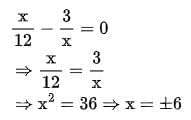
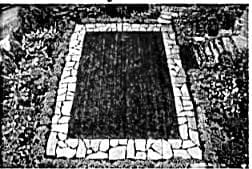
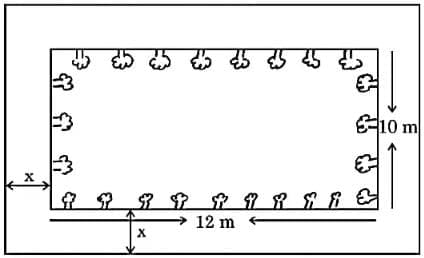 The total area of the lawn and the walkway is 360 square metres. The width of the walkway is same on all sides. The dimensions of the lawn itself are 12 metres by 10 metres. Based on the information given above, answer the following questions: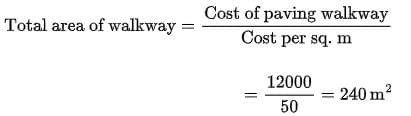
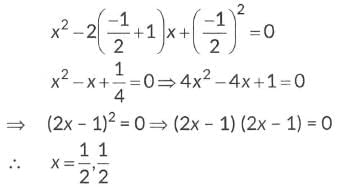


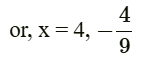
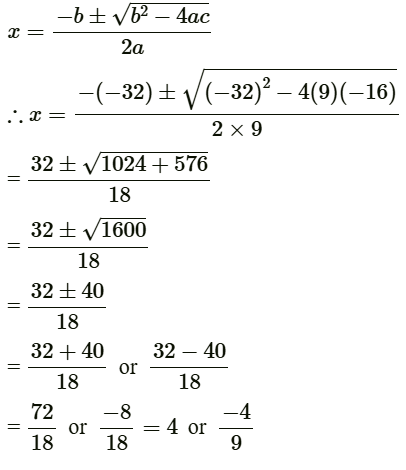

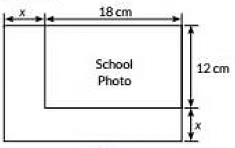 OR
OR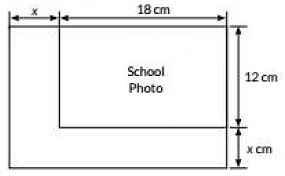
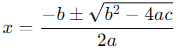
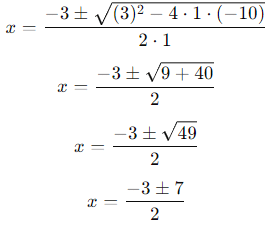
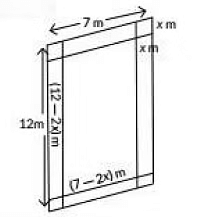
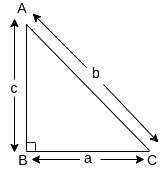

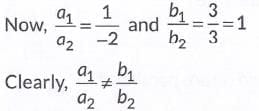
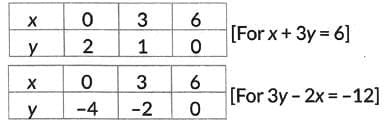
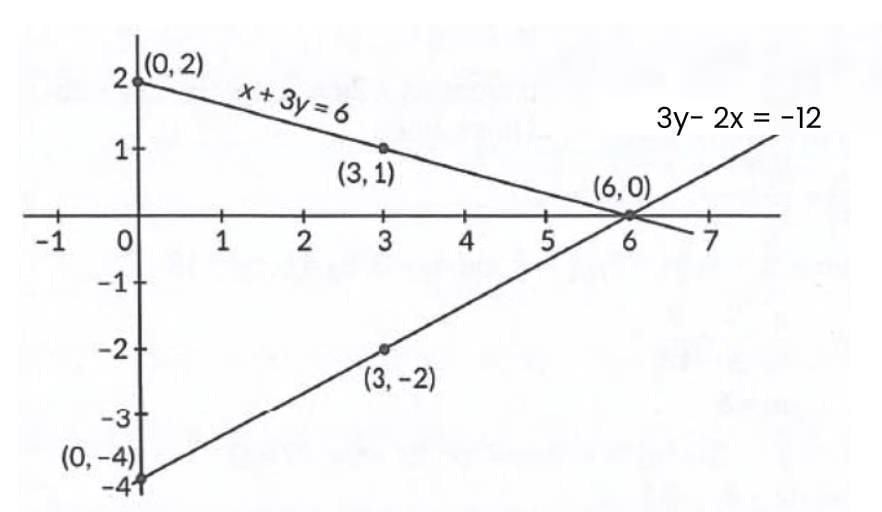 Hence, (6, 0) is the solution of given system of equations.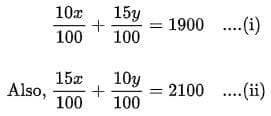


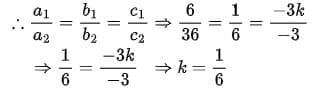
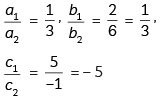
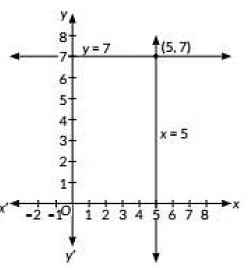
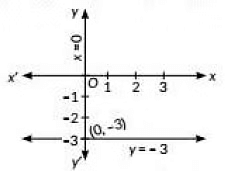


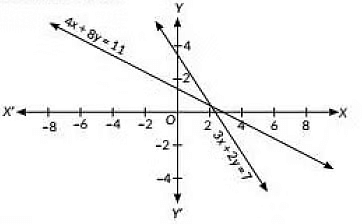
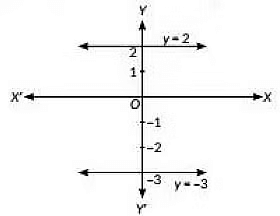

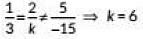
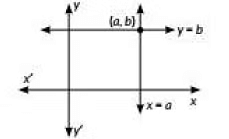

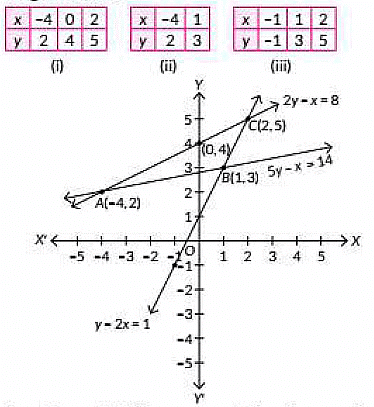


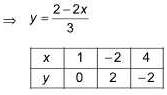
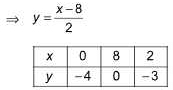
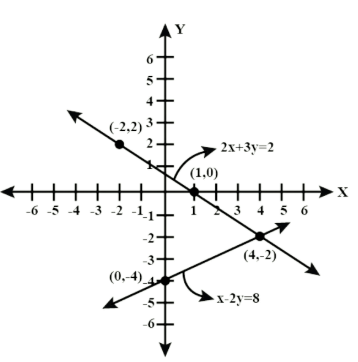
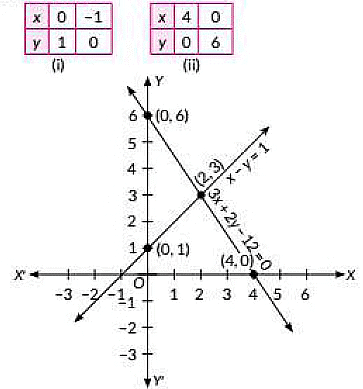

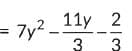



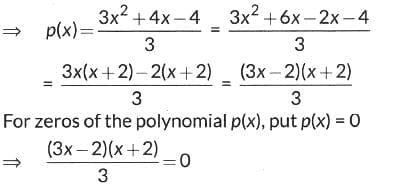
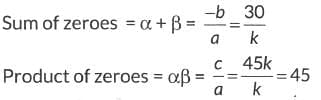

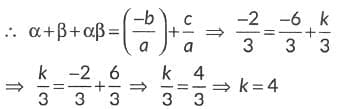
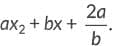
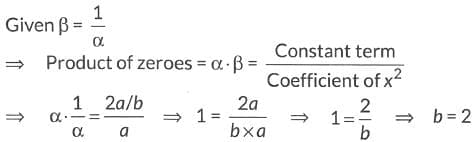

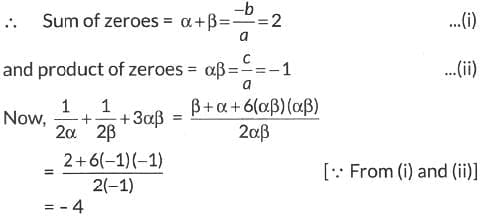
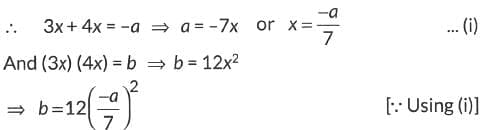

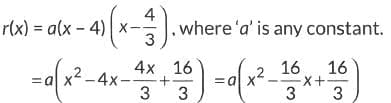
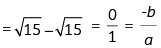
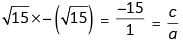
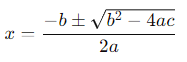



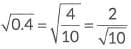
 is an irrational number.
  is an irrational number.
 is an irrational number. 3
 be a rational number.
 where b ≠ 0 and a, b are co-prime integers.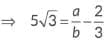
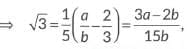 which is a rational number.
 is an irrational number.
 is an irrational number.
 be a rational number.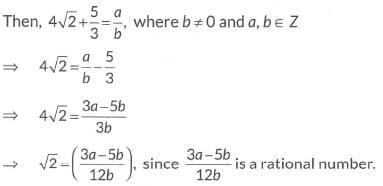
 is an irrational number.
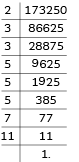
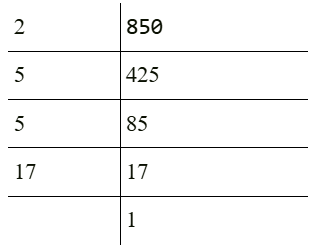
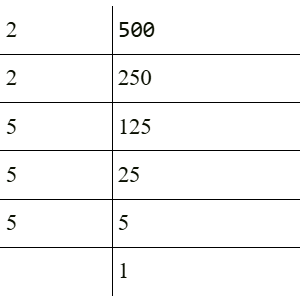
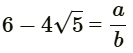 …[b ≠ 0; a and b are integers]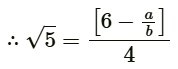
 is a rational number.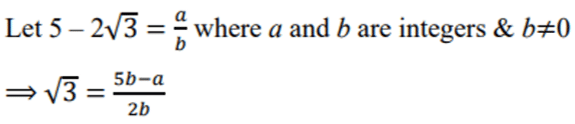
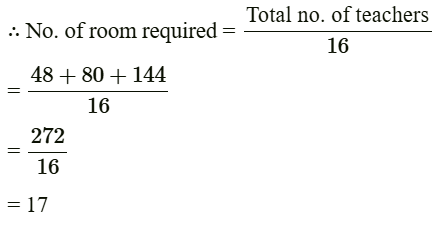

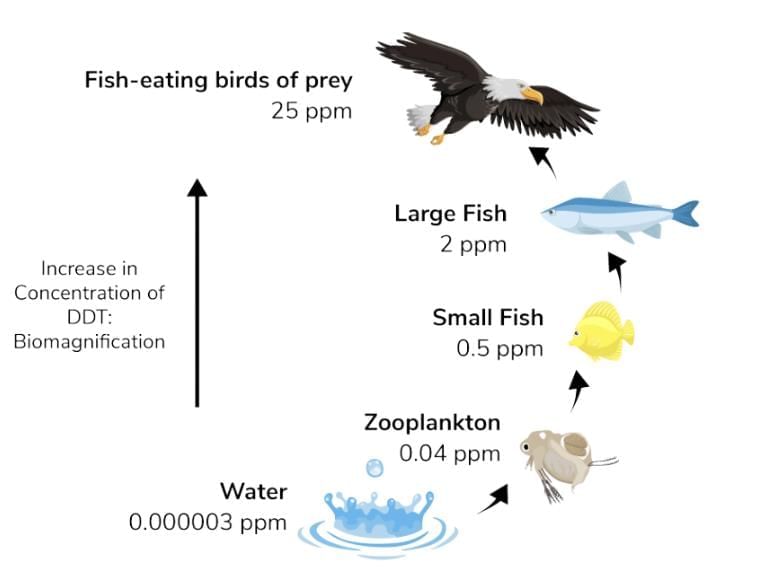
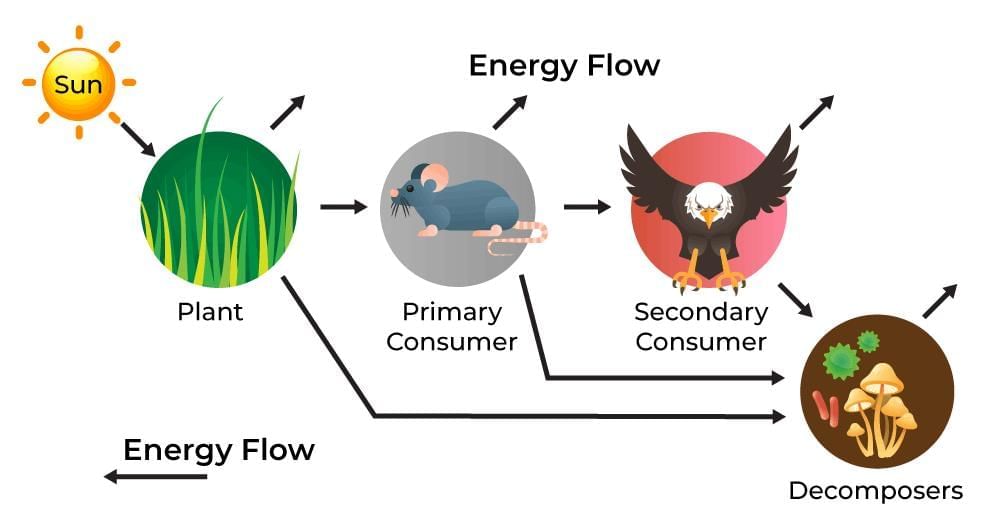
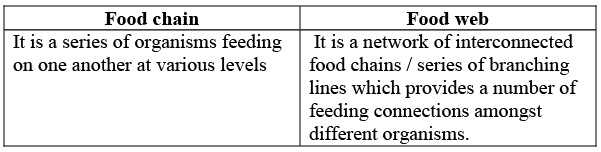
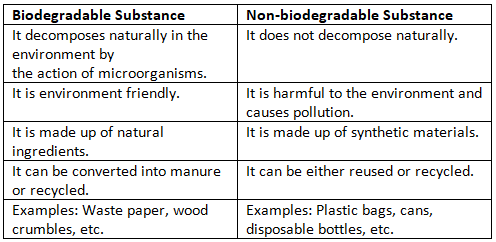
 Biomagnification of DDT in an Aquatic Food Chain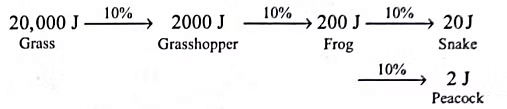
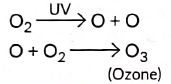
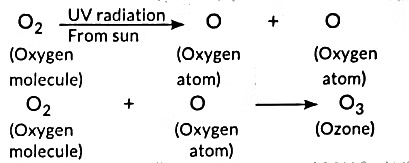
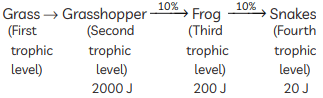
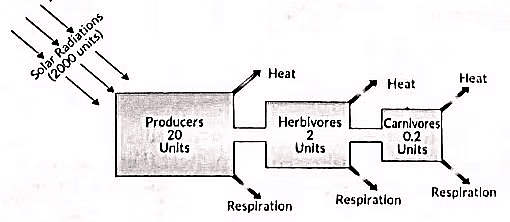
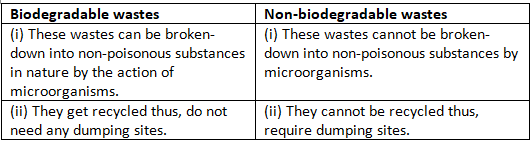
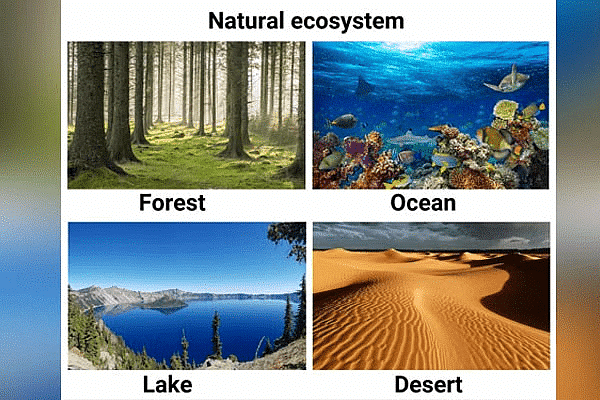 Types of Natural Ecosystem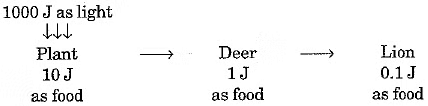
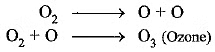
 Hence, B depends on:
 (For a positive charge it would be into the page.)
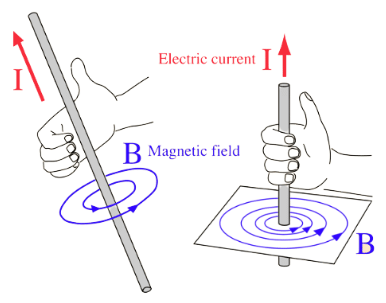
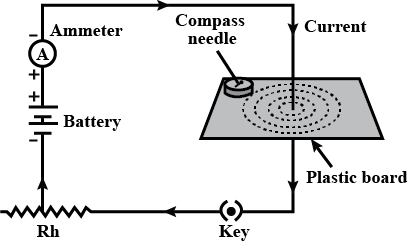 (b) Permanent magnet / Current carrying solenoid/ Electromagnet is used to magnetise a piece of magnetic material.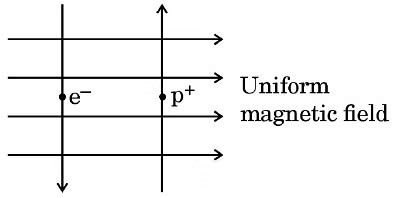
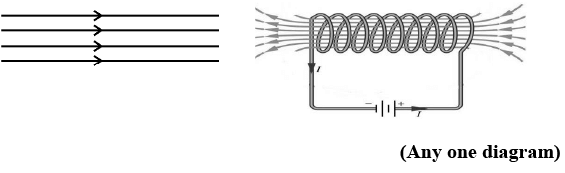
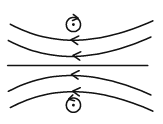
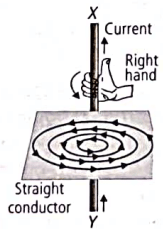
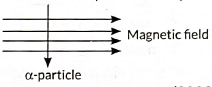
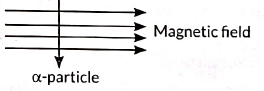
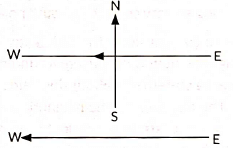
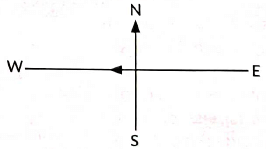
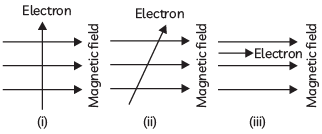
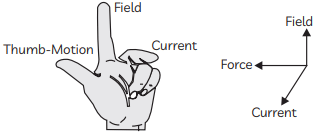
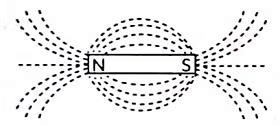
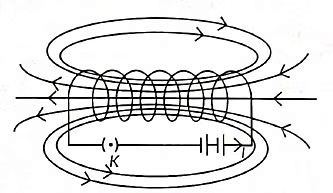
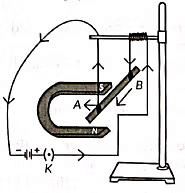
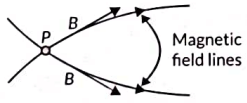
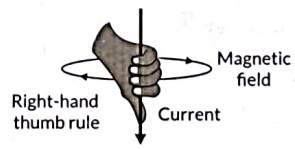
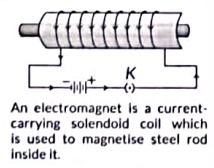

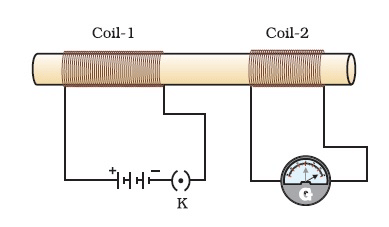
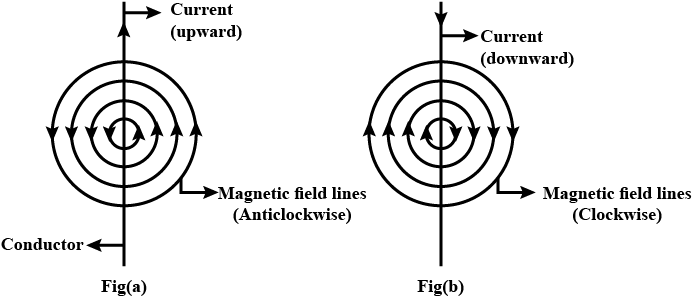
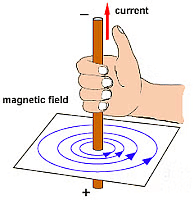
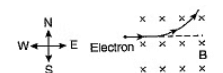
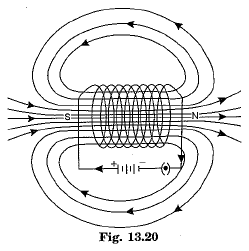
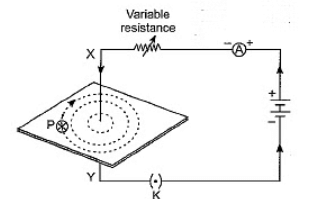

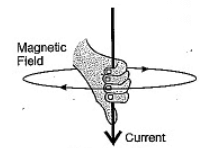
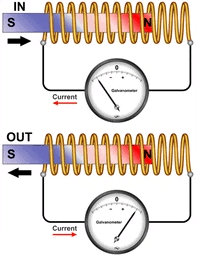
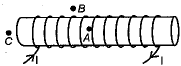
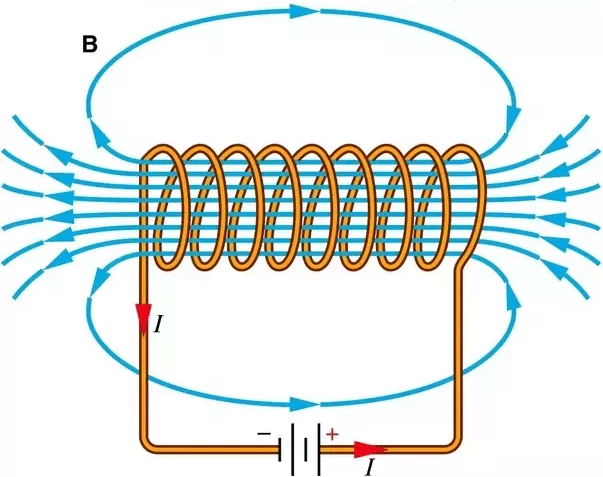

 Hence, the total equivalent resistance becomes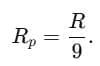
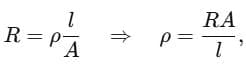
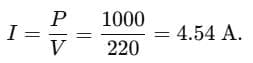


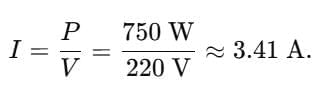

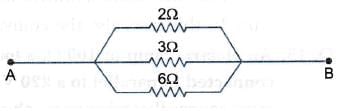
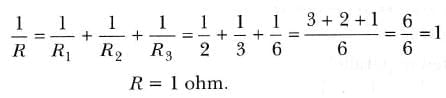


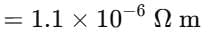
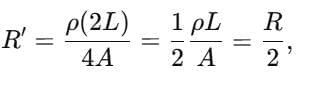
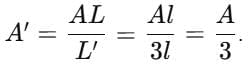

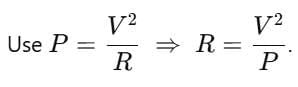
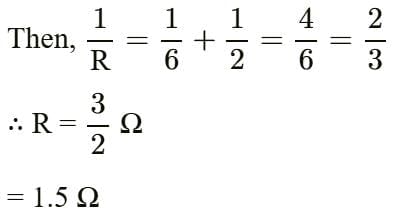






 = 0.04 Ω.
 We can rearrange formula to solve for V:
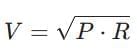 Substitute the values:
 ⇒ The potential difference across the 4 Ω resistor is 20 volts.
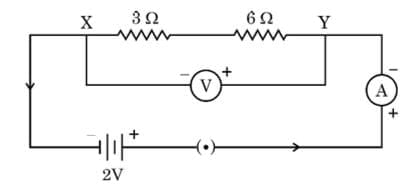 (I) Draw a circuit diagram showing the above two resistors X and Y joined in parallel with the same battery and same ammeter and voltmeter. (1 Mark)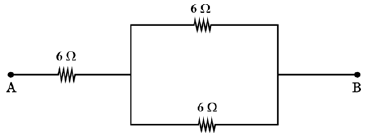

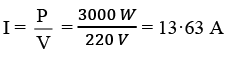
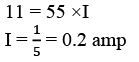
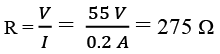

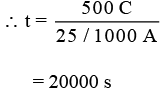
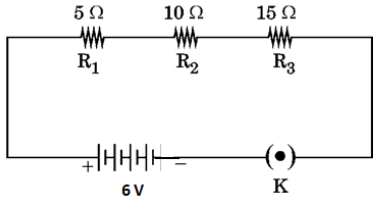
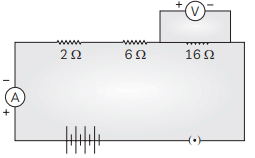
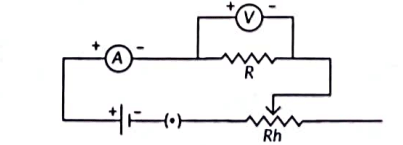
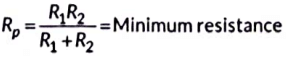

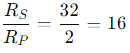

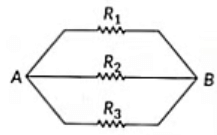
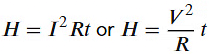
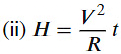


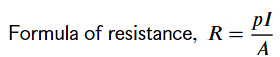

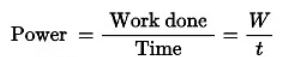
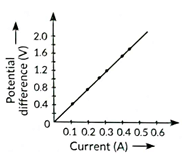
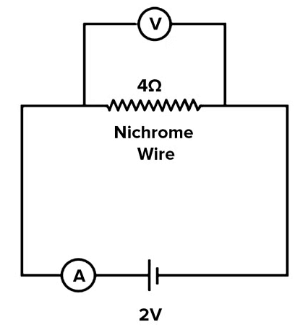
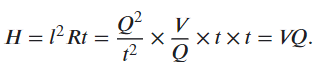

 where:
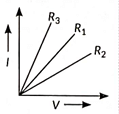 (a) R1 = R2 = R3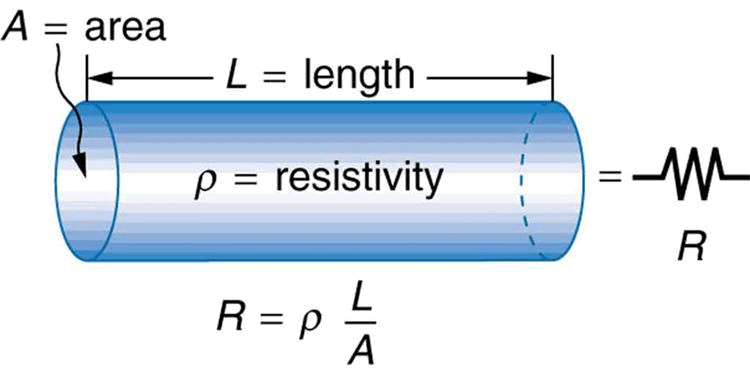

 = Ω-m
= Ω-m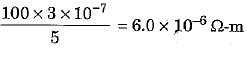

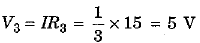
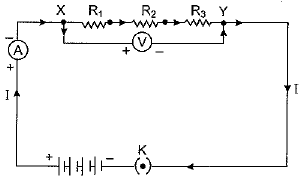

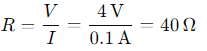
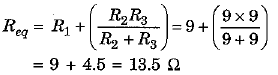
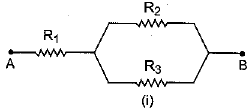
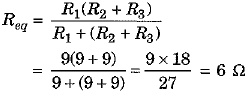
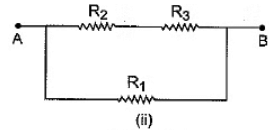
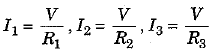
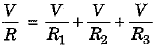
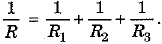

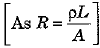 So the current flowing in the circuit increases.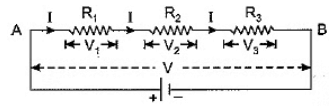

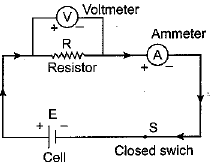

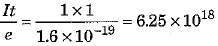
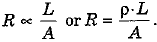
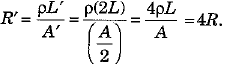

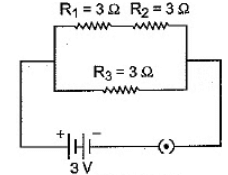
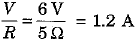
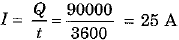

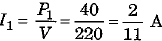


 Therefore, the minimum resistance that can be made using five resistors, each of 1/5Ω, is 1/25Ω.
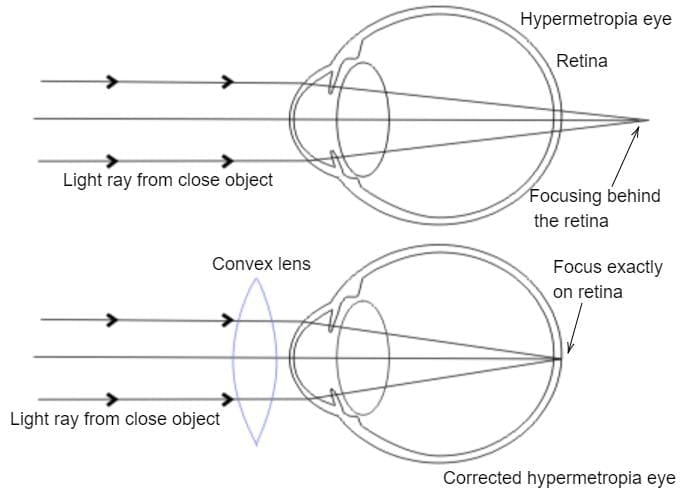 Glasses Type: Convergent (convex lens)
 (in metres).
 Compute step by step: f = 1/- 0.5 = -2.0 meters = -200 cm.
 N = Near point of a hypermetropic eye

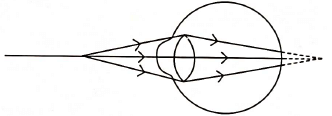
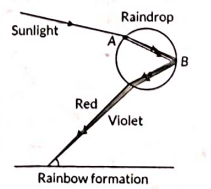
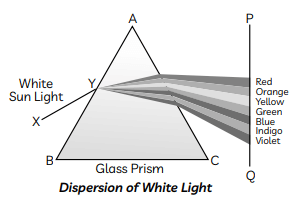

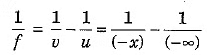 ⇒ f = -x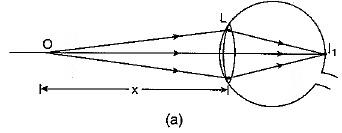
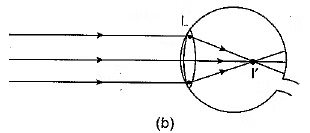
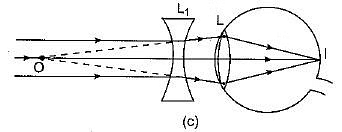
 An important point to be noted here is that a rainbow is always formed in a direction opposite to that of the Sun.
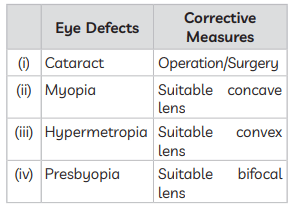
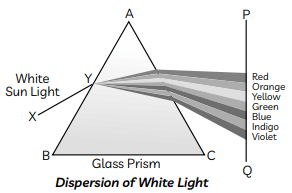
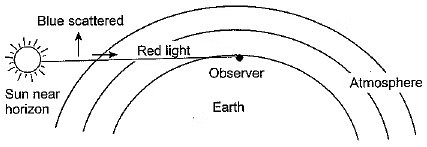
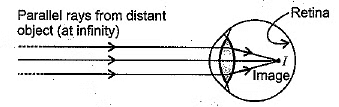
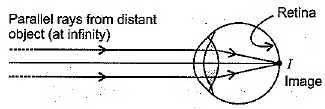
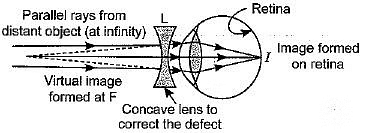
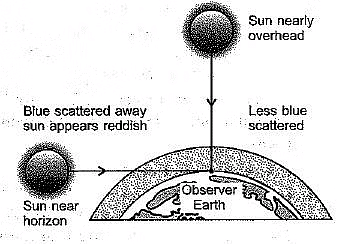
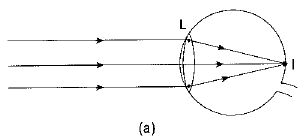
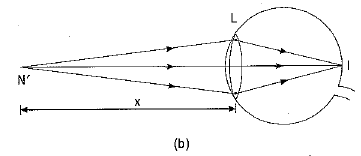
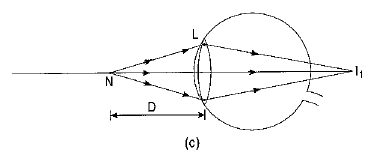
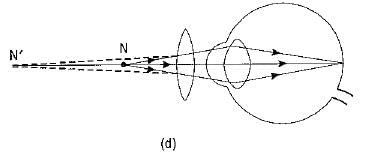
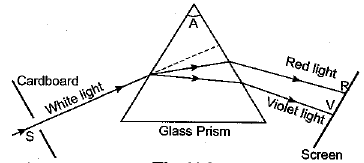 Cause of Dispersion: When a beam of white light enters a glass prism (or any other dispersive medium), the light ray bends towards the normal one entering into the glass. However, different colours of light bend through different angles concerning the incident ray The red light bends the least while the violet light bends the most. So, rays of different colours emerge along different paths and, thus, become distinct. Hence, dispersion is caused and a spectrum is formed.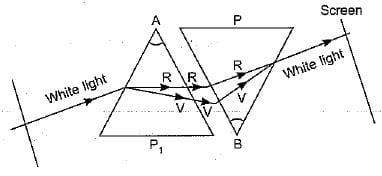

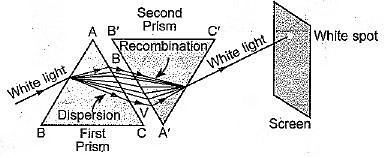 (c) A beam of white light entering the prism ABC undergoes refraction and is dispersed into its constituent seven colours.
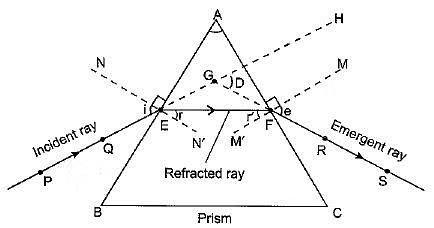 Whenever refraction of light takes place through a prism, the emergent ray bends towards the base of the prism. The angle between the directions of the incident ray and the emergent ray is called the angle of deviation D.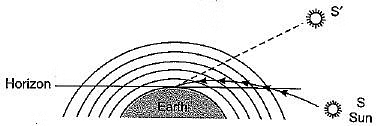
 The fluctuation in the positions of the stars occurs continuously due to the changing amount of light entering the eye. The stars sometimes appear brighter and at some other times, they appear fainter. This causes the twinkling of stars.

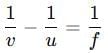
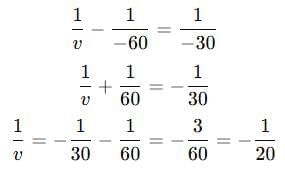
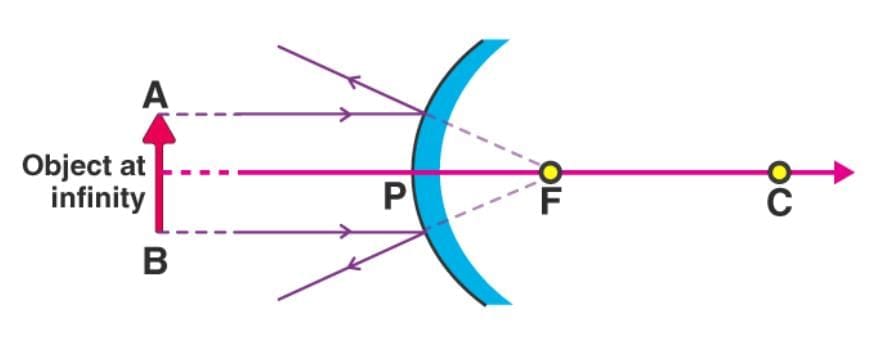
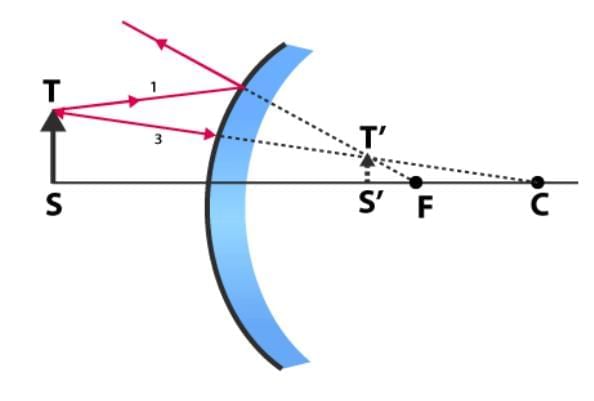

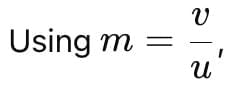



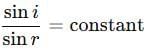 for a given pair of media and light colour. This constant is the refractive index of the second medium with respect to the first (Snell’s law).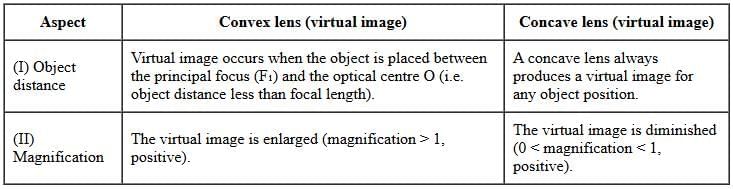
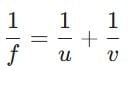
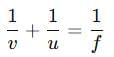 For a concave mirror take u = -10 cm (object to the left) and f = -15 cm. Substitute:
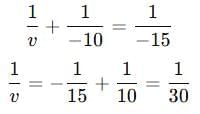 so, v = +30 cm.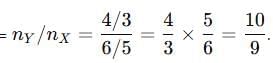
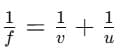 Take u = -30 cm (object to the left) and v = -60 cm (real image in front of mirror, same side as object).
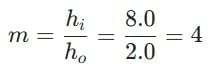 Step 2:
 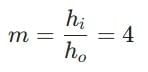 and
and Image distance v =−24 cm indicates image is on the same side as object (virtual image).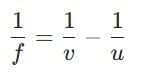
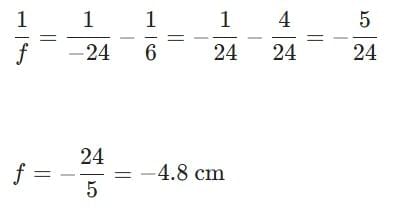

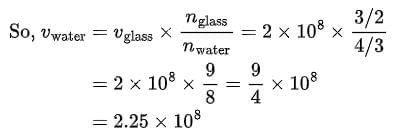
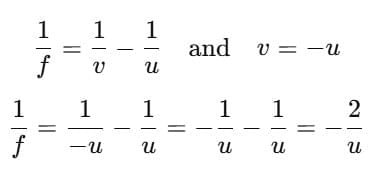
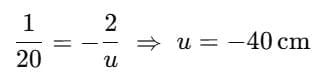 (Sign ‘−’ means the object is placed on the incoming-light side; distance = 40 cm.)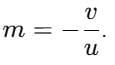
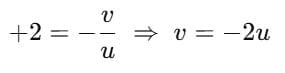 Mirror formula: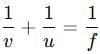
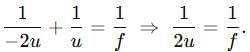
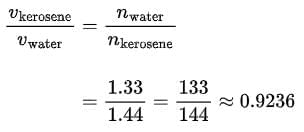


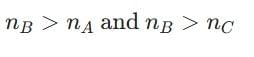 This means that the speed of light in medium B is less than that in A and C:
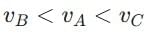

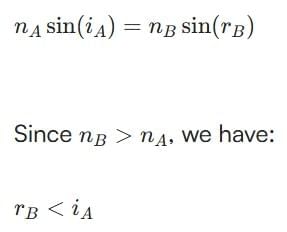
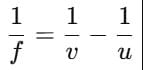
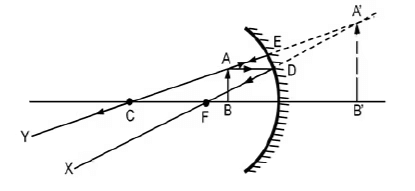
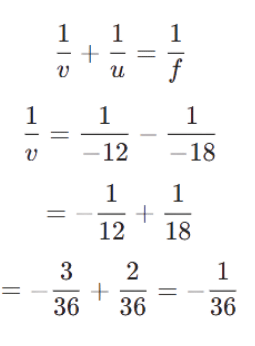 v = -36 cm
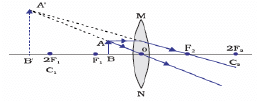
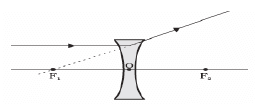
 (2) is directed towards its principal focus
 (ii) Given u = –16 cm, f = + 24 cm, h = 4 cm
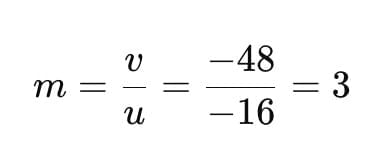

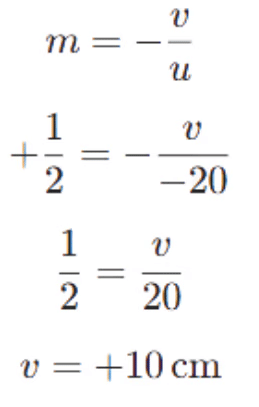 The image is at v=+10cm, virtual and behind the mirror.
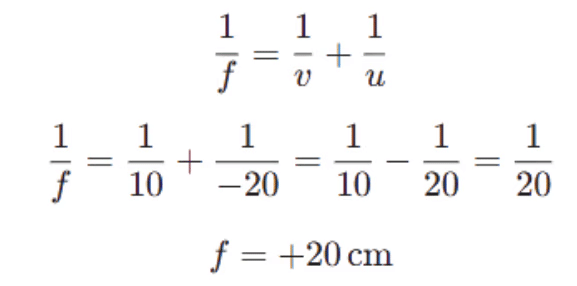 The positive focal length indicates a convex mirror, consistent with the positive magnification.
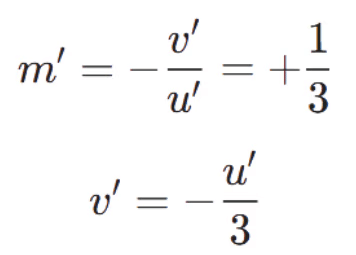 Mirror Formula: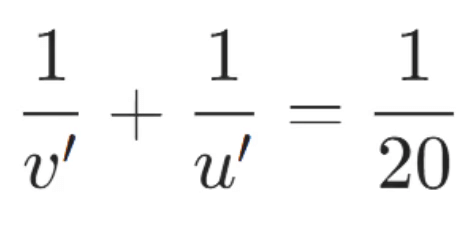
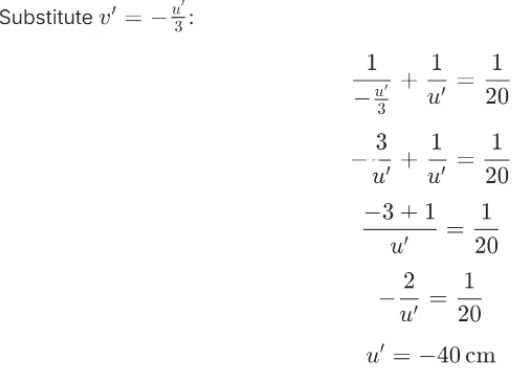 The new object distance is 40 cm from the mirror.
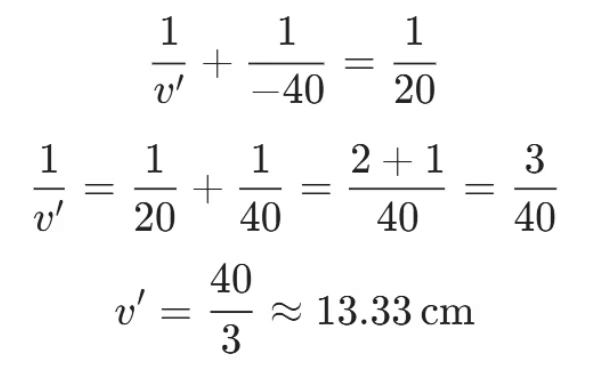 Magnification:
 The magnification is +1/3, as required.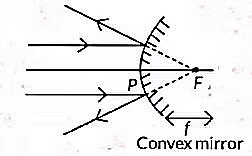
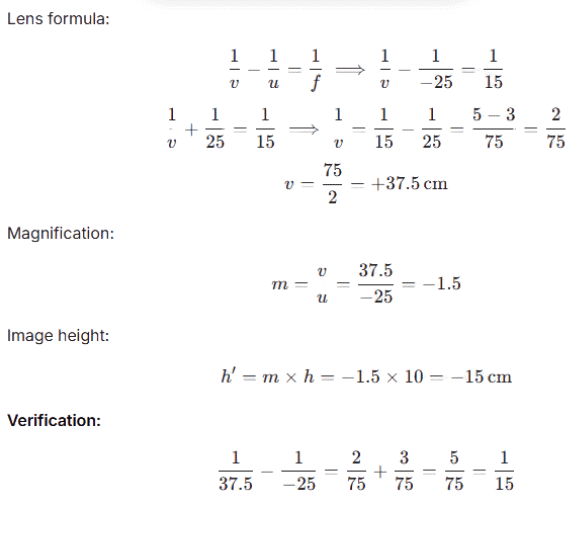
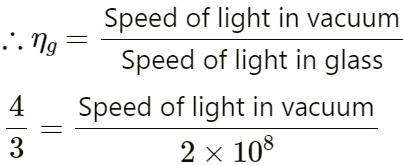

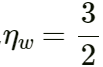
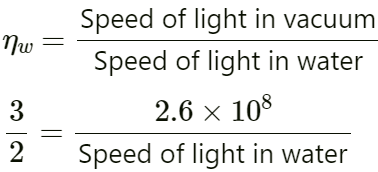
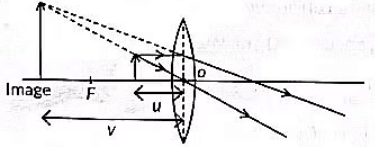
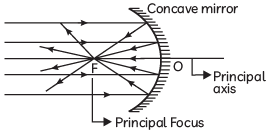
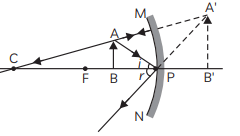
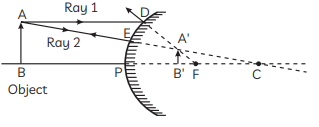 (B) The image of object obtained in the convex mirror is erect and diminished. This is because a convex mirror always forms a virtual, erect and diminished image of an object.
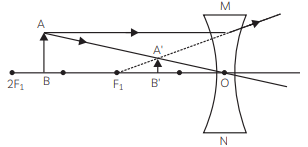
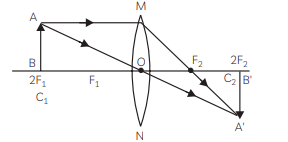 The image formed is real, inverted and of the same size.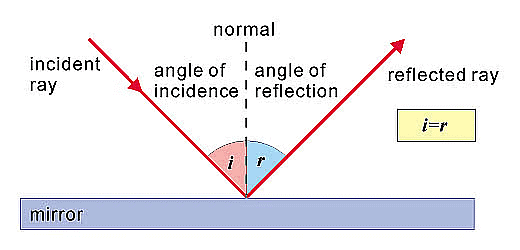
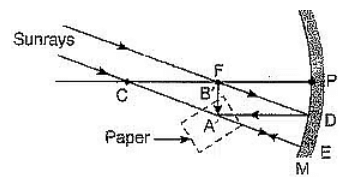

 So, the object is placed at u=−25.
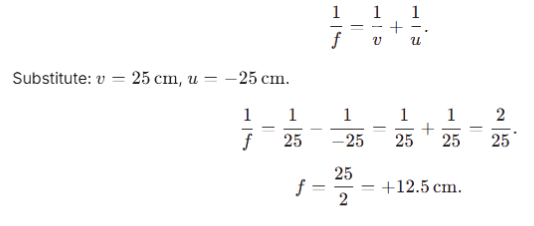 The positive focal length indicates the lens is convex with a focal length of 12.5 cm.
 The negative sign indicates the image is formed on the same side as the object.Negative v′ means a virtual image on the object side.Object position: u=−25 cm (25 cm in front of lens).Focal length: f=+12.5 cm, convex lens.New image position: v′=−50 cm (50 cm on same side as object).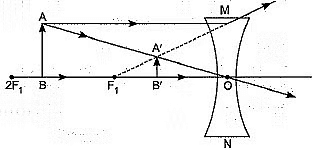

 (c) The four characteristics of the image formed by the convex mirror are virtual, erect, diminished and laterally inverted.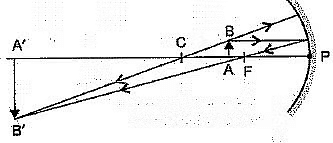
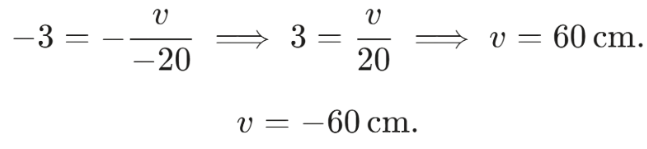

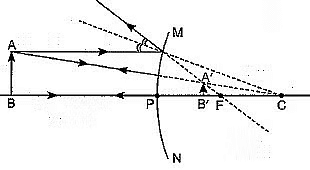
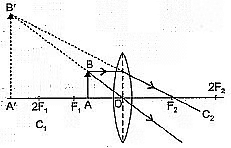
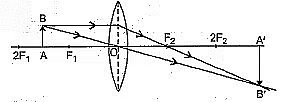
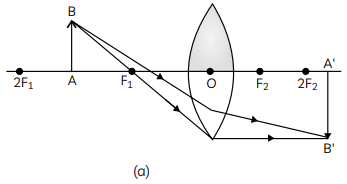
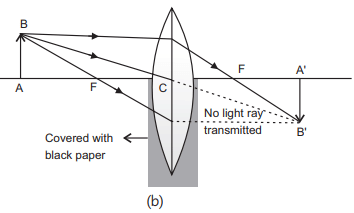
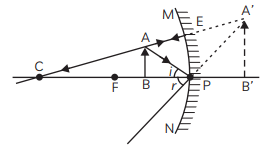
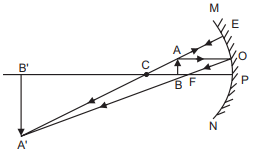
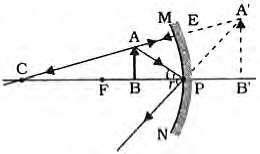
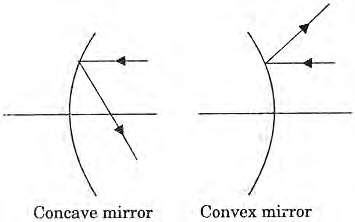
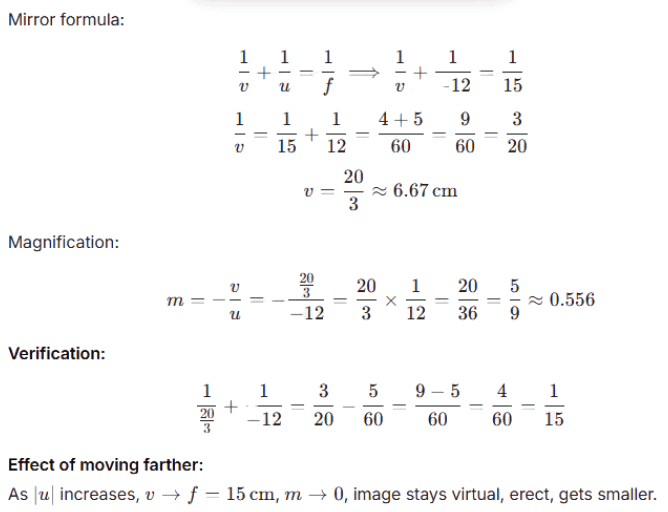
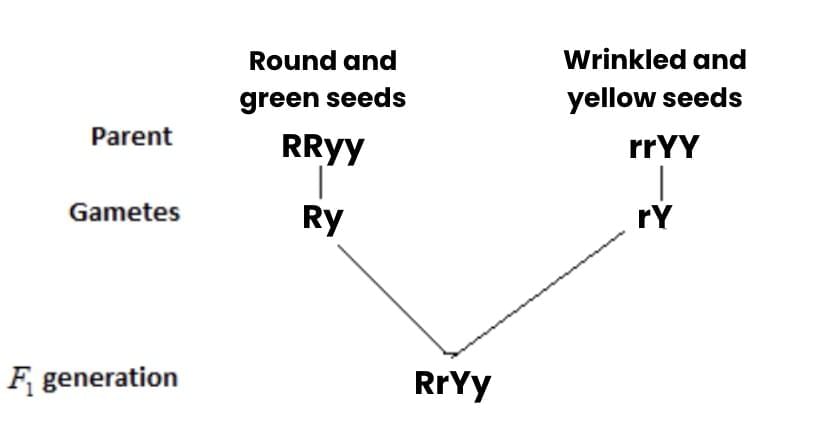 Hence, when RRyy (round, green) is crossed with rrYY (wrinkled, yellow), all F₁ offspring have the genotype RrYy, expressing the dominant traits — round and yellow seeds.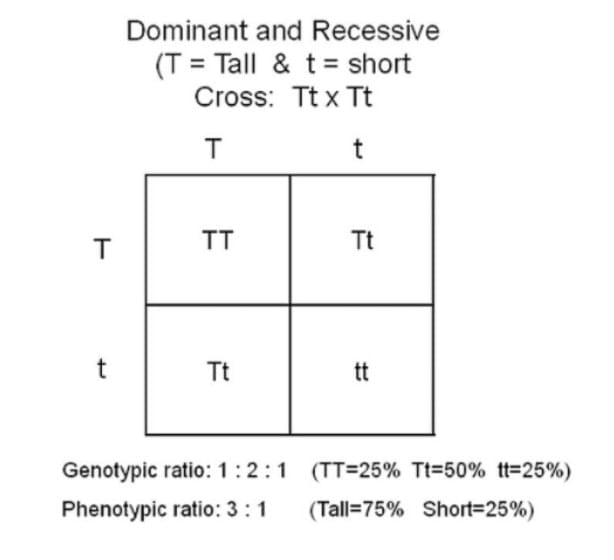
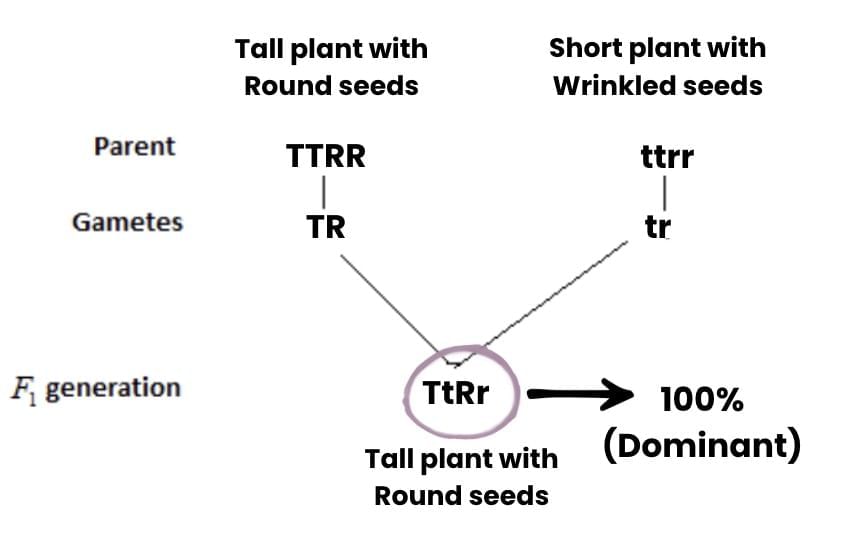
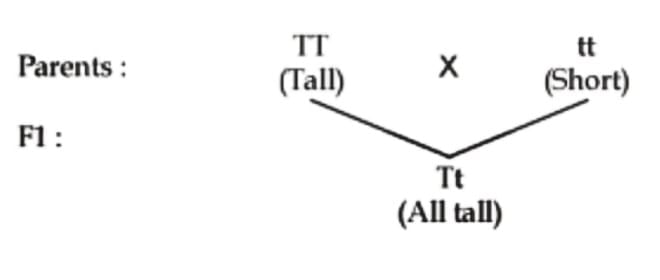 When TT is crossed with tt, all offspring have the genotype Tt, which expresses the dominant tall trait.
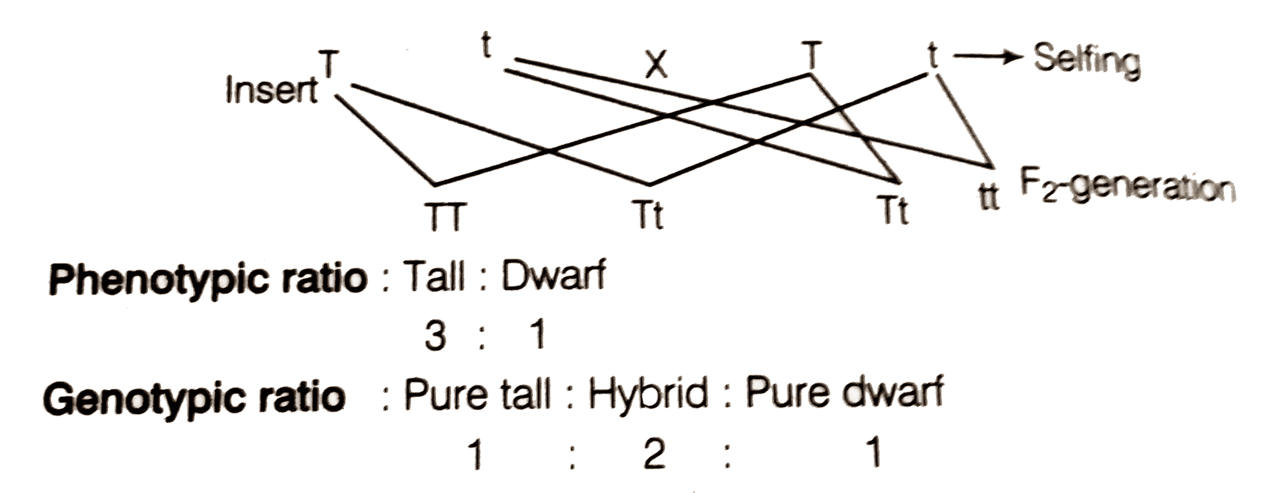 1 TT : 2 Tt : 1 tt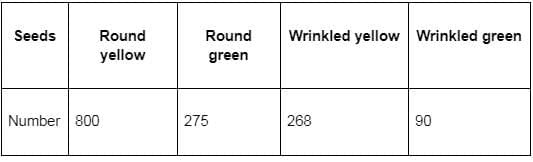
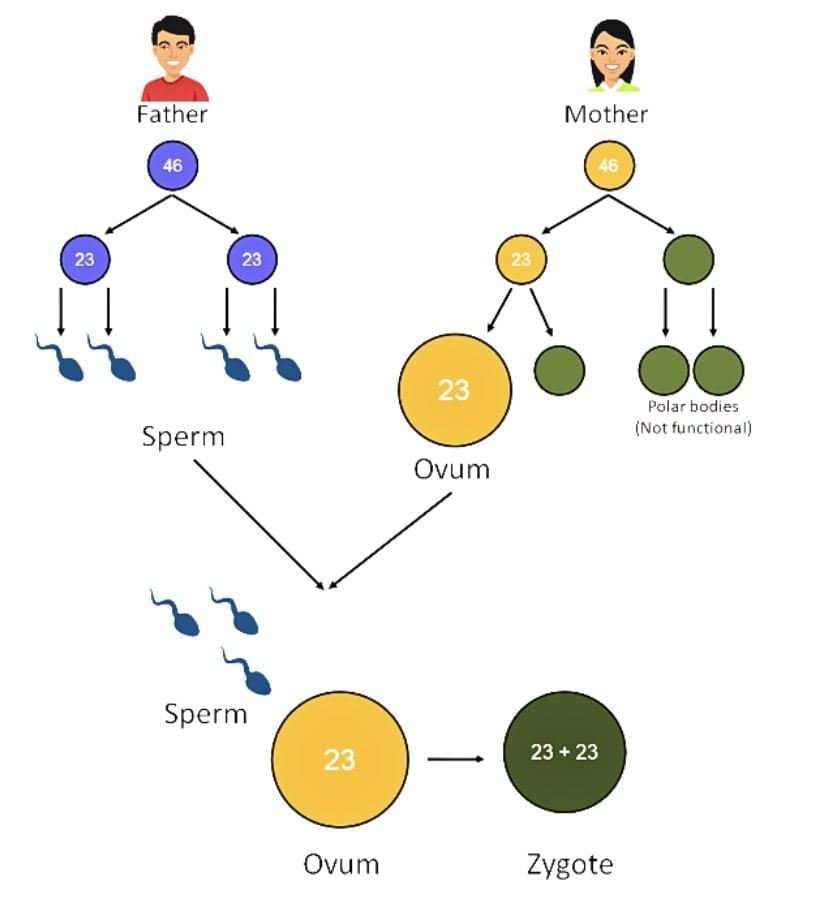 During fertilisation, the male and female gametes fuse to form a zygote, restoring the diploid number of chromosomes. This ensures the stability of DNA content and the chromosome number in each new generation.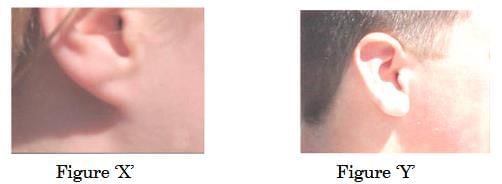
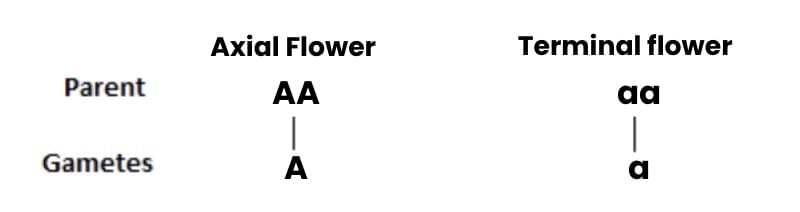
 (b) On self-pollinating the F₁ plants (RrYy × RrYy), the F₂ generation shows four possible trait combinations of seeds in the ratio 9 : 3 : 3 : 1 —
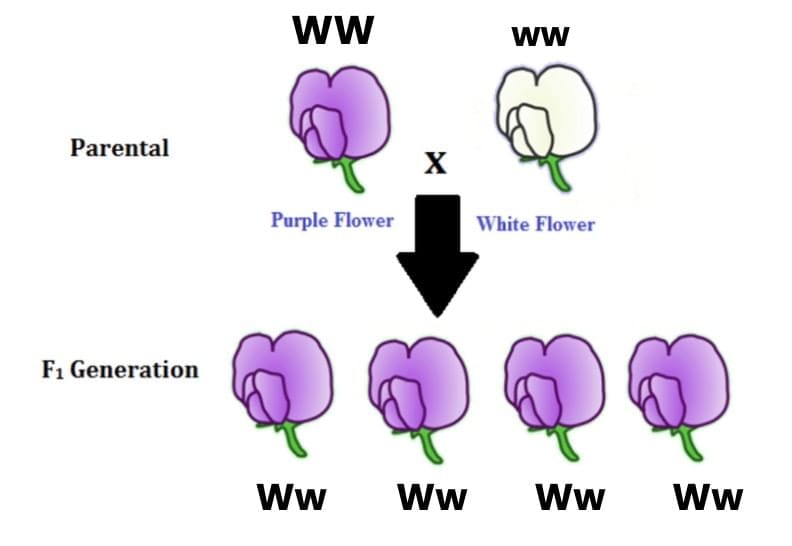
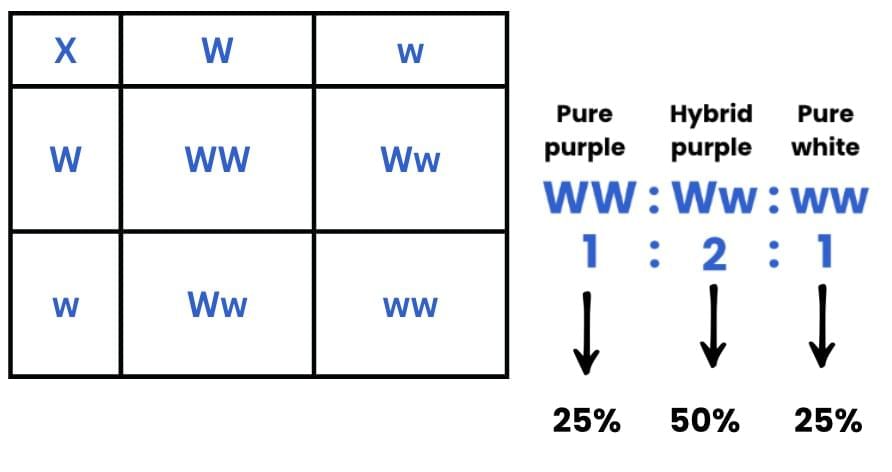
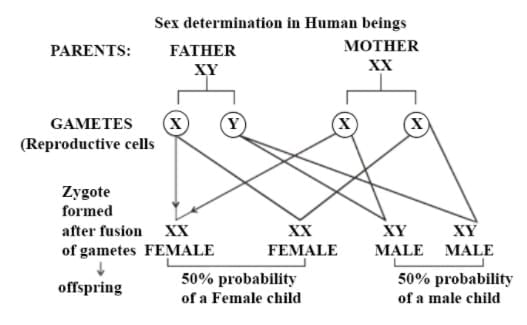
 (iii) (A) Self-pollination / Self-fertilisation / Selfing of F1 plants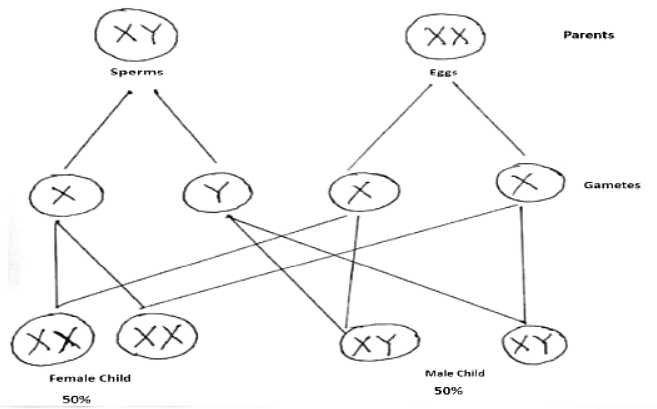
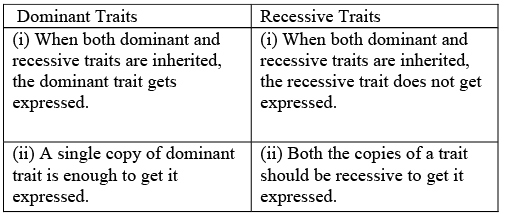 75% yellow seeds
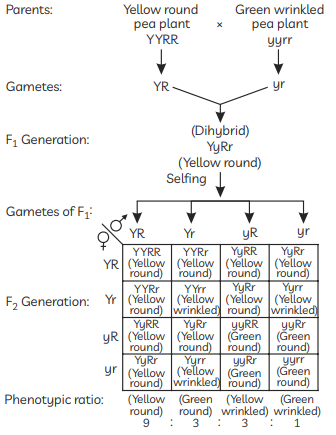 OR
OR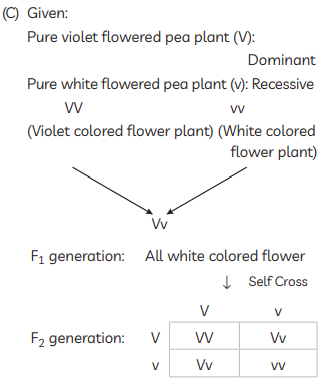
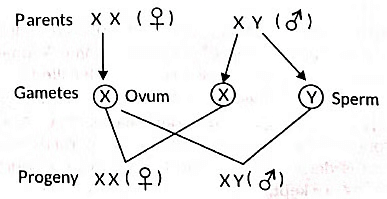
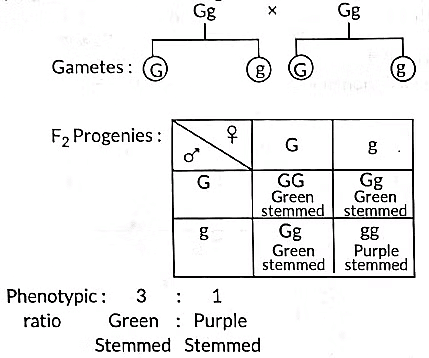
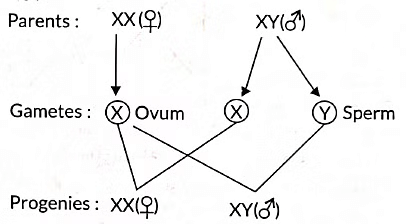
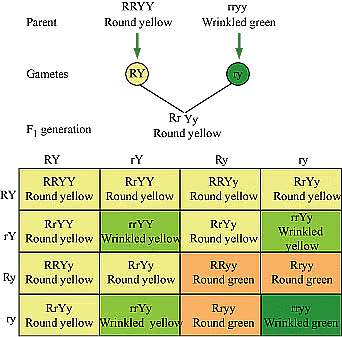
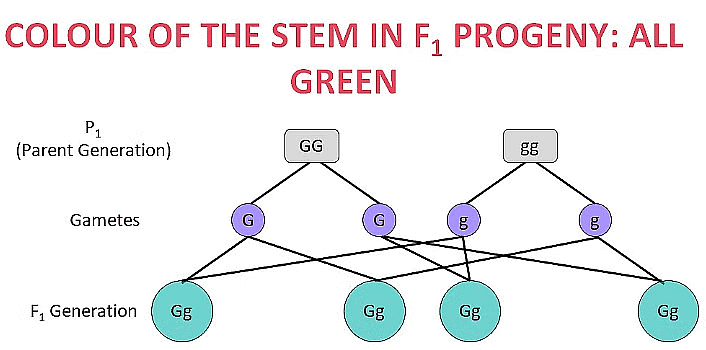
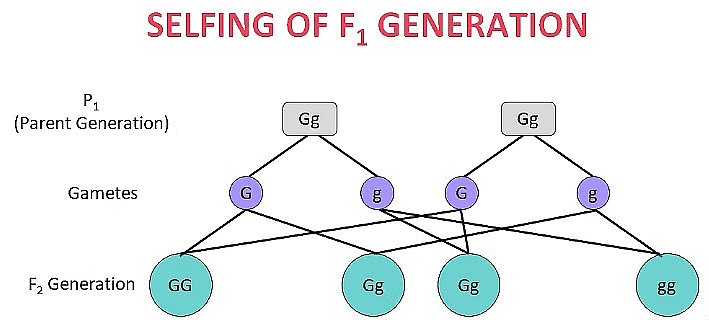
 So, the plants of F1 generation will be all tall plants and after self pollinating the ratio of tall and dwarf plants that Mendel obtained in F2 generation plants is 3 : 1.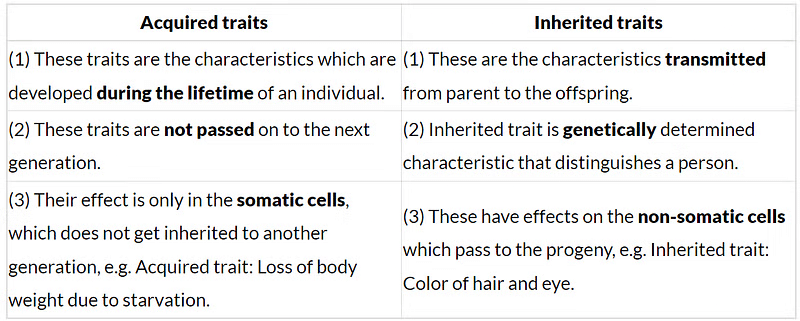
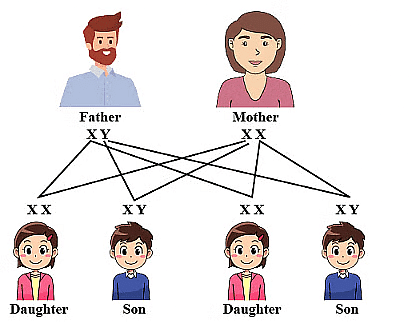
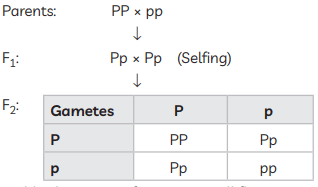
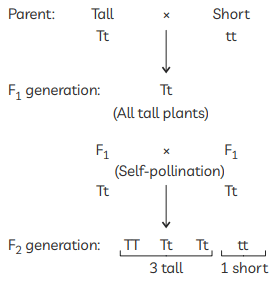
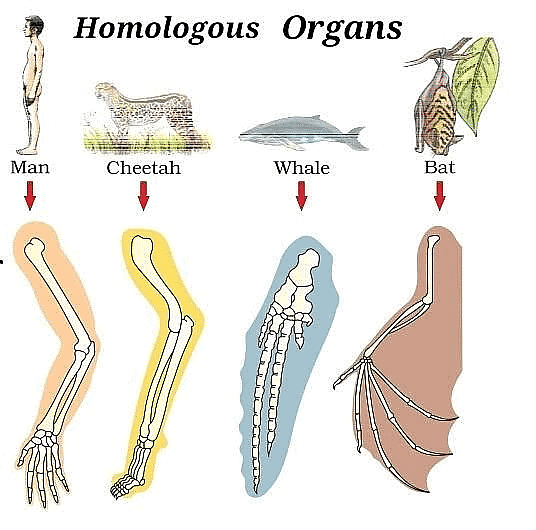
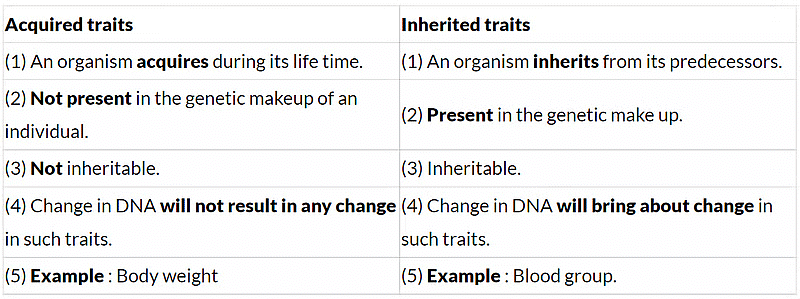
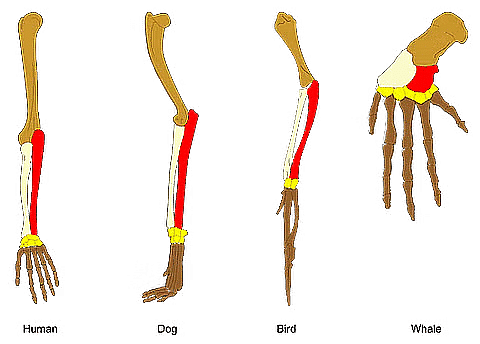 Skeleton of forelimbs of (a) Human (b) Dog (c) Bird (d) Whale showing homologous features.
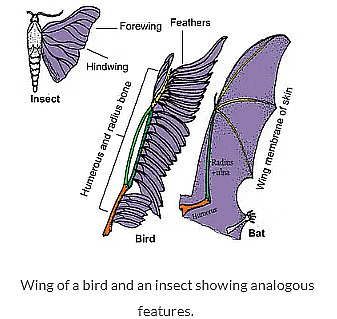 (ii) Analogous organs: Such organs which perform similar functions but are structurally different are called analogous organs. For example, wings of a bird and wing of an insect. Presence of such organs show that these organisms have different origin.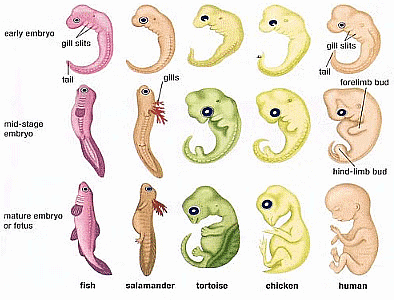

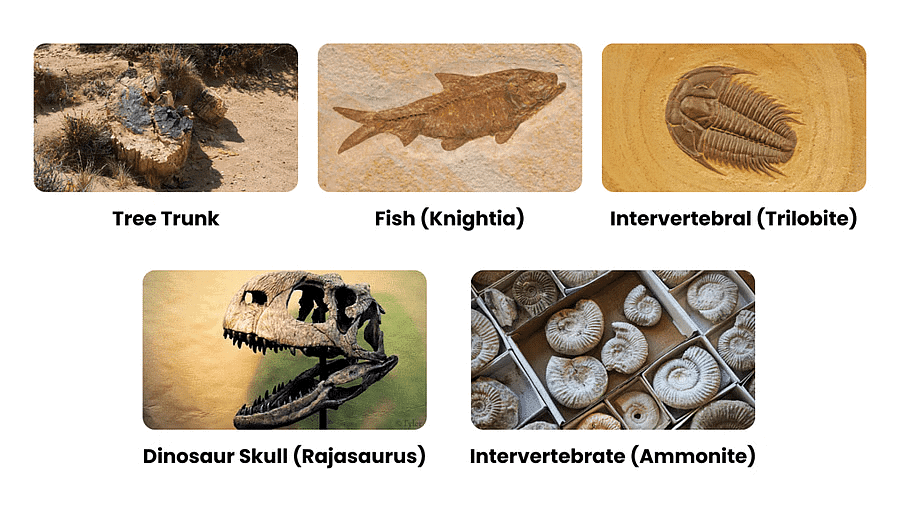
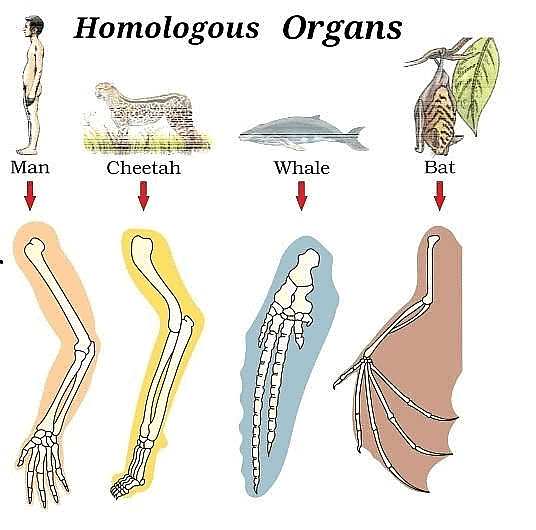
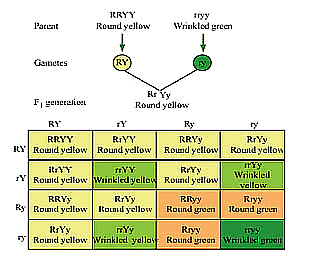 Independent inheritance of two separate traits, shape and colour of seeds(i) Traits may be dominant or recessive: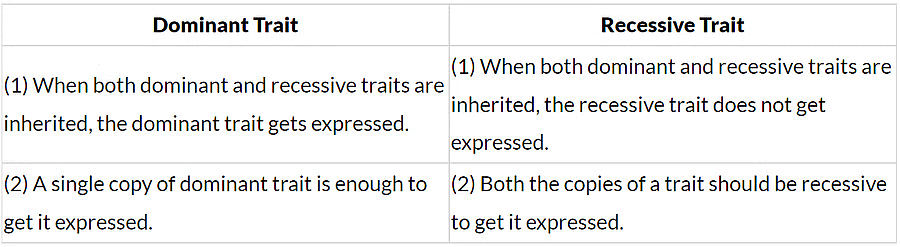
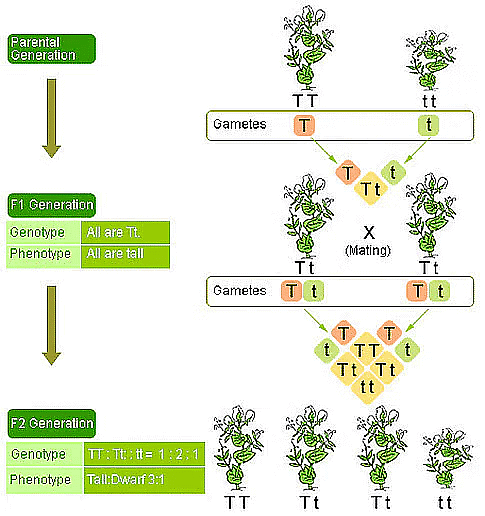 Hence, genotype Tt with a recessive gene is expressed as phenotype of Tall. This shows that only dominant gene is expressed as the trait (T) while ‘t’ is not expressed.
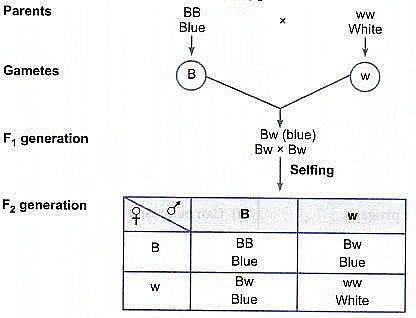 (a) All flowers in F1 progeny will be blue in colour.