Previous Year Questions 2025
Q1: The correct/true statement(s) for a bisexual flower is/are: (1 Mark)
(i) They possess both stamen and pistil.
(ii) They possess either stamen or pistil.
(iii) They exhibit either self-pollination or cross-pollination.
(iv) They cannot produce fruits on their own.
(a) (i) only
(b) (iv) only
(c) (i) and (iii)
(d) (i) and (iv)
Ans: (c)
A bisexual flower contains both stamen (male part) and pistil (female part), allowing it to undergo self-pollination or cross-pollination. This is clearly mentioned in the chapter where examples like Hibiscus and mustard are given.
Q2: (a) (i) Write the functions of the following parts of human female reproductive system: (5 Marks)
(I) Ovary,
(II) Fallopian tube,
(III) Uterus.
(ii) State briefly two contraceptive methods used by human males.
OR
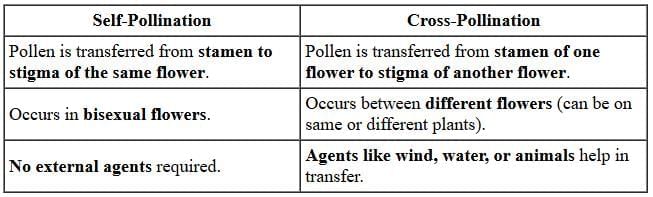
(b) (i) Differentiate between self-pollination and cross-pollination.
(ii) Identify A, B, and C in the diagram given below and write one function of each.
Ans (a):
(i) Functions of the parts of human female reproductive system:
(I) Ovary:
- The ovary produces female germ-cells or eggs (ova).
- It also secretes female hormone estrogen that regulate the reproductive cycle.
(II) Fallopian tube (Oviduct):
- It carries the egg from the ovary to the uterus.
- It is the site of fertilisation, where the male sperm meets the female egg.
(III) Uterus:
- The uterus is the site where the embryo gets implanted after fertilisation.
- It provides nourishment and protection to the developing embryo or foetus until birth.
(ii) Two contraceptive methods used by human males:1. Use of condoms:
- Acts as a mechanical barrier preventing sperm from entering the female body.
- Also helps reduce the risk of sexually transmitted diseases (STDs).
2. Surgical method (Vasectomy):
- The vas deferens is blocked to prevent sperm from mixing with semen.
- Thus, fertilisation cannot occur.
Ans (b):
(i) Difference between Self-Pollination and Cross-Pollination:
(ii) Parts and Functions (Flower Diagram):
A. Stigma: Receives pollen grains during pollination.
B. Pollen tube: Carries male gametes from the pollen grain to the ovule.
C. Female germ-cell / Egg cell: Fuses with the male gamete to form a zygote.
Q3: Bryophyllum produces new plant through: (1 Mark)
(a) Apical buds formed on the tip of the plant
(b) Vegetative buds produced in the notches of the leaf
(c) Flowers produced in the notches of the branches
(d) Fruits formed on the branches of the plant
Ans: (b)
In Bryophyllum, small buds develop in the notches along the leaf margins.
When these buds fall on the soil, they grow into new plants.
This is a form of vegetative propagation, an example of asexual reproduction in plants.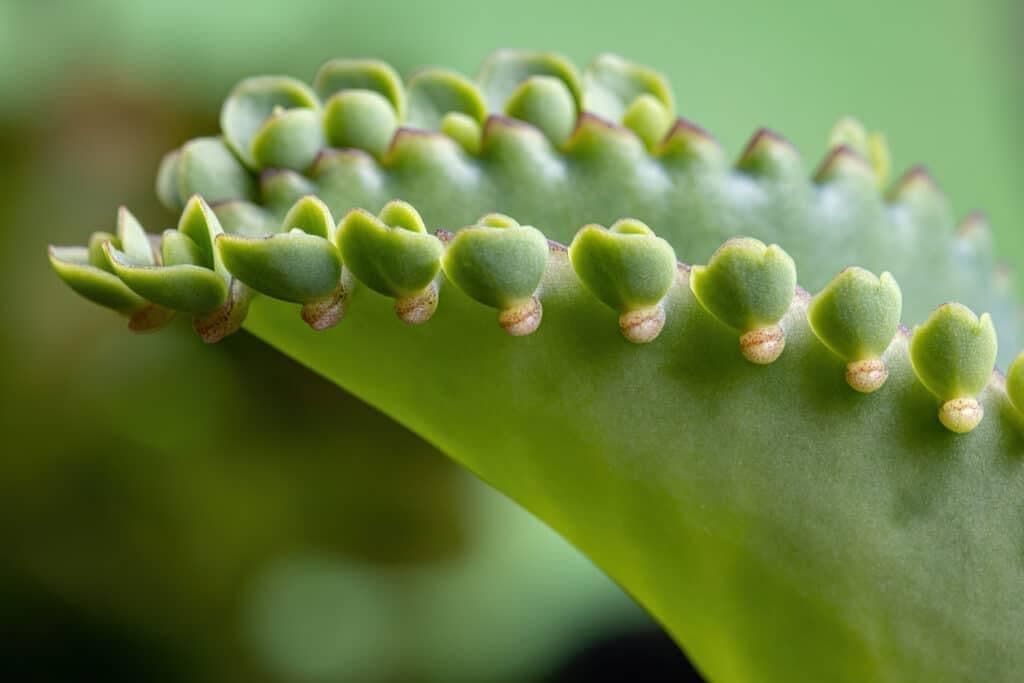
Q4: The number of chromosomes in a cell division is halved. This kind of cell division is observed in: (1 Mark)
(a) Only testis
(b) Only ovary
(c) Ovary and testis both
(d) All cells of the body
Ans: (c)
The halving of chromosomes occurs during the formation of germ-cells (gametes) — sperm in males and eggs in females.
This special type of cell division takes place in the testes and ovaries.
Q5: Which one of the following statements is not correct for the plants raised by vegetative propagation? (1 Mark)
(a) Can bear flowers and fruits earlier than those produced from seeds.
(b) Those plants that have lost the capacity to produce seeds can be grown.
(c) As compared to the parent plant, vegetatively propagated plants show more variations.
(d) All the plants produced in this way are genetically similar to the parent plant.
Ans: (c)
Plants produced by vegetative propagation are genetically similar to the parent plant and show no variation.
Hence, statement (c) is incorrect.
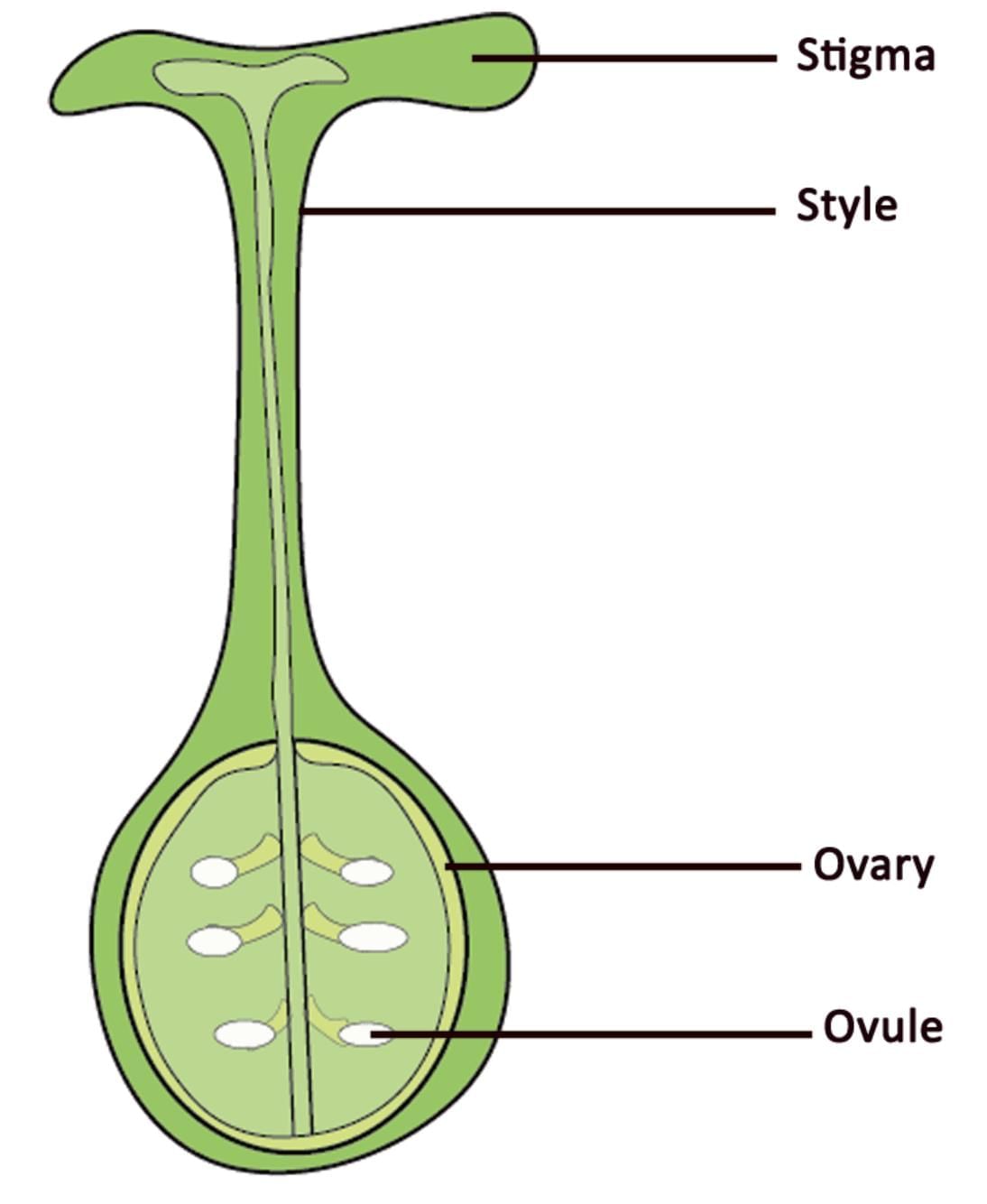
Q6: Which of the following is the correct sequence of parts of female reproductive system of flowering plants in terms of their placement? (1 Mark)
(a) Stigma, ovule, ovary, style
(b) Ovule, stigma, ovary, style
(c) Style, stigma, ovule, ovary
(d) Stigma, style, ovary, ovule
Ans: (d)
In the female reproductive part (pistil) of a flower:
- The stigma is the top sticky part that receives pollen.
- The style is the elongated tube below the stigma.
- The ovary is the swollen base.
- Inside the ovary are the ovules, each containing an egg cell.
Q7: When a girl is born, the ovaries already contain thousands of immature eggs. On reaching puberty, some of these start maturing. One matured egg is released every month by one of the ovaries. The two oviducts unite into an elastic bag-like structure known as uterus.
(a) Write the site of fertilization in human female. (1 Mark)
(b) How does the uterus prepare itself to receive and nurture the growing embryo? Explain. (1 Mark)
(c) (i) What happens when the egg is not fertilized? (2 Marks)
OR
(c) (ii) How does the developing embryo get nutrition from the mother’s blood? Explain. (2 Marks)
Ans:
(a) The site of fertilisation in the human female is the oviduct or fallopian tube.
It is here that the male sperm meets the female egg to form the zygote.
(b) The uterus prepares itself by thickening its lining and becoming richly supplied with blood to nourish the growing embryo after implantation.
(c) (i) When the egg is not fertilised:
- The unfertilised egg lives for about one day.
- The thickened lining of the uterus breaks down and comes out through the vagina as blood and mucus.
- This process is called menstruation, which lasts for about two to eight days.
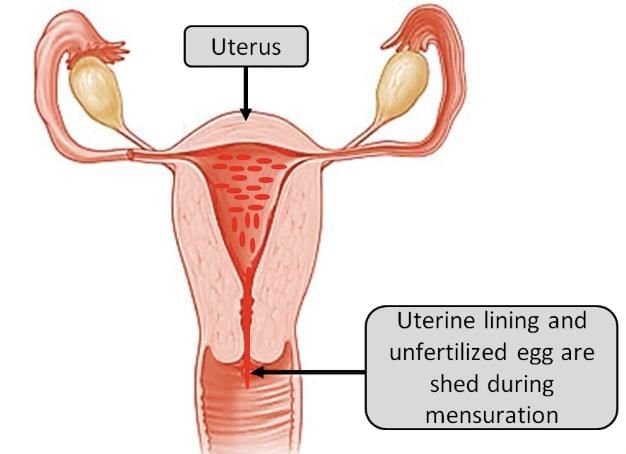
OR
(c) (ii) Nutrition of the developing embryo:
- The embryo receives nutrition through a special tissue called the placenta.
- The placenta is embedded in the uterine wall and has villi on the embryo’s side and blood spaces on the mother’s side.
- This arrangement provides a large surface area for glucose and oxygen to pass from the mother to the embryo and for wastes to be removed into the mother’s blood.
Q8: Match Column-I with Column-II and select the correct option from the choices provided. (1 Mark)
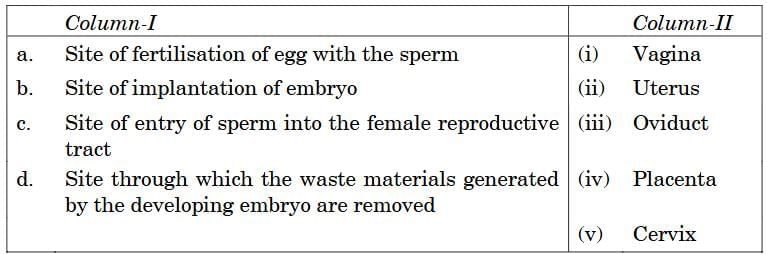
Ans:
The correct matching is a-(iii), b-(ii), c-(i), d-(iv).
- Fertilisation occurs in the oviduct (fallopian tube).
- The embryo implants in the uterus.
- sperm enter through the vagina.
- The placenta removes waste from the embryo’s blood into the mother’s blood.
Q9: Plants like rose and banana have lost the capacity to produce: (1 Mark)
(a) Flowers
(b) Buds
(c) Seeds
(d) Fruits
Ans: (c)
Plants such as rose and banana have lost the capacity to produce seeds.
They are grown by vegetative propagation, where new plants arise from stems, roots, or leaves instead of seeds.
Q10: In a bisexual flower the male gametes are present in the: (1 Mark)
(a) Anther
(b) Ovary
(c) Stigma
(d) Filament
Ans: (a)
In a bisexual flower, the stamen is the male reproductive part.
Its anther produces pollen grains, which contain the male gametes.
Q11: The modes of reproduction in Spirogyra and Planaria respectively are: (1 Mark)
(a) Regeneration and budding
(b) Regeneration and fragmentation
(c) Fragmentation and regeneration
(d) Budding and regeneration
Ans: (c)
- Spirogyra reproduces by fragmentation, where the filament breaks into pieces, and each piece grows into a new individual.
- Planaria reproduces by regeneration, where each cut piece of the body develops into a complete organism.
Q12: Select the option having correct matching of the organism given in Column I with the mode of reproduction in Column II: (1 Mark)
(a) P-4, Q-2, R-1, S-3
(b) P-3, Q-4, R-5, S-2
(c) P-3, Q-4, R-1, S-2
(d) P-4, Q-3, R-2, S-1
Ans: (c)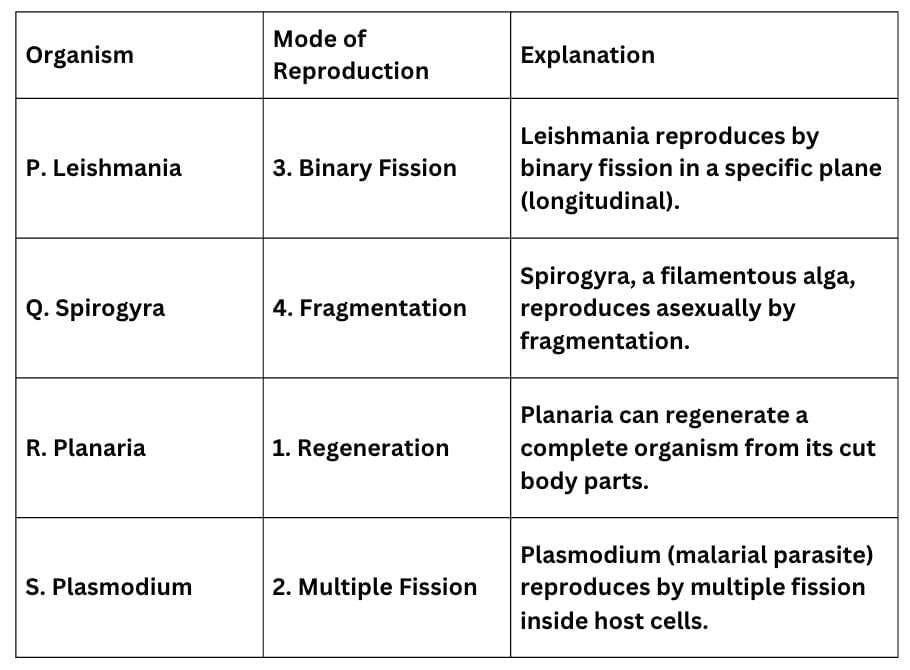
Q13: Give reasons: (2 Marks)
(a) The male reproductive organ responsible for formation of germ cells is located outside the abdominal cavity.
(b) The roles of the glands, present along the path of the vas-deferens, are very significant.
Ans:
(a) The testes, which form the male germ-cells (sperm), are located outside the abdominal cavity in the scrotum because sperm formation requires a lower temperature than the normal body temperature.
The scrotum helps maintain this lower temperature, which is essential for healthy sperm production.
(b) The glands present along the vas deferens, such as the prostate gland and seminal vesicles, add their secretions to the sperm.
These secretions:
- Provide nutrition to the sperm, and
- Make their transport easier by forming a fluid medium.
Q14: (a) Define fertilisation.
(b) What happens to Zygote, Ovule, Ovary, and Stamens after fertilisation in a flowering plant? (3 Marks)
Ans:
(a) Fertilisation is the process of fusion of the male and female germ-cells (gametes) to form a zygote.
In flowering plants, the male germ-cell from the pollen grain fuses with the female gamete present in the ovule.
(b) After fertilisation in a flowering plant:
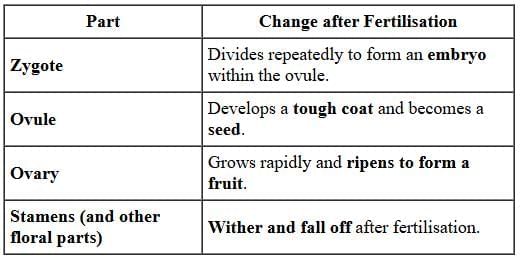
Q15: Differentiate between a gamete and a zygote. State their significance in sexual reproduction. (3 Marks)
Ans:
Significance in sexual reproduction:
- Gametes ensure genetic variation by combining DNA from two individuals.
- The zygote is the first cell of the new organism; it divides repeatedly to form an embryo, which develops into a new individual.
Q16: Differentiate between self-pollination and cross-pollination. Which one of the two is better for the survival of species? Give reason to justify your answer. (3 Marks)
Ans: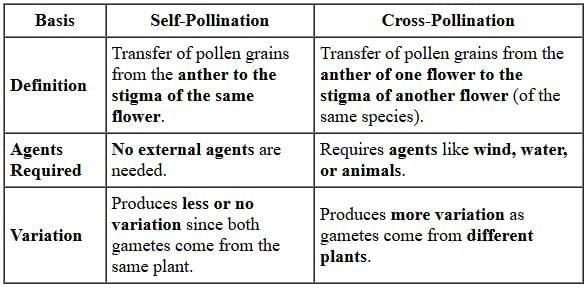
Q17: (a) (i) Identify the parts ‘X’ and ‘Y’ in the figure given below: (5 Marks)
(ii) Name the yellowish coloured structures produced by the part labelled as ‘Y’.
(iii) Write the name of the process by which these are transferred to the part labelled as ‘X’.
(iv) Explain the process of seed formation in a flowering plant.
OR
(b)
(i) Name the type of asexual mode of reproduction shown in the given figure.
(ii) Identify the unicellular organism in the diagram.
(iii) List any two advantages of asexual reproduction over sexual reproduction.
(iv) Name and explain any one mode of asexual reproduction observed in Hydra. (5 Marks)
Ans: (a)
(i) Parts: X = Stigma, Y = Anther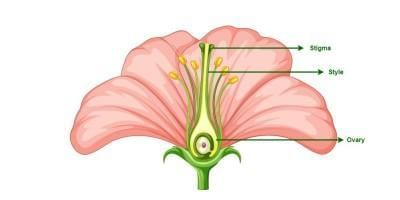 (ii) Yellowish Structures: Pollen grains
(iii) Process: Pollination
(iv) Seed Formation: After pollination, pollen grains on the stigma germinate, forming a pollen tube that grows through the style to the ovary. The male gamete fuses with the egg in the ovule (fertilization), forming a zygote. The ovule develops into a seed, with the zygote becoming the embryo, the ovule wall forming the seed coat, and the ovary developing into the fruit.
Ans (b):
(i) Type: Binary fission
(ii) Organism: Leishmania
(iii) Advantages:
- Faster reproduction, as it does not require a mate or complex processes.
- Produces genetically identical offspring, ensuring successful traits are passed on in stable environments.
(iv) Budding in Hydra: In budding, a small outgrowth (bud) forms on the Hydra’s body due to cell division. The bud grows, develops tentacles and a mouth, and eventually detaches as a new Hydra.
Q18: (A) (a) Define Puberty. List any two changes seen in boys at the time of puberty.
(b) Why are testes in human males located outside the abdominal cavity in scrotum?
(c) List any three techniques of contraception used by humans. Which one of these is not meant for males? (5 Marks)
OR
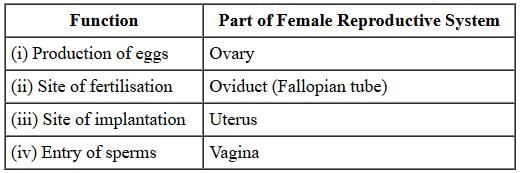
(a) Name the part performing the following functions in human female reproductive system:
(i) production of eggs,
ii) site of fertilization,
(iii) site of implantation,
(iv) entry of the sperm.
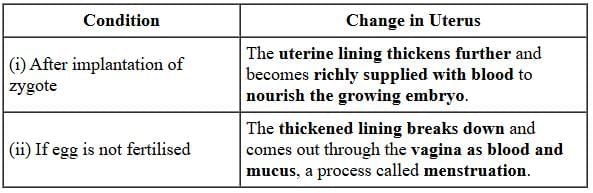
(b) What changes are observed in the uterus:
(i) subsequent to implantation of zygote and
(ii) if an egg does not get fertilized? (5 Marks)
Ans: (A)
(a) Puberty and changes in boys:
Puberty is the period during adolescence when the reproductive tissues mature, and the body becomes capable of reproduction.
Two changes in boys at puberty:
- Growth of thick hair on the face (beard and moustache) and other body parts.
- Voice begins to crack and becomes deeper.
(b) Location of testes:
The testes are located outside the abdominal cavity in the scrotum because sperm formation requires a lower temperature than the normal body temperature.
The scrotum maintains this lower temperature, ensuring proper sperm production.
(c) Three techniques of contraception:
- Condoms – act as a mechanical barrier to prevent sperm from entering the female body.
- Oral pills – change the hormonal balance so that eggs are not released.
- Copper-T (loop) – placed in the uterus to prevent pregnancy by stopping implantation.
Not meant for males:
Oral pills and Copper-T are for females
OR
(a) Parts and Functions:
(b) Uterus Changes:
Previous Year Questions 2024
Q1: (A) (i) Name three techniques/devices used by human females to avoid pregnancy. Mention the side effects caused by each. (4 to 5 Marks) (2024)
(ii) What will happen if in a human female (a) fertilization takes place, (b) an egg is not fertilized?
OR
(B) (i) Draw a diagram showing spore formation in Rhizopus and label the (a) reproductive and (b) non-reproductive parts. Why does Rhizopus not multiply on a dry slice of bread?
(ii) Name and explain the process by which reproduction takes place in Hydra.
Ans: (A) (i)
- Chemical Method/Oral pills Side effects: Change the hormonal balance of the body.
- Barrier method / Loop / Copper–T Side effects: Irritation in uterus.
- Surgical method / Fallopian tube in female is blocked; Side effects – may cause infections.
(ii) (a) Fertilized egg/zygote gets implanted in the lining of uterus and starts dividing.
(b) If the egg is not fertilized, the thick and spongy lining of the uterus breaks and comes out through the vagina as blood and mucous.
(B) (i)
(a) Reproductive part – Sporangia
(b) Non-reproductive part – Hypha/Hyphae.
Dry slice of bread does not provide moisture and nutrients necessary for the germination and multiplication of Rhizopus.
(ii) Budding: Hydra uses regenerative cells for reproduction. A bud develops as an outgrowth due to repeated cell division at one specific site and develop into tiny individuals. On maturation, these buds detach from the parent and become new individuals.
Alternate answer: Regeneration: It is carried out by specialised cells. If hydra is cut or broken into many pieces, many of these pieces grow into separate individuals.
Q2: Identify the mode of asexual reproduction in the following organism: (1 Mark) (2024)
(a) Fragmentation
(b) Multiple fission
(c) Budding
(d) Binary fission
Ans: (c)
In the organism shown, you can observe a small new organism growing from the body of the larger one. This is typical of budding, where a new organism develops from an outgrowth or bud due to cell division at one particular site. This method is common in yeast and some invertebrates like hydras.
Q3: Explain the events that take place once a sperm reaches the oviduct till it becomes a foetus. Write the role of the placenta in pregnancy. (3 Marks) (2024)
Ans:
- In the oviduct, sperm encounters the egg and fertilisation takes place.
- The fertilized egg (zygote) starts dividing and forms a ball of cells or embryo.
- Embryo is implanted in the lining of the uterus, where it continues to grow and develops organs to become a foetus.
- Role of Placenta:
(i) Provides a large surface area for glucose and oxygen to pass from the mother to the embryo.
(ii) Waste generated by the embryo will be removed by transferring them into the mother’s blood.
Q4: Part(s) of a flower which attracts insects for pollination is (are) (1 Mark) (2024)
(a) petals and Sepals
(b) anther and Stigma
(c) petals only
(d) sepals only
Ans: (c)
Petals are often brightly colored and fragrant, which helps attract insects for pollination. They serve as visual cues that guide insects to the flower, encouraging them to visit and transfer pollen from one flower to another, aiding in plant reproduction.
Q5: (a) (i) What are spores? On which structures are they formed? How do they overcome unfavourable conditions? Name the organism which multiplies with the help of these structures. (4 to 5 Marks) (2024)
(ii) Give two reasons why some plants are grown by the method of vegetative propagation. List two methods used to grow plants vegetatively.
OR
(b) (i) Study the diagram given below and name the parts marked as A, B and C. What happens when B reaches C in the ovary ? Mention its significance.
(ii) Write the post fertilisation changes that occur in a flower.
Ans: (a) (i)
- Spores are reproductive structures that detach from the parent and give rise to a new individual.
- Sporangium / Sporangia
- Covered by thick walls to protect them from unfavourable conditions.
- Rhizopus
(ii)
- Plants which have lost the capacity to produce seeds.
- Plants bear flowers and fruits earlier so as to reduce time.
- To get genetically similar plants.
Methods: Layering and Grafting
OR
(b) (i)
- A – Male Germ Cell/Male Gamete; B – Pollen tube; C – Female Germ Cell / Female Gamete.
- B carries A (male germ cell) and this germ cell fuses with C (female germ cell) to form a zygote.
- Significance: Zygote is capable of growing into a new plant.
Q6: The plants that can be raised by the method of vegetative propagation are: (1 Mark) (2024)
(a) Sugarcane, roses, grapes
(b) Sugarcane, mustard, potato
(c) Banana, orange, mustard
(d) Papaya, mustard, potato
Ans: (a)
Vegetative propagation is a method of asexual reproduction where new plants are grown from parts of existing plants, such as stems, roots, or leaves. Sugarcane, roses, and grapes can be easily propagated using this method, allowing for the rapid production of new plants with desirable traits.
Q7: A zygote is formed by the fusion of a male gamete and a female gamete. The number of chromosomes in the zygote of a human is: (1 Mark) (2024)
(a) 23
(b) 44
(c) 46
(d) 92
Ans: (c)
In humans, a zygote is formed when a male gamete (sperm) and a female gamete (egg) fuse together. Each gamete contains 23 chromosomes, so when they combine, the zygote has a total of 46 chromosomes, which is the normal number for human cells.
Q8: Name the type of nutrition exhibited by Amoeba. Explain how food is taken in and digested by this organism. (2 Mark) (2024)
Ans:
- Heterotrophic /Holozoic Nutrition
- Amoeba takes in food using temporary finger-like projections/pseudopodia of the cell which fuse over the food particle forming a food vacuole. Inside the food vacuole complex substances are broken down into simpler substances.
Q9: (a) Explain with the help of a labelled diagram, the process of reproduction in Hydra by budding. Name the cells used for reproduction in this process. (4 to 5 Marks) (2024)
OR
(b) List two roles of each of the following in human reproductive system :
(i) Seminal vesicles and prostate gland
(ii) Oviduct
(iii) Testis
Ans: (a) In hydra, a bud develops as an outgrowth due to repeated cell division at one specific site. These buds develop into tiny individuals and when fully mature, detach from the parent body and become new independent individuals.
Regenerative cells.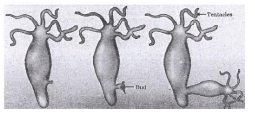
OR
(b) (i) Seminal vesicles and prostate glands:
- Secrete a fluid for nourishment of sperm.
- Secrete a fluid which makes the transport of the sperm easier
(ii) Oviduct:
- Egg is carried from ovary to the womb or uterus.
- Site of Fertilization
(iii) Testis:
- Produces sperm
- Secretion of hormone – testosterone
Q10: The incorrect statement about placenta is: (1 Mark) (2024)
(a) It is a disc embedded in the uterine wall.
(b) It contains villi on the embryo’s side of the tissue.
(c) It has a very small surface area for glucose and oxygen to pass from mother to the embryo.
(d) The embryo gets nutrition from the mother’s blood through it.
Ans: (c)
This statement is incorrect because the placenta actually has a large surface area, which allows for efficient transfer of nutrients like glucose and oxygen from the mother’s blood to the embryo. The placenta is designed to maximize the exchange of these essential substances to support the developing fetus.
Q11: Some unicellular organisms such as Plasmodium and Leishmania differ in the manner in which they reproduce. Name and explain the reproductive process taking place in them. (1 Mark) (2024)
Ans: (i) Plasmodium: Multiple fission- A single cell divides into many daughter cells simultaneously.
(ii) Leishmania: Binary fission- Splitting of one cell into two daughter cells in definite orientation.
Q12: Case-based/data-based questions with 3 short sub-parts. Internal choice is provided in one of these sub-parts. (4 to 5 Marks)(2024)
Pollination is an important process in sexual reproduction of plants. It is an essential process that facilitates fertilisation in plants. Pollinating agents can be wind, water, insects and birds. Several changes take place in the flower after the fertilization has taken place.
(a) Write the main difference between self-pollination and cross-pollination.
(b) Name the part of the flower which attracts insects for pollination. What happens to this part after fertilisation?
(c) (i) Define fertilisation. What is the fate of ovules and the ovary in a flower after fertilisation?
OR
(c) (ii) In a germinating seed, which parts are known as future shoot and future root? Mention the function of cotyledon.
Ans: (a) (b) Petals, they dry and fall off.
(c) (i) Fusion of male and female gametes to form a zygote
Ovule – Seed,
Ovary – fruit
OR
(c) (ii) Future shoot – Plumule,
Future root – Radicle
Cotyledon – Stores food.
Q13: List two roles of each of the following in human reproductive system: (3 Marks) (2024)
(i) Seminal vesicles and prostate gland
(ii) Oviduct
(iii) Testis
Ans: (i) Seminal vesicles and prostate glands:
- Secrete a fluid for nourishment of sperm.
- Secrete a fluid which makes the transport of the sperm easier
(ii) Oviduct:
- Egg is carried from ovary to the womb or uterus.
- Site of Fertilization
(iii) Testis:
- Produces sperm
- Secretion of hormone – testosterone
Q14: Chromosomes:
(i) carry hereditary information from parents to the next generation.
(ii) are thread-like structures located inside the nucleus of an animal cell.
(iii) always exist in pairs in human reproductive cells.
(iv) are involved in the process of cell division. (2 Marks) (2024)
The correct statements are :
(a) (i) and (ii)
(b) (iii) and (iv)
(c) (i), (ii) and (iv)
(d) (i) and (iv)
Ans: (c)
(i) carry hereditary information from parents to the next generation: True. Chromosomes carry genetic information from parents to offspring, which determines inherited traits.
(ii) are thread-like structures located inside the nucleus of an animal cell: True. Chromosomes are thread-like structures made of DNA and proteins, located in the nucleus of animal cells, especially visible during cell division.
(iii) always exist in pairs in human reproductive cells: False. Human reproductive cells (sperm and egg) contain only one set of chromosomes (haploid), not pairs. The chromosome pairs are restored during fertilization when sperm and egg combine.
(iv) are involved in the process of cell division: True. Chromosomes ensure that genetic material is accurately copied and distributed to daughter cells during both mitosis and meiosis.
Thus, the correct combination is (i), (ii), and (iv).
Q15: Assertion (A) and Reason (R), answer these questions selecting the appropriate option given below: (1 Mark) (2024)
Assertion (A): Offsprings produced by asexual reproduction are genetically similar to the parents.
Reason (R): Asexual reproduction involves a single parent.
(a) Both (A) and (R) are true and (R) is the correct explanation of (A).
(b) Both (A) and (R) are true and (R) is not correct explanation of (A).
(c) (A) is true, but (R) is false.
(d) (A) is false, but (R) is true.
Ans: (a)
Offspring produced by asexual reproduction are genetically identical to their parent because asexual reproduction involves only one parent, resulting in no mixing of genetic material. This is why the assertion about the genetic similarity of offspring and the reason about single-parent involvement are both true and directly related.
Q16: Offsprings formed as a result of sexual reproduction produce more variations because:
(a) genetic material is contributed by many parents.
(b) sexual reproduction is a lengthy process.
(c) genetic material is contributed by two individuals of same species to produce a new generation.
(d) DNA copying is not accompanied by the creation of cellular apparatus. (1 Mark) (CBSE 2024)
Ans: (c)
In sexual reproduction, offspring inherit genetic material from two parents, each contributing half of the genetic information. This combination of genetic material introduces genetic variation, as the offspring have a mix of traits from both parents. This variation is essential for the evolution and adaptation of species.
The other options are incorrect:
(a) Genetic material is not contributed by many parents but by two parents.
(b) The length of the process does not directly cause variations.
(d) DNA copying in sexual reproduction is accompanied by cellular processes that support the formation of the zygote.
Therefore, the correct answer is (c) genetic material is contributed by two individuals of the same species to produce a new generation.
Q17: (A) Name any two sexually transmitted diseases.
(B) Prenatal sex determination is prohibited by law. Why?
(C) Name any three methods of contraception stating one side-effect of each. (4 to 5 Marks) (CBSE 2024)
Ans: (A) Gonorrhoea, HIV-AIDS and Human Papillomavirus (HPV). (Any two)
(B) Prenatal sex determination has been prohibited by law because these are sometimes misused by people who do not want a particular child, as in case of illegal sex-selective abortion of female foetuses. For a healthy society, the female-male sex ratio must be maintained. Due to reckless female foeticides, child sex ratio is declining at an alarming rate.
(C) (i) Pills: These act by changing the hormonal balance of the body so that eggs are not released and fertilisation cannot occur.
Side-effects: Causes severe hormonal imbalance.
(ii) Copper-T or loop: Placed in the uterus to prevent pregnancy.
Side effect: Causes irritation of the uterus.
(iii) Surgical methods: Vas deferens in male or fallopian tube in female are blocked to stop the sperm and egg transfer in males and females respectively.
Side effects: Surgery can cause infections and other problems if not performed properly.
Previous Year Questions 2023
Q1: (i) What happens when:
(1) Leaves of Bryophyllum fall on the soil?
(2) Planaria is cut into many pieces.
(3) Sporangia of Rhizopus on maturation liberate spores?
Mention the modes of reproduction in each of the above three cases.
(ii) Write the changes that occur in a flower once the fertilization has taken place. (5 Marks) (2023)
Ans: (i) (1) When the Bryophyllum leaf falls on the wet soil, the buds present in the notches along the leaf margin develop into new plants. This is one of the example of vegetative propagation by leaves.
(2) When Planaria accidentally cut into many pieces then its each piece grows into a complete organism. This is one of the example of regeneration.
(3) The sporangia of Rhizopus contain cells or spores that can eventually develop into new Rhizopus individuals when it bursts on maturation. Rhizopus reproduce asexually by the formation of the spores (sporulation).
(ii) After fertilization, the fertilized egg (or zygote) divides several times to form an embryo within the ovule. The ovule develops a tough coat around it and is gradually converted into a seed. The ovary of flower develops and becomes a fruit (with seeds inside it). The other parts of flower like sepals, petals, stamens, stigma and style dry up and fall off. Only the ovary is left behind. So, at the place on plant where we had a flower originally, we now have a fruit (which is the ovary of the flower containing seeds). A fruit protects its seeds.
Q2: Select the INCORRECT match (between the plant and its vegetative part) from the following:
(a) Bryophyllum, leaf
(b) Potato, stem
(c) Money-plant, stem
(d) Rose, root (1 Mark) (CBSE 2023)
Ans: (d)
(a) Bryophyllum, leaf: Correct match. Bryophyllum reproduces vegetatively through its leaves, which can develop buds that grow into new plants.
(b) Potato, stem: Correct match. Potato reproduces vegetatively through its modified stem, called a tuber.
(c) Money-plant, stem: Correct match. The money plant reproduces through its stem cuttings.
(d) Rose, root: Incorrect match. Rose plants are typically propagated vegetatively through stem cuttings, not roots.
Therefore, the correct answer is (d) Rose, root because it is an incorrect match.
Q3: (A) Name the parts of a bisexual flower that are not directly involved in reproduction.
(B) Differentiate between self-pollination and cross-pollination. List any two significance of pollination.
(C) What is the fate of ovules and ovary after fertilisation in a flower? (4 to 5 Marks) (CBSE 2023)
Ans: (A) The sepals and petals of a flower are non-essential parts. They specialise in protecting the reproductive organs and draw pollinators like insects and birds. The gynoecium and androecium are the flower’s essential parts that are directly involved in reproduction.
(B)
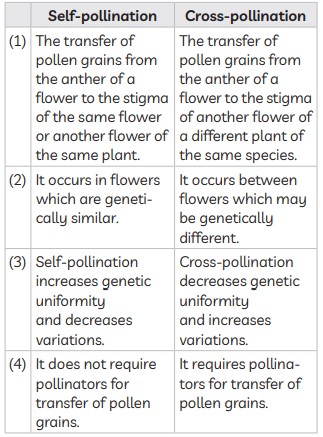
Significance:
(i) Plant reproduction and genetic diversity.
(ii) Food production.
(C) The ovules develop into the seed and the ovary develops into the fruit after the fertilisation in a flower.
 | Get additional INR 200 off today with EDUREV200 coupon. | Avail Offer |
Previous Year Questions 2022
Q1: (a) Which of the following flowers will have higher possibility of self-pollination?
Mustard, Papaya, Watermelon, Hibiscus
(b) List the two reproductive parts of a bisexual flower. (2022)
Ans: (a) Mustard and Hibiscus will have higher possibility of self pollination, since these are bisexual flowers i.e., produced on the same plant
(b) The two reproductive parts of a bisexual flower are stamens (male reproductive part) and carpels (female reproductive part).
Q2: In flowering plants, the pollen grains are transferred to stigma by pollination but the female germ cells are present in the ovary. Explain with the help of a labelled diagram (only concerned parts), how the male germ cells reaches the ovary. (2022)
Ans: The pollen particle receives water and nutrients after touching a suitable stigma. It creates a tube known as a pollen tube. Pollen tube develops in the style and travels to the ovary. Two male gametes, or sperm cells, and a tube nucleus may be found at its tip. The advancing pollen tube penetrates the inside of the embryo sac of an ovule, often through the micropyle. The tube ruptures at this point, releasing its two male gametes. To create a zygote, one male gamete unites with one egg.
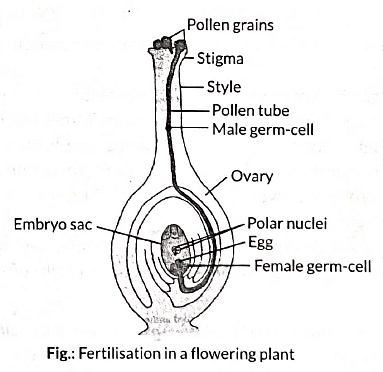
The action is referred to as syngamy. Endosperm is created when the second male gamete combines with binucleate central cells. Triple fusion is the name given to the process since it includes the fusing of three haploid nuclei. Accordingly, triple fusion is the union of a male gamete with two polar nuclei inside the angiosperm’s embryo sac.
Q3: Give reasons:
(i) Placenta is extremely essential for fetal development.
(ii) Uterine lining becomes thick and spongy after fertilisation. (2022)
Ans: (i) Placenta is a special tissue by means of which embryo gets nutrition from the mother’s blood. The villi present in placenta provides larger surface area for glucose and oxygen to pass from the mother’s blood to the embryo. Also, the waste generated by the developing embryo is removed by transferring them into the mother’s blood through placenta. Hence, placenta is extremely essential for fetal development.
(ii) The uterine lining becomes thick after fertilisation and is richly supplied with blood to nourish the growing embryo.
Q4: What Is puberty? Mention any two changes that are common to both boys and girls in early teenage years (2022)
Ans: Puberty is the age of human males and females at which the reproductive organs become functional, gonads start producing gametes and sex hormones, and the boys and the girls become sexually mature. Changes that are common to both boys and girls in early teenage years are as follows :
- Hair grows in the pubic area and armpits
- Increase in height and acquisition of muscle mass.
Q5: Name the part/organ of the human female reproductive system (2022)
(a) where contraceptive devices such as loop or copper-T are placed to prevent pregnancy.
(b) which is blocked to prevent the transfer of eggs.
(c) where formation of green cells as ova takes place.
(d) from where the embryo gets nutrition from the mother’s blood.
Ans: (a) The part/organ of the human female reproductive system where contraceptive devices such as loop or copper-T are placed to prevent pregnancy is the uterus or womb. These devices are inserted into the uterus to inhibit fertilization and implantation of a fertilized egg.
(b) The part/organ of the human female reproductive system that is blocked to prevent the transfer of eggs is the fallopian tubes. These tubes connect the ovaries to the uterus, and they are blocked or sealed off in certain contraceptive methods or sterilization procedures to prevent the eggs from reaching the uterus for fertilization.
(c) The part/organ of the human female reproductive system where the formation of green cells as ova takes place is the ovaries. Ovaries are responsible for producing and releasing mature eggs, or ova, during the menstrual cycle.
(d) The part/organ of the human female reproductive system from where the embryo gets nutrition from the mother’s blood is the placenta. The placenta is a temporary organ that develops during pregnancy and attaches to the uterine wall. It facilitates the exchange of nutrients, oxygen, and waste products between the mother’s blood and the developing fetus.
Previous Year Questions 2021
Q1: Define fragmentation. (2021 C)
Ans: Fragmentation is the mode of reproduction in which parent body breaks into two or more fragments and each fragment develops into a new individual. E.g., Spirogyra.
Q2: Mention the changes that occur in the following after fertilisation in a flower:
(a) Petals
(b) Zygote
(c) Ovary
(d) Ovule (Term-11,2021 C)
Ans: (a) Petals: After fertilization, the petals of the flower may start to wither and fall off. This is because their primary function of attracting pollinators has been fulfilled, and they are no longer needed for reproduction.
(b) Zygote: After fertilization, the zygote is formed. The zygote undergoes mitotic divisions and develops into an embryo. It is the beginning of the new plant’s life cycle.
(c) Ovary: After fertilization, the ovary develops into a fruit. The ovary wall thickens and matures, protecting the developing seeds inside. The fruit helps in the dispersal of seeds and ensures the survival of the next generation.
(d) Ovule: After fertilization, the ovule develops into a seed. The ovule contains the fertilized egg, which develops into an embryo. The ovule undergoes changes in structure and becomes the seed coat, which protects the embryo and provides nutrients for its growth and development.
Q3: Name the reproductive parts of an angiosperm. Where are these parts located? Explain the structure of its male reproductive part. (Term II, 2021)
Ans:
- The reproductive parts of an angiosperm are the flower, which is located at the tip of the stem. The male reproductive part of an angiosperm is called the stamen. The stamen consists of two main parts: the filament and the anther.
- The filament is a slender stalk that supports the anther. The anther is a sac-like structure located at the top of the filament. Inside the anther, there are pollen sacs that contain pollen grains. These pollen grains are the male gametes, which are responsible for fertilizing the female reproductive cells. The anther releases these pollen grains when they are mature and ready for pollination.
- Overall, the structure of the male reproductive part of an angiosperm, the stamen, is specialized for the production and release of pollen grains for fertilization.
Q4: (a) Name the reproductive and non-reproductive parts of bread mould (Rhizopus).
(b) List any two advantages of vegetative propagation. (Term II, 2021)
Ans: (a) Reproductive part of bread mould or Rhizopus— Sporangia, a bob like structure which contain spores. Non-reproductive part – Hyphae, which are thread like structures developed on bread.
(b) Advantages of vegetative propagation:
(i) It produces a large number of plants in shortest time.
(ii) All plants produced are genetically similar to parent, preserves purity, resistance and good qualities.
Q5: (a) Name the process shown below and define it:
(b) Name the type of cells present in the organisms which exhibit this process. (Term II, 2021)
Ans: (a) The process shown is regeneration in Planaria. Regeneration is the ability to give rise to a new individual from any broken or injured body part.
(b) Regeneration in Planaria is carried out by specialised cells known as neoblasts (stem cells).
Q6: What is vegetative propagation? List with brief explanation three advantages of practising this process for growing some types of plants. Select two plants from the following which are grown by this process: Banana, Wheat, Mustard, Jasmine, Gram (2021)
Ans: Vegetative propagation is an asexual method of reproduction in plants. In this method, new plants are obtained from the parts of old plants (like stems, roots and leaves), without the help of any reproductive organs.
Advantages of vegetative propagation are as follows:
- Vegetative propagation is usually used for the propagation of those plants which produce either very few seeds or do not produce viable seeds.
- Seedless plants can be obtained by artificial vegetative propagation.
- Grafting is a propagation method which is very useful for fruit trees and flowering bushes. It enables to combine the most desirable characteristics of two plants. Banana and jasmine are generally grown through vegetative propagation method.
Previous Year Questions 2020
Q1: What are chromosomes? Explain how in sexually reproducing organisms the number of chromosomes in the progeny is maintained. (2020)
Ans: ‘Chromosomes’ are long thread-like structures which contain hereditary information of the individual and are thereby the carriers of genes. Chromosomes are located in the nucleus of a cell.
The parents are diploid (2n) as each of them has two sets of chromosomes. They form haploid (In) male and female gametes through the process of meiosis. The haploid gametes have one set of chromosomes. These two gametes fuse during fertilisation and the offspring become diploid (2n) which is same as parents chromosome number.
Q2: (a) What provides nutrition to human sperm? State the genetic constitution of a sperm.
(b) Mention the chromosome pair present in a zygote which determines the sex of (i) a female child and (ii) a male child. (2020)
Ans: (a) The secretions of seminal vesicles and prostate gland provides nutrition to the human sperm and also make their further transport easier. The genetic constitution of a 50% sperm have X chromosome and 50% have Y chromosome.
(b) (i) X X – Female child
(ii) X Y – Male child
Q3: (a) Name the mode of reproduction of the following organisms and state the important feature of each mode:
(i) Planaria
(ii) Hydra
(iii) Rhizopus
(b) We can develop new plants from the leaves of Bryophyllum. Comment.
(c) List two advantages of vegetative propagation over other modes of reproduction. (2020)
Ans: (a) (i) Planaria – Regeneration
- Regeneration of organism from its cut body parts occurs by the process of growth and development.
- Regeneration is an asexual mode of reproduction common in lower plants and animals.
(ii) Hydra – Budding
- In budding, a small part of the body of the parent organism grows out as a bud which on detaching from a new organism.
(iii) Rhizopus – Spores Spores are usually produced in sporangia. Spore formation is a common method of an asexual reproduction in bacteria and most of the fungi.
(b) The leaves of a Bryophyllum have special type of buds in their margins. These buds may get detached from the leaves fall to ground and then grow to produce new Bryophyllum plants. The buds can also drop to the ground together with the leaf and then grow to produce new plants.
(c) Advantages of vegetative propagation are:
- The new plants produced by artificial vegetative propagation are exactly like the parent plants.
- Many plants can be grown from one plant via vegetative propagation.
Q4: Draw a neat diagram showing fertilisation in a flower and label
(a) pollen tube
(b) Male germ cell and
(c) Female germ cell on it.
Explain the process of fertilisation in a flower.
What happens to the (i) ovary and (ii) ovule after fertilisation? (2020)
Ans: Diagram showing fertilisation in a flower is as follows: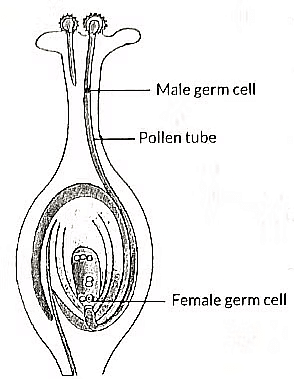 Fertilisation, in plants, occurs when the male gamete present in pollen grain fuses with the female gamete (or egg) present in ovule. When a pollen grain falls on the stigma of the carpel, it bursts open and grows a pollen tube downwards through the style towards the female gamete in the ovary. Male gametes move down the pollen tube. The pollen tube enters the ovule in the ovary. The tip of pollen tube bursts and male gametes comes out of pollen tube. In ovary, the male gamete of pollen combines with the female gamete or egg present in ovule to form a fertilised egg. After fertilisation,(i) ovule develops into seed
(ii) ovary develops into fruit.
Q5: (a) Identify the modes of asexual reproduction in each of the following organisms:
(i) Hydra
(ii) Planaria
(iii) Amoeba
(iv) Spirogyra
(v) Rhizopus
(b) List three advantages of vegetative propagation.
(c) Why cannot fertilisation take place in flowers if pollination does not occur? (2020)
Ans: (a) The modes of asexual reproduction in each of the following organisms are:
(i) Hydra – Budding
(ii) Planaria – Fragmentation and Regeneration
(iii) Amoeba – Binary Fission
(iv) Spirogyra – Fragmentation and Asexual spore formation
(v) Rhizopus – Spore formation and Fragmentation
(b) Three advantages of vegetative propagation are:
- Genetic uniformity: Vegetative propagation produces offspring that are genetically identical to the parent plant. This ensures that desirable traits, such as high yield or disease resistance, are preserved in the offspring.
- Faster propagation: Vegetative propagation allows for rapid multiplication of plants compared to sexual reproduction, which requires the development of seeds and germination.
- Preservation of unique characteristics: Some plants have unique and desirable characteristics that cannot be reliably passed on through seeds. Vegetative propagation allows for the preservation and multiplication of these characteristics.
(c) Fertilisation cannot take place in flowers if pollination does not occur because pollination is the transfer of pollen grains from the anther to the stigma of a flower. The pollen grains contain the male gametes (sperm cells), while the stigma contains the female gametes (egg cells). Fertilisation can only occur when the sperm cells reach the egg cells. Without pollination, there is no transfer of pollen to the stigma, and thus, the sperm and egg cells cannot meet for fertilisation to take place.
Q6: (a) In the female reproductive system of human beings, state the functions of:
(i) Ovary
(ii) Oviduct.
(b) Mention the changes which the uterus undergoes, when
(i) it has to receive a zygote.
(ii) no fertilisation takes place.
(c) State the functions of placenta. (2020)
Ans: (a) (i) The ovaries in female are primary sex organs (or female gonads) which perform the dual function – production of female gametes (eggs or ova) and secretion of female sex hormones (estrogen and progesterone).
(ii) Oviducts or fallopian tube are paired tubes originating near the ovaries of their respective sides and extend upto uterus. The terminal part of fallopian tube is funnel-shaped with finger-like projections called fimbriae lying near ovary. Fimbriae pick up the ovum released from ovary and push it into fallopian tube. Fertilisation also takes place in the oviduct.
(b) (i) As the ovary releases one egg every month, the uterus also prepares itself, every month to receive fertilised egg by making its lining thick and spongy to nourish the zygote if fertilisation takes place.
(ii) When the female gamete/egg is not fertilised, this lining is not needed any longer. So, the lining slowly breaks and comes out through vagina as blood and mucus through menstrual cycle that takes place every month.
(c) Placenta performs the following functions:
(i) All nutritive elements from maternal blood pass into the fetus through it.
(ii) Placenta helps in respiration i.e., supply of oxygen and removal of CO2 from fetus to maternal blood.
(iii) Fetal excretory products diffuse out into maternal blood through placenta and are excreted by mother.
(iv) Placenta also secretes various hormones during pregnancy.
Q7: (a) What is puberty?
(b) Describe in brief the functions of the following parts in the human male reproductive system.
(i) Testes
(ii) Seminal vesicle
(iii) Vas deferens
(iv) Urethra
(c) Why are testes located outside the abdominal cavity?
(d) State how sperm move towards the female germ cell. (2020)
Ans: (a) The age at which the sex hormones begin to be produce and the boy and girl becomes sexually mature, i.e., able to reproduce is called puberty.
(b) (i) Testes: The two testes in male are the sites where male gametes, i.e., sperm are formed. Testes also produce the male sex hormone called testosterone.
(ii) Seminal vesicles: Seminal vesicles are one pair of sac-like structures near the base of bladder. Seminal fluid is a watery alkaline fluid that contains nutrients (fructose) which serve as a source of energy for the sperm. Each seminal vesicle releases its contents into the ejaculatory duct during ejaculation.
(iii) Vas deferens: This is a straight tube, about 40 cm long, which carries the sperm to the seminal vesicles, where mucus and a watery alkaline fluid containing fructose, mix with the sperm. (iv) Urethra : It is a long tube that arises from urinary bladder. Urethra carries urine from the bladder as well as sperm from the vas deferens, through the penis.
(c) Testes are located outside the abdominal cavity because sperm formation requires a lower temperature than normal body temperature. The temperature of the testes in the scrotum is about 2-2.5°C lower than normal body temperature. This temperature is ideal for sperm formation and development.
(d) The sperm present in the testes of man are introduced into the vagina of the woman through penis during copulation. Millions of sperm are released into the vagina at one time. The sperm are highly active and mobile. They travel from here upward through the uterus at the top of fallopian tube within five minutes.
Q8: Based on the given diagram answer the questions given below:
(a) Label the parts A, B, C and D.(b) Name the hormone secreted by testis and mention its role.(c) State the functions of B and C in the process of reproduction. (2020)
Ans: (a) A-Ureter
B – Seminal vesicle
C – Urethra
D – Vas deferens
(b) Testes produce male sex hormone testosterone Hormone testosterone brings about the development of secondary sexual characters during puberty in boys like growth of facial hair, deepening of voice, build up of muscle mass and also regulates formation of sperm.
(c) Seminal vesicles (B) release its contents into the ejaculatory duct during ejaculation. Urethra (C) carries sperm from the vas deferens through the penis.
Q9: The growing size of the human population is a cause of concern for all people. The rate of birth and death in a given population will determine its size. Reproduction is the process by which organisms increase their population. The process of sexual maturation for reproduction is gradual and takes place while general body growth is still going on. Some degree of sexual maturation does not necessarily mean that the mind or body is ready for sexual acts or for having and bringing up children. Various contraceptive devices are being used by human beings to control the size of population.
(i) List two common signs of sexual maturation in boys and girls.
(ii) What is the result of reckless female Foeticide?
(iii) Which contraceptive method changes the hormonal balance of the body?
(iv) Write two factors that determine the size of a population. (2020)
Ans: (i) Two common signs of sexual maturation in boys and girls are:
(a) Growth of pubic hair and extra hair in the armpits.
(b) Development of oily skin and pimples.
(ii) Female Foeticide is reducing the number of girls drastically in our country, due to which male-female sex ratio is also declining.
(iii) Chemical contraceptive method changes the hormonal balance of the body.
(iv) The rate of birth and death in a given population will determine the size of a population.
Q10: (a) List three different categories of contraceptive methods.
(b) Why has Government of India prohibited prenatal sex determination by law? State its benefits in the long run.
(c) Unsafe sexual act can lead to various infections. Name two bacterial and two viral infections caused due to unsafe sex. (2020)
Ans: (a) Three different categories of contraceptive methods are:
(i) Barrier methods, i.e., use of condoms, etc.
(ii) Oral contraceptive methods, i.e., use of oral pills etc.
(iii) Surgical methods, i.e., vasectomy and tubectomy.
(b) Prenatal sex determination was banned in India in 1994. This was done to prevent sex selective abortion. It is being used to kill the normal female fetus. This killing of the unborn girl child is called female feticide which is reducing the number of girls drastically in some societies of our country. Due to reckless female feticide, male-female sex ratio is declining at an alarming rate. Its benefit in the long run is that the female-male ratio could be maintained for a healthy society.
(c) Bacterial diseases due to unsafe sex are gonorrhoea and syphilis. Viral diseases due to unsafe sex are AIDS and genital herpes.
| Also watch: Sexual Reproduction In Flowering Plants |
Previous Year Questions 2019
Q1: After examining a prepared slide under the high power of a compound microscope, a student concludes that the given slide shows the various stages of binary fission in a unicellular organism. Write two observations on the basis of which such a conclusion may be drawn. (2019)
Ans: The two observations that was taken by the student that concludes that the given slide shows the various stages of binary fission in a unicellular organism are as follows:
- Presence of unicellular and uninucleate organism showing irregular outline.
- Division of nucleus of parent cell into two equal halves.
Q2: Define multiple fission. Give its one example. (2019, Foreign 2014)
Ans: Multiple fission is an asexual mode of reproduction in which the parent organism splits to form many new organisms at the same time. Multiple fission occurs in Plasmodium.
Q3: Draw labelled diagram to show the following parts in an embryo of a pea seed: Cotyledon, Plumule, Radicle (2019)
Ans: Embryo of pea seed is shown as follows: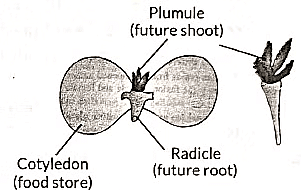
Q4: What are testes? List two functions performed by testes in human beings. (2019 C)
Ans: Testes are the primary reproductive organs in males. Testes produce male gametes (sperm) and male sex hormones (testosterone)
Q5: What are sexually transmitted diseases? List two examples each of diseases caused due to (i) bacterial infection and (ii) viral infection. Which device or devices may be used to prevent the spread of such diseases? (2019)
Ans: The diseases that are spread by sexual contact with an infected person are called sexually transmitted disease (STDs).
(i) Bacterial infection causes gonorrhoea, syphilis.
(ii) Viral infection causes AIDS, genital herpes. STDs can be prevented by using male and female condoms.
Q6: Define pollination. Explain the different types of pollination. List two agents of pollination. How does suitable pollination lead to fertilisation? (Delhi 2019)
Ans: The process of transfer of pollen grains from anther of a flower to the stigma of the same flower or another flower of the same species is known as pollination. Pollination may be of two major types- (i) self pollination and (ii) cross pollination.
- Self pollination is the transfer of pollen grains from the anther to the stigma of the same flower, or to the stigma of another flower of the same plant. This pollination generally takes place in bisexual flowers because they have both male and female gametes in them.
- Cross pollination is the transfer of pollen grains from the anther of a flower of one plant to the stigma of a flower of another plant of the same species. This occurs in unisexual as well as bisexual flowers. Two agents of pollination are wind and water. Pollination results in the deposition of related pollen grains over the receptive stigma of the carpel. Pollen grains after landing on stigma, absorb water, swell and then germinate to produce pollen tubes.
Many pollen tubes grow into the stigma, but only one passes through the style and then moves towards the ovary. Two non- motile male gametes are formed inside the tube during its growth through the style. After reaching the ovary, pollen tube enters the ovule through the micropyle. The tip of the tube finally pierces the micropylar end of the embryo sac. After penetration, the tip of pollen tube ruptures releasing two male gametes into the embryo sac. The mature embryo sac consists of an egg apparatus (one haploid egg and two synergids), two polar nuclei and three antipodal cells. During the act of fertilisation, one male gamete fuses with the egg to form the diploid zygote.
Q7: (a) Draw a diagram of human female reproductive system and label the parts:
(i) which produce an egg
(ii) where fertilisation takes place
(b) List two bacterial diseases which are transmitted sexually.
(c) What are contraceptive devices? Give two reasons for adopting contraceptive devices in humans. (Al 2019)
Ans: (a) The sectional view of human female reproductive system is as follows: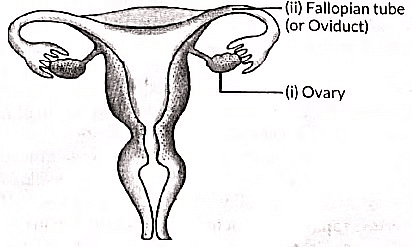 (b) Gonorrhoea and syphilis are two bacterial diseases which are transmitted sexually.
(c) Contraceptive devices are those devices which are used to prevent pregnancy. It includes diaphragm, condom and intrauterine devices. Contraceptive methods are adopted:
(i) to avoid unwanted birth.
(ii) to keep the population of a country under control.
Q8: (a) Identify the given diagram. Name the parts 1 to 5
(b) What is contraception? List three advantages of adopting contraceptive measures. (NCERT Exemplar, Delhi 2019)
Ans: (a) The given diagram is the sectional view of human female reproductive system. The labelled parts are:
1. Funnel of fallopian tube or oviduct
2. Ovary
3. Uterus or womb
4. Cervix
5. Vagina
(b) Contraception is the avoidance of pregnancy. Three advantages of adopting contraceptive methods are:
(i) They prevent frequent or unwanted pregnancies.
(ii) They prevent the transfer of sexually transmitted infections.
(iii) They help to regulate the population growth.
Previous Year Questions 2018
Q1: Write one difference between asexual and sexual mode of reproduction. Which species is likely to have comparatively better chances of survival – the one reproducing asexuaily or the one reproducing sexually? Give reason to justify your answer. (CBSE 2018)
Ans: Differences between asexual and sexual mode of reproduction. The species reproducing sexually will have better chances of survival because genetic variation is created during sexual reproduction; in case of an adverse environmental change, atleast some variants will survive and continue the race.
Q2: (a) Write the functions of the following parts in human female reproductive system:
(i) Ovary
(ii) Oviduct
(iii) Uterus
(b) Describe the structure and function of placenta. (CBSE 2018)
Ans: (a) (i) Ovary
- It produces the female gametes or germ cells, called ova.
- It secretes the female sex hormones such as oestrogen and progesterone.
(ii) Oviduct
- It transports the ova from the ovary to uterus/womb.
- Fertilisation occurs in the oviduct.
(iii) Uterus
- Implantation of the embryo occurs in the lining of uterus and; the complete development of foetus occurs here.
- the contractions of the muscles of uterus help in child birth.
(b) Structure of placenta:
- Placenta is a disc-like structure embedded in the uterine wall.
- It contains villi on the embryo’s side and on the mother’s side there are blood spaces, which surround the villi; this arrangement provides a large surface area for exchange of materials.
Functions of placenta:
- It transfers glucose and oxygen from the mother’s blood to the foetus.
- It also removes the wastes (CO2 and nitrogenous wastes) generated by the foetus to the mother’s blood.
Previous Year Questions 2017
Q1: Newly formed DNA copies may not be identical at times. Give one reason. (NCERT,AI 2017)
Ans: When a cell reproduces, DNA replication occurs which results in formation of two similar copies of DNA. The process of copying the DNA leads to some variations each time. As a result, the DNA copies produced are similar to each other but sometimes may not identical.
Q2: When a cell reproduces, what happens to its DNA? (AI 2017)
Ans: When a cell reproduces, DNA replication occurs which forms two similar copies of DNA.
Q3: Name the method by which Spirogyra reproduces under favourable conditions. Is this method sexual or asexual? (Delhi 2017)
Ans: The method by which Spirogyra reproduces under favorable conditions is fragmentation. This is an asexual mode of reproduction.
Q4: How does Plasmodium reproduce? Is this method sexual or asexual? (Delhi 2017)
Ans: Plasmodium reproduces through multiple fission method. In this method, the parent organism splits to form many new organisms at the same time. This is an asexual method of reproduction.
Q5: Reproduction is one of the most important characteristic of living beings. Give three reasons in support of the statement. (Al 2017)
Ans: Reproduction is one of the most important characteristics of living beings because:
(i) it is essential for existence and continuity of a species.
(ii) it helps to pass genetic information to next generation.
(iii) it brings variations in next generation which is the basis for evolution.
Q6: State the basic requirement for sexual reproduction. Write the importance of such reproductions in nature. (Delhi 2017)
Ans: The basic requirement for sexual reproduction is involvement of both sexes, i.e., male and female, to produce an offspring. It takes place by the combination of gametes which come from two different parents.
The importance of sexual reproduction in nature are:
(i) Fusion of male and female gametes coming from two different and sexually distinct individuals, exhibit diversity of characters in offspring.
(ii) Meiosis during gametogenesis provides opportunities for new combination of genes, which leads to variation required for evolution and plays a prominent role in the origin of new species. Variations lead to the appearance of such characters, which fit to the changing environment, resulting in the survival of the species.
Q7: List any two steps involved in sexual reproduction and write its two advantages. (Delhi 2017)
Ans: The two main steps involved in sexual reproduction are:
(i) formation of male and female gametes.
(ii) fusion of a male gamete with a female gamete to form a new cell called zygote by the process of fertilisation.
The two important advantages of sexual reproduction are:
(i) It promotes diversity of characters in the offspring through genetic variations.
(ii) It plays an important role in continuous evolution of better organisms that may lead to the origin of new species.
Q8: State the changes that take place in the uterus when:
(a) Implantation of embryo has occurred.
(b) Female gamete/egg is not fertilised. (Delhi 2017)
Ans: (a) Implantation is the close attachment of the blastocyst (young multicellular embryo) to the uterine wall. It is followed by a number of developmental changes in the thickened wall of uterus. An intimate connection between the fetal membrane and the uterine wall called placenta is formed. This is a disc which is embedded in the uterine wall. The placenta serves as the nutritive, respiratory and excretory organ of the fetus.
(b) When the female gamete/egg is not fertilised, this lining is not needed any longer. So, the lining slowly breaks and comes out through vagina as blood and mucus. This cycle takes place every month and is known as menstrual cycle.
Q9: List three techniques that have been developed to prevent pregnancy. Which one of these techniques is not meant for males? How does the use of these techniques have a direct impact on the health and prosperity of a family? (NCERT Exemplar, Al 2017)
Ans: Methods developed to prevent pregnancy are:
(i) barrier method, i.e., use of condoms, diaphragm, etc.
(ii) oral contraceptive method, i.e., use of oral pills.
(iii) surgical method, i.e., vasectomy and tubectomy. Out of these methods, chemical method is not meant for males.
Use of these techniques help to keep control over number of children in a family, which directly affects prosperity of a family. One of the most common reason for deterioration of women’s health is frequent conception. Controlled childbirth will directly affect women health and this will indirectly affect the prosperity of family and nation.
Q10: What happens when
(a) accidently, Planaria gets cut into many pieces
(b) Bryophyllum leaf falls on the wet soil
(c) on maturation sporangia of Rhizopus bursts? (NCERT Exemplar, Delhi 2017)
Ans: (a) When Planaria accidently gets cut into many pieces then its each piece grows into a complete organism. This is known as regeneration.
(b) When the Bryophyllum leaf falls on the wet soil, the buds present in the notches along the leaf margin develop into new plants. This is known as vegetative propagation.
(c) The sporangia of Rhizopus contain cells or spores that can eventually develop into new Rhizopus individuals when it bursts on maturation.
Q11: Describe reproduction by spores in Rhizopus. (Al 2017)
Ans: Fungus Rhizopus reproduces by spore formation. During the growth of Rhizopus, small rounded, bulb-like structures develop at the top of the erect hyphae. Such structures are called sporangia. Inside each sporangium, : nucleus divides several times. Each nucleus gets surrounded by a little amount of cytoplasm to become spore. Large number of spores are formed inside each sporangium. After sometime sporangium bursts and spores are released in the air. When these spores land on food or soil, under favourable conditions, they germinate into new individuals.
Q12: What is vegetative propagation? State two advantages and two disadvantages of this method. (Al 2017)
Ans: Vegetative propagation is a type of asexual reproduction in which the plant parts other than seeds are used as a propagule.
Advantages of vegetative propagation :
- Desirable character of the plant can be preserved through generation.
- Seedless plants can be grown via this method.
Disadvantages of vegetative propagation:
- Plants produced by this method posses less vigour and are more prone to diseases.
- Plants produced by this method show no genetic variation.
Q13: (a) Name the organ that produces sperm as well as secretes a hormone in human males. Name the hormone it secretes and write its functions.
(b) Name the parts of the human female reproductive system where fertilisation occurs.
(c) Explain how the developing embryo gets nourishment inside the mother’s body. (Delhi 2017)
Ans: (a) The male organ is testis. It secretes the hormone testosterone which regulates the formation of sperm. — It brings about changes in the appearance of boys at the time of puberty.
(b) Fertilisation occurs in the oviduct.
(c) The developing embryo gets nourishment from the mother’s blood with the help of a special tissue, called placenta. The placenta provides a large surface area for the passage of glucose and oxygen from the mother’s blood to the embryo.
Q14: (a) What is variation ? How is variation created in a population ? How does the creation of variation in a species promote survival ?
(b) Explain how, offspring and parents of organisms reproducing sexually have the same number of chromosomes. (CBSE 2017-18 C)
Ans: (a) Variation is occurrence of differences between organisms.
Variations are created in a population in different ways :
(i) There may be minor changes/errors during DNA copying mechanism which happens before any cell division. These variations may go on accumulating from previous generations, ultimately leading to visible changes.
(ii) In sexually reproducing organisms, the traits of two individuals combine and give rise to new combination in the progeny. This also leads to variation.
(iii) Thus combining variations from two or more individuals would thus create new combinations of variations.
Organisms with suitable variations will have better chances of survival. Depending on the nature of variation, different individuals would have different kind of advantages.
(b) In sexually reproducing organisms each cell has two copies of each chromosome, one each from the male and female parent. During gamete formation, one chromosome from each pair goes to a gamete. Hence, the gametes have half the number of chromosomes, but one chromosome of each pair. When two gametes combine, they restore the normal number of chromosome in the progeny.
Q15: Sneha was taught by her teacher that ‘‘Variation is useful for the survival of species.’’ She passed on the same information to her friend, Abdul. Support the view of both Sneha and her teacher by giving a suitable justification for the same. (CBSE 2017)
Ans: Variations that are favourable, increase the chances of survival of the species. If an organism can withstand a higher temperature, then the variation goes on accumulating in its future generations. Hence, these organisms can survive sudden rise in the temperature. This ensures the survival of the species. But other organisms (variants) without this variation may not survive due to sudden rise in temperature. So, variation is beneficial to the species, but not a necessity for an individual.
Previous Year Questions 2016
Q1: Name the part of Bryophyllum where the buds are produced for vegetative propagation. (Delhi 2016)
Ans: Bryophyllum propagates vegetatively by the buds produced at the margins of leaves.
Q2: What happens when a mature Spirogyra filament attains considerable length? (Al 2016)
Ans: When a mature Spirogyra filament attains considerable length it simply breaks into two or more fragments and each fragment, then grows into a new Spirogyra.
Q3: What are all organisms called which bear both the sex organs in the same individual? Give one example of such organism. (Al 2016)
Ans: Organisms which bear both male and female sex organs in the same individual are called bisexual. For example, Hibiscus.
Q4: List two unisexual flowers. (Foreign 2016)
Ans: Flowers of papaya and cucumber are unisexual.
Q5: Why is fertilisation not possible without pollination? (NCERT Exemplar, Foreign 2016)
Ans: The process of pollination (in plants) ensures that male gametes bearing structure called pollen comes in contact with the female reproductive structure of the plant. Once the male and female gametes are in close vicinity, they fuse and fertilisation is accomplished. Hence, fertilisation cannot take place without pollination.
Q6: List two functions of ovary of human female reproductive system. (AI 2016)
Ans: Two functions of ovary of human female are:
(i) production of female gametes, i.e., ova
(ii) secretion of female hormones, i.e., estrogen and progesterone.
Q7: Define reproduction. How does it helps in providing stability to the population of species? (NCERT Exemplar, Al 2016)
Ans: The production of new organisms by the existing organisms of the same species is known as reproduction. It is linked to the stability of population of a species. DNA replication during reproduction ensures transfer of specific characters or body design features that is essential for an individual of a population to live and use that particular niche. Some variations present in a few individuals of population caused due to reproduction which also helps in their survival at changing niches.
Q8: What is multiple fission? How does it occur in an organism? Explain briefly. Name one organism which exhibits this type of reproduction. (Delhi 2016)
Ans: Multiple fission refers to the process of asexual reproduction in which many individuals are formed from a single parent. This method of reproduction occurs in unfavourable conditions. The unicellular organism develops a protective covering called cyst, over the cell. The nucleus of the cell divides repeatedly producing many nuclei. Later on, each nucleus is surrounded by small amount of cytoplasm and many daughter cells are produced within the cyst. When conditions are favourable, the cyst breaks and small offspring are liberated. This type of reproduction is seen in some protozoans, e.g., malarial parasite (Plasmodium).
Q9: Explain the term “regeneration” as used in relation to reproduction of organisms. Describe briefly how regeneration is carried out in multicellular organisms like Hydra. (AI 2016)
Ans: The process of formation of entire organism from the body parts of a fully differentiated organism is called regeneration. It occurs by process of growth and development. Simple animal like Hydra shows regeneration. When a small piece of Hydra breaks off it grows into complete new Hydra. During regeneration, the cells of cut body part of the organism divide rapidly to make a mass of cells. The cells here move to their proper places within the mass where they have to form different types of tissues. In this way complete organism is regenerated.
Q10: In the context of reproduction of species state the main difference between fission and fragmentation. Also give one example of each. (Al 2016)
Ans: The main differences between fission and fragmentation are as follows: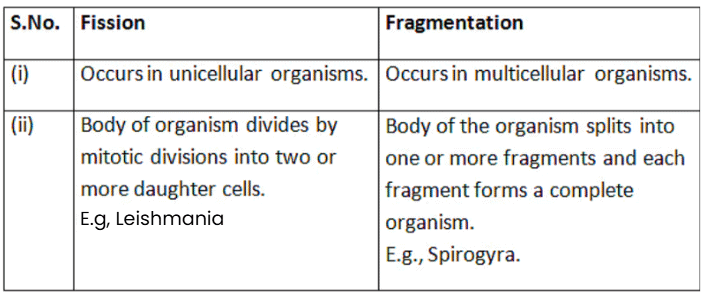
Q11: What happens when
(a) Planaria gets cut into two pieces
(b) a mature Spirogyra filament attains considerable length
(c) on maturation sporangia burst? (Foreign 2016, Delhi 2016)
Ans: (a) When Planaria is cut into two pieces then each piece grows into a complete organism. This is known as regeneration.
(b) When a mature Spirogyra filament attains a considerable length it breaks into small pieces called fragments. These fragments grow into new individuals and this mode of reproduction is called fragmentation.
(c) When a sporangia burst, large number of spores are released in the air. When these spores land on food or soil, under favourable conditions they germinate into new individuals.
Q12: List and explain briefly any three methods of contraception. (CBSE 2016-17 Cl)
Ans: Three methods of contraception :
(i) Mechanical Barrier – Condoms on penis or vagina is a covering worn so as to create a barrier such that sperm do not reach the egg.
(ii) Oral Contraceptive Pills – They change the hormonal balance o f the body so that eggs are not released and fertilisation does not take place.
(iii) Intra-Uterine Device – Devices like copper-T or loop are placed in the uterus which change the pH of uterus and hence sperm cannot survive, thereby preventing pregnancy.
(iv) Surgical Method – Blocking vas deferens in males and fallopian tube in females, would allow respective gametes to be released and hence act as contraceptive.
Q13: How do organisms, whether reproduced asexually or sexually maintain a constant chromosome number through several generations? Explain with the help of a suitable example. (CBSE 2016)
Ans: When an organism reproduces sexually, it produces gametes through a special type of division called meiosis or reductional division, in which the original number of chromosome becomes half. In sexual reproduction, male gametes and female gametes are combined to form zygote, and the original number of chromosomes is restored.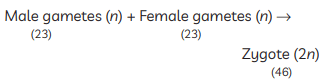
In asexual reproduction, only mitotic divisions are involved and the chromosome number remains the same.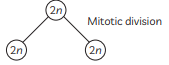
Example: Humans have 46 chromosomes or 23 pairs of chromosomes. When the gametes formed through meiosis, the chromosomes number becomes half. Thus, an organism maintains a constant chromosome number through several generations.
Previous Year Questions 2015
Q1: Name the life process of an organism that helps in the growth of its population. (AI 2015)
Ans: Reproduction is a life process that helps in multiplication of an organism and growth of its population.
Q2: Name two simple organisms having the ability of regeneration. (Al 2015)
Ans: Hydra and Planaria are two organisms that have the ability to regenerate.
Q3: Name the causative agent of the disease “Kala-azar” and its mode of asexual reproduction. (Foreign2015)
Ans: Causative agent of the disease Kala-azar is Leishmania. It reproduces asexually by binary fission.
Q4: Why is DNA copying an essential part of the process of reproduction? What are the advantages of sexual reproduction over asexual reproduction? (2015)
Ans: DNA copying is an essential part of the process of reproduction as it results in passing of nearly same genetic information from parents to the off springs. DNA replication also ensures that same number of chromosomes are passed from parents to offspring. Advantages of sexual reproduction over asexual reproduction is that sexual reproduction provides variations which is a major factor for evolution that helps in survival of species in changing environment.
Q5: Draw a diagram of the longitudinal section of a flower exhibiting germination of pollen on stigma and label (i) ovary, (ii) male germ cell, (iii) female germ cell and (iv) ovule on it. (2015)
Ans. The diagram of the longitudinal section of flower is as follows: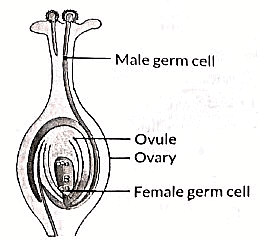
Q6: The diagram shown depicts the process of pollination. Choose the options that will show a maximum variation in the offspring.
(a) A, B and C
(b) B and D
(c) B, C and D
(d) A and C (CBSE 2015, 11)
Ans: (b)
In the context of pollination, maximum variation in the offspring is achieved through cross-pollination, which involves the transfer of pollen between two different plants. Cross-pollination increases genetic diversity compared to self-pollination (where pollen from the same plant fertilizes its own flowers).
From the diagram:
(i) B and D indicate cross-pollination between different plants, which would result in greater genetic variation in the offspring.
(ii) A and C or other combinations involving the same plant would indicate self-pollination, which results in less variation.
Thus, (b) B and D is the correct option as it will show maximum variation in the offspring.
| Also watch: Sexual Reproduction In Flowering Plants |
Previous Year Questions 2014
Q1: No two individuals are absolutely alike in a population. Why? (Delhi 2014)
Ans: No two individuals are absolutely alike in a population because sexual reproduction promotes diversity of characters in the offspring by providing genetic variation.
Q2: Describe in brief the function of the various parts of the female reproductive part of a bisexual flower. (2014)
Ans: A carpel is made of three parts : stigma, style and ovary. The top part of carpel is called stigma. Stigma is for receiving the pollen grains during pollination. Stigma is sticky so that pollen can stick to it. The middle part of carpel is called style. Style is a tube which connects stigma to the ovary. The swollen part at the bottom of a carpel is called ovary. The ovary contains ovules. Ovules contain the female gametes or female sex cells (egg) of the plant. There are usually many ovules in the ovary.
Q3: Name the two reproductive parts of a bisexual flower which contain the germ cells. State the location and function of its female reproductive part. (2014)
Ans: The two reproductive parts of a bisexual flower which contain the germ cells are carpel (female reproductive part) and stamen (male reproductive part). Carpel is situated in the centre of the flower as a flask-shaped structure. A carpel is made up of three parts-stigma, style and ovary. The distal part of a carpel is called stigma. Stigma is responsible for receiving pollen during pollination. Style is an elongated tubular structure which connects stigma with ovary. The basal swollen part of carpel is ovary. Ovary bears several ovules. After fertilisation, ovules form seeds and ovary forms the fruit.
Previous Year Questions 2011
Q1: Name the method by which Spirogyra reproduces under favourable conditions. Is this method sexual or asexual? (CBSE 2011)
Ans: The method by which Spirogyra reproduces under favourable conditions is fragmentation. It is an asexual mode of reproduction.
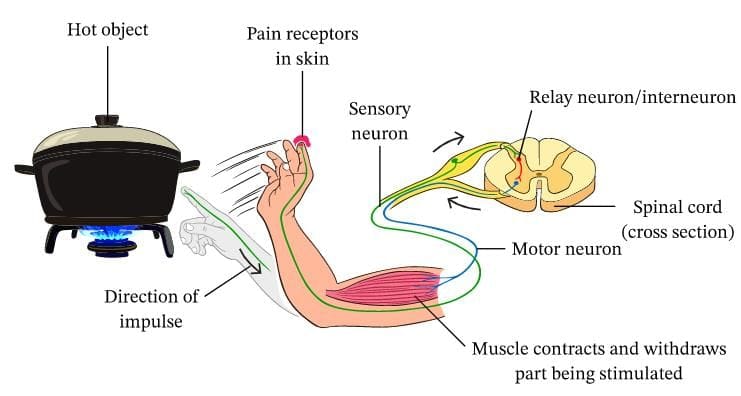
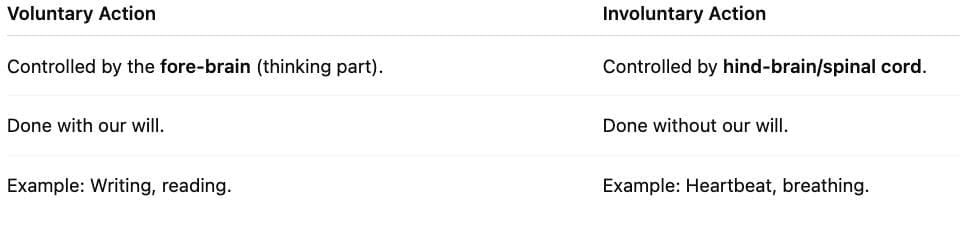 (ii)A reflex action is a quick, automatic, and involuntary response to a stimulus. It is controlled by the spinal cord and helps protect the body from sudden harmful changes in the environment.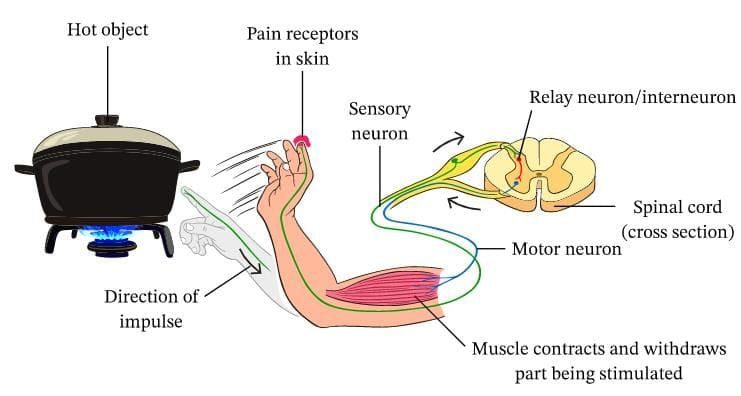
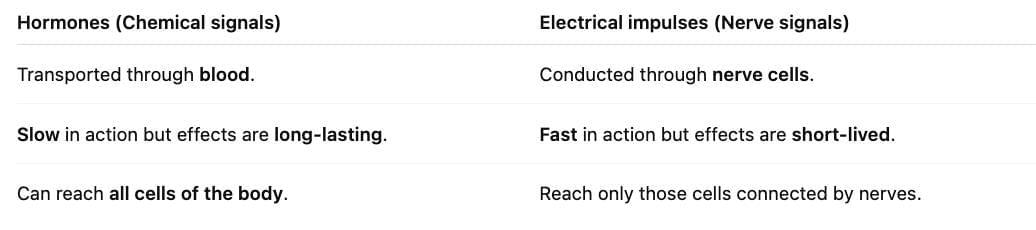
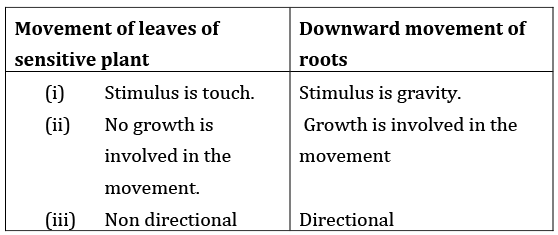 OR
OR
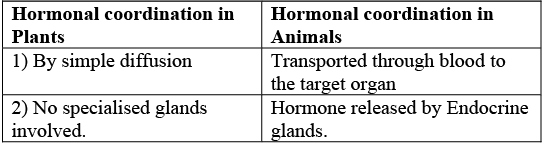
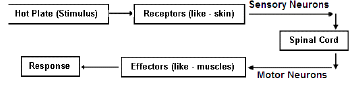
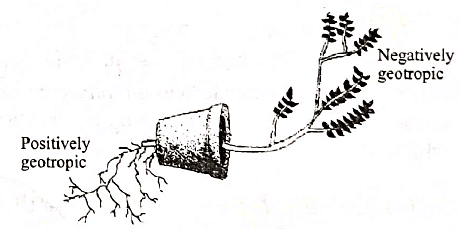
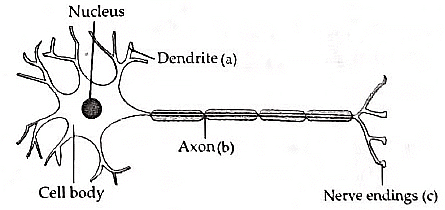
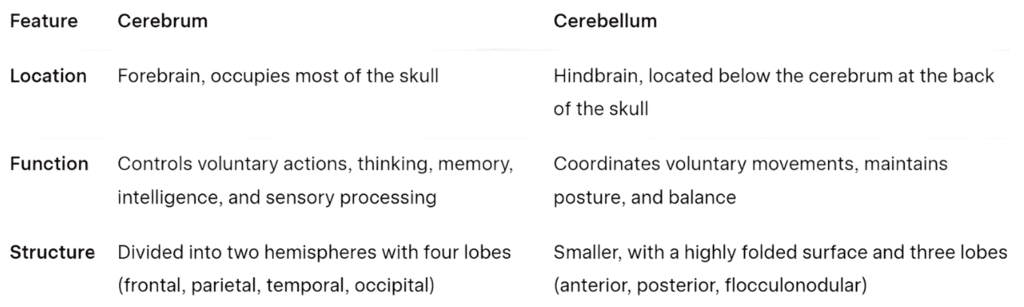
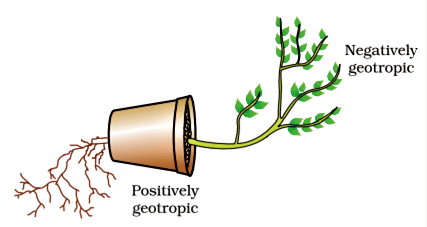
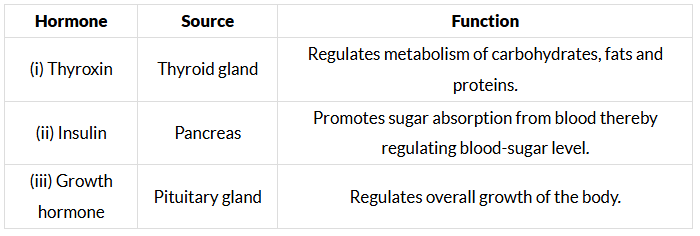
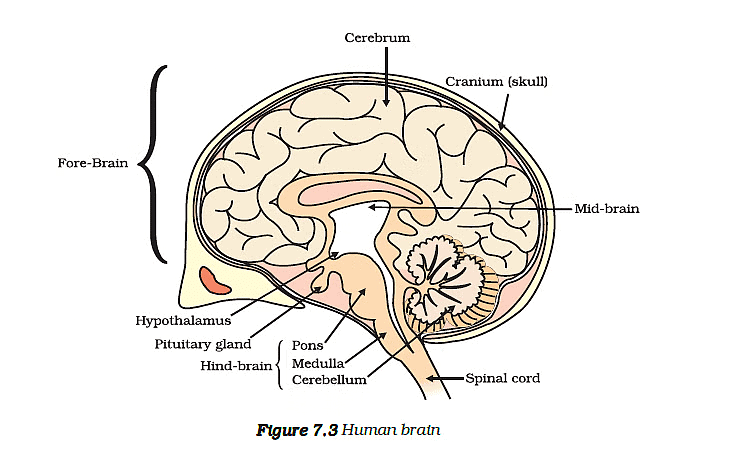
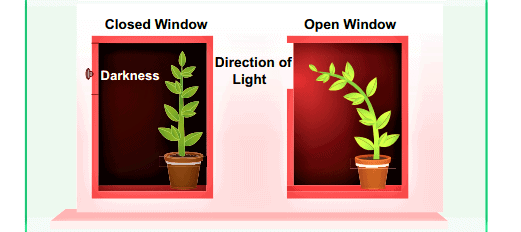
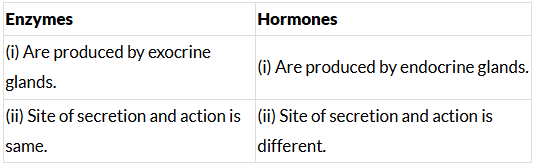
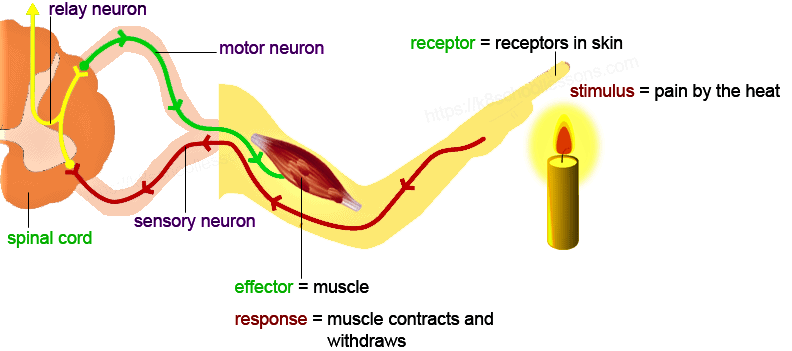 Sequence of events when we touch a hot object are:

 (ii) During inhalation, the ribs move upward and outward, and the diaphragm contracts and moves downward, increasing the space in the chest cavity. This creates low pressure, allowing air to enter the lungs.

 (a) Evaporation : maintains water contents in leaf cells.
 (ii) The separation of the heart into right and left sides is beneficial because:


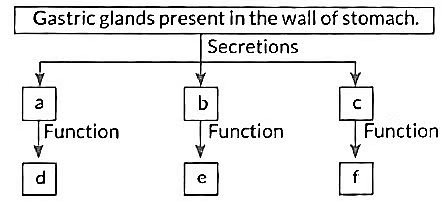
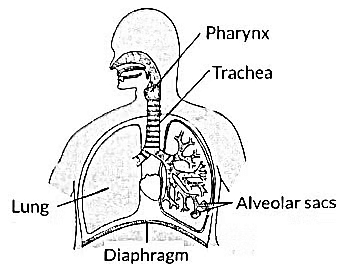
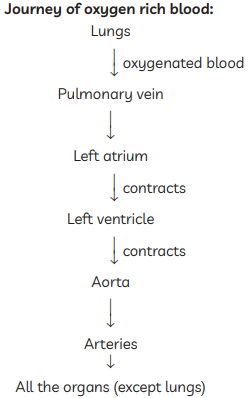
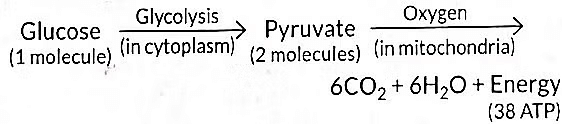

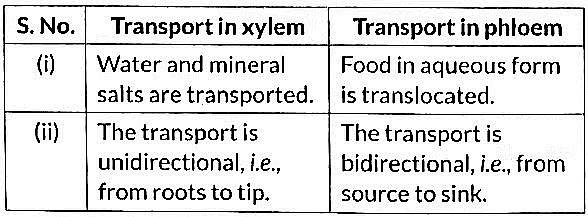
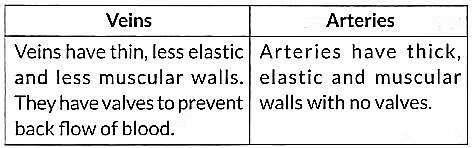


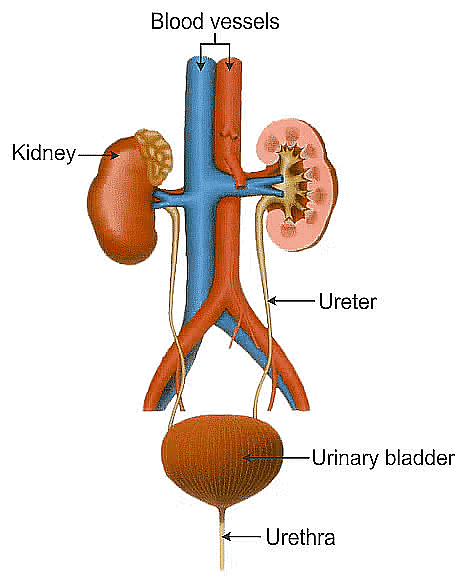 Excretory System of Human Beings
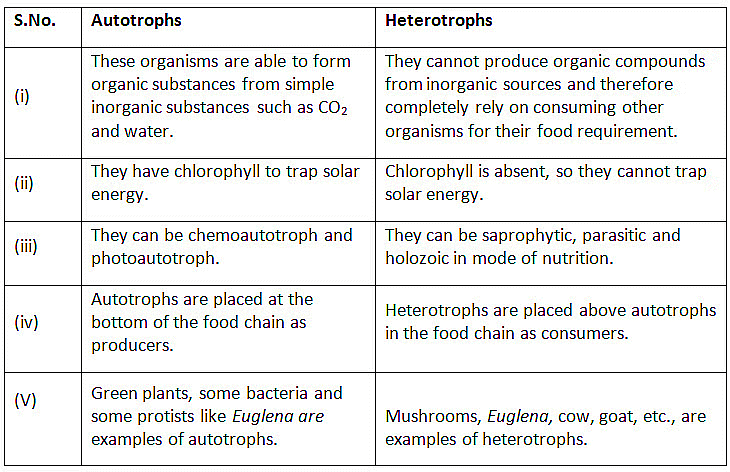
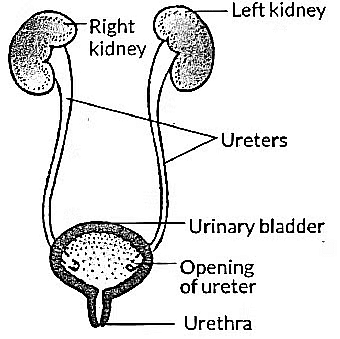


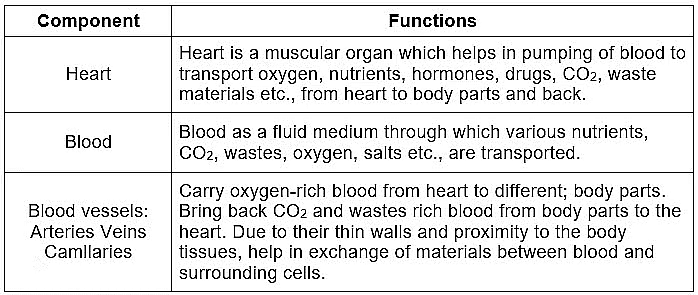
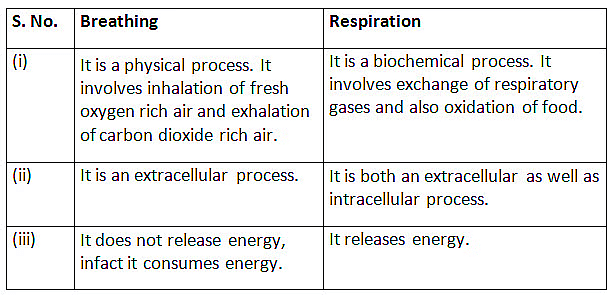
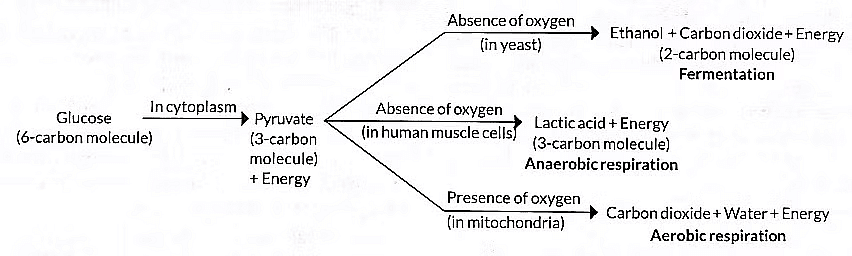
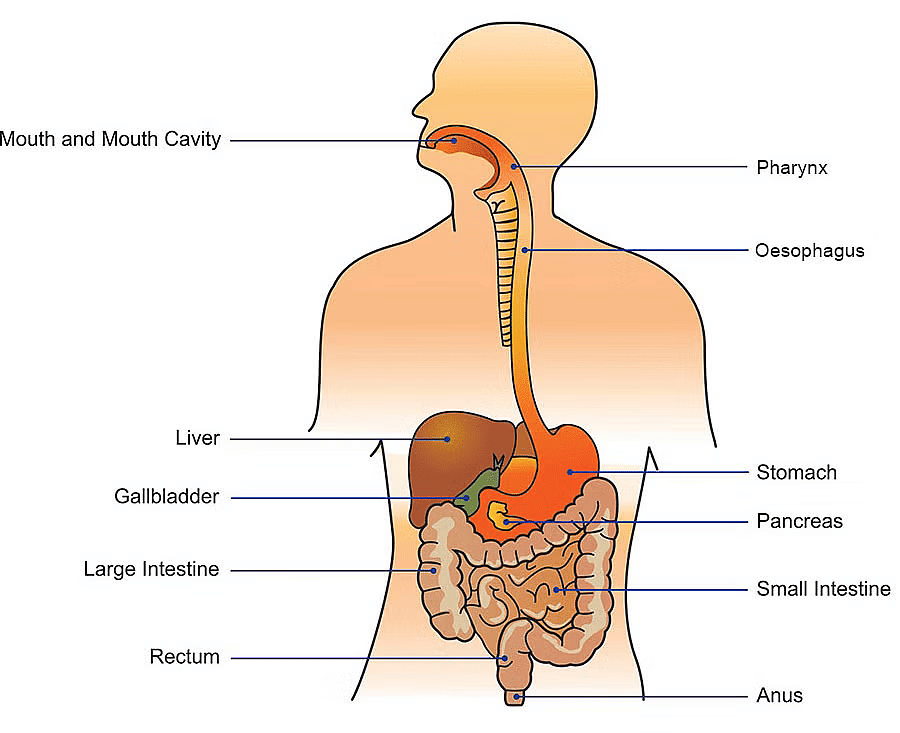
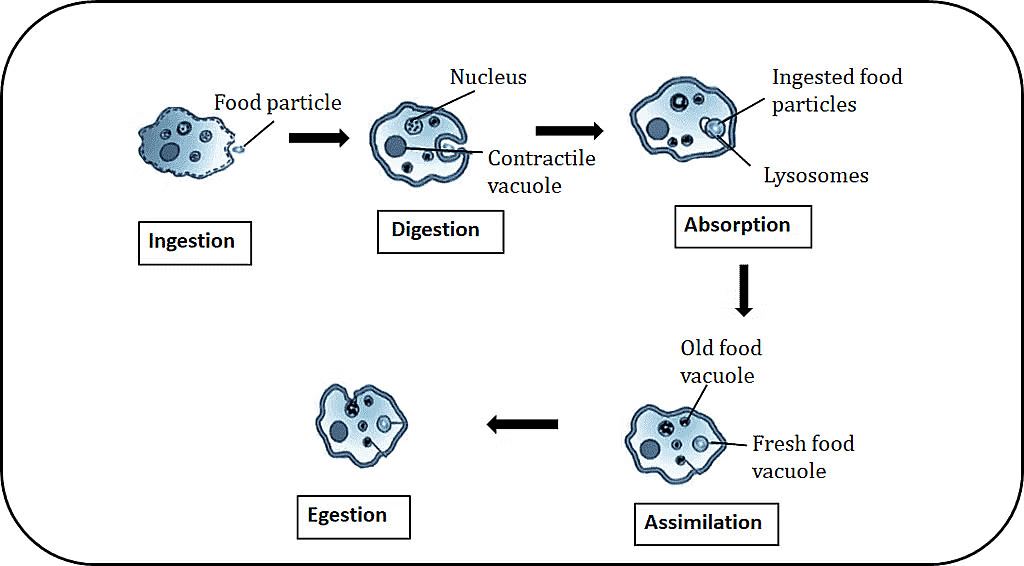



 Electron dot structure of Methane
 Cyclohexane


 When a soap is dissolved in water, the molecules associate together as clusters called micelles in which, water molecules being polar in nature, surround the ions and the hydrocarbon part of the molecule attracts grease, oil and dirt.Hard water has Ca2+ and Mg2+ ions when they react with soap to form insoluble compound and soap goes waste.






 (iv) Electron Dot Structure of B (CH₃COOH):



 Reaction between the alcohol and the acid in presence of an acid (esterification)
 (Ester formed: ethyl ethanoate, a sweet-smelling compound used in perfumes and flavoring.)
 (c) (A) NH₃ Formation:
 OR
OR 

 OR
OR






 Due to small size, the nucleus of carbon atom can hold its shared pairs of electrons strongly. As a result, the bonds that carbon forms with most of the other elements such as hydrogen, oxygen, nitrogen, etc. are very strong there by making these compounds exceptionally stable.






 (C) Compound C is ethane. When it undergoes combustion, it forms CO2 and water.
 (D) Hydrogenation reactions are used in the production of saturated vegetable ghee from unsaturated vegetable oils.

 (b) The compound ‘X’ is likely an unsaturated compound (such as an alkene or alkyne) that burns in air, producing a yellow, sooty flame with significant smoke.






 So, the gas is hydrogen that is evolved during the reaction.
 In this reaction, sodium displaces hydrogen from ethanol, resulting in the formation of sodium ethoxide and the release of hydrogen gas.






 There are total 7 covalent bonds. Six C — H covalent bonds and one C — C covalent bond.

 OR
OR

 (B) Metal oxides are categorised as amphoteric oxides that react with both acids as well as bases to create salts and water. Amphoteric oxides, among many others, include lead oxide and zinc oxide. These oxides are oxygen compounds that show both acidic and basic characteristics. These undergo a neutralisation reaction to form water and salt.
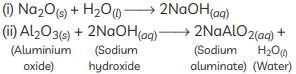

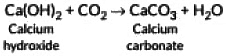 Thus, the “milkiness” arises from the formation of solid calcium carbonate.OR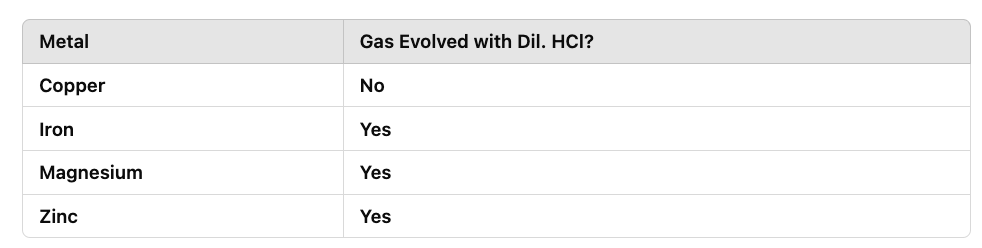
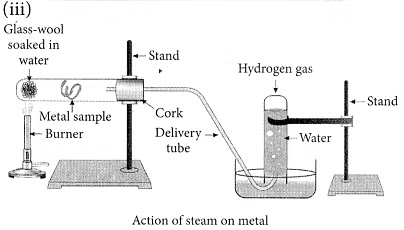







 (b) The metals in the middle of the reactivity series are obtained from their ores by chemical reduction with a suitable reducing agent, e.g.






 (ii) Sodium chloride is neutral in nature because it is formed from a strong acid (HCl) and a strong base (NaOH), giving a salt with pH 7.


 (B) The differences between baking soda and baking powder are:
 X: NaOH (Sodium hydroxide)

 Baking soda on heating gives sodium carbonate which on crystallisation from aqueous solution gives washing soda, e.g.








 The black coating turns brown again as copper metal is regenerated.


 (Hydrogen and oxygen combine to form water.)
 (Lead nitrate decomposes to form lead oxide, nitrogen dioxide, and oxygen.)










 It is an endothermic reaction/decomposition reaction.
 It is exothermic/combination reaction
 OR(b)
OR(b)



 However, when excess carbon dioxide is passed through the solution, the calcium carbonate further reacts with the carbon dioxide and water to form calcium hydrogen carbonate, which is soluble in water, causing the solution to become clear again:
 Thus, the correct answer is (b).