Q1: Distinguish between speed and velocity.
Ans: Speed of a body is the distance travelled by a body per unit time while velocity is the displacement travelled by a body per unit time.
Q2: Under what condition(s) is the magnitude of the average velocity of an object equal to its average speed?
Ans: If the distance travelled by a body is equal to the displacement, then the magnitude of the average velocity of an object will be equal to its average speed.
Q3: What does the odometer of an automobile measure?
Ans: The odometer of an automobile is used to measure the distance covered by an automobile.
Q4: What does the Graph of an object look like when it is in uniform motion?
Ans: Graphically it will be linear; it looks like a straight line when it is in uniform motion.
Q5: During an experiment, a signal from a spaceship reached the ground station in five minutes. What was the distance of the spaceship from the ground station? The signal travels at the speed of light, that is, 3 × 10⁸ms−1
Ans: The given data is that time is five minutes and speed is(3 × 10⁸ms−1)
Distance = Speed × Time
⇒ 5min × (3 × 108ms−1)
⇒( 5 × 60)sec × (3 × 108ms−1)
⇒ 300sec × (3 × 108ms−1)
⇒ 900 × 108ms−1 = 9 × 10¹⁰m
∴ Distance = 9 × 10⁷km
Q6: When will you say a body is in
(i) Uniform acceleration?
Ans: When an object travels in a straight line and its velocity changes by equal amount in an equal interval of time, it is said to have uniform acceleration.
(ii) Non-uniform acceleration?
Ans: Non-uniform acceleration is also called variable acceleration. When the velocity of an object changes by unequal amounts in equal intervals of time, it is said to have non-uniform acceleration.
Q7: A bus decreases its speed from 80kmh−1 to 60kmh−1 in 5s. Find the acceleration of the bus.
Ans: Initial speed of bus (u) = 80kmh−1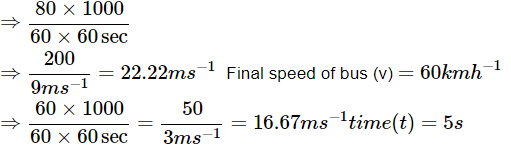
Acceleration (a) = 
∴ Acceleration (a) = −1.11m/s2
Q8: What is the nature of the distance time graphs for uniform and non-uniform motion of an object?
Ans: If an object has a uniform motion then the nature of distance time graph will be linear, that is it would in a straight line and if it has non-uniform motion then the nature of the distance-time graph will be a curved line.
Q9: What is the quantity which is measured by the area occupied below the velocity-time graph?
Ans: The area occupied below the velocity-time graph measures the displacement moved by any object.
Q10: A bus starting from rest moves with a uniform acceleration of 0.1ms−2 for 2 minutes . Find
(a) The speed acquired,
Ans: u = 0, a = 0.1ms−2, t = 2min = 120sec
v = u + at = 0 + 0.1 × 120=12ms−1
Speed acquired = v = 12ms−1
(b) The distance travelled.
Ans: s = ut + 1/2at2 = 0 × 120 + 1/2 x 0.1 × 1202 = 720m
Q11: A trolley, while going down an inclined plane, has an acceleration of 2cm s−2 . What will be its velocity 3s after the start?
Ans: Given : u = 0, a = 2cm/s2, t = 3s
v = u + at = 0 + 2 × 3
= 6cm/s
Q12: A racing car has a uniform acceleration of4ms−2 . What distance will it cover in 10s after start?
Ans: Given: u =0, a = 4m/s2, t = 10s
s = ut + 1/2at2
s = 0 × 10 + 1/2 × 4 × 102
∴ s = 200m
Q13: Differentiate between distance and displacement?
Ans: The difference between distance and displacement is as below, 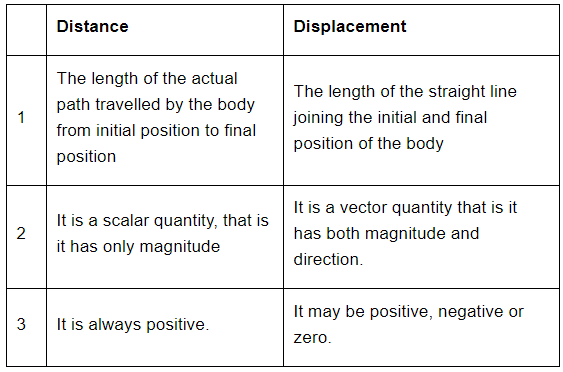
Q14: Derive mathematically the first equation of motion V = u + at?
Ans: Acceleration is defined as the rate of change of velocity.
Let V = final velocity; Vo = initial velocity, T = time, a = acceleration.
So by definition of acceleration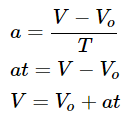
If Vo = u = initial velocity, then [V = u + at]
Q15: Calculate the acceleration of a body which starts from rest and travels 87.5m in 5sec?
Ans: Given Data: u = 0 (starts from rest) u = initial velocity
a = acceleration = ?
t = 5sec, t = time
S = 87.5m (S = distance)
From second equation of motion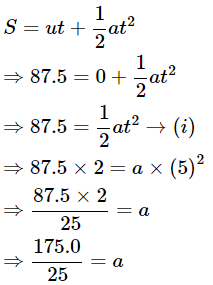
∴ a = 7m/s2
Q16: Define uniform velocity and uniform acceleration?
Ans:
- Uniform velocity:- A body is said to move with uniform velocity if equal displacement takes place in equal intervals of time, however small these intervals may be.
- Uniform acceleration:- A body is said to move with uniform acceleration if equal changes in velocity take place in equal intervals of time, however, small intervals may be.
Q17: The velocity-time graph of two bodies A and B traveling along the +x direction are given in the (a) Are the bodies moving with uniform acceleration?
Ans: Yes the bodies are moving with uniform acceleration.
(b) Which body is moving with greater acceleration A or B?
Ans: Body A is moving with greater acceleration.
Q18: Calculate the acceleration and distance of the body moving with 5m/s which comes to rest after traveling for 6sec?
Ans: Acceleration = a = ?
Final velocity = V = o (body comes to rest)
Distance = s =?
Time = t = 6 sec
From, V = u + at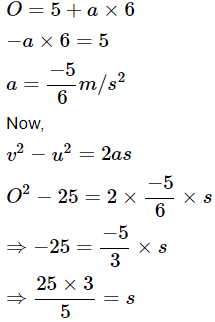
∴ s = 15m
Q19: A body is moving with a velocity of 12m/s and it comes to rest in 18m, what was the acceleration?
Ans: Initial velocity = u = 12m/s
Find velocity = V = 0
S = distance=18m
A= acceleration =?
From 3rd equation of motion;
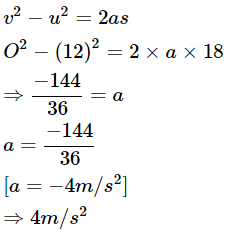
Q20: A body starts from rest and moves with a uniform acceleration of 4m/s2 until it travels a distance of 800m, find the find velocity?
Ans: Initial velocity =u=0
Final velocity = v = ?
Acceleration=a=4m/s2
Distance = s = 800m
v2 − u2 = 2as
v2 − (0) = 2 × 4 × 800
v = 80m/s
Q21: Differentiate between scalars and vectors?
Ans: The difference between scalars and vectors is as below,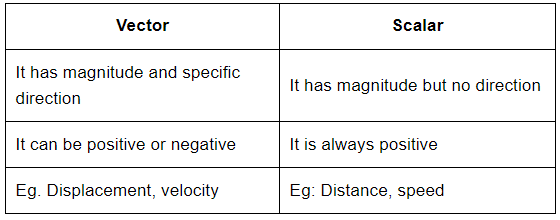
Q22: An object has moved through a distance. Can it have zero displacements? If yes, support your answer with an example.
Ans: Yes, if an object is moved through a distance it can have zero displacement because displacement of an object is the actual change in its position when it moves from one position to the other position. So if an object travels from point A to B and then returns back to point A again, the total displacement will be zero.
Q23: A train starting from a railway station and moving with uniform acceleration attains a speed 40kmh−1 in 10min. Find its acceleration.
Ans: Since the train starts from rest (railway station) = u = zero
Final velocity of train = v = 40kmh−1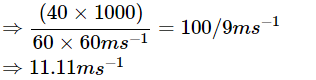
time(t) = 10min = 10 × 60 = 600 seconds
Since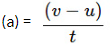

Q24:What can you say about the motion of an object whose distance time graph is a straight line parallel to the time axis?
Ans: If the object’s distance time graph is a straight line parallel to the time axis indicates that with increasing time the distance of that object is not increasing hence the object is at rest that is not moving.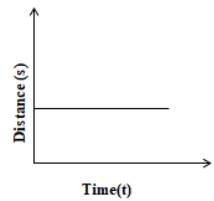
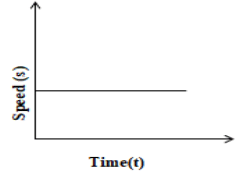
Q25: What can you say about the motion of an object if its speed time graph is a straight line parallel to the time axis?
Ans: Such a graph indicates that the object is travelling with uniform velocity.
Q26: A train is travelling at a speed of 90kmh−1 . Brakes are applied so as to produce a uniform acceleration of−0.5ms−2 . Find how far the train will go before it is brought to rest.
Ans:

Given: a = −0.5ms−2, v = 0 (train is brought to rest)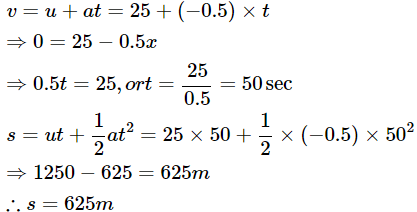
Q27: A stone is thrown in a vertically upward direction with a velocity of5ms−1 . If the acceleration of the stone during its motion is10ms−1 in the downward direction, what will be the height attained by the stone and how much time will it take to reach there?
Ans: Given: u = 5ms−1, a = −10ms−2
v = 0 (since at maximum height its velocity will be zero)
v = u + at = 5 + (−10) × t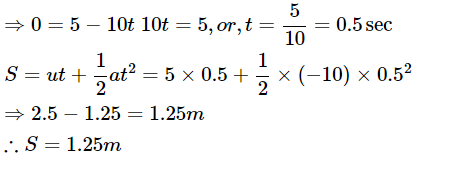
Q28: Two cars A and B are moving along in a straight line. Car A is moving at a speed of 80kmph while car B is moving at a speed of 50kmph in the opposite direction, find
(a) The relative velocity of car B with respect to A.
(b) Relative velocity of car B with respect to A
Ans:
(a) The relative velocity of car B with respect to A.
Velocity of car A = 80kmph
Velocity of Car B = − 50 kmph (-ve sign indicates that Car B is moving in the opposite direction to Car A )
The relative velocity of car A with respect to B
velocity of car A + (- velocity of car B)
⇒ 80 + (−(−50))
⇒ 80 + 50
⇒ +130kmph
shows that for a person in car B, car A will appear to move in the opposite direction with a speed of the sum of their individual speed.
(b) Relative velocity of car B with respect to A
Ans:
⇒ Velocity of car B+ (- velocity of car A)
⇒ −50 + (−80)
⇒ −130kmph
It shows that car B will appear to move with 130 kmph in opposite direction to car A
Q29: A ball starts from rest and rolls down 16m down an inclined plane in 4s.
(a) What is the acceleration of the ball?
Ans: Given: u= initial velocity = 0 (body starts from rest) S= distance = 16 m
T= time = 4s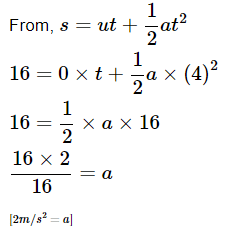
(b) What is the velocity of the ball at the bottom of the incline?
Ans: From, v = u + at
v = 0 + 2 × 4
[v = 8m/s]
Q30:
Fig 2.26 shows the displacement-time graph for the motion of two boys A and B along a straight road in the same direction. Answer the following:
(i) When did B start after A ?
(ii) How far away was A from B when B started?
(iii) Which of the two has greater velocity ?
(iv) When and where did B overtake A ?
.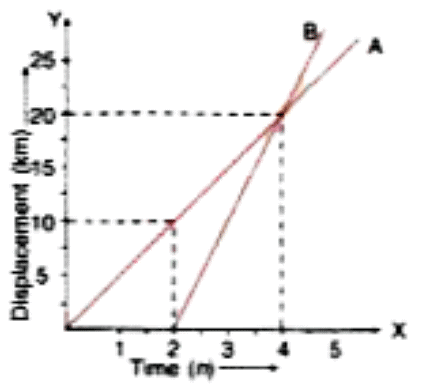 Ans:(i) B started his motion 2 h later from the start of A.
(ii) When B started, A was at distance 10 km away from B.
(iii) B has greater velocity than A since the straight line on graph for B has greater slope than that for A.
(iv) B overtook A at the instant when both were at the same place. This position is at the point where the two straight lines meet each other. For this point, distance from the starting point is 20 km and time is 4 h. Thus B overtook A when A has travelled for 4 h (or B has travelled for 4 – 2 = 2 h) at distance 20 km from the starting point
Q31: A body is dropped from a height of320m. The acceleration due to the gravity is 10m/s2?
(a) How long does it take to reach the ground?
Ans: Given Data: Height = h
Distance = s = 320m
Acceleration due to gravity = g = 10m/s2
Initial velocity = u = 0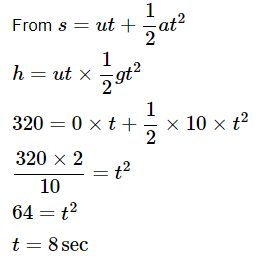
(b) What is the velocity with which it will strike the ground?
Ans: From v = u + at
v = 0 + 10 × 8
v = 80m/s
Q32: Derive third equation of motion v2 − u2 = 2as numerically?
Ans: We know,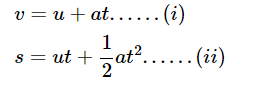
When, v= final velocity
u= initial velocity
a = acceleration
t = time
s = distance
From equation (i) 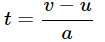
Put the value of t in equation (ii)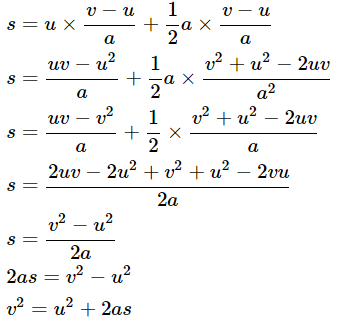
Q33: The velocity-time graph of the runner is given in the graph.
(a) What is the total distance covered by the runner in16s?
Ans: We know that area under v-t graph gives displacement:
So, Area = distance = s = area of triangle + area of rectangle Area of triangle = 1/2 × base × height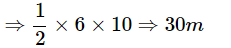
∴Area of triangle = 30m
Area of rectangle= length × breadth
⇒ (16 − 6)×10
⇒ 10 × 10
⇒ 100m
Total area = 130m
Total distance = 130m
(b) What is the acceleration of the runner at t = 11s?
Ans: Since at t = 11sec , particles travel with uniform velocity so, there is no change in velocity hence acceleration = zero.
Q34: A boy throws a stone upward with a velocity of 60m/s .
(a) How long will it take to reach the maximum height(g=−10m/s2)?
Ans: u = 60 m/s; g = -10m/s2; v=0
The time to reach maximum height is
v = u + at = u + gt
0 = 60 − 10t
t = 60 / 10
=6s
(b) What is the maximum height reached by the ball?
Ans: The maximum height is: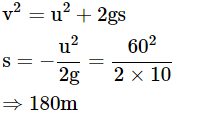
(c) How long will it take to reach the ground?
Ans: The time to reach the top is equal to the time taken to reach back to the ground. Thus, the time to reach the ground after reaching the top is 6s or the time to reach the ground after throwing is 6 + 6 = 12s.
Q35: Derive the third equation of motion v2 − u2 = 2as as graphically?
Ans: Let at time t = 0, the body moves with initial velocity u and time at ‘t’ has final velocity ‘v’ and in time ‘t’ covers a distance ‘s’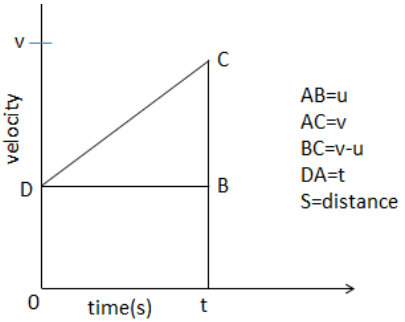
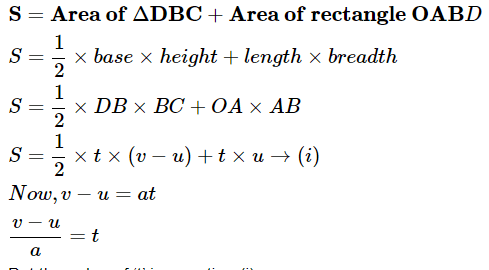
Put the value of ‘t’ in equation (i)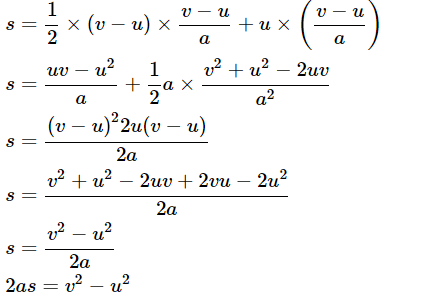
Third equation of motion.
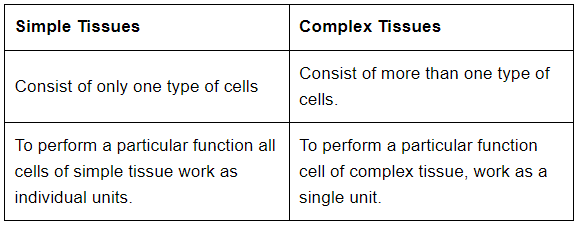
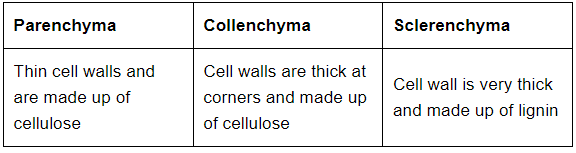
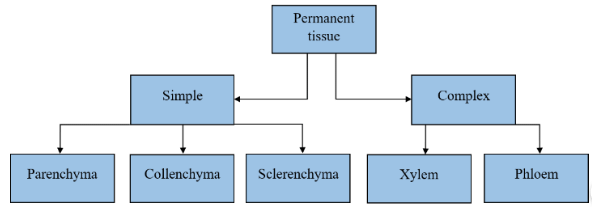
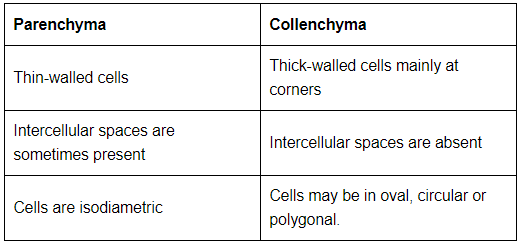
 Q3: Name types of simple tissues.
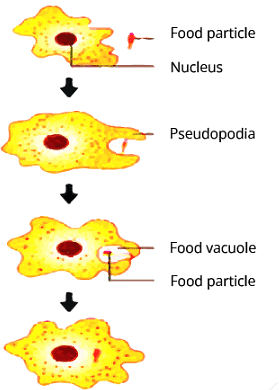 Process showing Amoeba obtaining its food
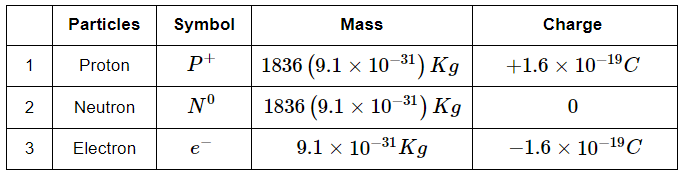



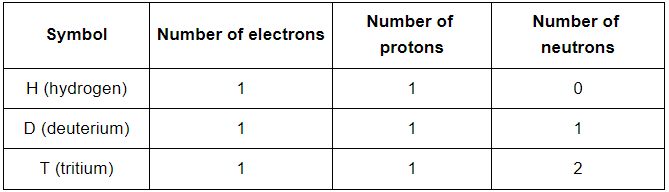
 . Isotopes have the same number of electrons and protons.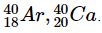


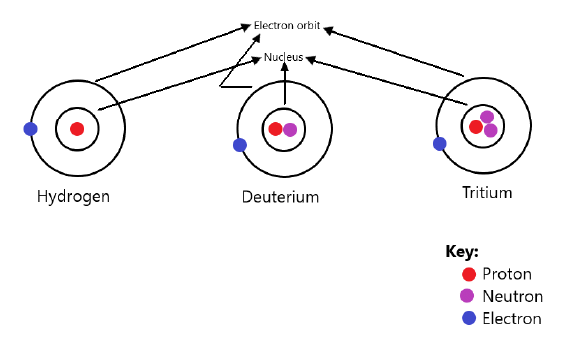



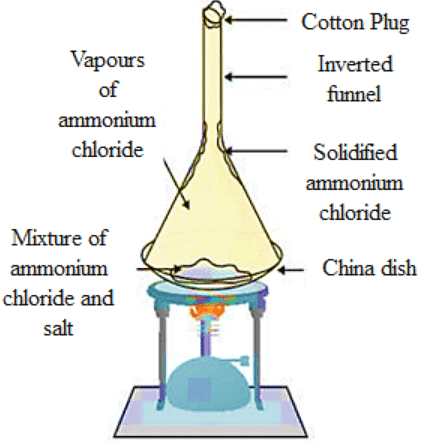
 Fig: Sublimation(c) Common salt, water and sand
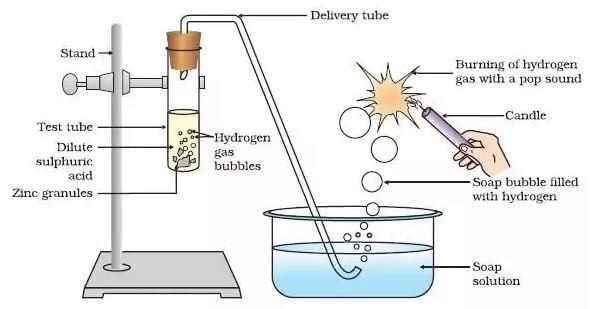 Fig: Reaction of zinc with hydrochloric acid
 Fig: Subliming dry ice
 Fig: Mixture of sand and water
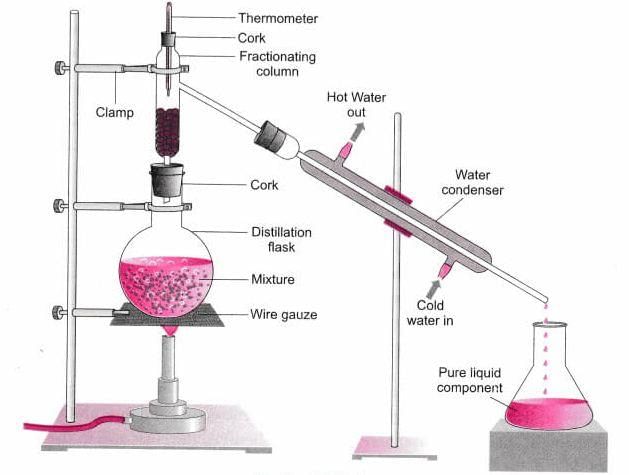 Fig: Fractional distillation(c) One of the components changes directly from solid to gaseous state.
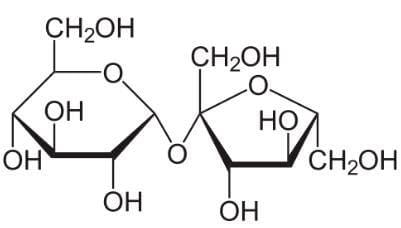 Fig: Structure of sucrose
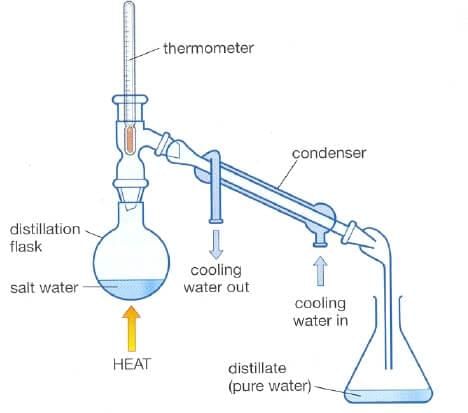 Fig: Distillation process
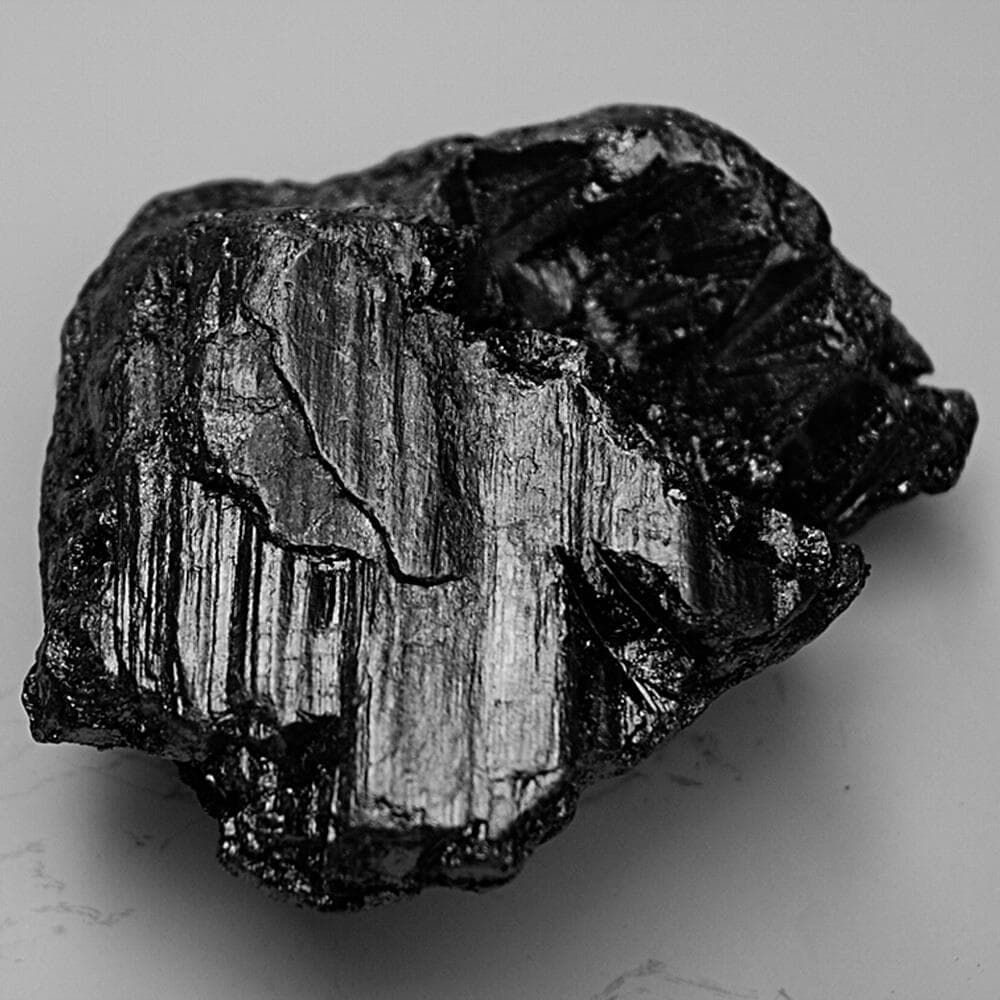 Fig: Graphite